Tag: Kevin Johnson

  • Starbucks CEO Kevin Johnson is retiring, and Howard Schultz is returning as interim chief

    Starbucks CEO Kevin Johnson is retiring, and Howard Schultz is returning as interim chief

    Starbucks CEO Kevin Johnson is retiring after five years on the job. Howard Schultz will return as interim CEO, once again taking the helm of the coffee chain he elevated to a global brand while the company searches for a long-term successor. This will be his third tenure as Starbucks’ chief executive.

    Shares of the company rose 7% in morning trading on the news. Starbucks announced the leadership transition ahead of its annual shareholder meeting later Wednesday.

    “A year ago, I signaled to the Board that as the global pandemic neared an end, I would be considering retirement from Starbucks. I feel this is a natural bookend to my 13 years with the company,” Johnson said in a statement.

    Johnson, 61, joined the board in 2009 while working as CEO of Juniper Networks, and became a member of the leadership team in 2015 as president and COO. In 2017, he was named president and CEO, succeeding Schultz. Wednesday’s annual shareholder meeting marks his 14th with the company, he wrote in his final letter to employees.

    In addition to steering the company through the Covid pandemic, Johnson used his expertise as a former tech executive throughout his tenure to push Starbucks into the digital age, revamping its loyalty program and updating its store footprint to reflect the different ways consumers want to buy their coffee. He also accelerated the chain’s expansion in China, now its second-largest market.

    In his time as head of the company, shares of Starbucks rose more than 50%, including Wednesday’s gains. The stock underperformed compared with the S&P 500, which rose 83% in the same time.

    The chair of Starbucks’ board, Mellody Hobson, said on Wednesday that the company intends to select a permanent successor by the fall.

    “We’re not going to hire over Zoom, I can tell you that,” Hobson, co-CEO of Ariel Investments, said.

    She added the company already has a number of strong candidates in contention for the top job.

    Schultz, 68, said in a statement he previously had no plans to return to the company. He served as CEO from 1986 to 2000, and again from 2008 to 2017. He also weighed a potential run for president ahead of the 2020 elections.

    “When you love something, you have a deep sense of responsibility to help when called. Although I did not plan to return to Starbucks, I know the company must transform once again to meet a new and exciting future where all of our stakeholders mutually flourish,” Schultz said in a statement. “With the backdrop of COVID recovery and global unrest, its critical we set the table for a courageous reimagining and reinvention of the future Starbucks experience for our partners and customers.”

    Schultz’s salary as interim chief executive will be $1, the company said. Hobson said Starbucks wants to lean on “all of Howard’s expertise and all of his brilliance” throughout the transition, but denied he would stay on longer as the company’s next full-time chief executive.

    “We have a great slate of candidates. People want this job, and we’re fully confident we’ll have a new leader in the fall,” she said. “He’s not going to stay for three years…We get him until the fall, full stop. Trust me.”

    Some were caught by surprise that the board knew Johnson planned to retire a year before publicly discussing a transition or a successor.

    “Howard Schultz knows Starbucks. He knows the company’s strategy and goals. And Schultz is in a position to help in ways other interim CEOs could not. But, for a company the size and stature of Starbucks not to have a solid succession plan is surprising,” said Timothy Hubbard, an assistant management professor at University of Notre Dame’s Mendoza College of Business.

    Former Chief Operating Officer Roz Brewer, once thought to be the heir apparent, departed the company in early 2021 to become chief executive of Walgreens Boots Alliance. Starbucks’ CEO shift comes against a backdrop of growing efforts among the company’s baristas to unionize. To date, roughly 140 Starbucks stores in 26 states have petitioned the National Labor Relations Board to unionize, according to organizers Starbucks Workers United. Six locations so far have voted in favor of a union.

    In a move that may have signaled his return to the company, Schultz appeared at Buffalo, New York-area cafes ahead of union elections, along with other top Starbucks executives, to attempt to dissuade baristas from voting in favor of unionizing.

    This week, the National Labor Relations Board filed a complaint over accusations Starbucks retaliated against two employees in Phoenix who were seeking to unionize their store location. On Tuesday, a group of 75 investors in Starbucks sent a letter to Hobson and Johnson urging the company to adopt a policy of neutrality for all current and future attempts by its workers to organize.

    Hobson said Wednesday that Starbucks “made some mistakes” when asked about the union push.

    “When you think about, again, why we’re leaning on Howard in this moment, it’s that connection with our people where we think he’s singularly capable of engaging with our people in a way that will make a difference,” she said.

    Johnson’s retirement announcement marks the fourth notable CEO transition from a publicly traded restaurant company in recent months.

    Domino’s Pizza CEO Ritch Allison will retire at the end of April, and Darden Restaurants’ Gene Lee will do the same the following month. Wingstop announced Monday that CEO Charlie Morrison stepped down to become chief executive of Salad and Go, a much smaller drive-thru salad chain.
  • Starbucks CEO talks about the future in China after the opening of its biggest store yet

    Starbucks CEO talks about the future in China after the opening of its biggest store yet

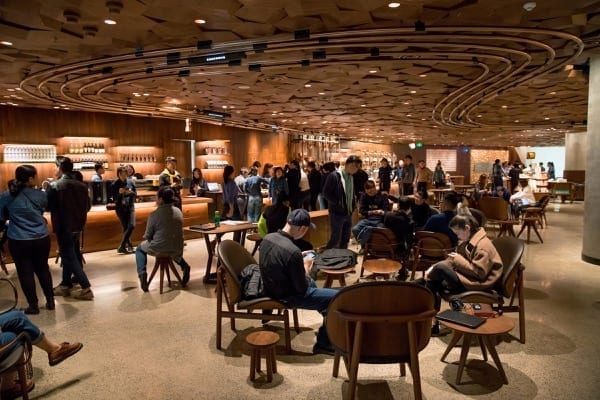
    That would be the company’s new Shanghai Roastery, a 30,000 square-foot “coffee wonderland,” which opened Tuesday and is Starbucks’ largest store to date.

    Located in the company’s fastest-growing country, the new Roastery is double the size of the original in Seattle that opened in 2014. It features three coffee bars offering multiple brewing methods; a 3D-printed tea bar; an Italian bakery, Princi; and a ceiling built with 10,000 handmade wooden hexagon-shaped tiles. There’s also a two-story, 40-ton copper cask with more than 1,000 hand-engraved Chinese stamps that tell the story of Starbucks and coffee.

    Technology is weaved into the store, including Starbucks’ first-ever in-store augmented reality experience, built in partnership with Chinese tech giant Alibaba, which is also selling Roastery coffee and merchandise on its Tmall online marketplace. Yahoo noted that sales on Tmall reached $1 million in the 48 hours before the Roastery opened.

    Starbucks plans to open more Roastery locations next year in Milan and New York City; and in Chicago and Tokyo in 2019. Speaking at the GeekWire Summit in October, Starbucks CEO Kevin Johnson explained that the Roastery stores act as “a center of innovation” for the company, which now has 27,000 stores in 75 countries and serves 90 million customers per week.

    “You’ll see us invest in taking the innovation we get from the Roasteries and propagate it throughout all our Starbucks stores around the world,” Johnson said.

    China represents Starbucks’ fastest-growing market with more than 3,000 stores across 136 cities, and 600 alone in Shanghai. The company posted same-store sales growth of 8 percent in the most recent quarter for China, compared to a 2 percent global average growth for stores worldwide. In July, Starbucks paid $1.3 billion to acquire the remaining shares in its East China business as it unified mainland China as a company-operated market.

    At a press event in Shanghai this week, Johnson said that China will become Starbucks’ fastest-growing market within a decade, according to the South China Morning Post.

    “If you look at the growing middle class in China and the opportunity for more and more people to frequent Starbucks, we can build stores in China for decades and still have runway to build more,” Johnson said at the GeekWire Summit.

    Starbucks CEO Kevin Johnson speaks at the 2017 GeekWire Summit.
    China can also act as a testbed for the company’s new digital products and services, given that there are nearly 700 million smartphone users. In July, Starbucks Chairman Howard Schultz hinted that Starbucks would partner with more Chinese tech companies “based on the fact that the consumer in China is well more advanced than the U.S. consumer in terms of being a digital native.” It previously partnered with another Chinese tech giant, Tencent, for social gifting integration on WeChat.

    At the GeekWire Summit, Johnson noted that Starbucks is working to create a “unified commerce platform” that enables its rewards program to work seamlessly across international markets.

    “The key factor is some software that our teams are writing that is rolling out country by country around the world, and it might take us another two years to touch every country,” he noted.

    Asked how Starbucks creates a consistent customer experience at its stores around the world while staying true to local culture, Johnson said it’s about creating a welcoming store environment, providing top quality coffee, and most importantly, human connection — the “one thing that every single one of us on this planet has in common.”

    “We’ve all experienced joy and sorrow; we’ve all experienced the struggle and the success,” Johnson explained. “So just anchoring on the fact that human beings, we are tribal people — we get energy from one another. If you create an environment where people are connecting with other people in our stores, it works everywhere.”

    Johnson also talked about how Starbucks ties together a physical store experience with digital innovation.

    “One, you must be focused on experiential retail that creates an experience in your store that becomes a destination for the customer,” Johnson explained when asked about what physical retailers must consider in 2017. “And number two, you have to extend that experience from brick-and-mortar to a digital-mobile relationship. So our approach to this is investing in elevating the experience we create in our stores, and investing in the digital-mobile connection we have with our customers.”


  • Starbucks names Kevin Johnson President and COO

    Starbucks names Kevin Johnson President and COO

    Starbucks has appointed Kevin Johnson as president and chief operating officer effective 1 March.

    Johnson, who has been a Starbucks board member since 2009, will lead the company’s global operating businesses across the Americas, EMEA (Europe Middle East and Africa), and China/Asia Pacific, as well as Starbucks supply chain, information technology, and mobile and digital platforms.

    “I am looking forward to working with him and our strongest management team in the company’s 44-year history,” Howard Schultz, Starbucks chairman, president and CEO.

    Johnson served as chief executive officer of Juniper Networks Inc., from September 2008 through December 2013. Prior to that, he served as the president of the Platforms Division at Microsoft Corporation and was a member of Microsoft’s senior leadership team and held a number of senior executive positions over the course of his 16 years at Microsoft.

    Prior to joining Microsoft in 1992, he worked for International Business Machine Corp.’s systems integration and consulting business. In 2008, Johnson was appointed by President George W. Bush to the National Security Telecommunications Advisory Committee (NSTAC) where he served through the end of 2013.

    “Over the past six years I have gotten to know the company well and I look forward to extending my 33 years of operating experience to help propel Starbucks to the next decade of growth and innovation. I am honored and humbled to join Starbucks, a company that I love, during this important time,” Johnson said.