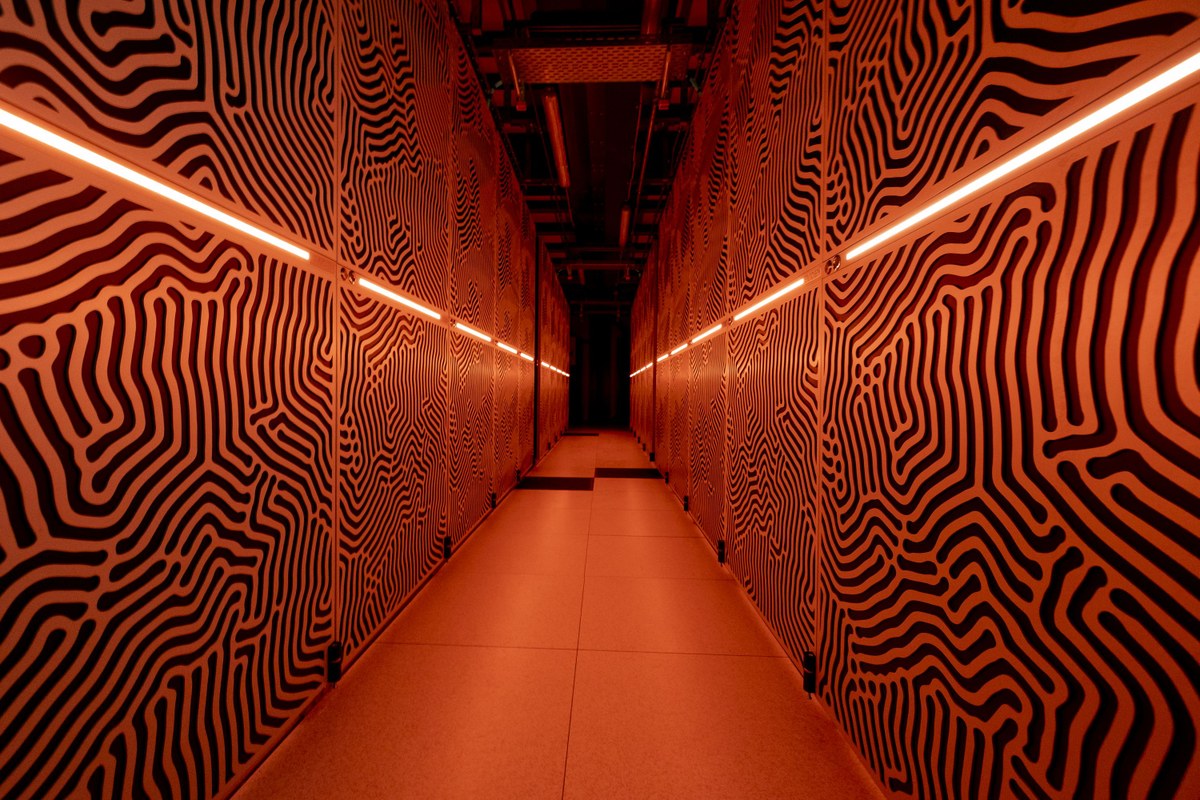
South Korea unveiled its sixth national supercomputer, Hangang, on November 2, launching a 382.5-billion-won ($276 million) infrastructure installation designed to advance artificial intelligence and scientific research.
The Ministry of Science and ICT partnered with the Korea Institute of Science and Technology Information (KISTI) to host the launch ceremony at KISTI headquarters in Daejeon, bringing together approximately 200 representatives from industry, academia, and government research bodies.
KISTI President Lee Sik oversees the system, which pairs 8,496 graphics processing units, including NVIDIA GH200 Grace Hopper Superchips, with 9,936 central processing units to hit a theoretical peak speed of 614.7 petaflops, or 614.7 quadrillion floating-point operations per second.
Computing Power Expands for Industrial Simulation
Hangang replaces Nurion, the country’s fifth national supercomputer that handled public computing tasks after entering service in 2018. Compared to the older machine, the new platform delivers 24 times the theoretical computing speed, 10 times the storage capacity, and four times the network transfer performance.
State planners designed the infrastructure to process high-intensity artificial intelligence workloads alongside commercial engineering simulations. Key industrial applications include digital vehicle crash testing and real-time meteorological forecasting, targeting design cycles where physical prototyping slows time to market.
State Backing for Enterprise AI Models
Computing bottlenecks have tightened across East Asia as commercial enterprises and university laboratories compete for high-end processing hardware. Hangang pools specialized processing power into a state-subsidized platform, lowering entry barriers for domestic technology firms training large models against regional rivals.
The risk sits in resource allocation. Sovereign compute networks frequently face friction between academic basic research and commercial deployment, with capacity quotas often favoring state-led agendas over fast-moving enterprise applications. Hangang will direct substantial capacity toward K-Moonshot, a government-directed program deploying advanced artificial intelligence models to resolve scientific targets.
Replacing Nurion After Six Years of Service
The retirement of Nurion follows a six-year operational cycle during which global artificial intelligence training shifted from conventional central processing units to dense graphics processing clusters. Nurion lacked the unified memory architectures and specialized tensor cores required for modern transformer models, leaving South Korean institutions reliant on foreign commercial cloud vendors for heavy AI development.
Korea Institute of Science and Technology Information President Lee Sik said: “We will do our utmost to ensure stable operations and top-tier user support, using KISTI’s long-standing operational experience in supercomputing.”
Next Steps for National Deployment
Engineers began pilot testing on the cluster in late October to calibrate thermal controls and network distribution across the 8,496 graphics processors. KISTI plans to begin full commercial and research operations on December 16.