Tag: korea retail

  • Positive trend for South Korean duty free sales

    Positive trend for South Korean duty free sales

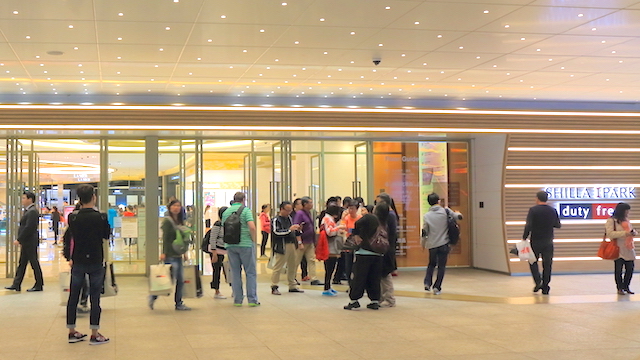
    South Korean duty free sales in the first nine months of 2018 have exceeded total sales for 2017. Sales hit an all-time high of US$12.9 billion between January and September, according to Korea Duty Free Shops Association. That figure exceeds the US$12.8 billion recorded for full year 2017.

    The performance comes despite a significant fall in the number of Chinese tourists to South Korea since the THAAD dispute erupted in early 2017, with a number of restrictions imposed by the Chinese government including a ban on group tours.

    As reported, the latest Korea Tourism Organization (KTO) figures showed that Chinese arrivals were up just +6.5 percent year-on-year (to 3,059,075) in the first eight months of 2018, reflecting a very tough first quarter before Korean-Chinese relations improved as the THAAD dispute eased.

    In the first eight months of 2016 – long before the THAAD crisis began– some 5,608,046 Chinese arrived in South Korea. That figure is +83% higher than the 2018 performance over the same timeframe, highlighting the scale of the drop in Chinese tourist numbers.

    A key factor driving sales is the daigou phenomenon.

    Daigou (also known as ‘shuttle traders’ in South Korea) buy goods abroad (predominantly cosmetics but also a wide range of accessories and other premium and luxury goods, as well as commodity items such as milk powder) and resell them (often through well-organised networks) on the Mainland.

    As reported though, a Chinese government crackdown on returning daigou shoppers after the Golden Week holiday (1-7 October) has raised serious questions about the future of a sector that has buoyed Asia Pacific travel retail in recent times.

    Many South Korean retailers expect China to continue to ease economic and travel restrictions, including a full lifting of the ban on group tours in the near future.

    The return of group tours would be a significant boost – and could mean the pendulum swings back from individual shuttle traders to large group tours and traditional FIT business in terms of being the key driver of duty free sales.

  • South Korea’s service sector investment focused on wholesale, retail and restaurants

    South Korea’s service sector investment focused on wholesale, retail and restaurants

    South Korea’s investment in the service sector has been focused on low value-added areas, such as wholesale, retail and restaurants, official data showed Monday.

    The gross fixed capital formation for the service sector was tallied at 256.1 trillion won ($239.6 billion) in 2015, the findings by the Bank of Korea and the National Assembly Budget Office showed. This represents a solid 13.9 percent increase to 224.8 trillion won reported in 2006.

    The GFCF refers to the net increase in assets that takes into account both investments and deductions within a set period of time.

    The tally, however, showed investments in high value-added areas, such as cultural and education industries, backtracking.

    An injection of funds into this sector reached 18.1 trillion won in 2015, or a 69.2 percent spike from 10.7 trillion won tallied in 2006.From 2006 through 2015, when investment in the service sector shot up the steepest, investment was centered on restaurants and catering, as well as retail and wholesale.

    The increase rate is five times faster than gains for the entire service industry as a whole in the same time period.

    The central bank said the sharp rise has allowed restaurants and catering businesses, and retail and wholesale to make up 7.1 percent of all service sector investments in 2015 from 4.8 percent in 2006.

    On the other hand, investment in the cultural sector contracted 20.8 percent to 7.6 trillion won in 2015 from 9.6 trillion in 2006, with 15.2 percent drop being reported for education-related outlays in the same period.

    Hong Joon-pyo, a senior analyst at the Hyundai Research Institute , said areas where investment has focused on in recent years is closely associated with self-employed posts.

    “Many people who retire and do not have any skill sets often go into these businesses so there has been a natural rise in investment,” he said.

    The economist said that this trend has led to an over saturation of certain service sectors that has eaten into profits.

    Statistics Korea said operating profits of restaurants and catering industries stood at 13.4 percent in 2015 or down 9 percentage points from five years earlier, while numbers for retail and wholesale correspondingly stood at 5 percent or down 2 percentage points.

    The statistical office said this has led to such stores’ average survival rate three years after opening standing at an average of just 39.1 percent. Such dismal numbers are not conducive to sustainable growth for the economy as a whole.

  • Korean online mall sales lose traction

    Korean online mall sales lose traction

    South Korean online mall sales growth has decelerated as competition grows more fierce, government data shows.

    There was a 3.6 per cent increase in the combined revenue of 26 offline and online retailers to 10.22 trillion won (US$9 billion) in July, according to the Ministry of Trade, Industry and Energy. This gain marks a deceleration from 7.2, 6.3 and 7.2 per cent growth posted in April, May and June respectively.

    The slowdown is attributed largely to fewer sales on online open markets such as eBay and 11st.

    Sales at 13 major online shopping malls rose 4.4 per cent last month, following double-digit growth for five straight months since February. Meanwhile, the sales of the 13 offline retailers, including department stores, discount chains and convenience stores, rose 3.2 per cent on-year on the back of strong performance by convenience stores.

    Convenience stores saw their sales rise 11.1 per cent last month, with hypermarket chains posting 1.7 per cent growth and department stores having a 1.3 per cent revenue slide.

  • Seoul shares close slightly lower on geopolitical concerns

    Seoul shares close slightly lower on geopolitical concerns

    South Korean stocks closed 0.13 percent lower Tuesday on concerns over North Korea’s nuclear provocations, but the decline slowed compared to previous sessions as investors engaged in bargain hunting, analysts said. The Korean won sharply fell against the US dollar.

    The benchmark Korea Composite Stock Price Index dropped 3.03 points, or 0.13 percent, to 2,326.62. Trade volume was moderate at 317 million shares worth 4.81 trillion won ($4.25 billion), with losers outnumbering gainers at 569 to 239.

    On Monday, the main bourse sank more than 1 percent as retail investors dumped local shares after North Korea claimed a day earlier that it successfully tested a hydrogen bomb that can be mounted on an intercontinental ballistic missile.

    While the main bourse continued to lose ground on Tuesday, analysts said the downward pressure was limited as institutions scooped up underappreciated shares.

    Based on past examples, foreigners and institutions tend to consider the North Korean risk an opportunity to purchase bargain shares,” said Byun Joon-ho, a researcher from Hyundai Motor Investment & Securities Co.

    Institutions scooped up a net 242 billion won, while individual investors offloaded a net 65.5 billion won. Foreigners sold more shares than they bought at 213 billion won.

    Tech shares closed bullish, with Samsung Electronics moving up 1.56 percent to 2,338,000 won. Leading chipmaker SK hynix shot up 2.64 percent to 69,900 won. LG Electronics also jumped a whopping 4.59 percent to 86,500 won.

    Carmakers closed mixed, with Hyundai Motor backtracking 1.43 percent to 138,000 won while its auto parts arm Hyundai Mobis closed unchanged at 238,500 won. Kia Motors, the country’s second largest automaker shed 2.29 percent to 34,100 won.

    No. 1 steelmaker POSCO shed 0.72 percent to 342,500 won, while Korea Zinc climbed 1.37 percent to 517,000 won. Hyundai Steel moved down 1.55 percent to 57,000 won.

    The local currency closed at 1,131.10 won against the US dollar, up 1.90 won from the previous session’s close.

    Bond prices, which move inversely to yields, ended higher. The yield on three-year Treasurys shed 0.2 basis point at 1.780 percent and the return on the benchmark five-year government bonds also lost 0.5 basis point to 1.996 percent.

  • Sales soar for major Korean retailers

    Sales soar for major Korean retailers

    Major South Korean retailers saw their sales soar in January from a year earlier, driven by convenience stores and supermarket chains, government data shows.

    Combined sales for department stores, large outlets and online malls gained 8.3 per cent for the month, snapping a slide for three straight months, according to figures from the Ministry of Trade, Industry and Energy.

    Brisk sales and particularly soaring demand during the Lunar New Year holiday in late January helped boost sales, says the ministry.

    Sales by convenience stores surged 15.5 per cent year-on-year, followed by those of supermarkets with an 11.3 per cent gain. Department stores saw their sales rise 4.6 per cent.

    More “lone diners” – people who prefer to live and eat alone – has in part fuelled sales of prepared meals at convenience stores and frozen dishes at supermarkets, says the ministry.

    Convenience stores saw sales of instant meals, such as microwavable lunch boxes, hike 35.1 per cent, while the number of such stores grew by 13.3 per cent in the same period.

    Food sales by supermarket chains also helped boost growth with an 18.5 per cent gain.

    In contrast, online social commerce sites saw their sales inch down 0.1 per cent in January, largely because of increased marketing costs amid fierce competition. Online retailers overall saw their combined sales edge up 6 per cent for the month.

  • Chuseok sales weren’t as terrible as expected

    Chuseok sales weren’t as terrible as expected

    Going into last week’s Chuseok holidays, expectations were low in the retail sector due to a prolonged economic slowdown and a soon-to-be-implemented anti-graft law that will make expensive presents unlawful.

    Against all odds, however, four major department stores in Korea enjoyed growth in the sales of holiday gift sets. To skirt an anti-graft law known as the Kim Young-ran Act, which goes into effect Sept. 28 and bans the exchange of gifts costing more than 50,000 won among civil servants and even journalists, the stores offered lower-cost gift sets.

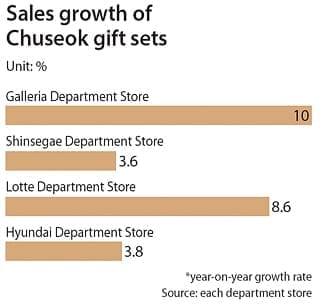
    Galleria Department Store said sales of holiday gift sets rose 10 percent between Aug. 26 and Sept. 14 compared to the same period last year.

    The proportion of products that were cheaper than 50,000 won was 26 percent – the highest share and 6 percentage points more than last year. Products that cost more than 300,000 won accounted for 14 percent, 1 percentage point lower than last year.

    Galleria Department Store expanded gift options that cost less than 50,000 won from last year’s 56 items to 478. As a result, revenue generated from 50,000-won-or-less products rose by 47 percent year-on-year.

    Lotte Department Store said sales of holiday gift sets between Aug. 26 and Sept. 13 rose 8.6 percent year-on-year. Sales of processed food products and daily necessities – which usually cost less than 50,000 won – rose by 16.5 percent. But sales of meat and gulbi (dried corvinas) – relatively expensive holiday gifts – only increased by 6.5 and 3.8 percent respectively.

    Hyundai Department Store said its holiday gift set sales between Aug. 29 and Sept. 14 rose by 3.8 percent.

    Shinsegae Department Store saw a sales increase of 3.6 percent in Chuseok gift sets sold between Aug. 26 and Sept. 13. Products or sets cheaper than 50,000 won saw an increase of 7.8 percent while more costly items only rose 2.9 percent.

    The Kim Young-ran Act was not the only factor in holiday spending.

    An unprecedented heat wave during the summer on top of a prolonged economic slowdown prompted many consumers to buy health supplements, which are cheaper than agricultural and marine products.

    The most popular product was red ginseng extracts or pills. Health-related products saw a sales surge of 26 percent year-on-year at branches of Galleria Department Store. The top seller in the health category was red ginseng extract, which is in the 80,000-won price range.

    Shinsegae, which is known for its extensive and affordable wine selection, said sales of wine rose the most – 40.5 percent – followed by health-related items, which rose by 20.8 percent year-on-year.

    Health-conscious products were the most popular at Lotte as well, enjoying a 28 percent year-on-year increase in sales.