Tag: KOSPI

  • Asian Equities Slide as South Korea Drops 3.6% and AI Spending Faces Scrutiny

    Asian Equities Slide as South Korea Drops 3.6% and AI Spending Faces Scrutiny

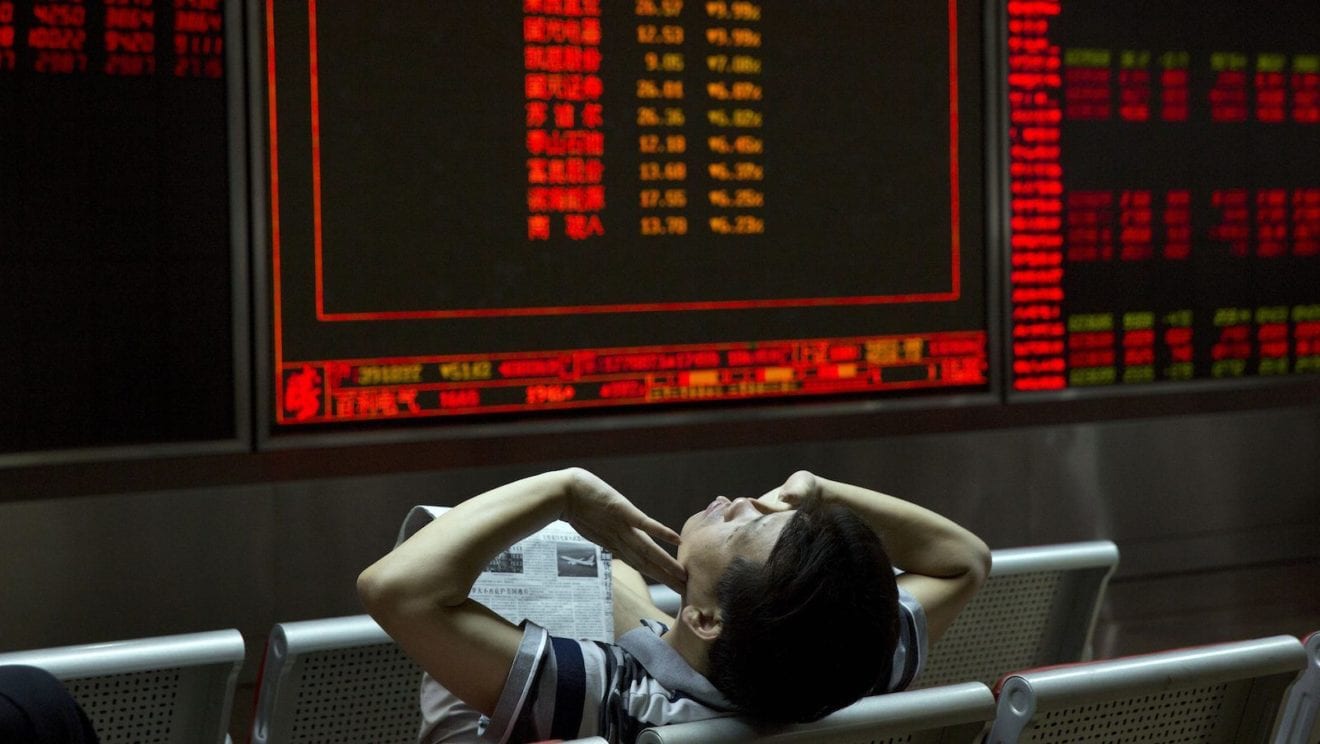
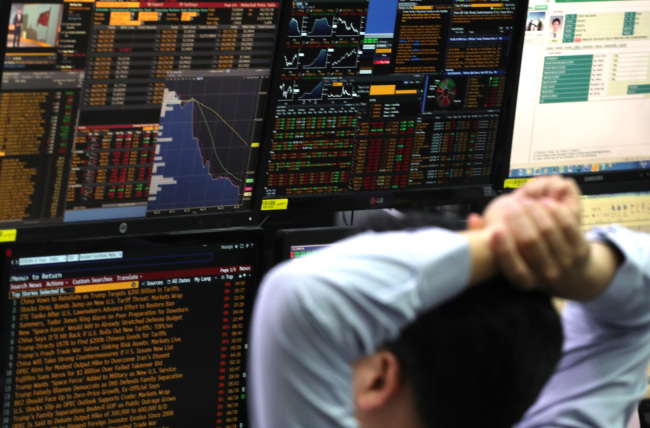
    Asian equity markets retreated across the board on Tuesday as South Korea’s benchmark index tumbled 3.61 per cent ahead of major global technology earnings.

    The MSCI Asia ex-Japan index fell 0.93 per cent while Tokyo’s Nikkei 225 dropped 1.28 per cent, reflecting investor hesitation across key regional hardware and semiconductor hubs.

    Seoul and Tokyo Lead Stock Declines

    Selling was heaviest in South Korea, where tech heavyweights dragged the KOSPI down sharply during morning trade. Market debutant Elice Group, a South Korean artificial intelligence infrastructure provider, opened 16 per cent below its initial public offering price after raising 201.1 billion won ($151.12 million) in its listing.

    European index futures pointed lower as well. Euro Stoxx 50 futures fell 0.71 per cent, DAX futures slipped 0.40 per cent and FTSE futures lost 0.44 per cent, while S&P e-minis held flat at 7,734.25.

    AI Spending Faces Heavy Scrutiny

    Investor attention is shifting toward corporate balance sheets as market participants demand direct evidence that enterprise software demand and consumer spending justify elevated capital commitments. Meta platforms, scheduled to report quarterly numbers on Wednesday, is one of five major hyperscalers projected by Goldman Sachs to push collective capital expenditure to $1.2 trillion next year.

    Hardware suppliers face an immediate test as results arrive from Tesla, Lam Research and Texas Instruments later in the week, alongside private operator SpaceX.

    The market is happy to cover shorts and unwind defensive trades, but that’s very different from having the conviction to rebuild aggressive exposure to AI.

    For component suppliers and contract manufacturers across East Asia, the stakes are elevated because regional valuations have priced in continuous quarterly gains. If hyperscalers signal any moderation in data centre buildouts, Asian memory and chip assembly vendors will bear the initial brunt of order adjustments.

    Institutional funds have begun pulling back from aggressive tech exposure, rotating into defensive holdings until earnings prints validate revenue conversion rates. The sharp discount on new market listings like Elice Group reflects shrinking risk tolerance for loss-making infrastructure plays across the region.

    Energy Markets and Trade Directives

    Crude oil prices ticked upward as energy traders tracked political developments in Washington and unrest in Europe. Brent crude rose 0.21 per cent to $109.78 a barrel, while US West Texas Intermediate gained 0.15 per cent to trade at $103.82 a barrel.

    An executive order issued by US President Donald Trump on Friday waived selected sanctions and tariffs on Russian energy exports, including duties on crude shipments and refined goods. Trump stated on Saturday that a final policy determination remains pending, leaving refiners and logistics providers uncertain about trade enforcement rules.

    Gold prices retreated from recent highs, with spot gold slipping 0.51 per cent to $4,118.71 an ounce.

    Currency Flows and Central Bank Signals

    Currency trading showed safe-haven positioning following weekend civil unrest in France that prompted municipal curfews in Paris, Lille and Nice. The euro traded at $1.12 after recovering 0.06 per cent from Monday’s slide, while the British pound held at $1.33 and the Japanese yen weakened marginally to 158.57 per dollar.

    Comments from US Federal Reserve officials, including Chair Kevin Warsh, indicated that monetary authorities see sustained domestic economic momentum and feel little urgency to adjust policy rates immediately. Digital assets followed equity markets lower, with bitcoin dropping 0.67 per cent to $81,386.40 and ether falling 0.54 per cent to $2,385.75.

    Traders now look to upcoming policy speeches from European Central Bank officials Martin Kocher and Olli Rehn, followed by Bank of England policymaker Megan Greene in London, ahead of Meta’s earnings release on Wednesday.
  • South Korean Regulators Face Backlash as Margin Debt Hits 33.7 Trillion Won

    South Korean Regulators Face Backlash as Margin Debt Hits 33.7 Trillion Won

    South Korean financial authorities face mounting criticism after retail margin debt climbed to 33.7 trillion won ($2.53 billion) during a week of violent swings on the Seoul stock exchange.

    The benchmark Kospi tumbled through seven consecutive sessions before rebounding 2.05 percent to close at 5,668.05 on Friday, while retail cash reserves sank toward recent lows.

    Regulators Convene Emergency Session

    Financial Services Commission Chairman Lee Eog-weon convened an emergency review in Seoul with executives from the Financial Supervisory Service, the Korea Exchange, the Korea Capital Market Institute and the Korea Financial Investment Association. Officials reviewed risks tied to artificial intelligence semiconductor valuations, prospective United States interest rate increases and elevated crude oil prices.

    Lee instructed brokerage houses to tighten their lending standards to curb speculative exposure during volatile trading cycles.

    “Financial companies should refrain from extending credit indiscriminately and make every effort to protect customers and manage risks,” he said.

    Margin Loans Surge Above Thresholds

    Outstanding margin loans have remained above 30 trillion won for an extended run, touching a three-month peak by Wednesday. Retail accounts expanded their borrowed exposure even as the Kospi breached the 6,000-point threshold and briefly threatened the 5,500-point mark.

    Cash deposits held by retail investors dropped toward recent cyclical lows over the same period. The divergent metrics reveal that individual traders committed further to used bets rather than holding cash cushions during severe market sell-offs.

    Volatilities spilled into tech equities across North Asia as market participants reassessed capital expenditure on AI infrastructure. In Seoul, Samsung Electronics edged up 0.23 percent while SK Hynix slipped 1.26 percent, tracking broader weakness in semiconductor components.

    Market Participants Demand Concrete Steps

    Institutional desks in Seoul argue that rhetorical warnings fail to alter trading behavior when foreign funds offload local equities. Repeated government sessions without structural measures risk desensitizing domestic market participants.

    Used retail positioning poses liquidity threats to mid-cap listings if forced liquidations accelerate across secondary brokerages. Margin calls triggered during intraday slides drain trading volume from high-growth tech firms that depend on domestic retail capital.

    Index Swings Trigger Circuit Measures

    The Thursday session delivered a plunge of more than 7 percent across the Kospi, culminating in a seven-day losing streak before Friday’s technical rebound. The tech-heavy Kosdaq index jumped as much as 5 percent intraday on Friday, activating a buy-side sidecar mechanism that temporarily suspended automated program trading.

    Investor anxiety remained elevated despite the Friday bounce, with the Kospi 200 Volatility Index recording its third-largest single-day increase on record and hitting a six-week high.

    Brokers now track whether margin balances stay above the 33 trillion won line as third-quarter earnings reports from key tech exporters roll out across the region.

  • Tokyo Stocks Plunge 5 Percent as Chipmakers Lead Broad Regional Selloff

    Tokyo Stocks Plunge 5 Percent as Chipmakers Lead Broad Regional Selloff

    Japan’s Nikkei 225 stock average tumbled 5.39 percent on Thursday, hitting an intraday low of 64,092.74 points during afternoon trade in Tokyo.

    The drop wiped out recent gains across the benchmark index as semiconductor equipment makers, memory producers and technology conglomerates tracked sharp losses from Wall Street.

    Selling started at the opening bell and deepened through the session. Chip-testing equipment manufacturer Advantest dropped more than 15 percent by midday, while fabrication gear supplier Tokyo Electron fell about 8 percent. Tech investment giant SoftBank Group slid more than 10 percent, and flash-memory manufacturer Kioxia shed over 11 percent.

    Regional Chip Supply Chains Take Direct Hit

    The rout swept immediately into Seoul, where heavy exposure to memory chips triggered steeper losses across the Kospi. South Korea’s benchmark fell nearly 8 percent, pulled down by an almost 10 percent drop in Samsung Electronics and an 11 percent tumble at SK Hynix.

    For hardware operators and component procurement managers across Asia, the valuation drop reflects growing investor hesitation around capital expenditure timelines for artificial intelligence infrastructure. Equipment vendors face tighter scrutiny on order backlogs as customer balance sheets absorb higher financing costs. The pressure spreads down the supply tier to component distributors, who must navigate sudden shifts in inventory financing rates while factory input costs remain high.

    Energy Costs and Rate Uncertainty Squeeze Margins

    Higher consumer prices in North America sparked the slide. The United States reported September inflation of 3.7 percent on Wednesday, prompting futures traders to briefly price in a 50 percent probability of an interest rate increase before odds settled back to 27 percent. The US Federal Reserve holds its next policy meeting on Oct. 27 and 28.

    Sustained commodity pressure compounds the interest rate risk for Asian electronics manufacturers and logistics networks. Brent crude held above $100 a barrel as Middle East tensions persisted, driving up freight surcharges and factory utility bills across import-dependent industrial hubs in Japan and South Korea.

    Sovereign Debt and Currency Shifts

    Capital rotated swiftly into safe-haven assets as equities retreated throughout Thursday morning. The yield on the 10-year Japanese government bond fell to 2.93 percent, marking its lowest reading in roughly a month as bond prices rose.

    Currency markets reflected the defensive positioning. The Japanese yen strengthened below 158 against the US dollar on Thursday after changing hands near 159 on Wednesday night.

    Retreat From Historic Benchmark Highs

    Thursday’s drop places the Nikkei more than 10 percent below its all-time high of 72,831.73 set in June. Tokyo’s primary index had climbed above the 70,000 threshold as recently as Oct. 5, supported by US technology momentum, and remains up 35 percent over the past 12 months.

    Market attention now turns to the Federal Reserve rate decision on Oct. 28 and third-quarter earnings disclosures from regional chip producers, where order books for advanced memory and foundry tools will show whether capital spending plans hold firm.

  • Korea Exchange Extended Session Triggers 5,354 Trading Halts in First Week

    Korea Exchange Extended Session Triggers 5,354 Trading Halts in First Week

    South Korea’s new evening equity session triggered 5,354 volatility interruptions during its first week. Retail traders dominated thin trading books.

    Daily turnover across the extended four-hour window averaged 1.1 trillion won ($811 million) between Sept. 14 and Friday. That represented 4.6 percent of total equity trading value across the Korea Exchange.

    Trading runs from 4 p.m. To 8 p.m. To help domestic investors trade outside office hours, the exchange created the window. Instead, speculative retail flow concentrated into illiquid listings. The evening block generated 77.17 percent of all circuit-breaker style volatility interruptions recorded across the entire exchange over the five-day stretch.

    Retail Concentration Drives Market Friction

    Individual accounts generated more than 90 percent of all executed trades during the inaugural evening sessions. Foreign investors accounted for 6.7 percent of volume. Domestic institutions and pension funds contributed just 2.6 percent.

    Institutional market makers stayed away, leaving order books vulnerable to sharp imbalances. An average of 54.85 million shares changed hands daily across the late session. Volume was spread across hundreds of main-board Kospi and junior Kosdaq listings without offsetting bids to absorb retail momentum.

    Kosdaq Small Caps Suffer Wild Swings

    Distortions hit smaller counters on the tech-heavy Kosdaq board fastest. Thin order books let minimal volume drive outsized price jumps. These gains evaporated by the next morning’s regular open.

    Pony Link illustrated the structural gap on Sept. 14. After finishing daytime trading at 2,400 won, the Kosdaq-listed stock hit its daily upper price limit of 3,150 won in after-hours trading. That jump took just 1,417 shares, roughly one-tenth of its daytime volume of 15,641 shares. The gain vanished the next morning, and the stock closed regular hours down at 2,365 won.

    Exchange Defends Auction Mechanics

    Bourse officials rejected claims that the high number of volatility interruptions pointed to structural failure. The mechanisms pause continuous trading for short single-price auctions. This prevents transactions at distorted levels and restores orderly pricing.

    Halts cooled over the week. The market recorded 1,112 volatility interruptions on Sept. 14, dropping by half to 553 events by Friday.

    The number of volatility interruptions should not necessarily be interpreted as an indicator of market volatility, as the measures help curb excessive price movements by preventing trades at abnormal prices and facilitating price discovery through single-price auctions.

    Surveillance Team Deployed Through December

    Regulators at the Korea Exchange have assigned a dedicated task force to monitor the evening session through the end of the year. The unit will track order patterns for spoofing, price manipulation, and artificial momentum in thinly traded counters.

    Brokerages in Seoul will watch whether institutional desks deploy automated liquidity before year-end, or if the evening window stays an exclusive arena for retail day traders.

  • South Korea KOSPI Tests 7,100 on Chip Gains Before Pre-Holiday Selling

    South Korea KOSPI Tests 7,100 on Chip Gains Before Pre-Holiday Selling

    South Korea’s benchmark KOSPI broke past 7,100 in early Tuesday trading as semiconductor heavyweights tracked a Wall Street rally before profit-taking trimmed gains ahead of the Chuseok holiday.

    The index opened 1.94 percent higher at 7,153.99, gaining 136.08 points at the opening bell, before retreating to the late 7,020 level as domestic traders liquidated positions ahead of a two-day market closure.

    Semiconductor Heavyweights Drive Early Surge

    Tech issues led the opening advance, tracking overnight strength in the United States where the Philadelphia Semiconductor Index gained 2.06 percent and the tech-heavy Nasdaq Composite reached a record close of 27,244.28. Samsung Electronics advanced as much as 2.80 percent intraday to touch 285,000 won (approximately $210) before paring its advance to around 2 percent. SK Hynix climbed 1.96 percent to reach 1.9 million won (approximately $1,400) in early deals before flattening out.

    Chip-adjacent suppliers and affiliate holdings tracked the initial rally. SK Square rose 4.41 percent, Samsung Electronics preferred shares gained 3.31 percent, and Samsung Electro-Mechanics climbed 2.22 percent. On the junior KOSDAQ board, equipment maker Wonik IPS added 4.68 percent while Simmtech and HPSP gained 2.57 percent and 2.03 percent respectively.

    Retail Debut Sparks Household Goods Rally

    Wise Planet Company delivered the session’s sharpest single-stock move during its KOSDAQ debut. The household goods retailer jumped 230 percent above its initial public offering price of 12,000 won (approximately $8.9) to trade at 29,200 won (approximately $22), reaching an intraday peak gain of 243.33 percent. The listing lifted the broader household goods index by 134.92 percent.

    Other consumer and industrial names showed sharp dispersion. POSCO Future M opened more than 4 percent higher after confirming a 1.1 trillion won (approximately $814.1 million) lithium iron phosphate cathode supply contract with battery maker SK On, but selling pressure pulled the stock into negative territory by midday. Shipping operator KSS Line gained roughly 15 percent following a share buyback disclosure, while cyber-security provider Xgate posted double-digit gains.

    Institutional and Foreign Positioning

    Trading flows fluctuated sharply as domestic retail participants moved into cash. Retail investors on the main board sold a net 366 billion won (approximately $270.9 million) in opening deals, while foreign and institutional desks recorded net purchases of 174 billion won (approximately $128.8 million) and 142.9 billion won (approximately $105.8 million) before shifting volume across the morning session.

    In the foreign exchange market, the South Korean won traded around the early 1,350 won level against the US dollar, opening at 1,349.8 won as dollar conversions from exporters provided currency support.

    Holiday Consolidation Mirrors Previous Session

    Tuesday’s price action repeated the pattern of the prior trading day. On Monday, the KOSPI opened 2.20 percent higher at 7,161.61, reached an intraday high of 7,171.44, and then gave up nearly all its gains to close at 7,017.91, up just 0.15 percent after retail accounts sold a net 1.8886 trillion won (approximately $1.4 billion).

    South Korean financial markets remain closed on Wednesday and Thursday for the Chuseok holiday, leaving domestic bourses scheduled to resume regular trading on Friday, September 26.

  • Goldman Raises Asia Pacific Ex-Japan Index Target to 1,120

    Goldman Raises Asia Pacific Ex-Japan Index Target to 1,120

    Goldman raised its forecast for the MSCI AC Asia Pacific ex-Japan Index to 1,120 from 1,080, projecting a 26 per cent upside driven by higher earnings expectations in Korea and Taiwan.

    Second-quarter earnings across the benchmark grew 102 per cent, with 44 per cent of companies beating forecasts compared with 27 per cent that missed.

    Earnings growth was led by Singapore, Taiwan and Indonesia, while Australia, Malaysia and India lagged, with Singapore and Taiwan recording the highest number of firms exceeding expectations.

    North Asian Tech Dominates the Rally

    The bank assigned an overweight rating to Japan, South Korea, Taiwan and mainland China A-share equities. South Korea’s benchmark Kospi received a revised 12-month target of 12,000, representing a 79 per cent upside from current trading levels, underpinned by heavyweight chipmakers Samsung Electronics and SK Hynix.

    By contrast, Hong Kong, Singapore, Malaysia, India and offshore Chinese equities remain rated at market weight. Southeast Asian markets face a split outlook, with Thailand, Indonesia and the Philippines assigned underweight ratings alongside Australia.

    Consumer Retail and Hardware Divergence

    Sector allocations show a sharp divide between capital-intensive tech manufacturing and consumer-facing retail. Goldman designated tech hardware, semiconductors, capital goods, healthcare and non-Australian, non-Chinese lenders as its most favored sectors.

    Consumer retail, media and property remain ranked at market weight across the region, reflecting steady but unspectacular domestic consumer demand. Transportation, utilities and automotive manufacturers received underweight ratings.

    Earlier Forecast Trajectory

    The revised projections build on earlier upgrades from May, when Goldman set an initial 12-month Kospi target of 9,000 before tech earnings accelerated. The broader index target of 1,120 reflects cleaner investor positioning following recent portfolio unwinds across regional exchanges.

    Investors now track third-quarter tech hardware order books and upcoming United States midterm election policy rhetoric, which remain key external risks alongside elevated bond yields and Middle East tensions.

  • South Korea Retail Investor Deposits Drop Below 100 Trillion Won

    South Korea Retail Investor Deposits Drop Below 100 Trillion Won

    South Korean retail investor deposits fell below 100 trillion won ($72.4 billion) as individual stock traders increasingly turned to borrowed money to finance equity purchases in Seoul.

    Deposits held by individual investors reached 98.92 trillion won on Wednesday, shedding 3.62 trillion won in a single session, according to data from the Korea Financial Investment Association. The contraction marks the first drop below the 100 trillion won threshold since Aug. 12, reversing a brief rebound that peaked at 106.58 trillion won on Aug. 19.

    Margin Debt Climbs for Seven Sessions

    While cash balances shrank, margin debt climbed to 33.1 trillion won, adding 254 billion won on the day. The figure crossed the 33 trillion won mark for the first time in nearly a month, following an upward run across seven consecutive trading sessions that started Aug. 18. Outstanding margin balances had dropped to 27.4 trillion won on Aug. 4 before reversing course.

    Retail market participants offloaded a net 2.25 trillion won worth of shares on the benchmark Kospi on Aug. 26. The combination of falling cash deposits and persistent net equity sales indicates that individuals are pulling direct liquidity out of their trading accounts even as debt-financed exposure expands.

    Credit Stress and Index Resistance

    Short-term credit transactions climbed to 1.15 trillion won, an increase of 146.9 billion won from the previous trading day. Forced liquidations triggered by unpaid credit, known as margin selling, reached 12.7 billion won, representing 1.3 per cent of total short-term credit balances outstanding.

    Across regional equity desks, high domestic retail use often amplifies market swings when local indices stall at major technical barriers. Individual retail flows in Seoul remain heavily sensitive to market momentum, and rapid debt accumulation during rangebound periods leaves trading portfolios exposed to sharp forced selling if share prices drop.

    Trading desks in Seoul are now tracking whether the Kospi can break past the 7,000-point level or if margin liquidations will expand beyond the current 12.7 billion won daily threshold.

  • Samsung and SK Hynix Slump Drags Seoul Benchmark Down 3.12 per Cent

    Samsung and SK Hynix Slump Drags Seoul Benchmark Down 3.12 per Cent

    South Korea’s benchmark KOSPI index dropped 3.12 per cent on Monday as sharp declines in Samsung Electronics and SK hynix dragged down Seoul equities. The semiconductor sell-off erased gains from the previous two sessions, leaving Samsung tumbling 8.70 per cent and SK hynix down 3.41 per cent by the close.

    The benchmark index settled at 6,696.96 points, down 215.99 points from Friday after opening 0.46 per cent lower. Foreign institutional funds drove the retreat, offloading a net 3.69 trillion won ($2.67 billion) in shares, while domestic institutions sold 1.29 trillion won. Local retail buyers absorbed 3.32 trillion won of the selling pressure.

    Divergent Shareholder Return Strategies

    Investor disappointment centered on the stark contrast between the capital return programs announced by the two semiconductor giants. SK hynix revealed a plan last Wednesday to repurchase and cancel 40 trillion won of its own stock, alongside a pledge to return at least 50 per cent of its free cash flow over the next three years. The chipmaker immediately started buying roughly 650,000 shares a day, accounting for up to 15 per cent of its daily trading volume.

    Samsung took a different approach, winning board approval on Friday for a capital allocation package worth between 90 trillion and 110 trillion won this year. That total includes about 30 trillion won in cash payouts and regular third-quarter dividends. Traders reacted negatively to the lack of immediate share cancellations, dumping the stock after management deferred specific allocation mechanics.

    Retail Buyers Cushion Foreign Outflows

    Across regional tech capital, institutional funds increasingly reward immediate share retirements over cash dividends because equity cancellations permanently reduce share count. Samsung’s reliance on cash payouts left investors exposed to timing uncertainty while SK hynix locked in direct daily buying demand.

    Capital that fled Samsung found a temporary home in smaller technology names. The secondary Kosdaq index gained 1.42 per cent to close at 813.33 points as money rotated into secondary battery suppliers and electronic materials manufacturers. In foreign exchange trading, the Korean won ended onshore trade at 1,382.4 per US dollar, strengthening by 4.1 won.

    Samsung’s board of directors is scheduled to meet in late October to determine the final dividend allocation and exact cash distribution timetable for the remaining portion of its 110 trillion won plan.

  • Asia shares slip as China’s Huawei in legal hot water; focus on Sino-US talks

    Asia shares slip as China’s Huawei in legal hot water; focus on Sino-US talks

    Asian shares stumbled on Tuesday and the dollar hovered near two-week lows as prospects for a long-awaited Sino-US trade deal was dealt another blow after the United States levelled sweeping criminal charges against China’s telecom giant Huawei. MSCI’s broadest index of Asia-Pacific shares outside Japan got off to a shaky start with losses accelerating as other regional markets opened.

    Australia and New Zealand led the losses, with their benchmark indices down 0.7% each while South Korea’s KOSPI was off 0.3%. Chinese shares opened in the red too, with the blue-chip index down 0.2%.

    Japan’s Nikkei slid about 1%. US stock futures also lost ground following from a torrid overnight session on Wall Street, with E-Minis for the S&P 500 down 0.4%.

    Investor sentiment, already shaken by pessimism over global growth, took another hit after the US Justice Department unsealed indictments against China’s top telecom equipment maker, Huawei, accusing it of bank and wire fraud to evade Iran sanctions and conspiring to steal trade secrets from T-Mobile US Inc.

    The jolt to Huawei could undermine prospects for a trade deal between the economic giants as markets nervously await a fresh round of trade talks with Chinese Vice Premier Liu He set to meet US officials on Wednesday and Thursday.

    Further complicating matters, China triggered the legal process on Monday for the World Trade Organization to hear Beijing’s challenge to US tariffs, and berated the United States for blocking the appointment of judges who could rule on it.

    Souring US-China relations roiled global markets for much of last year, and have kept investors on the back foot this month. The trade war’s broadening impact on world growth is one reason the US Federal Reserve has signalled it will be patient on policy after raising rates four times in 2018.

    Overnight, markets got a reminder of the potentially damaging economic impact of the Sino-US trade war as Wall Street stocks were hit by profit warnings.

    The losses came as shares of Caterpillar and Nvidia Corp nosedived after the two manufacturers joined a growing list of companies cautioning about the crippling effects of softening Chinese demand.

    Caterpillar plunged more than 9% for its worst single-day drop since August 2011 while chipmaker Nvidia slid 13.8%.

    “Both companies are seen as industry bellwethers and their disappointing results provide further evidence that this time China’s slowdown is for real,” said Rodrigo Catril, Sydney-based strategist at National Australia Bank.

    The downbeat global growth impulse mean investors will look for further confirmation the Fed will pause its rate-hike cycle at a two-day policy meeting ending Wednesday.

    Overnight on Wall Street, the Dow and S&P 500 each closed down 0.8% and the Nasdaq was off more than 1%.

    WARNING BELLS

    Worryingly, earnings at China’s industrial firms too shrank in December, pointing to more troubles for the country’s vast manufacturing sector already struggling with a decline in orders, job layoffs and factory closures.

    Slowdown fears slugged the US dollar which faltered to its lowest in two weeks on Monday. The dollar’s index, which measures the greenback against a basket of major currencies, was last at 95.758.

    Against the safe haven Japanese yen, the dollar was down at 109.17, on track for a third straight session of losses.

    Markets will have more catalysts this week with over a 100 of the S&P500 companies reporting results, including Amazon, Apple and Facebook.

    Many economists, including the International Monetary Fund, have cut their forecasts for global growth this year citing the US-China trade war.

    “Slowdown is feeding into some acute areas of economic unease,” US investment bank Citi said in a note, citing recent disappointing factory output data out of Europe and China.

    “In some respects, markets seem to have reacted more to recent negative changes in economic data than at other points in recent decades,” it added, while noting investors are now pricing in a 1% contraction in global earnings per share (EPS) this year.

    “This would be the worst year-on-year percentage change in EPS since 2015” even though economic growth is seen much higher this year than in 2015.

    Elsewhere, Sterling dithered against the dollar ahead of voting in Britain’s parliament on Tuesday that aims to break the Brexit deadlock. It was last at $1.3148

    Oil bounced after hefty overnight losses. US crude was last up 16 cents at $52.15 a barrel while Brent gained 18 cents to $60.11.

    US gold futures hovered near a seven-month high around $1,302.3 per ounce. Spot gold was last at 1,303.3 after breaking above a key psychological barrier of $1,300 an ounce on Friday.

  • Seoul stocks inch down as retail investors sell

    Seoul stocks inch down as retail investors sell

    Korean stocks closed slightly lower Friday as institutions and retail investors dumped local stocks offsetting a buying spree by foreign traders. The South Korean won extended its rally against the U.S. dollar.

    The benchmark Kospi slipped 0.8 point, or 0.03 percent, to close at 2,533.99. Trade volume was moderate as 355.21 million shares worth 6.46 trillion won ($5.88 billion) changed hands, with gainers barely beating losers 404 to 394.

    The index started higher on an upbeat mood after a U.S. tax reform bill made some progress in Congress, but institutions expanded their selling as the strengthening local currency raised the concerns of major exporters.

    Oil prices also ended lower again on Thursday on increased concerns about rising U.S. supply despite major producers’ efforts to tighten the market.

    “If the Korean won continues to strengthen against the U.S. dollar, it could burden major exporters in the short term,” Kim Byung-yeon, an analyst at NH Investment & Securities, said.

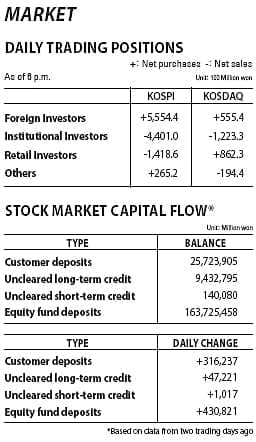
    Offshore traders bought a net 549 billion won worth of local stocks, while institutions and retail investors sold a net 442 billion and 127 billion won, respectively.

    Auto shares were down as the rising value of the local currency raised concern over their price competitiveness in overseas markets.

    Industry leader Hyundai Motor declined 1.57 percent to 157,000 won, and its auto-parts maker Hyundai Mobis dropped 3.04 percent to 255,000 won.

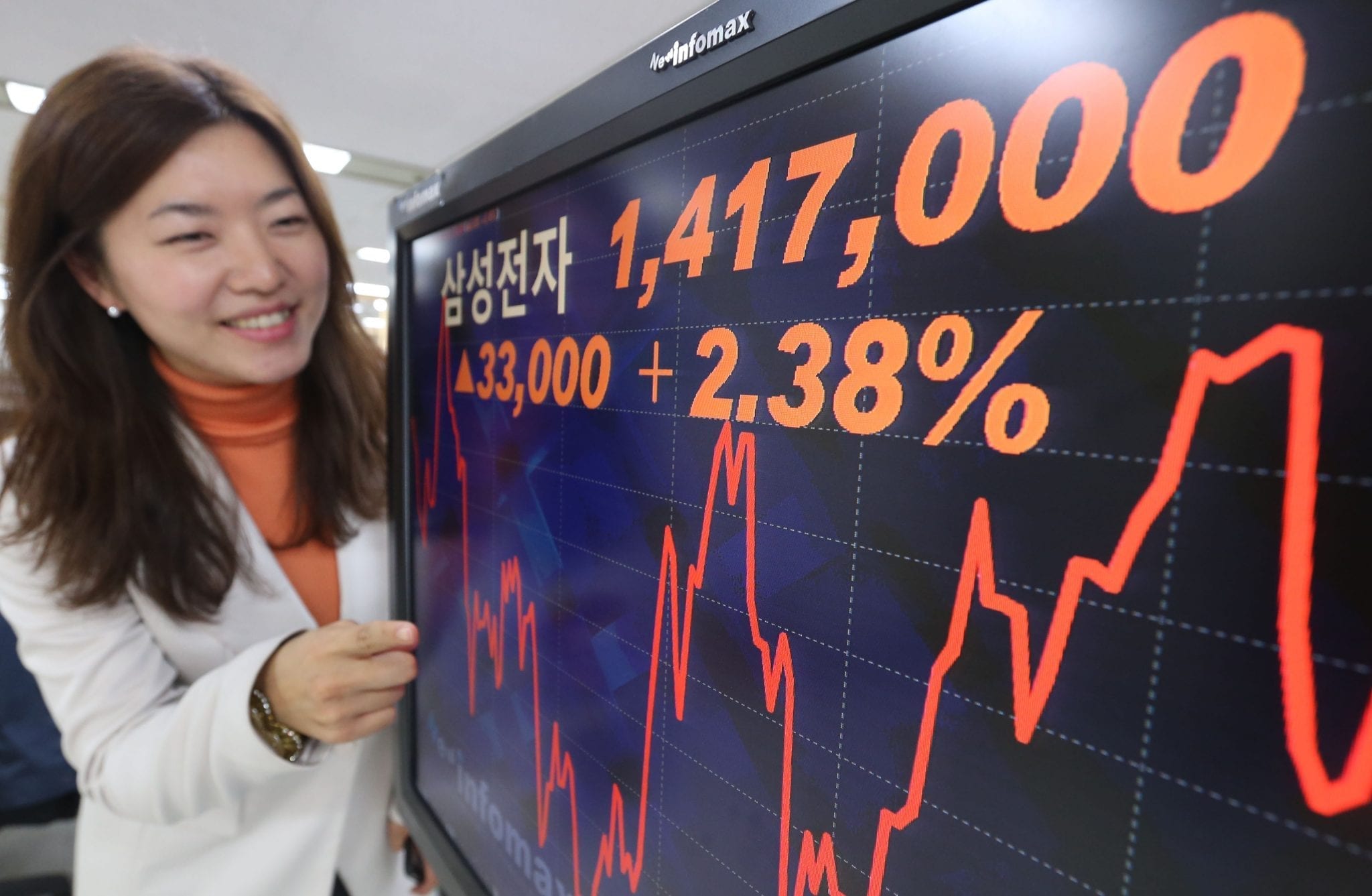
    Tech shares were in positive terrain. Market bellwether Samsung Electronics inched up 0.07 percent to 2,791,000 won, and SK Hynix, the world’s No. 2 chipmaker, edged up 0.61 percent to 83,000 won.

    Airlines were among best performing stocks as lower oil prices and the stronger local currency are expected to lower their financial burden and costs.

    Korean Air, Korea’s largest airline, jumped 5.48 percent to 32,750 won, and its smaller rival Asiana Airlines shot up 11.26 percent to 4,840 won.

    Secondary Kosdaq closed at 775.85, down 4.37 points or 0.56 percent from the previous trading day.

    Top-listed Celltrion lost slipped 0.09 percent to close at 218,800 won.

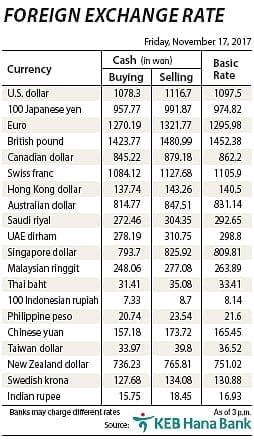
    The Korean won closed at 1,097.5 won against the U.S. dollar, up 3.9 won from the previous session’s close, which rose to the highest level since September 2016.

    Bond prices, which move inversely to yields, fell. The yield on three-year bonds gained 0.3 basis point to 2.174 percent, and the return on the benchmark five-year government bonds added 0.8 basis point to 2.383 percent.


  • Seoul shares edge up on pharmaceutical, retail gains

    Seoul shares edge up on pharmaceutical, retail gains

    South Korean stocks rose marginally high on Tuesday, propped up by rallies in pharmaceutical and retail companies. The local currency lost against the greenback.

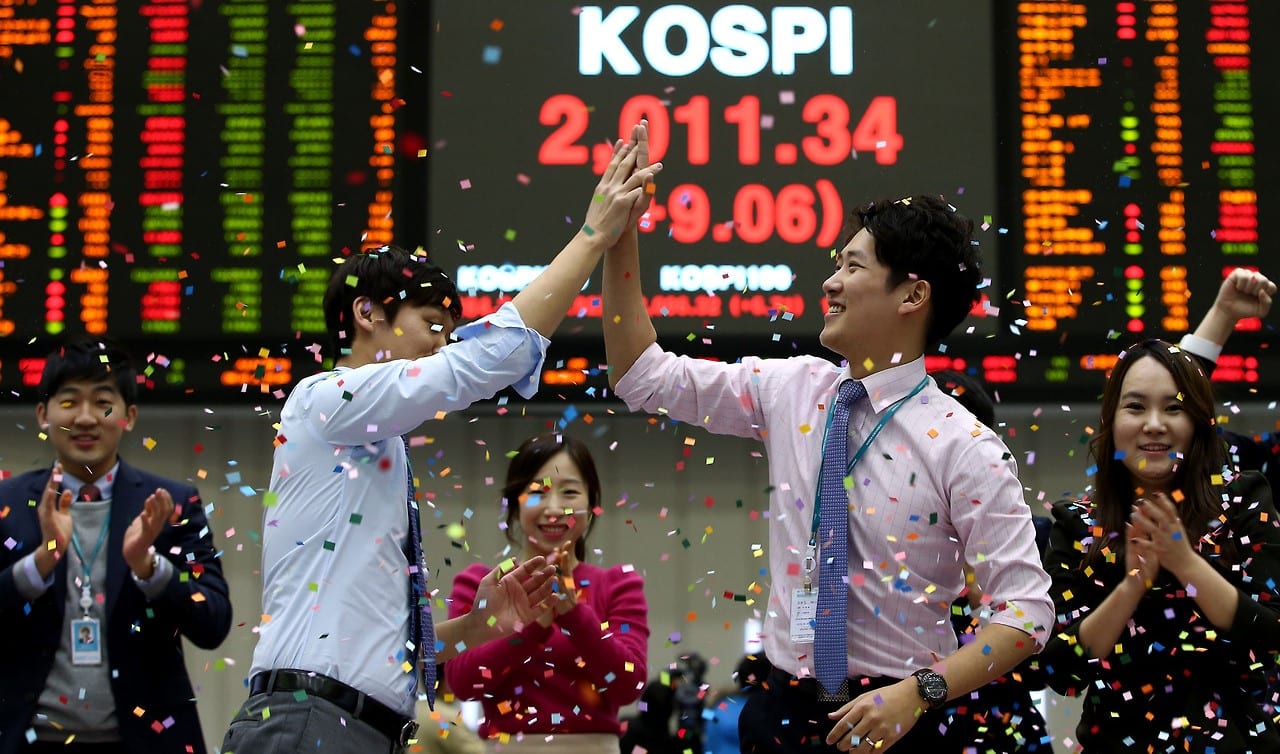
    The benchmark Korea Composite Stock Price Index (KOSPI) added 2.25 points, or 0.11 percent, to end at 1,966.31. Trade volume was thin at 394.49 million shares worth 3.76 trillion won (US$3.21 billion), with winners beating losers 461 to 368.

    The market started lower and moved in and out of positive terrain. Propping up the market are individual investors who picked up about 265 billion won worth of shares, while institutions and foreign investors remained net sellers.

    “The mood remained subdued in the KOSPI market as investors locked in taking profits from gains prompted ahead of the ex-dividend date when shares lose the right to receive dividends,” said Kim Hyung-rae, a KDB Daewoo Securities analyst.

    Large-cap shares ended mixed, with pharmaceutical companies leading the upward move.

    No. 1 drug maker Hanmi Pharm jumped 14.46 percent to 736,000 won, while Green Cross gained 4.91 percent to 181,500 won. Furniture maker Hansem surged 6.73 percent to 238,000 won.

    Banking and steel issues weighed on the market. The Industrial Bank of Korea shed 5.26 percent to 12,600 won, while steelmaker POSCO fell 3.69 percent to 169,500 won.

    Telecom giant SK Telecom plunged 6.52 percent to 215,000 won following media reports over the SK Group chairman’s planned divorce with his long-estranged wife, which prompted uncertainty over its corporate governance.

    The local currency ended at 1,169.6 won against the greenback, down 4.2 won from Monday’s close.