Retail News CRM

Tag: KT

  • KT and Samsung to develop 5G-powered medical service

    KT and Samsung to develop 5G-powered medical service

    KT Corporation, along with Samsung Medical Center (SMC), has announced the launch of a 5G-enabled medical service as an initial step to set up a 5G-based smart hospital. The pilot project, which is developed by the Seoul-based South Korean telecom giant, developed service environments in operating and proton therapy rooms and performed a test operation.

    Based on the results from the pilot, both KT, formerly Korea Telecom, and SMC are planning to continue the development of smart patient care and 5G-powered new medical practices and better the hospital operational efficiency. Park In-Young, vice president of KT’s ICT convergence business department, said: “KT, in partnership with the Samsung Medical Center, is pioneering innovative medical services for the new 5G era. We will continue to further refine 5G-powered medical technology by applying VR and AR technologies for real-time education.”

    In the coming years, 5G-enabled medical services would, in theory, speed up surgery and other treatment processes by allowing uninterrupted access to surgeons that will help them obtain pathological data that is critical in determining the serious conditions of patients. The network would also provide quick access to CT and MRI data on proton therapy.

    Last September, KT entered into roaming agreements with Italy’s TIM, Switzerland’s Sunrise, and Finland’s Elisa, allowing the company’s 5G subscribers to use the 5G networks provided by the three European operators. The Korean operator has standing agreements with operators in 185 countries for 3G and LTE roaming and now is extending those contracts to 5G as soon as 5G services go live in those countries.

    According to reports from the South Korean Ministry of Science and ICT, the country hit the milestone of four million 5G subscribers last December. As of October, the Ministry reported 3.98 million 5G subscribers in the country and in September, it said that 516,000 more people subscribed to the 5G services.

  • KT and Samsung to develop 5G-powered medical service

    KT and Samsung to develop 5G-powered medical service

    KT Corporation, along with with Samsung Medical Center (SMC), has announced the launch of a 5G-enabled medical service as an initial step to set up a 5G-based smart hospital. The pilot project, which is developed by the Seoul-based South Korean telecom giant, developed service environments in operating and proton therapy rooms and performed a test operation.

    Based on the results from the pilot, both KT, formerly Korea Telecom, and SMC are planning to continue the development of smart patient care and 5G-powered new medical practices and better the hospital operational efficiency. Park In-Young, vice president of KT’s ICT convergence business department, said: “KT, in partnership with the Samsung Medical Center, is pioneering innovative medical services for the new 5G era. We will continue to further refine 5G-powered medical technology by applying VR and AR technologies for real-time education.”

    In the coming years, 5G-enabled medical services would, in theory, speed up surgery and other treatment processes by allowing uninterrupted access to surgeons that will help them obtain pathological data that is critical in determining the serious conditions of patients. The network would also provide quick access to CT and MRI data on proton therapy.

    Last September, KT entered into roaming agreements with Italy’s TIM, Switzerland’s Sunrise, and Finland’s Elisa, allowing the company’s 5G subscribers to use the 5G networks provided by the three European operators. The Korean operator has standing agreements with operators in 185 countries for 3G and LTE roaming and now is extending those contracts to 5G as soon as 5G services go live in those countries.

    According to reports from the South Korean Ministry of Science and ICT, the country hit the milestone of four million 5G subscribers last December. As of October, the Ministry reported 3.98 million 5G subscribers in the country and in September, it said that 516,000 more people subscribed to the 5G services.

  • KT taps Samsung to expand PS-LTE coverage in South Korea

    KT taps Samsung to expand PS-LTE coverage in South Korea

    Samsung has signed an agreement with KT to help expand the telco’s public safety LTE (PS-LTE) network in South Korea, the vendor announced.

    The expansion deal will see Samsung provide KT with LTE network solutions based on 3GPP Release 13 in 10 major metropolitan regions in South Korea including Seoul by 2020.

    The expanded deal will also see the pair deliver what they say is the world’s first narrowband Internet of Things (NB-IoT) service over the PS-LTE network to help prevent and respond to natural disasters such as fires and people stranded in remote, mountainous areas.

    In addition to LTE radio base stations that support 700-MHz, Samsung is providing KT with a virtualized core and features such as MCPTT solutions, RAN sharing, evolved Multimedia Broadcast Multicast Service (eMBMS), Isolated eUTRAN Operation for Public Safety (IOPS), and device to device (D2D) network solutions.

    For instance, D2D allows direct and undisrupted communications between any two devices without traversing radio base stations or core networks, even in areas where bases stations are not provided.

    Samsung said D2D and NB-IoT technologies will play crucial roles in public safety network by ensuring stable, seamless, and reliable network in unfavorable environments.

    “By acquiring innovative wireless communications from Samsung, we are able to aid in life-threatening situations where data traffic is severely congested or connection is completely out of reach,” said Yoon-Young Park, senior executive vice president and head of enterprise business group at KT. “These first-of their-kind networks help responders connect with those in need.”

    KT and Samsung have been collaborated since 2016. The pair deployed the first PS-LTE network in 2016 throughout Gangwon (Pyeongchang) province of South Korea.

    In 2017, the companies delivered LTE-railway service on a high-speed train traveling at up to 250 km/hour (155 mph) using MCPTT solutions.

    The two companies are now aiming to expand the PS-LTE network further into the metropolitan areas around the country, including Seoul, Gyeonggi, Gangwon, Jeolla, Gyeongbuk and Chungnam provinces.

    South Korea’s three major carriers-KT, SK Telecom and LG Uplus- launched full-fledged commercial 5G services in early April and racked up over 260,000 5G subscribers that month.

  • KT, Hyundai Mobis join to develop connected-car tech

    KT, Hyundai Mobis join to develop connected-car tech

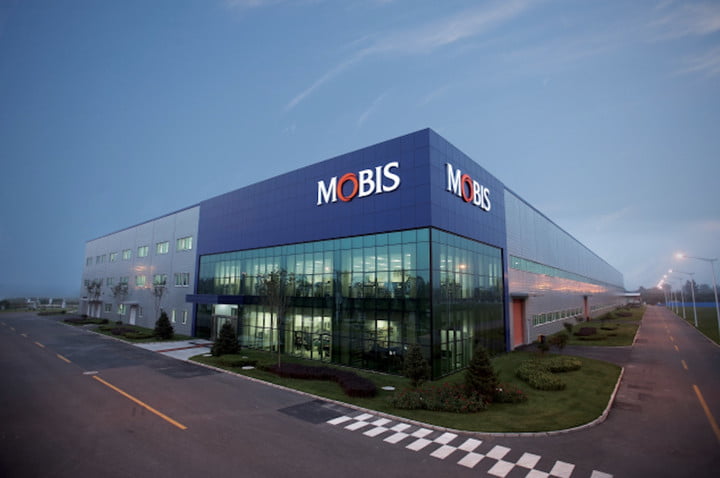
    KT said Thursday that it will collaborate with Hyundai Mobis to develop self-driving and connected-car technology.  The two companies agreed to work on real-time navigation technology and vehicle-to-everything technology, which will allow cars to communicate with connected devices. To enable development, the telecommunications company said it will install 5G infrastructure at the Hyundai Mobis test-drive course in Seosan, South Chungcheong.

    The fast 5G network will allow sensors on a Hyundai Mobis self-driving car to send significant amounts of data to servers immediately to allow for accurate real-time traffic navigation. The process takes minutes in existing 4G networks.

    The cooperation comes as the two prepare for the fast-growing connected car market. Industry researcher IHS Markit predicted connected-car sales to reach 72.5 million units by 2023 from 24 million units in 2015.

  • Korea’s KT 5G bus hits the road

    Korea’s KT 5G bus hits the road

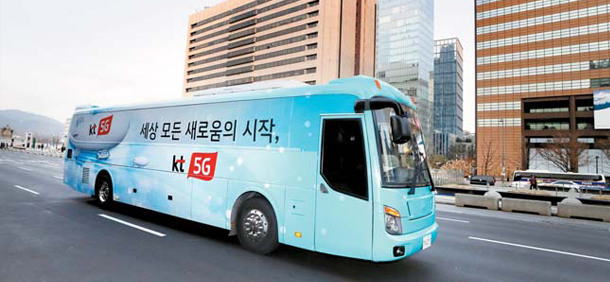
    Are you curious about all the hype over 5G? A ride on a 5G-powered bus may answer some questions. Mobile carrier KT announced Tuesday that people can sign up for free rides on its 5G bus. The bus will be connected to its ultra-fast 5G wireless network and will demonstrate devices that can be used to enjoy new media services like KT’s GiGA Live TV. GiGA Live is a head-mounted display – thick goggles with a screen embedded inside. GiGA Live supports virtual reality (VR) media services, including live sports broadcasts, as well as 360-degree films.

    VR and augmented reality (AR) are commonly cited as the technologies that have the most to benefit from 5G network. Because 5G promises up to 20 times faster speeds than LTE, it can transfer large volumes of data quickly in real-time, which is integral to the proper operation of VR and AR services.

    Those who want to take 30-minute sojourns on the 5G bus can apply online at www.kt5Gbus.com. The bus will run in the Gwanghwamun area from Jan. 15 to 24, and Gangnam Station from Jan. 25 to Feb. 2. Rides will be offered five times a day, excluding Sundays and Mondays.

    “5G network makes it possible to transfer huge volumes of information safely and in real-time,” said Park Hyun-jin, head of KT’s 5G business. “We will continue to offer innovative 5G services that can provide new experiences and value to consumers.”

    Earlier this month, KT added 5G-capabilities to its barista robot B;eat in Samsung Life Insurance’s Seocho District office. The robot, which looks like an advanced vending machine, can now recognize customers’ presence and send real-time footage of orders to human managers.

  • LG U+ 5G pass self-drive test on expressway

    LG U+ 5G pass self-drive test on expressway

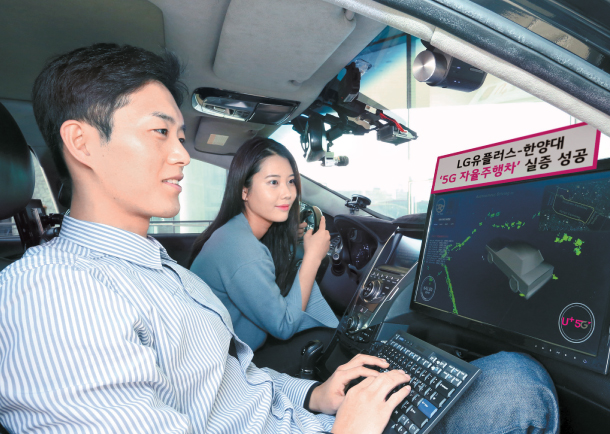
    LG U+ has successfully tested a 5G-powered self-driving vehicle on an expressway for the first time. The mobile carrier announced Tuesday that a self-driving car developed by Hanyang University successfully drove on LG U+’s 5G network for 25 minutes across seven kilometers (4.35 miles) of busy city roads including the Gangbyeon Expressway and Olympic Expressway.

    A low latency video transmitter developed by LG U+ delivered real-time footage of the test drive to Hanyang University. Two cameras attached to the self-driving vehicle recorded the front and rear of the car.

    During the test drive, the vehicle had to react to certain scenarios such as avoiding obstacles and changing course. The vehicle was also tested to see how it reacts to new traffic information such as a blocked parking lot entrance.

    The vehicle was remote controllable, offering added safety measures in case of emergency.

    It was the first time that a self-driving car has completed a test drive on such a scale on an expressway or high-speed road in Korea, according to the company.

    “Self-driving cars that run on the 5G network will make important contributions to solving social problems like traffic volume and accidents,” said Sunwoo Myung-ho, who teaches automotive engineering at Hanyang University.

    “It’s significant that we were able to produce substantial results with self-driving cars through cooperation between industry and academia,” said Kang Jong-oh, who manages future technologies at LG U+. “We will continue to invest our efforts into developing self-driving car technology through cooperation between mobile carriers and the auto industry.”

    LG U+ will continue to work with Hanyang University to polish its 5G-based self-driving car technology.

    Competitors SK Telecom and KT are also actively investing in self-driving technology. KT, for example, successfully tested a self-driving bus at Incheon International Airport last month.

  • Factories, tractors and robots benefit from 5G in Korea

    Factories, tractors and robots benefit from 5G in Korea

    All three of Korea’s mobile carriers launched their 5G networks on Saturday, the first day of December, officially kicking off an era of the high-speed network. SK Telecom started transmissions from its Bundang network management center in Seongnam, Gyeonggi; KT from its Gwacheon network control center in Gyeonggi; and LG U+ from Magok Science Park in western Seoul. All of the 5G networks operate on a 3.5-gigahertz (GHz) frequency band.

    5G boasts a 20 times faster data transmission speed than the currently prevailing fourth-generation long-term evolution (LTE). Its competitive edge lies in ultra-wide bandwidth, ultra-low latency and ultra-fast connectivity. Data transmission speed of 5G is more than 20 gigabytes per second (Gbps), meaning a 2.5-gigabyte ultra high-definition video can be downloaded in just one second.

    The network can currently only be accessed by corporate clients, not individual users. Businesses can use the card-shaped mobile routers to pick up the 5G network and convert it into super-fast Wi-Fi.

    Individual subscribers are expected to be able to start using 5G from March, when smartphone devices supporting the new network will become available. Samsung Electronics is expected to unveil its Galaxy S10 smartphone as early as February and may come up with two different versions: one supporting LTE and one that works on 5G.

    SK Telecom’s first 5G customer was Myunghwa, a product quality assessment firm in Banwol Industrial Complex in Ansan, Gyeonggi. The company is using the network to process ultra-high definition photos of auto components taken from different perspectives as the products are being moved on a conveyer belt. The images are transmitted using the 5G mobile router to a cloud server, where a high-performance artificial intelligence interface can instantly tell whether a product is faulty.

    SK Telecom also began test operations of its 5G autopilot vehicles in Hwaseong and Siheung, both in Gyeonggi. The vehicles are able to exchange information about their status while on the road with a control center and traffic lights dozens of times per second.

    KT celebrated the launch of its 5G network by having a robot as its first subscriber. The robot, called Lota, will be guiding visitors to the Seoul Sky observatory at Lotte World Tower in Songpa District, eastern Seoul.

    “We chose Lota to show that 5G doesn’t simply mean a generational shift, but will become a platform that will innovate our overall lives and industry,” said KT in a statement.

    KT plans to prioritize 24 major cities nationwide as well as key public transportation routes and university areas, where traffic demand is expected to be high, for 5G installation in the near future.

    LG U+’s first corporate customer is LS Mtron, an industrial machine developer based in Anyang, Gyeonggi. The two companies have jointly developed a 5G remote-controlled tractor, the first in Korea. LG U+ said 5G-based remote-controlled technologies may minimize human engagement in risky working environments, such as the removal of mines and industrial waste disposal.

  • KT subscribers jump ship after fire accident

    KT subscribers jump ship after fire accident

    KT’s week has taken yet another turn for the worse as the fire that caused major telecommunications disruptions in Seoul and the surrounding area has likely left the company with a hefty compensation bill and subscribers looking to take their business elsewhere.

    According to data from the Korea Telecommunications Operators Association on Tuesday, the number of KT’s mobile service subscribers has been shrinking since a fire broke out at the carrier’s Ahyeon telecommunications switching center in Seodaemun District, western Seoul, on Saturday.

    On Saturday, the total number of subscribers to the country’s second-largest mobile carrier fell by 828 people compared to the previous day. This means that the number of people that left KT was larger than those who newly subscribed to the carrier that day.

    On the contrary, subscribers to SK Telecom increased by 246 people and LG U+ 582 people on the day of the accident.

    On Monday, the number of KT subscribers again dropped by 678 people. During the two operating days, KT lost a net 1,506 subscribers.

    Before the accident, the number of KT subscribers was on the rise. On Thursday, KT’s pool of subscribers increased by 69 people and by 83 people on Friday, but that trend was reversed after the fire.

    The troubled company said most fire-affected services have returned to normal on Tuesday, but analyst Kim Hyun-yong from eBest Investment & Securities said, “KT’s sales and brand image can be damaged if the situation is not fixed quickly considering the long hours and broad scope of disruptions [caused by the accident,]” in a report.

    SK Telecom also suffered from problems in its mobile communications services in April and LG U+ last year, but disruptions were resolved in a matter of hours, not days.

    Analysts estimate KT will have to spend at least 23.2 billion won ($20.5 million) in compensation to individual customers as it decided to waive a month’s phone bill for KT subscribers residing in the affected regions. The amount is roughly 1.6 percent of KT’s projected operating profit for this year according to Yang Jong-in, a research fellow from Korea Investment & Securities, Tuesday.

    “We made our assumptions based on KT’s market share in the five affected districts in Seoul,” Yang said.

    Another analyst Kim Joon-sop from KB Securities estimated the amount of compensation to be larger, at around 31.7 billion won.

    As compensation plans for the business losses of small and microbusiness operators have not yet been laid out by the mobile carrier, the amount of compensation could snowball.

    The accident comes at a tragic time for KT, as it was just a week before the carrier expected to introduce its first 5G network-based services. Korean carriers have been preparing to launch their first 5G services in dongle-type devices from December and had scheduled large press briefings this week prior to the official launch.

    KT has now delayed its event. On Monday, the mobile carrier sent notices saying “we decided to cancel our scheduled event to quickly fix telecommunications disruptions caused by the fire,” to reporters.

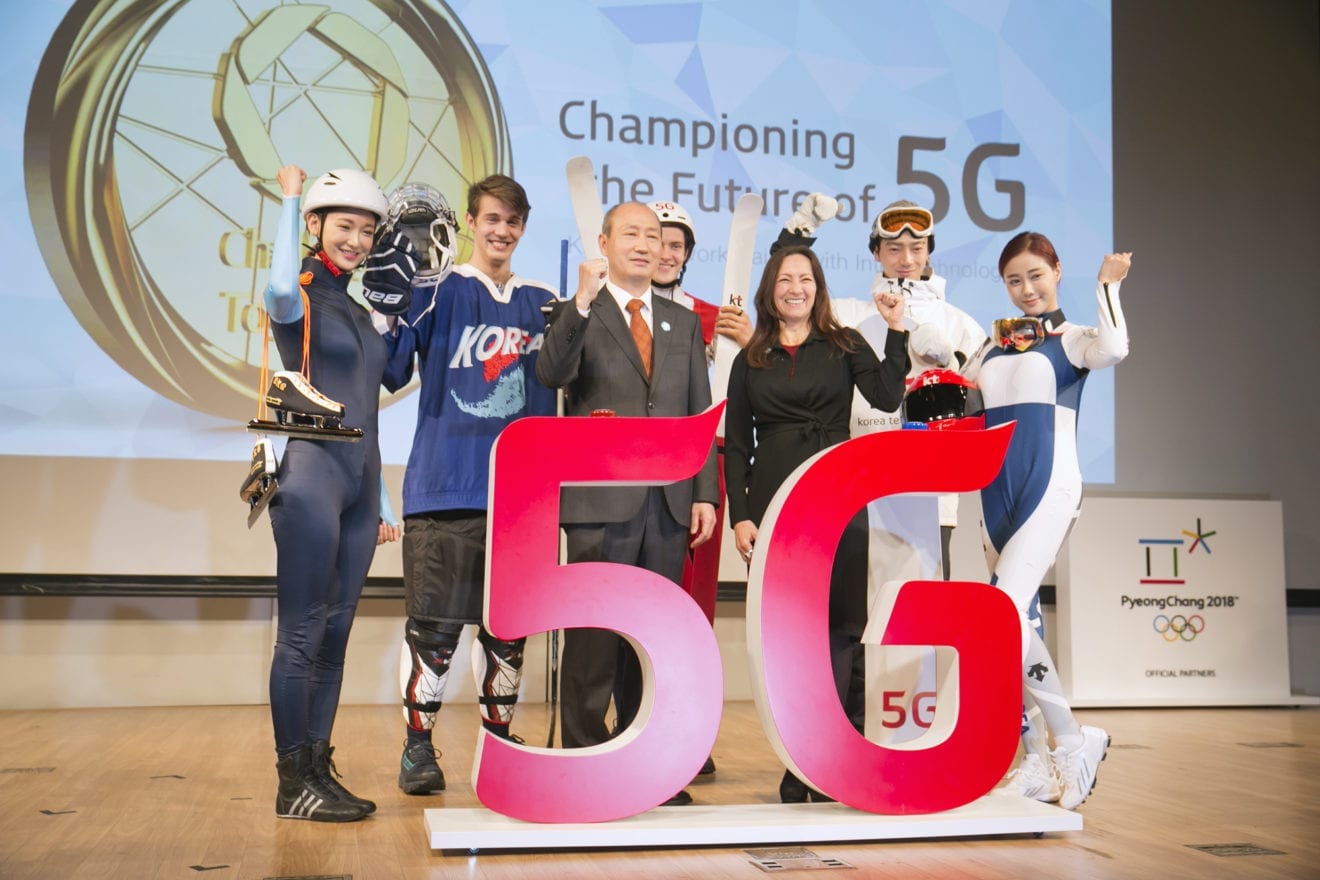
    The 5G network has been KT’s key focus and Chairman Hwang Chang-gyu had promised in September to invest a whopping 9.6 trillion won into its 5G business over the next five years. The company had also cemented its image as a leading 5G service provider by serving as the official telecommunications partner at the PyeongChang Winter Olympic Games earlier this year.

    The latest incident, however, has hampered KT’s latest bid to take a bigger share of the local telecommunications market, which has been in a similar shape for the last decade: SK Telecom taking 50 percent, followed by KT with 30 percent and LG U+ 20 percent.

    “SK Telecom, which boasts a well-established image of offering quality mobile services, and LG U+, which bets on cost-effective services, are likely to take advantage of the latest accident,” an industry insider said.

    Still, KT is trying its best to restore the disrupted network.

    According to KT, 96 percent of its mobile communications service has been restored, while 99 percent of landline internet and 92 percent of fixed-line phone services are repaired as of 11 a.m. Tuesday.

    KT said microbusiness operators still suffering from telecommunications disruptions are those that depend on copper cables rather than more modernized fiber optic cables. While 99 percent of fiber optic cable-based landline phone services are back to normal, only 10 percent of the copper cable-based services have been restored.

    “Copper cables are heavy and thick so they cannot be taken out through manholes for restoration,” KT said in statement. “They can only be recovered after our people are allowed into the tunnel where the fire broke out.”

    To minimize damage to copper-cable users, KT said it will offer 1,500 wireless LTE routers to shop operators so they can use electronic card payment systems. KT is also offering 300 wireless payment devices to convenience stores after discussions with the various franchise headquarters. The carrier has also been rushing to convert copper cables to fiber optic ones in areas with a large number of shops since Monday.

    From the government’s side, the Ministry of Science and ICT created a task force on Tuesday consisting of related government officials and representatives from mobile carriers to discuss how to manage low-level telecommunications facilities like the Ahyeon facility, which was graded D in terms of importance.

  • KT promotes its 5G team to run entire mobile business

    KT promotes its 5G team to run entire mobile business

    Mobile carrier KT announced its annual reshuffle Friday as it actively prepares to gain a strong foothold in 5G-related activities in 2019. The next-generation 5G mobile network is expected to be 20 times faster than the current 4G network. Mobile carriers are working to achieve commercialization of the technology by March next year.

    KT’s 5G business team used to be part of the company’s marketing division. Following the reshuffle, the team is in charge of the carrier’s entire mobile business.

    Its main role will be developing customer services using the 5G network.

    A new 5G Platform Development team will be part of the marketing division. It is tasked with devising services for corporate clients, including those related to smart cities, smart factories and connected cars.

    As for changes at the top, former chief secretary, Kim In-heo, 55, was appointed president of KT. Kim has been noted inside the company for his practical working style and flexibility with regard to fixed customs.

  • Korea’s KT skips Huawei for 5G

    Korea’s KT skips Huawei for 5G

    KT has chosen Samsung Electronics, Ericsson and Nokia as suppliers of 5G network equipment. As expected, Huawei was excluded from the list.  “In choosing 5G equipment providers, the company considered a wide range of factors: the level of technology, investment costs and management stability based on the compatibility with the existing LTE network,” KT said in a statement.

    The bid results, announced by the company Thursday, come a month after SK Telecom named Samsung Electronics, Ericsson and Nokia as its 5G equipment providers.

    This is the second time Huawei was left out despite having participated in internal tests along with the three selected.

    SKT and KT’s choices were anticipated because both had used equipment from Samsung, Ericsson and Nokia for their 4G LTE networks.

    Compatibility of equipment is an advantage for mobile carriers in terms of cost and maintenance, especially in the early stages when 5G equipment is not fully installed nationwide.

    LG U+ is the only one among Korea’s three mobile carriers that has not yet announced 5G equipment suppliers. The smallest mobile carrier is likely to include Huawei on its list. It partnered with the Chinese company for its 4G LTE network, along with Samsung, Ericsson and Nokia.

    An LG spokesman said Thursday that the company “does not have plans to openly disclose selected bidders for 5G network equipment at the moment,” as it is not mandatory.

    However, LG U+ Vice Chairman Ha Hyun-hwoi gave a strong hint at the parliamentary audit late last month when he gave a positive answer to a lawmaker’s question on whether it was “unavoidable” to use Huawei’s 5G equipment as its 4G equipment was from the same company.

    The biggest advantage of Huawei’s 5G equipment is cost efficiency. The Chinese company is known to charge prices that are 20 to 30 percent lower than other global competitors for high-quality 5G equipment. A factor that argues against Huawei is security concerns.

    Due to its ties to the Chinese government, there have been worries that the company’s equipment is being used for spying. In August, the U.S. and Australian governments banned Huawei from supplying equipment for their 5G wireless infrastructure citing security reasons. Britain said in July it “is less confident” about the integrity of Huawei products.

    The concern is shared by some local customers as well. Online petitions at the Blue House’s official website have been posted since June requesting a stop to LG’s adoption of Huawei’s 5G equipment. Huawei has been denying such allegations.

    In a press release last month, the Chinese tech company highlighted that, despite ongoing security concerns, there has been zero cases of actual information leakage in the past.

    “We have supplied LTE equipment for LG U+ since 2013, and until now, there were no cases of security accidents,” said the statement. “After multiple verifications by the government, it has been proved that there have been no problems.”

  • KT increases fixed-line network speed tenfold, to 10Gbps

    KT increases fixed-line network speed tenfold, to 10Gbps

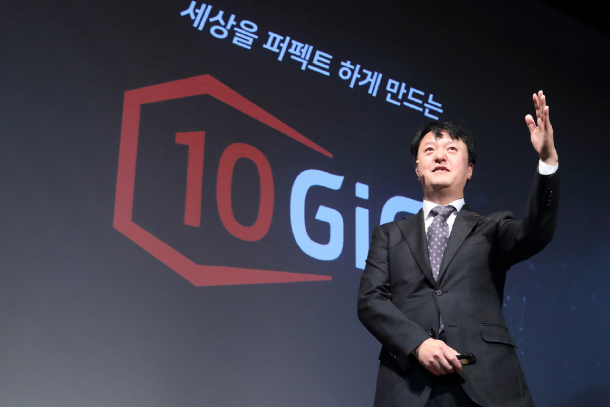
    KT announced Wednesday it will introduce a fixed-line network 10 times faster than its current offerings in Seoul as well as six major Korean cities.  The launch of Korea’s first home internet with speeds of up to 10 gigabits per second (Gbps) comes about four years after the mobile carrier launched wired internet with 1-Gbps speed.

    According to the company, Korea’s largest fixed-line internet service provider, a faster home internet has become a necessity as the number of independent content creators, like YouTubers and dedicated Esports players, has grown explosively.

    “The 10 times faster network will enable creators to air their content in ultra high-definition quality,” said Lee Pill-jai, senior executive vice president for marketing at KT. “It will also make virtual reality and augmented reality content a norm.”

    In a demonstration Wednesday at KT headquarters in Gwanghwamun, central Seoul, the actual download and upload speeds of the new internet service exceeded 8 Gbps whereas the existing internet achieved speeds of less than 1 Gbps. With the new internet, it takes only 30 seconds to download a 33-gigabyte ultra high-definition movie, according to KT. At 1 Gbps, it takes four minutes and 30 seconds.

    “You also need to think of the many devices that will be connected to home internet in the future,” said Park Hyun-jin, head of the wire and wireless business unit at KT. “I personally use five internet-powered devices, but by 2021, an average person will have 13 devices connected to the internet.”

    According to Park, the connection of numerous devices will slow internet speeds and make a 10-Gbps fixed-line a necessity to maintain tolerable internet speeds on each device.

    Faster fixed-line internet will also support the deployment of the high-speed 5G wireless internet nationwide, according to KT.

    “The 5G network is offered as wireless internet through base stations, but 5G network equipment and base stations need to be connected via a wired backbone network,” a spokesperson from KT said. “Having a 10-Gbps fixed-line network as the 5G’s backbone network will increase the stability of the wireless service.”

    The so-called backbone is a part of a computer network that connects other networks.

    According to KT, its 10-Gbps internet will be able to cover about 60 percent of the country by the early half of next year.

    To subscribe to the 10-Gbps internet, it costs 110,000 won ($96) per month, but if users already subscribe to KT for TV services, the monthly fee could be discounted to 77,000 won on a three-year contract basis.

    The company also released 5-Gbps and 2.5-Gbps internet plans, for those wanting faster but affordable home internet.

    To enable users to get a feel for 10-Gbps internet, KT said it will gradually install the network at 80 Starbucks Reserve shops in Korea and six PC rooms operated by AfreecaTV by this year.

  • KT secures $26.5m smart meter project in Uzbekistan

    KT secures $26.5m smart meter project in Uzbekistan

    South Korean telco KT has signed a 30 billion won ($26.5 million) contract with state-run power electricity supplier Uzbekenergo to install smart meters in Uzbekistan. Under the deal, KT will install smart meters in 360,000 households throughout the central Asian country over the next two years. KT has made its foray into Uzbekistan’s energy sector since it secured a 120 billion won deal ($106 million) with Uzbekenergo to provide its smart energy meters in 2015.

    The company so far installed its smart meters in 1 million Uzbek households throughout the three provinces of Samarkand, Jizzakh and Bukhara as a result of the first contract.

    Smart meters are electronic devices that record electricity consumption and have a two-way, real-time communication feature between the power company and its customers.

    With the smart energy meters, Uzbek households can monitor their real-time power usage and view online billing, enabling them to use electricity in a more efficient and effective way, KT said in a statement.

    Following the deal with Uzbekenergo, KT said it hopes to expand its smart meter business to the energy sectors in other Eurasian countries.

    “This project shows KT’s success in building trust in Uzbekistan with our technological excellence,” said Yoon Kyoung-Lim, head of KT’s global business office.

  • KT’s Kids’ Land is now available on the move

    KT’s Kids’ Land is now available on the move

    KT’s Kids’ Land will soon be available on the move, as the mobile carrier tries to take on YouTube Kids by moving its popular child-friendly content service to smartphones.
    Kids’ Land, which launched in May on KT’s internet-protocol TVs, is now used by 3.6 million customers, according to KT. By creating a mobile app that is connected with the IPTV, the carrier said that kids will now be able to enjoy their favorite content anywhere they want.

    New content was also been added to the service, now upgraded to Kids’ Land 2.0, on Tuesday. While most of the content on the original Kids’ Land was for children, the new version comes with new videos dedicated to parenting, made for KT in cooperation with Dr. Oh Eun-young, a famous figure in the field of child care in Korea.

    Oh’s content will cover 10 big topics in parenting, spanning about 50 video clips, so that parents can easily learn how to behave with their children in specific situations, like when they won’t sleep.

    “There is so much, in fact, too much information on parenting that parents these days can’t really tell between reliable content and those that are not,” Oh said. “KT’s platform offers curated and reliable content that parents can always turn to.”

    Kang In-sik, vice president of the media content department at KT, said KT will be working to provide more original content to beat competition from other platform providers like YouTube. KT is currently contacting experts to make videos specifically targeting infants as well as the elderly and those hoping to learn a new language.

    The new Kids’ Land app will be ad-free and filter out harmful content for children.

  • KT expands reach of AI-powered smart city solution to SEA

    KT expands reach of AI-powered smart city solution to SEA

    South Korea’s KT has announced plans to expand the reach of its self-developed AI technology with the launch of services for hotels and smart cities in Southeast Asia.

    The operator will introduce customized AI solutions for the market, starting with Vietnam.

    KT last month entered an agreement with Vietnam’s largest construction company Hoa Binh Construction Group (HBC) JVC for the provision of AI-powered hotel and apartment services in Southeast Asia. The partners have also agreed to subsequently co-operate on smart building and city projects in major metros in the region.

    KT used its platform to launch the first hotel in South Korea to offer AI-assisted room services in July – a Novotel Ambassador hotel in Seoul – and plans to open three more smart hotels across Seoul by 2020.

    The company’s hotel AI service platform is a customization of KT’s GiGA Genie AI powered smart home media hub, which launched in 2017 and now has more than 1 million subscribers in South Korea.

    “It’s a big first step for KT’s AI platform to reach out to the world, thanks to the partnership with HBC,” KT marketing group senior vice president Lee Pil-Jai said. “With great success in South Korea, we will step up efforts to localize our AI hotel service and smart city solutions for Southeast Asia and beyond.”

  • KT signs partnership to build AI hotels in Vietnam

    KT signs partnership to build AI hotels in Vietnam

    KT said Tuesday that it inked a partnership with Vietnam’s largest construction company, Hoa Binh Construction Group, to build artificial intelligence-equipped hotels and smart cities.

    Based on the partnership, the two companies plan to install AI services in hotels and apartments in Vietnam and other Southeast Asian countries. In the longer term, the two hope to expand the cooperation to create smart cities featuring digital technologies.

    KT has already created an AI hotel in Korea earlier this year by installing smart speakers customized for hotels in rooms at the Novotel Ambassador Hotel & Residences in Dongdaemun, eastern Seoul. Hotel guests can use a version of KT’s GiGA Genie smart speaker to turn on lights, change TV channels and order more towels from the front desk.