Tag: LED TV

  • Samsung dreams of a future filled with 8K TVs

    Samsung dreams of a future filled with 8K TVs

    Samsung Electronics will expand its lineup of 8K televisions this year, hoping to launch the premium products in 60 countries around the world. 8K televisions have four times more pixels than 4K, which until recently was the most cutting-edge screen a high-end television could have. When compared to a 4K TV, 8K screens are brighter with more color contrast and sharper edges. Samsung released its first 8K television last year.

    Han Jong-hee, Samsung’s president in charge of the visual display business, said in a press conference Friday that he expects 2019 to mark the start of a new era where 8K becomes the new norm in the high-end television market.

    “4K grew to take up 60 percent [of all Samsung TV sales] in five years – I expect 8K to show a similar level of performance, maybe faster considering how tech develops so fast these days in all sectors including content and displays,” he said at the event held in Samsung’s Suwon complex in Gyeonggi.

    The company’s 2019 goal for 8K TVs is to reach a double-digit year-on-year growth rate for market share in the local high-end TV sector. Han says the goal is “reachable,” adding that half of the large Samsung televisions sold in the country after November were 8K. That month, Samsung started local sales of the product.

    Regarding its global business, the QLED 8K started selling in Europe, Korea, the United States and Russia last year. Tomorrow, the company will unveil new models for 2019 at the Samsung Forum, a showcase event for clients that simultaneously takes place in various regions around the world.

    This year’s plan is to launch sales in 60 countries.

    Whereas last year the QLED 8K lineup came with four size variations with the largest at 85 inches, this year there will be six variations with the largest at 98 inches. The new sizes are in line with Samsung’s strategy to continue strengthening its lineup of massive TVs to keep a competitive edge in the high-end price sector.

    It remains to be seen whether Han’s optimistic views on 8K television will come to fruition as quickly as he projects. Even if 8K TVs exist, the higher definition and the high price it comes at won’t be of much use if video content remains at the 4K level.

    “5G networks will spread this year and the demand for 8K content will go up as well,” responded Han when asked about the problem. Han particularly expressed anticipation for the 2020 Tokyo Olympics. Japan’s national broadcaster NHK plans to live stream the games worldwide in 8K.
  • LG claims to have wowed the industry at Vegas’ CES

    LG claims to have wowed the industry at Vegas’ CES

    LG Electronics, one of the leading home appliance manufacturers in the world, said Sunday it received a total of 132 awards at this year’s Consumer Electronics Show (CES) in Las Vegas. It said its products received the coveted CES top innovation title announced by the Consumer Technology Association. LG, which has been a major player in big-screen TVs and is a global leader in the field of organic light-emitting diode (OLED) screens, unveiled the world’s first mass production-capable rollable TV at the gathering that ran from Tuesday through Friday.

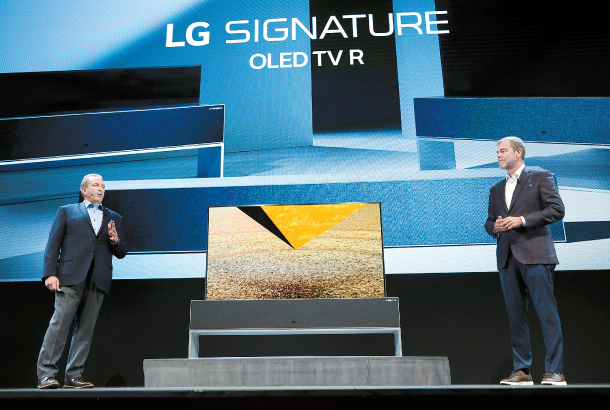
    The LG Signature OLED TV R received considerable attention, with Engadget, a multilingual blog network and the official award partner at CES, naming it Best TV Product.

    The innovative TV that allows the big OLED screen to vanish into a long box with embedded speakers was also noted by some 50 media outlets, such as the Wall Street Journal and Cnet.

    The company said its 8K resolution OLED TV and Super Ultra HD TV, as well as an artificial intelligence-equipped TV set, were praised by tech experts from around the world.

    Media outlets and online publications like USA Today and TechRadar, also gave LG HomeBrew, a craft beer making machine, their highest awards, while the waterfall OLED display at the entrance of the company’s booth – made up of 260 flexible panels – won recognition from numerous international IT outlets.

    Beside such products, the company’s LG SuitBot, an exoskeleton that can help physical laborers, and Styler, a clothing care system, received praise at this year’s CES.

    Song Dae-hyun, who heads LG’s home appliance business, said in a press conference over the weekend that the company is aiming expand its presence in the United States through the marketing of premium products.

    He said in the built-in appliance market in North America, LG is targeting high income earners.

    “If LG competes in mid-range consumer appliances, it will struggle and not turn a lot of profit so it makes sense to shift to premium products,” the senior executive said.

    He said that, in particular, the U.S. market is attractive because it has considerable growth potential.

    The executive said to better engage prospective clients, LG opened its first overseas Signature Kitchen Suite showroom in California’s Napa Valley.

    The Experience and Design Center is the second of its kind after one in southern Seoul, with another to be built in New Jersey.

    Unlike other countries, the United States has always been a so-called builder’s market with the customer having greater say in what kind of appliances go into a home, making it ideal for high-end products.

  • LG unveils TV that rolls up for storage

    LG unveils TV that rolls up for storage

    LG Electronics unveiled the world’s first “rollable” television at the Consumer Electronics Show (CES) 2019 that launched in Las Vegas, United States, on Tuesday. Last year, its affiliate LG Display unveiled a prototype of a 65-inch rollable OLED display panel at the same event. Dubbed the LG Signature OLED TV R9, it uses the same technology, only it comes with an aluminium case at the screen’s bottom that looks like a long tissue box.

    A rolling OLED display was possible because unlike TV panels of the past, OLED screens don’t need backlight to show color, but have molecules that let out light on their own.

    The panel can roll itself up and down from the case so that the television set looks more like a long, rectangular table once the screen is completely inserted. LG boasts that the screen can maintain its color definition even as it rolls itself. R9 won the CES 2019 Innovation Awards in the video display sector.

    LG plans to launch global sales of R9 this year, starting from Korea. Its price was not disclosed, but it will be among LG’s premium television lineups. The advantage of the rollable TV set is that it can be placed in locations like the window side or in the middle of a room. For conventional TV screens, the popular choice was beside or on the walls as they take up space and block the view if installed elsewhere.

    The television set also comes with high-quality speakers and an artificial intelligence software that enhances the set’s performance to adjust definition and sound according to the film or video played. It also recognizes simple vocal commands.

    When the screens are rolled inside the case, R9 can work similarly to an audio set as it can play music via connection to smartphones or other portable devices. It also comes with various modes to use the screen apart from watching movies and TV shows.

    It can function like a huge electronic canvas that shows photos saved in your smartphone. For those who want to create a cozy atmosphere, it has a “Mood” mode that plays a video of a fireplace or displays mood-specific light on the screen.

    LG Display Vice Chairman Han Sang-beom expressed confidence in the panel in front of local reporters on Tuesday at the CES. According to Han, the rollable panel was rolled and unrolled more than 100,000 times during its development process.

    “We’re talking with other clients as well [apart from LG Electronics] for the rollable TV panels,” he said. “My plan is to target the premium market instead of aiming for sales volumes.”

  • Samsung cooperates with Apple

    Samsung cooperates with Apple

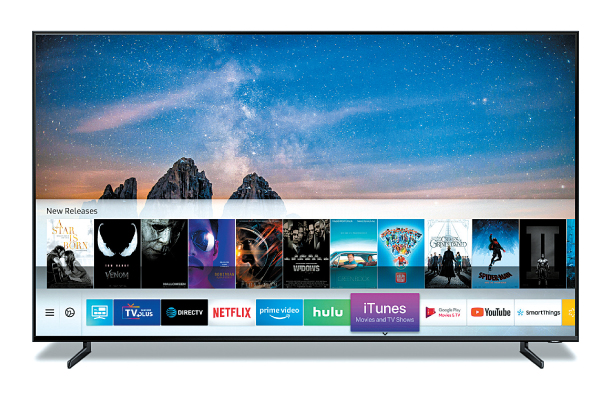
    Samsung Electronics is teaming with arch-rival Apple to enable its smart TVs to access video, audio and other programming from iTunes. It is the first time the two have cooperated on content. The partnership was announced Monday. Beginning this spring, Samsung smart TVs will have iTunes movies and TV as a default option, along with YouTube and Netflix. For customers with older versions of Samsung smart TVs, the service can be added with a software update.

    Apple’s new movie and TV streaming service is set for official introduction in March. Samsung Smart TVs will be the first non-Apple devices to have access to the service.

    Another feature to be made possible on Samsung TVs is AirPlay 2, a function that allows for wirelessly access to movies, photos, podcasts or music from Apple devices.

    Until recently, before Chinese manufacturers became smartphone leaders, Apple and Samsung competed intensely for domination in the market.

    The two were also embroiled in a seven-year patent battle that was only concluded last year.

    Despite the rivalry, they have continued to do business with each other. Samsung has supplied Apple with smartphone chips and displays.

    At an event held in Las Vegas Monday before the Consumer Electronics Show 2019, the president of the Samsung visual display business, Han Jong-hee said that the collaboration is a “win-win” for both companies while customers will benefit from a wider range of choices.

    “For now, the collaboration will be about content. But in the future, I expect there to be other fields in which we can work together as well,” said Han. According to another senior executive at the event, the project was initially suggested by Samsung.

    The company suggested that it is open to partnerships with other companies as well, saying in a press release that it aims to minimize the barriers between products and providers to offer a “rich selection of content.”

    For Samsung, Apple programming will give it an upper hand in attracting customers.

    The war in the TV market is now as much about what is available on devices as it is about brighter, more colorful and slimmer panels. How TVs seamlessly link to online resources is one of the major battlegrounds.

    The partnership also reflects how Apple is increasingly putting weight on services instead of hardware – the reason it came up with the iTunes video streaming service. Global iPhone sales are falling short of expectations as customers don’t change phones as frequently as before and many are being turned off by the high prices.

    Samsung brings with it the strength of being No. 1 in the global TV market, with more than a 40 percent share.

    “We look forward to bringing the iTunes and AirPlay 2 experience to even more customers around the world through Samsung smart TVs, so iPhone, iPad and Mac users have yet another way to enjoy all their favorite content on the biggest screen in their home,” said Eddy Cue, senior vice president of Internet Software and Services at Apple.

  • Flatscreen TV sales slide in SE Asia

    Flatscreen TV sales slide in SE Asia

    The total sales volume of flat panel TV continues to slow in six key Southeast Asian markets monitored by research house GfK.

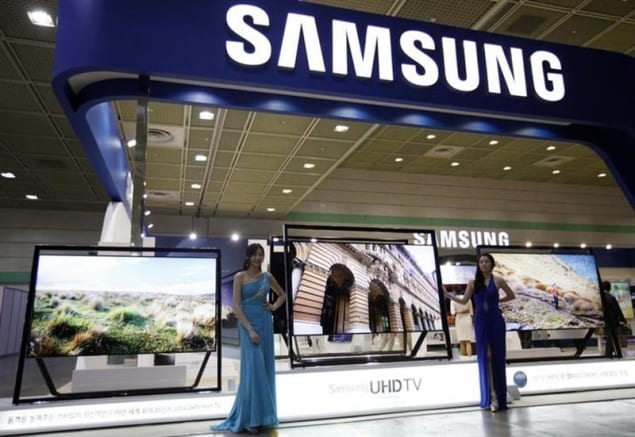
    But consumer demand for ultra-high definition (UHD) models has spiked exponentially in the past year to help fuel the strong growth of this segment as well as the overall value growth of the TV market.

    According to GfK’s point of sales tracking in Singapore, Malaysia, Thailand, Vietnam, Indonesia and the Philippines, the 11.8 million TV sets sold in April 2014 to March 2015 marks a 2.9 per cent drop compared with the same period a year ago. However, robust sales of the higher value UHD models managed to drive up dollar value generated by the entire TV market by 2.9 per cent.

    “With the near completion of switchover trend in developing Southeast Asian countries, consumers are now focusing on upgrading to the latest screen technology,” said Gerard Tan, account director for Digital World in GfK.

    “Manufacturers and retailers have been aggressively launching attractive promotions to stimulate take up rates.”

    The six individual countries reported surges in sales value of their respective UHD TV markets in the range of 20 to 77 per cent, with Singapore (77 per cent), Indonesia (67 per cent) and Vietnam (47 per cent) registering the fastest growth. In unit terms, sales volume from a year ago climbed  in the range of nine to 37 per cent – led by Singapore and Indonesia (37 per cent) and followed by Vietnam (23 per cent).

    According to GfK findings, the UHD segment contributed nearly eight per cent of the region’s TV sales dollars; accounting for US$354 million – an increment of 280 per cent over the same period the year before. Penetration is highest in the most developed market of Singapore, where more than one in every 10 (13 per cent) of sets sold UHD.

    The rising share of UHD in the TV market has also resulted in the average price of a UHD TV falling around 61 per cent, from US$5500 to $2160.

    Meanwhile, the most commonly purchased screen size for this segment is 41”-50”, making up 35 per cent in share of the UHD sales volume.

    “TV technology is constantly evolving, and with each new launch, we see the progression of consumers moving from small to big screens, with affordability increasing over time,” said Tan.

    “Moving forward into the rest of 2015, we can expect to see rising excitement in the UHD TV market as manufacturers battle for the consumer dollar with more offerings at more attractive prices; and at the end of the day, consumer s are the ones who get to enjoy the good deals resulting from the fierce competition,” he concluded.