Retail News CRM

Tag: Levi

  • Ukraine war to sully clothes sales from Levi to Ralph Lauren

    Ukraine war to sully clothes sales from Levi to Ralph Lauren

    Levi Strauss and Ralph Lauren are among U.S. apparel brands likely to be worst hit by Russia’s invasion of Ukraine which is again clogging supply chains in Europe where they derive at least a quarter of sales, Wall Street analysts say.

    American clothes firms’ European businesses were just recovering from two years of pandemic restrictions. But war-related Western sanctions on Moscow, airspace bans, and shipping route changes have put new squeezes on East-West supply chains.

    “Cargo checks are now one of the biggest disruptions to shippers, making sure they are not breaking sanctions at ports in the EU (European Union) and the UK,” said Jane Hali, CEO of investment research firm Jane Hali & Associates.

    Analysts see particular exposure to Calvin Klein and Tommy Hilfiger owner PVH, Levi Strauss, Ralph Lauren, Michael Kors owner Capri Holdings and Nike , who get roughly 25%-40% of sales from Europe.

    “Europe is definitely going to feel the brunt of the economic damage … which will impact consumer sentiment and consumer wallets,” CFRA Research analyst Zachary Warring said on the fallout for apparel retailers.

    Due to the war, Wedbush analysts have reduced yearly revenue growth estimates by anywhere from 100 to 400 basis points for Adidas AG. and at least eight U.S.-based companies including Skechers USA and Farfetch Ltd.

    The brokerage also downgraded ratings on PVH and Ralph Lauren’s stock to “neutral” from “outperform,” while reducing Nike’s price target.

    Adding to sales pressures, numerous brands have also halted operations in Russia altogether in protest or because of the newly-difficult operating environment. Chinese manufacturers had been sending more goods to Europe by rail across Russia.

    Companies with a smaller European presence, such as Carter’s, Bath & Body Works Inc and Kate Spade-owner Tapestry, are likely to be more insulated, analysts said, but the challenge remains sector-wide.

    “We’re afraid it won’t just be retailers with high exposure to Europe but most of retail,” CFRA’s Warring said.

  • Levi beats quarterly estimates as people refresh their wardrobes

    Levi beats quarterly estimates as people refresh their wardrobes

    Levi Strauss & Co on Wednesday beat third-quarter revenue and profit estimates, boosted by an uptick in demand for jeans from people refreshing their wardrobes as they returned to normal social life following easing pandemic restrictions.

    Shares of the jeans maker rose 2% in extended trading after the Dockers brand owner said its board had approved a $200 million share repurchase plan. The company has a market capitalization of $49.49 billion, according to Refinitiv data.

    With schools and offices reopening and people even going on vacations, as cases of coronavirus infections trend down, many are splurging on new apparel.

    Levi, which has been expanding at major retailers including Target and Nordstrom, has also benefited from a reopening of the economy in its European markets and investments in its direct-to-consumer business.

    Analysts expect Levi to faceless supply pressure than peers due to its minimal reliance on Vietnam, an apparel manufacturing hub that has seen several factories close due to COVID-19 outbreaks and lower usage of the congested West Coast port.

    “We have taken pricing actions and believe we have the pricing power to mitigate inflationary pressures,” Chief Financial Officer Harmit Singh said in a statement.

    Net revenue for the company rose to $1.50 billion from $1.06 billion in the third quarter ended Aug. 29. Analysts on average had expected $1.48 billion, according to IBES data from Refinitiv.

    Excluding items, Levi earned 48 cents per share, beating estimates of 38 cents per share.

    The company said it expects holiday-quarter net revenue growth of 20% to 21% from a year earlier, while analysts were expecting growth of 22%.

    Levi also said it expects fourth-quarter earnings per share to be between 38 cents and 40 cents per share, compared with analysts average expectation of 40 cents per share.

  • The R Collective teams with Levi’s in upcycled Denim Reimagined range

    The R Collective teams with Levi’s in upcycled Denim Reimagined range

    Upcycled fashion label The R Collective has launched its Denim Reimagined capsule collection at K11 Musea’s Levi’s store in Hong Kong.

    The Denim Reimagined collection, created by local designer Jesse Lee, uses surplus denim from Levi’s jeans and is being launched to coincide with the brand’s global #WearAndCare sustainable consumer care campaign. A virtual workshop conducted in English and Chinese is scheduled to be held on Wednesday next week to engage with locked-down, socially-distanced consumers on how to reduce the climate impact of the fashion industry via sustainable consumer care behavior.

    “I was inspired by how the ocean’s natural beauty plays a huge role in regulating the Earth’s climate,” said Lee at the Levi’s in-store launch. “Fashion inspires and designers must engage with customers, particularly during this uncertain time of socially-distancing, when we’re forced to reimagine the world we want to live in. Denim’s biggest climate impact is caused during consumer care and fabric production, and so Denim Reimagined tackles both upcycling and consumer care, so we can all have caring closets.”

    “Upcycling excess materials and extending the life of garments are two of the most sustainable things we can do with our clothing, as anyone who has owned a pair of vintage Levi’s knows,” said Levi Strauss & Co director of sustainability Liz Lipton-McCombie. “As such, we’re proud to support creative upcycling projects, like The R Collective’s Denim Reimagined, and are encouraged to see the progress they are making.”

    The collection features digital clothing care labels, which consumers can scan to learn more about the clothing item and receive one of four different sustainability messages: how the garment was made; how to care for clothes to reduce clothing’s climate impact; solutions for keeping fashion in use and out of landfills; and the collection’s story.

    “In a post-Covid-19 world,” said The R Collective founder/CEO Christina Dean, “consumers expect greater transparency and sustainability and so the value of having technology, like Denim Reimagined’s unique digital identities, allows us to interact with and, most importantly, educate consumers on how to care for their garments in a sustainable, climate-friendly way.”

  • Apple and Levi’s closing China store

    Apple and Levi’s closing China store

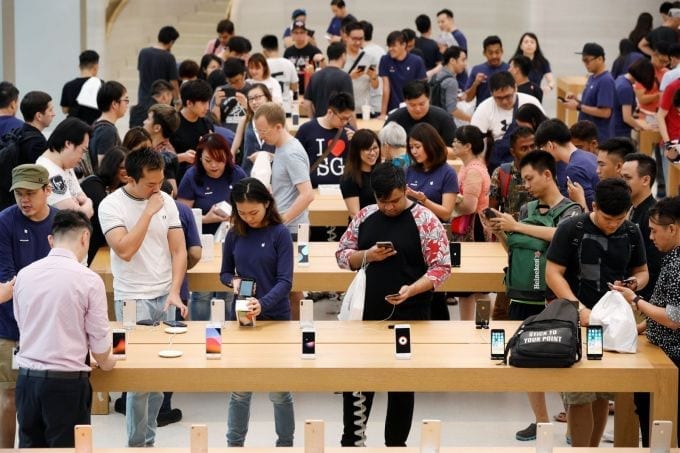
    Apple and Levi’s joined the growing list of international retailers shuttering stores in Mainland China as the infection rate and death toll from the coronavirus continued to grow over the weekend.

    Elsewhere, in South Korea, duty-free stores have closed and throughout Asia retailers have introduced policies for dealing with the virus aimed at protecting staff and customers.

    Apple says all of its 42 stores in Mainland China will remain closed until February 9, although customers will be able to continue to buy products on its online store.

    “Out of an abundance of caution and based on the latest advice from leading health experts, we’re closing all our corporate offices, stores and contact centers in Mainland China through February 9,” Apple said in a statement sent to CNN Business. “We will continue to closely monitor the situation and we look forward to reopening our stores as soon as possible.”

    Levi’s, meanwhile, has closed about half of its stores in the market, although China accounts for just 3 percent of its global revenue compared with 15 percent for Apple.

    Apple and Levi’s are not the only chains to have announced large-scale store closes on the mainland. Starbucks has closed more than 2000, KFC, Pizza Hut and Haidilao Hot Pot have closed stores in the worst-affected Hubei province and Ikea has closed all of its stores there.

    Shilla’s shutdown

    In Seoul, The Shilla Duty-Free closed its giant downtown store adjacent to its five-star hotel after it was confirmed a Chinese national infected with coronavirus visited the store twice in January.

    The company said it has already been rolling out disinfection operations to prevent possible contamination.

    Rival operator Lotte Duty-Free closed its Jeju Island store late Sunday after it was confirmed an infected person shopped there last month.

    “We just started banning new customers entering the shop and asking the customers to leave the outlet,” a company official told a local news outlet.

    “We will announce the date of the reopening after discussing the matter with health authorities and the Jeju provincial government officials.”

    E-Mart also closed one of its stores in Bucheon, near Seoul, after a similar confirmation of a visit by an infected patient.

    Hong Kong supermarkets see spike

    A spokesperson for Hong Kong-headquartered Dairy Farm International told Inside Retail Asia that, like other supermarket chains, its stores have experienced a spike in demand for fresh produce, along with household cleaning and hygiene products, as a result of the coronavirus.

    “In areas of high demand, we are working around the clock to restock as quickly as we can and will continue to do our best to serve the people of Hong Kong through our stores and online,” said the company, which operates the Wellcome grocery-store network.

    All of Dairy Farm’s stores in Hong Kong, including Ikeas, are operating as normal, however, the company has reinforced its sanitization and hygiene protocols.

    “In this challenging environment we remain focused on taking care of our customers and our team members, who we’ve offered flexible working arrangements to, where appropriate,” the spokesperson said.

  • Levi’s to opening 100 extra stores this year

    Levi’s to opening 100 extra stores this year

    San Francisco-based retailer Levi Strauss announced plans to open 100 new company-operated stores this year.

    The apparel maker, which launched on the US stock market last month, announced its plans for the store openings alongside a well-received debut batch of earnings as a public company.

    Company chief executive Chip Bergh told that most of the store openings would be in Europe and Asia, though mainline and outlet stores would open in the US as well.

    Levi’s posted a 7 per cent jump in net revenue to US$1.43 billion for the quarter ending February 24. The company produced a net income of US$147 million compared with the losses of US$19 million a year ago, when the results were hit with a tax-related charge.

    “We delivered our sixth consecutive quarter of double-digit constant-currency revenue growth,” Bergh said.

    “Growth was broad-based across all three regions and all channels, demonstrating that our strategies are working and our investments are paying off.”

    The 166-year-old brand operates 824 standalone stores, including 74 the retailer opened last year.

  • Levi Strauss Asia growth slows down

    Levi Strauss Asia growth slows down

    Levi Strauss Asia growth last quarter was solid – but well behind the US and Europe rates.

    Higher profit in all three regions reflects improved margins.

    Levi Strauss Asia sales were up 9 per cent compared to a 46 per cent rise in Europe and 14 per cent in the Americas. But operating income in Asia rose 13 per cent, while in Europe it surged 79 per cent and in the Americas by 23 per cent.

    “The momentum and growth trends we saw in the back half of last year not only continued but accelerated in the first quarter,” says president/CEO Chip Bergh. “Our results clearly show our strategies are working and that the incremental investments we are making in marketing, direct-to-consumer expansion and our more diversified portfolio are paying off.”

    Excluding favourable currency effects of US$10 million, net revenues in Asia grew 5 per cent, reflecting direct-to-consumer expansion and performance.

    Net revenues overall grew 22 per cent on a reported basis and 16 per cent excluding $55 million in favourable currency translation effects, driven by broad-based brand growth in all regions and channels.

    Direct-to-consumer revenues grew 24 per cent on the improved performance and an expansion of the company’s retail network, as well as e-commerce growth. The company had 56 more self-run stores at the end of the first quarter than 12 months earlier.

    Net income fell $79 million because of a $136 million provisional non-cash tax charge. Excluding this, adjusted net income was $117 million, nearly double last year’s $60 million.

    Gross margin for the first quarter was 54.9 per cent of revenues, compared with 51.2 per cent in the same quarter last year, reflecting the margin benefit from revenue growth in the direct-to-consumer channel and international business, lower product-sourcing costs and favourable currency exchange rates.

    Operating income of $174 million was up 61 per cent for the first quarter while operating margin increased to 13 per cent.

  • Levi Strauss merges with MENA markets

    Levi Strauss merges with MENA markets

    US denim giant Levi Strauss has merged its South Asia market business with the Middle East and North Africa.

    And the company has appointed its India head Sanjeev Mohanty to spearhead the consolidated Levi Strauss Asia-MENA business.

    The company cites common consumer preferences and synergies across the three regions as the reason for the restructure.

    Mohanty joined Levi’s India little more than 12 months ago after about nine months at troubled fashion e-tailer Jabong, and previously ran Benetton India.

    The Middle East, North Africa  and South Asia account for around US$200 million in wholesale turnover for Levi’s. Based in Bengaluru, Levi’s India reported revenue of more than Rs 842 crore (US$130 million) at the end of March, with a net profit of almost Rs 58 crore.

  • Levi’s Cambodia makes Siem Reap debut

    Levi’s Cambodia makes Siem Reap debut

    Levi’s Cambodia has opened its first store in downtown Siem Reap.

    The US denim-focused fashion brand now operates six official stores in the country, with four in Phnom Penh and one at Siem Reap international airport.

    Levi’s Cambodia has been operated by DKSH, the brand’s sole franchisee and distributor, since 2010.

    “We are optimistic about the prospects of Cambodia’s retail environment,” said Peter Hornby, VP for fashion apparel with DKSH Thailand.

    “In particular we have seen strong growth and demand for Levi’s branded products among Cambodia customers, and we plan to continue our retail expansion to 10 or more stores by the end of 2018.”

    The downtown store is also the first stand-alone outlet for the brand, with the other five in centre developments.

  • Levi Strauss net revenue up 6 percent in Q2

    Levi Strauss net revenue up 6 percent in Q2

    Levi Strauss saw its second quarter revenue grow 6 percent across regions and channels, the company announced on July 12th.

    Net revenue grew to $1.07 billion compared to $1.01 billion, for the second quarter ended May 28, 2017.

    Net income declined $13 million from 30.7 million to $17.5 million, primarily due to a $23 million loss related to debt refinancing activities taken during the quarter.

    Net revenue was the strongest in Europe for the second quarter, up 20 percent due to solid growth in the women’s and tops business, while operating income grew 31 percent.

    In the Americas, Levi Strauss also reported a net revenue growth of 3 percent reflecting higher direct-to-consumer revenues in the U.S. and higher revenues in Canada and Mexico. Still, the gain was partially offset by a decline in U.S. wholesale due to lower Dockers revenue.

    Meanwhile in Asia, net revenues grew three percent.

    “Our business is more diversified than ever before, driven by disciplined execution of our long-term growth strategies, and investments in product innovation and the consumer shopping experience,” said Chip Bergh, president and chief executive officer, Levi Strauss & Co, in a news statement. “Our strong year-to-date revenue growth reinforces the benefits of a more balanced portfolio as our women’s, tops, direct-to-consumer and international businesses delivered solid results, despite a slight decline in the U.S. wholesale business.”

    Bergh added that based on the performance of the company’s first half of the year, the company has raised their revenue growth guidance for the full year to 2-4 percent range in constant currency.

  • Levi’s to start company owned stores, e-commerce platform in India

    Levi’s to start company owned stores, e-commerce platform in India

    Iconic apparel brand Levi’s is planning to open company owned stores and launch its e-commerce platform to reach deeper in India, president and CEO Chip Bergh said.

    “One of the company’s growth algorithms is to try and reach deeper into countries like India,” Bergh told the Times of India. “Our business could be twice the size of what it is now in the next five years. Investments in e-commerce and retail will help us do that.”

    When Bergh took over, the company had around 150 franchisee partners, who operated one or two stores each. Currently, it has 22 franchisee partners, each of whom operates a larger number of stores. This has helped channelise more investment into the brand.

    Currently, for one pair of jeans, Levi’s sells three tops globally and Bergh wants to reduce that number. In India, however, the ratio is 1:1 for the clothing company.

    While globally Levi’s has been reporting consecutive years of revenue and profit growth and slashed its debt by more than half, in India, it turned profitable in 2014 after nearly two decades of lull.

    It reported a net profit of around Rs 79 crore in 2015-16, up 64% over the previous year with sales growing at 18.5% to Rs 753 crore.

  • Levi’s saved 1 billion litres of water through sustainability initiatives

    Levi’s saved 1 billion litres of water through sustainability initiatives

    Levi Strauss & Co (Levi’s) has saved 1 billion litres of water since 2011 through its Water<Less process, which reduces the water used in garment finishing by up to 96 percent, the clothing company said on Wednesday.

    It has also released an update on it 2007 study that examined the environmental impact of Levi’s products – Product Lifecycle Assessment (LCA). The new study analysed the complete product lifecycle, probing deeper into the environmental impacts of cotton in key growing regions, apparel production and distribution in a range of locations, and consumer washing and drying habits in key markets.

    The study shows that of the nearly 3,800 litres of water used throughout the lifetime of a pair of jeans, cotton cultivation (68 percent) and consumer use (23 percent) continue to have the most significant impact on water consumption. Consumer care is also responsible for the most significant energy use and climate impact, representing 37 percent of the 33.4 kilograms of carbon dioxide emitted during the lifecycle of a jean. The new LCA expands on previous research to better understand the impact of cotton cultivation and includes data from the world’s primary cotton producing countries, including the United States, China, Brazil, India, Pakistan and Australia. It also analyses consumer care data from new markets, including China, France and the United Kingdom, to understand the costs and benefits of differences in washing habits.

    To reduce the impact of cotton consumption, Levi’s is working with the Better Cotton Initiative (BCI) to train farmers to grow cotton using less water. Based on the latest BCI harvest data available, in 2013, cotton farmers in China reduced their water use by 23 percent compared with farmers who were not using BCI techniques. Levi’s plans to continue working with its global suppliers with the goal of sourcing approximately 75 percent Better Cotton by 2020, up from 6 percent today.

    The denim company will also continue to work toward using less water during manufacturing by expanding the Water<Less process to include more Levi’s products, such as tops. By 2020, the Levi’s brand aims to make 80 percent of its products using Water<Less techniques, up from nearly 25 percent today.

    The new LCA also reveals that Americans use more water and energy to wash their jeans than consumers in China, France and the UK It shows that consumers in China wear their jeans, on average, four times before tossing them into the wash – and if American consumers did this, they could reduce the water and climate change impact from washing their jeans by 50 percent.

    “It’s time to rethink autopilot behaviours like washing your jeans after every wear because in many cases it’s simply not necessary,” said Chip Bergh, CEO and president of Levi’s. “Our LCA findings have pushed us as a company to rethink how we make our jeans, and we’re proud that our water stewardship actions to date have saved 1 billion litres of water. By engaging and educating consumers, we can fundamentally change the environmental impact of apparel and, ideally, how consumers think about the clothes they wear every day.”