Tag: LG U+

  • LG U+ expected to acquire CJ Hello this week

    LG U+ expected to acquire CJ Hello this week

    LG U+’s plan to acquire cable TV company CJ Hello could be finalized as early as this week. Progress with the deal has been slow since Korea’s smallest mobile carrier first began considering the acquisition early last year. Industry sources said Monday that the deal is mostly finalized and, with a board meeting scheduled on Thursday, is likely to be concluded this week.

    With the acquisition, LG U+ will become the second-largest player in the domestic paid TV market. KT, with both an internet protocol TV (IPTV) service and satellite subsidiary KT Skylife, is currently the market leader.

    Paid TV services in Korea include cable TV, satellite TV and IPTV.

    LG U+ will likely acquire a 53.92 percent stake in CJ Hello from CJ’s entertainment arm CJ ENM. The cost is expected to be around a trillion won ($888.6 million).

    The acquisition would give the mobile carrier more negotiating power when acquiring or producing content. The carrier could also be in a strong position to lure CJ Hello’s 4.16 million subscribers, as of the first half of 2018, to its mobile service by offering favorable rates.

    LG U+ is already using its partnership with Netflix to attract more customers to its mobile and IPTV service.

    Once the mobile carrier decides to go ahead with the deal, it then needs to be approved by the Fair Trade Commission (FTC), the Ministry of Science and ICT and the Korea Communications Commission. In 2016 when SK Telecom tried to acquire CJ Hello, then CJ HelloVision, the deal fell through as the antitrust body disapproved on the grounds that the acquisition could hurt fair market competition.

    This time, though, FTC head Kim Sang-jo hinted during a recent interview that the commission would take a more positive stance regarding the deal considering the rapid changes in the media market. Kim questioned whether broadcasting and telecommunications can be considered completely separate in a quickly changing market.

    It is still to be seen whether LG U+ will more explicitly announce its intent to acquire CJ Hello and expand its paid TV services. The carrier is holding a press briefing for the launch of a new IPTV service targeting senior citizens in Seoul. Many questions are expected to focus on the acquisition deal and future IPTV strategy.

    Competitors KT and SK Telecom are also considering acquiring cable broadcasting companies to counter LG U+’s move. KT is reportedly interested in acquiring cable broadcasting company D’Live, which has a 6.45 percent share of the Korean paid TV market as of the first half of 2018. KT and KT Skylife control more than 30 percent of the market while CJ Hello owns 13 percent and LG U+ has 11.41 percent.
  • LG U+ says it can download things 10 times faster on 5G

    LG U+ says it can download things 10 times faster on 5G

    LG U+ said Wednesday that it has demonstrated 10 times faster download times compared to 4G LTE on its 5G network. While 4G LTE offers 133.43 megabits per second download speeds on average, according to data from the Ministry of Science and ICT, LG U+ said it realized 1.33 gigabits per second on its 5G network.

    LG U+ claims it is nearly the fastest speed consumers can practically experience on 5G. Next year, when 5G is commercialized for smartphones, the smallest carrier in the country projects data download speeds will increase to as fast as 2 gigabits per second when the 5G network will be coupled with the 4G LTE network.

    LG U+ believes 5G is its chance to move up the mobile carrier ranking, currently dominated by SK Telecom and KT.

  • LG U+ CEO says Huawei gear is not a risk

    LG U+ CEO says Huawei gear is not a risk

    LG U+ CEO and Vice Chairman Ha Hyun-hwoi has made it clear that the carrier does not think there are any security threats related to its use of Huawei equipment in its 5G infrastructure. Ha made the statement during a year-end press briefing on Wednesday in Yongsan District, central Seoul, rebuffing claims by some lawmakers that there is a risk of security leaks through the use of the Chinese tech giant’s equipment in the network. LG U+ currently partners with Huawei as well as Samsung Electronics, Ericsson and Nokia for its 5G infrastructure.

    According to Ha, the Chinese IT company has already applied for security certification of its 5G network equipment from an international certifying body in Spain. The CEO added the public will be able to see how secure the equipment is once the evaluations are complete next year.

    “Security concerns apply to every equipment vendor we partner with, not only Huawei, and we need to thoroughly verify all the equipment [we use] is secure,” Ha said. “There are roughly 170 countries that are already using Huawei’s network equipment, and there hasn’t been any security problems reported so far.”

    Locally, Huawei has set up equipment that abides by over 70 security guidelines set by the Korea Internet & Security Agency, according to LG U+.

    The main reason for the carrier taking the risk of using the controversial equipment is because 5G infrastructure needs to be built in conjunction with the existing network equipment for 4G long term evolution (LTE), some of which LG U+ also bought from Huawei. Ha said price, technological competitiveness and the ability to deliver the equipment in a timely manner were also considered when choosing the vendor.

    LG U+ has built 5,500 base stations to service the next-generation 5G network as of Wednesday, while its local competitors have reportedly established less than 1,000 5G base stations.

    On why the mobile carrier is rushing to establish its 5G infrastructure, Ha said, “It is important to have a head start to have a competitive edge in [5G] services considering the quality tests we need to go through before March [when the high-speed network is commercialized for smartphones].”

    Ha said the company invested roughly 4 trillion won ($3.6 billion) to set up its 5G infrastructure, including at 5G spectrum auctions.

    The company said it hopes to take up a larger share of the market, which is dominated by SK Telecom, with 50 percent, and KT, with 30 percent.

    “In July 2011, when we first began the LTE service, our local market share was 17.7 percent, but the share increased to 21.2 percent over time as of the end of October,” LG U+ said in statement. “We think next year could be the best time to shake up the competing structure.”

    The carrier is preparing a 5G-based smart factory service with its affiliates LG Electronics and IT service company LG CNS, targeting enterprise customers. For individual customers, LG U+ is focusing on augmented reality and virtual reality content that can offer an immersive experience of watching sports games and K-pop concerts at home.

    The CEO also commented on speculations that the carrier will acquire paid TV service operator CJ Hello. Ha said it has opened up its options to cable TV operators other than CJ Hello and plans to finalize the deal within the first half of next year. Industry sources, however, still say negotiations between the two parties have nearly come to a close and final results are likely to come out around March.

  • LG U+ 5G pass self-drive test on expressway

    LG U+ 5G pass self-drive test on expressway

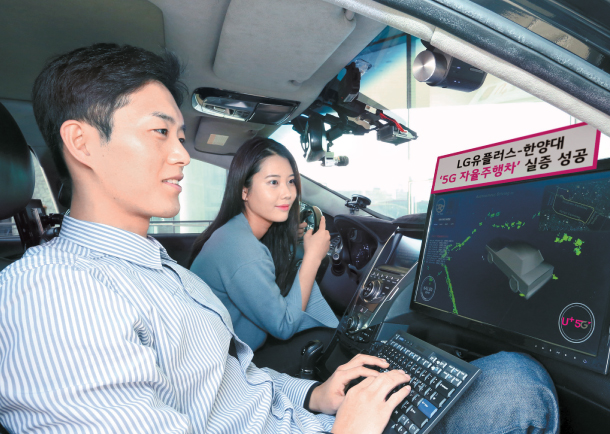
    LG U+ has successfully tested a 5G-powered self-driving vehicle on an expressway for the first time. The mobile carrier announced Tuesday that a self-driving car developed by Hanyang University successfully drove on LG U+’s 5G network for 25 minutes across seven kilometers (4.35 miles) of busy city roads including the Gangbyeon Expressway and Olympic Expressway.

    A low latency video transmitter developed by LG U+ delivered real-time footage of the test drive to Hanyang University. Two cameras attached to the self-driving vehicle recorded the front and rear of the car.

    During the test drive, the vehicle had to react to certain scenarios such as avoiding obstacles and changing course. The vehicle was also tested to see how it reacts to new traffic information such as a blocked parking lot entrance.

    The vehicle was remote controllable, offering added safety measures in case of emergency.

    It was the first time that a self-driving car has completed a test drive on such a scale on an expressway or high-speed road in Korea, according to the company.

    “Self-driving cars that run on the 5G network will make important contributions to solving social problems like traffic volume and accidents,” said Sunwoo Myung-ho, who teaches automotive engineering at Hanyang University.

    “It’s significant that we were able to produce substantial results with self-driving cars through cooperation between industry and academia,” said Kang Jong-oh, who manages future technologies at LG U+. “We will continue to invest our efforts into developing self-driving car technology through cooperation between mobile carriers and the auto industry.”

    LG U+ will continue to work with Hanyang University to polish its 5G-based self-driving car technology.

    Competitors SK Telecom and KT are also actively investing in self-driving technology. KT, for example, successfully tested a self-driving bus at Incheon International Airport last month.

  • LG U+ deploys Korea’s first NFV routing system

    LG U+ deploys Korea’s first NFV routing system

    South Korea’s LG U+ has deployed the nation’s first carrier-grade virtual routing system using technology from Juniper Networks, as part of efforts to prepare its network for the 5G evolution.

    LG U+ is deploying Juniper Networks’ Ethernet switches and its vMX virtual router for the upgrade project.

    The operator selected Juniper due to its prior experience with the vendor’s routing equipment, as well as the vendor’s support for OpenStack-based NFV orchestration and expertise in the NFV segment.

    Juniper was also able to meet the operator’s resiliency requirements with its virtual routing solution’s  auto recovery and auto healing functions.

    Juniper worked closely with LG U+ on the integration of the system with existing infrastructure and devices. The operator also enabled IPv6 routing, anti-hacking and anti-DDoS attack services in LG U+’s NFV infrastructure, and additional features may be aadded in the future.

    “We are very excited about Korea’s first commercial launch of a carrier-grade NFV-based router,” LG U+ GM for transport platform development Jae-ho Choi said.

    “I believe this will enable us to not only drastically improve our routing performance, but provide greater stability and a more diverse range of services for our customers. As a leader of the 5G era, LG U+ plans to expand the adoption of NFV equipment in close, continued cooperation alongside Juniper Networks.”