Retail News CRM

Tag: macroeconomy

  • Oil rises as traders expect Venezuelan supply disruptions amid U.S. sanctions

    Oil rises as traders expect Venezuelan supply disruptions amid U.S. sanctions

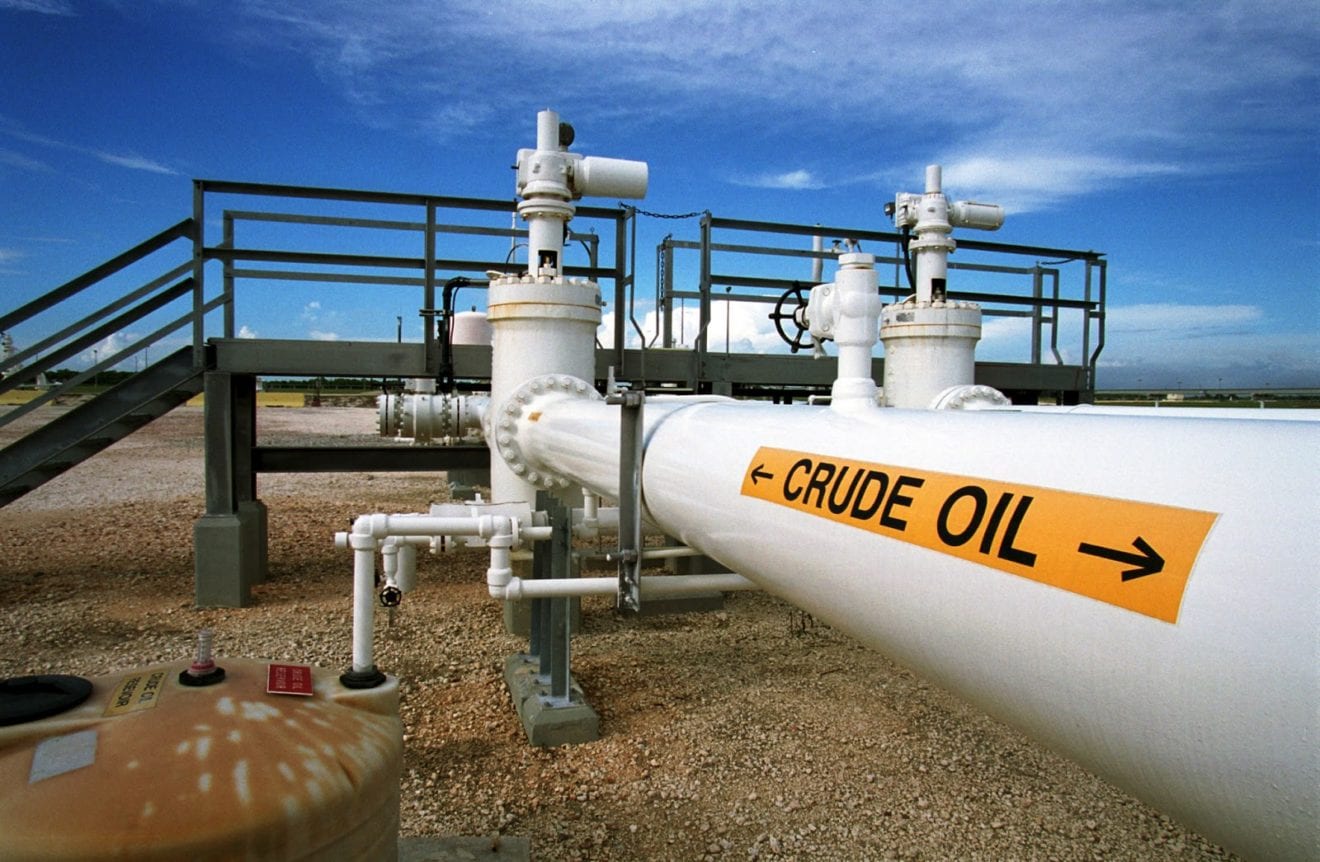
    Oil prices rose on Wednesday as concerns about supply disruptions following U.S. sanctions on Venezuela’s oil industry outweighed downward pressure from a darkening outlook for the global economy. U.S. West Texas Intermediate (WTI) crude futures were at $53.54 per barrel at 0455 GMT, up 23 cents, or 0.4 percent, above their last settlement.

    International Brent crude oil futures rose 37 cents, or 0.6 percent, to $61.69 per barrel.

    The gains followed a 2 percent price jump in the previous session, when markets first digested the U.S. sanctions on Venezuela’s oil exports.

    Washington on Monday announced export sanctions against state-owned oil firm Petroleos de Venezuela SA (PDVSA), limiting transactions between U.S. companies that do business with Venezuela through purchases of crude oil and sales of refined products.

    “The sanctions so far have been mostly disruptive for refiners on the U.S. Gulf Coast, who are being forced to seek alternative heavy crude supplies, and have stepped up purchases from Canada,” said Vandana Hari of Vanda Insights, an energy consultancy.

    She added, however, that Canadian oil exports would be “constrained by pipeline capacity bottlenecks.

    The sanctions aim to freeze sale proceeds from PDVSA’s exports of roughly 500,000 barrels per day (bpd) of crude oil to the United States.

    Although the move pushed up oil prices, markets appeared relatively relaxed as the sanctions only affect Venezuelan supply to the United States.

    “The (Venezuelan) export volumes will not be eliminated from the market, but rather rerouted to other countries,” said Paola Rodriguez-Masiu, an analyst at consultancy Rystad Energy.

    With the United States dropping out as a customer for Venezuelan oil, she added that “China and India … will be able to pick up these oil volumes at great discounts.”

    Despite this, some analysts said that non-U.S. oil trading firms with operations in the United States may still avoid dealing with Venezuelan oil.

    The Schork Report, a daily oil and gas trading publication, said on Wednesday that many “international oil traders … have significant trading operations in the U.S. … At least in the short-term, these traders will undoubtedly quit buying from Venezuela until such a time that they are assured that they are not running afoul of U.S. sanctions.”

    TRADE TALKS

    Other analysts also pointed to economic weakness as countering supply-side efforts to tighten the market such as the voluntary supply restraint by the Organization of the Petroleum Exporting Countries (OPEC).

    “Pulling in the opposite (oil price) direction are heightened concerns about global growth, particularly that of China,” said Ole Hansen, head of commodity strategy at Denmark’s Saxo Bank.

    Global economic growth and fuel consumption are expected to slow this year amid a trade dispute between the United States and China, the world’s two biggest economies.

    Officials from Washington and Beijing are set to launch a new round of trade talks on Wednesday aimed at resolving their disputes amid which both sides have slapped hefty import tariffs on each other’s goods.
  • Vietnam wants China to import more, invest more

    Vietnam wants China to import more, invest more

    China should increase imports of Vietnamese goods and make more hi-tech investments, government officials and business representatives say. Le Hoai Trung, Vietnam’s Deputy Minister of Foreign Affairs, proposed at the Vietnam-China Economic Promotion Forum Thursday that China creates more favorable conditions for more Vietnamese goods to enter the country through border gates.

    “We hope that the Chinese government will be more open to the Vietnam market, especially for products that Vietnam has strong supply and China has high demand for, such as rice, pork, milk, agriculture, seafood, electronics and consumer goods,” Trung said in the forum attended by 500 Vietnamese government and business representatives and 200 Chinese counterparts.

    Vietnam has a high trade deficit with China. From January to November, the country exported $37.7 billion worth of goods to China and imported $59.6 billion, a trade deficit of $21.9 billion, according to Vietnam Customs.

    Vu Tien Loc, chairman of the Vietnam Chamber of Commerce and Industry, said: “Although Vietnam’s exports to China have been increasing this year and trade deficit is declining, I don’t think this trend will be sustainable.”

    He said it would require a big effort from authorities to pave the way for Vietnamese goods, especially agriculture products, to enter China.

    Loc also proposed that that unofficial trade activities between the two countries at the border be formalized to guarantee long-term benefits for both sides.

    As protectionism in the world rises, Vietnam and China need to cooperate to control trade cheating, like Chinese businesses exporting its goods via Vietnam to other countries, which would impact on sustainable development of both countries, Loc said.

    Trung said at the forum that Vietnam welcomes foreign direct investment from China that is focused on high technology in infrastructure, supporting industry and agriculture.

    He added that Chinese FDI businesses should ensure environmental protection and Vietnamese labors’ benefits when investing in the country.

    Loc added that China, as a leading country in the world in the high-tech sector, can provide this kind of investment to Vietnam.

    “Vietnam is looking for a new type of foreign investment which has higher quality, integrate more with Vietnamese businesses using high-technology which are environment-friendly,” he said.

    China is Vietnam’s largest import market, while Vietnam is China’s largest trading partner in ASEAN and the 8th in the world.

    From January to November, bilateral trade turnover reached over $97 billion, up 16.5 percent year-on-year, according to official data.

    China has invested in over 2,000 projects in Vietnam, with a total registered capital of $13 billion. It ranks 7th out of 129 countries with FDI in Vietnam.

  • Vietnam to top 7 pct growth in 2018 and 2019

    Vietnam to top 7 pct growth in 2018 and 2019

    Vietnam may grow more than 7 percent in 2018, the highest in 10 years, and is likely to maintain the rate next year, experts say. Nguyen Xuan Thanh, director of development, and public policy lecturer at the Fulbright University of Vietnam, said the country’s economy is expected to grow at over 7 percent this year, the highest level since 2007.

    “The major contributor of growth comes from industries that benefit from policies to replace import goods, such as automobile and pharmaceutical production,” he said at a conference organized Thursday by the National Financial Supervisory Commission (NFSC).

    In 2017, Vietnam rode on 20-30 percent growth of phones and electronics, but this year, that sector’s growth slowed down to only 11 percent in the first 11 months of 2018, Thanh explained.

    He also noted that a positive aspect of the growth this year has been that it is no longer dependent on credit. The NFSC estimates credit growth to have slowed significantly to 15 percent this year from 18 percent in 2017.

    “Many experts were concerned that Vietnam’s high growth rate in previous years was linked to credit growth, but there has been strong economic growth this year without high credit growth,” Thanh said.

    Meanwhile, NFSC leaders said Vietnam’s growth may exceed 7 percent in 2018 and remain at between 6.9-7.1 percent in 2019.

    Truong Van Phuoc, acting chairman of the NFSC, said the high growth in 2018 is due to large contributions from the private sector. In addition, trade agreements such as the Comprehensive and Progressive Agreement for Trans-Pacific Partnership (CPTPP) and the EU-Vietnam Free Trade Agreement (EVFTA), which are expected to come into effect in 2019, may also bring positive impacts.

    Vietnam also has the opportunity to attract investment as well as new opportunities from the field of information technology and biotechnology, he added.

    But experts also point out some factors that could affect economic growth next year. Thanh noted that growth this year was not only due to investment and export but also the heavy consumption.

    Any changes to consumption can have immediate effect on economic growth, he said.

    In the first nine months this year, Vietnam’s GDP grew by 6.98 percent, the highest nine-month growth rate since 2011. The economy grew by 6.81 percent last year, the highest rate in a decade.

  • Malaysia’s exports rebound in September

    Malaysia’s exports rebound in September

    Malaysia’s exports rebounded by 6.7% in September 2018 to RM83 billion year-on-year (y-o-y) after a slight decrease in the previous month, according to Statistics Department. Total trade which was valued at RM150.8 billion increased RM3.3 billion or 2.3% in September 2018, chief statistician Malaysia Datuk Seri Dr Mohd Uzir Mahidin said in a statement.

    Mohd Uzir said the trade surplus recorded the highest value since October 2008 at RM15.3 billion, increased RM7.1 billion or 85.9% from a year ago.

    Re-exports was valued at RM16.5 billion registering an increase of 26.2% y-o-y and accounted for 19.9% of total exports, while domestic exports increased 2.7% or RM1.8 billion to RM66.5 billion.

    The export growth was contributed by expansion in exports to Hong Kong, Taiwan, Singapore, Australia and Republic of Korea. Meanwhile, lower imports were mainly from India, Republic of Korea, Vietnam, UAE and EU.

    The main products which contributed to the expansion in exports were electrical & electronic products, refined petroleum products, crude petroleum and liquefied natural gas (LNG).

    However, the department said decline was recorded for palm oil and palm oil-based products, timber and timber-based products and natural rubber.

    For imports, the lower in imports by ‘end use’ was mainly attributed to intermediate goods, capital goods, and consumption goods, it added.

  • Indonesia Falls in 2019 Ease of Doing Business Ranking

    Indonesia Falls in 2019 Ease of Doing Business Ranking

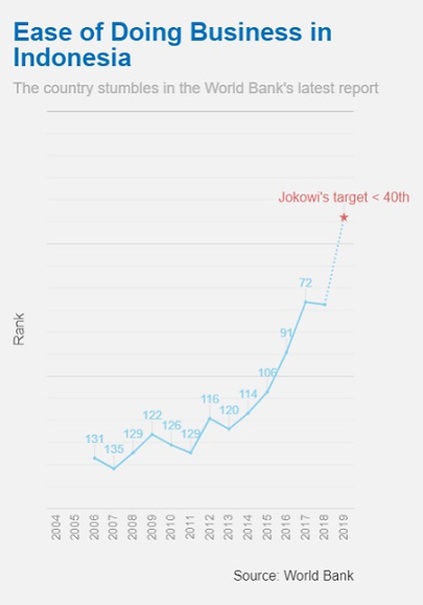
    If President Joko “Jokowi” Widodo wants to see Indonesia join the top 40 countries in the World Bank’s Ease of Doing Business ranking under his watch, he should make sure he wins re-election next year. Indonesia slipped one place to 73rd, behind Greece, the Ukraine and Kyrgyzstan, in the 2019 Ease of Doing Business report, released late on Wednesday. The president has set a target for the country to be in the top 40 by next year, but his second term will be decided in April, while the next report would not be out until next November.

    While Indonesia has made considerable progress in reforming the regulatory environment for businesses since Jokowi took office in 2014, Wednesday’s report reveals the stark realities of the country’s limited capacity to continue with these reforms.

    The country scored 67.96 out of 100 in the report’s aggregate measurement, up by only 1.46 points from last year. Slovenia, a Central European nation of only 2 million people and a $49 billion economy, sits in the coveted 40th place with an overall score of 75.61.

    Indonesia, for one, issued new rules that make starting a business, registering property and obtaining credit, easier for businesses and make it cheaper for them to get electricity. But reform stagnated in areas such as obtaining construction permits, protecting minority investors, paying taxes, trading across borders, enforcing contracts and resolving insolvencies.

    These bottlenecks allow economies like China, Kenya and Kyrgyzstan to overtake Indonesia. China made a leap to 46thplace in this year’s report, from 78th last year. Kenya moved up 19 places to 61st, while Kyrgyzstan went up seven places to 70th.

    Still, the report highlights Indonesia’s success in reforming its judiciary system and making the country a case study for others to emulate. The Supreme Court introduced training programs in 2003 for new and experienced judges, as well as special training for judges presiding over more specialized cases, such as those involving commercial or maritime disputes.

    “Indonesia’s efforts to train judges following judicial reforms bore positive results through a substantial decrease in court backlogs and insolvency case resolution times,” the World Bank said in the report.