Retail News CRM

Tag: mandiri

  • Axa Mandiri Lays Out Plans to Grow Premium Income

    Axa Mandiri Lays Out Plans to Grow Premium Income

    Axa Mandiri Financial Services, one of Indonesia’s major insurance companies, expects to maintain double-digit growth in premium income this year, by tapping into the large customer base of its parent company, Bank Mandiri.

    Axa Mandiri Financial Services (Axa Mandiri)’s president director Handojo G. Kusuma said that the insurer would market its products more intensively to customers of Bank Mandiri, which has one of the largest customer bases in the country.

    We hope to book double-digit growth in premium income by tailoring insurance products to the special needs of Bank Mandiri customers,» said Kusuma, who was quoted.

    Despite having worked together with Bank Mandiri for many years, Axa Mandiri’s penetration among the bank’s clients was still below optimal levels, he noted.

    To realize the targeted double-digit growth in premium income, Axa Mandiri did a data analytics study on Bank Mandiri’s market segmentation. «By understanding the needs of each segment better, we will be able to improve upselling and cross-selling,» Kusuma added.

    To effectively market to the millennials, the company would study the behavior and characteristics of customers in that segment and offer an affordable and easy-to-understand retail package that would be relevant and convenient for them, Handojo explained.

    For the growing halal market, the company planned to expand its portfolio of sharia-compliant products to between 20 percent and 25 percent of its business in the upcoming year from 4 to 5 percent at present.

    If we look at the market share potential, we can say that 90 percent of Indonesians are Muslims, [hence] we will continue to grow our sharia business, said Axa Mandiri sales director Henky Oktavianus.

    He added that the company was still studying the sharia market segmentation of its sister company, Bank Syariah Mandiri, to understand what products to offer its clients and how best to sell them.

    Axa Mandiri booked a gross premium income of 9.5 trillion rupiahs ($698.5 million) in 2019, an increase of 11 percent from 8.59 trillion rupiahs in 2018. Net investment touched 668 billion rupiahs in 2019, following a deficit of 1.68 trillion rupiahs in 2018.

    As a result, revenue totaled Rp 10.74 trillion in 2019, a 44 percent year-on-year increase. Net profit, therefore, rose 6 percent to  1 trillion rupiahs in 2019.

    Axa Mandiri is jointly owned by Bank Mandiri, which has a 51 percent stake, and Axa Group’s National Mutual International, which holds 49 percent.

  • Lippo Mall Puri in West Jakarta sells

    Lippo Mall Puri in West Jakarta sells

    Reit Lippo Malls Indonesia Retail Trust (LMIRT) plans to buy Lippo Mall Puri in West Jakarta for US$261.6 million.

    LMIRT Management, which runs LMIRT, said in a statement it has entered into a conditional sale-and-purchase agreement for the 115,600sqm mall, which will boost the Reit’s total net lettable area by about 10 per cent. Settlement is scheduled for the second half of this year.

    Lippo Mall Puri has seven floors of retail space – five above ground and two basement levels. The mall currently has 324 tenants including Uniqlo, Zara, Marks & Spencer, H&M, Best Denki and Adidas. It is anchored by Parkson and Matahari department stores and also includes dining, cinema and entertainment zones. At the end of last year it had an occupancy rate of 89.6 per cent.

    The property’s current owner is Mandiri Cipta Gemilang, which will provide ongoing support after the sale is completed.

    LMIRT Management CEO Gouw Vi Ven says that since Lippo Mall Puri was completed in July 2014, the average monthly footfall has grown from 176,000 to nearly 1.22 million.

  • Mandiri aims to tap Singapore asset pool uncovered in tax hunt

    Mandiri aims to tap Singapore asset pool uncovered in tax hunt

    Bank Mandiri, Indonesia’s largest state-owned lender, on Wednesday said it is seeking to establish a private banking business in Singapore. The move comes amid a global crackdown on tax evasion that has exposed vast Indonesian wealth parked in the city-state.

    Indonesia’s nine-month tax amnesty program, in which the government allowed citizens to report previously hidden domestic or overseas holdings and pay a small penalty, turned up some 4,900 trillion rupiah ($367.5 billion) in declared assets. In a news conference on Wednesday, Mandiri President Kartika Wirjoatmodjo said around 700 trillion rupiah in declared cash and securities are still parked in overseas banks — mostly in Singapore.

    “It’s quite a sizable portion,” Wirjoatmodjo said. “We want to capture this market by giving them services in Singapore. We already have a complete range of products.”

    Indonesia has also pledged to join the Automatic Exchange of Information, a framework developed up by the Organization for Economic Cooperation and Development in which financial regulators will share information about foreign taxpayer accounts. “There will be no more space to place money that cannot be traced by tax authorities,” Wirjoatmodjo said, “so there will be a level playing field.” He explained that wealthy Indonesians have shunned state-owned banks like Mandiri to avoid scrutiny by authorities.

    At the moment, Mandiri can only serve corporate clients in Singapore. In order for the bank to serve wealthy individuals, it needs to be designated a “Qualified ASEAN Bank” by the Monetary Authority of Singapore under a bilateral agreement with Indonesia’s Financial Services Authority, according to Wirjoatmodjo. QAB status, a concept developed by Association of Southeast Asian Nations members, enables banks to operate as local lenders in ASEAN markets.

    Earlier in July, Mandiri became the first bank to obtain the QAB designation in Malaysia. Talks between Singapore and Indonesia, however, have not been officially announced.

    Mandiri is hardly the only bank targeting previously hidden assets. Oversea-Chinese Banking Corp., Singapore’s second-largest bank by assets, in May launched private banking operations in Indonesia to cater to high-net-worth Indonesians with assets of more than $1 million.

  • Bank Mandiri to expand in Malaysia as first ‘ASEAN bank’

    Bank Mandiri to expand in Malaysia as first ‘ASEAN bank’

    Bank Mandiri will expand operations in Malaysia by using its newly awarded status as a cross-regional lender, Indonesia’s largest state-owned bank said Thursday.

    Mandiri said it is the first bank in the region to be designated a qualified ASEAN bank — a concept developed by Association of Southeast Asian Nations members as part of an effort to create an open, integrated financial market providing services to companies investing and trading in the region.

    To obtain QAB status, banks must meet certain conditions, such as in capital adequacy, and pass screening under bilateral agreements between monetary authorities. Indonesia and Malaysia agreed in 2016 to grant QAB status to three banks from each other’s countries.

    Such Malaysian banks as CIMB Group Holdings and Malayan Banking already have major operations in Indonesia, while Indonesian banks have been seeking opportunities to grow outside the home market. “We highly appreciate the Malaysian banking authorities that support the presence of banks from Indonesia,” said Muliaman Hadad, chairman of Indonesia’s Financial Services Authority. “Indonesia has also treated Malaysian banks as their own. This is a step forward that can strengthen relations between Indonesia and Malaysia.”

    Malaysia will become the first overseas market for Mandiri to operate a full-fledged banking business in, the lender said. It plans to invest 300 million ringgit ($70 million) to upgrade a remittance office in Kuala Lumpur to a full branch and roll out wholesale and retail banking services.

    Mandiri is also exploring expansion into Myanmar and the Philippines, it said in a news release.

  • Indonesia’s Mandiri eyes Singapore private banking business

    Indonesia’s Mandiri eyes Singapore private banking business

    Indonesia’s largest lender Bank Mandiri wants a piece of the lucrative private banking business in Singapore, particularly the accounts of wealthy Indonesian clients.

    Recent reforms in Indonesia, including a successful tax amnesty, have made ultra-rich citizens less averse to banking with state-owned institutions, said Mandiri chief executive Kartika Wirjoatmodjo.

    “In the past, they were worried that their undeclared wealth will be reported,” he told recently.

    “After the tax amnesty, everything is transparent so Indonesians who put money in Singapore are no longer worried about having us, a state-owned bank, as their banker.”

    Many wealthy Indonesians are believed to bank much of their fortune abroad and the local tax authorities believe some do so to avoid scrutiny and paying taxes.

    Finance Minister Sri Mulyani Indrawati said Indonesians have stashed about US$250 billion (S$346.5 billion) worth of assets overseas, of which a whopping 80 per cent is kept in Singapore.

    The tax amnesty, started in July last year, was introduced to encourage these rich citizens to come clean with the taxman on their assets at home and abroad by offering tax rates as low as 2 per cent.

    More than 4,000 trillion rupiah (S$417 billion) – about a third of Indonesia’s gross domestic product – of newly declared assets were recorded at the end of the scheme in March, with a small portion of the wealth repatriated from overseas.

    Mandiri, which operates in Singapore under an offshore bank licence granted by the Monetary Authority of Singapore (MAS), plans to apply for another licence to run private banking operations. This follows the opening of its securities subsidiary Mandiri Securities Singapore last October.

    Mr Kartika said Mandiri’s move into Singapore’s private banking sector will require a “limited retail banking licence” so that it can serve high-net-worth Indonesians there. “So we don’t want to deploy 200 ATMs in Singapore, perhaps just a couple of branches would do.”

    Mandiri also wants to make Singapore a hub for its corporate clients, most of whom have offshore financing, either bilateral bank loans or fund raising via capital markets, to access global investors.

    “Many investors operate their Asian accounts from Singapore, so by giving them access to the Singapore market, we automatically have global exposure,” said Mr Kartika.

    Besides growth in Singapore, the bank has been expanding its retail banking business in Malaysia and the Philippines.

    After long negotiations, Mandiri is set to get a full retail banking licence in Malaysia within the next two months which would allow it to open retail branches across the country, said Mr Kartika.

    In the Philippines, where the banking industry is less mature and saturated compared with Indonesia, Mandiri is betting on the country’s strong economic growth and is in talks with local banks for possible acquisitions of minority stakes.

    Analysts said Mandiri’s “Singapore strategy” will pave the way for it to become a regional player, just like DBS Bank or Malaysia’s CIMB.

    “It is a positive move if Bank Mandiri starts investing more in its international business,” said Mr Harry Su, head of strategy and research at stockbroker Bahana Sekuritas.

    But Mr Su added that while this is a part of the bank’s strategy to be a bigger player in South-east Asia, it is still early days as “contribution from such efforts will remain minimal to their overall earnings performance in the next three to five years”.

    Another analyst, who declined to be named because he is from a competing bank in Jakarta, said the top four banks control the majority of Indonesia’s total banking assets so the room for others is restricted.

    “This would make Malaysia, Singapore and the Philippines more competitive markets for Mandiri,” he said.

    “But it also means returns or profit margins from doing business there would be less, but as the biggest bank in Indonesia, Mandiri has to expand there.”

  • Bank Mandiri posts net profit of Rp4.1 trillion in Q1

    Bank Mandiri posts net profit of Rp4.1 trillion in Q1

    State lender Bank Mandiri posted a net profit of Rp4.1 trillion in the first quarter of 2017, up 6.9 percent from Rp3.8 trillion in the same period last year.

    One of the factors increasing the profit was the rise in the amount of financing as reflected by credit growth, which rose 14.2 percent to Rp656.2 trillion in the first quarter of 2017, with the gross non-performing loan (NPL) ratio reaching 3.98 percent, Bank Mandiri President Director Kartika Wirjoatmodjo said here on Tuesday.

    “Although the gross NPL ratio rose 80 points year-on-year, its value was relatively good compared to Dec 2016,” he stated.

    In addition, the net profit hike was also fueled by net interest income and net premiums, which rose by 3 percent to Rp13.4 trillion, and fee-based income, which went up by 25 percent to Rp13.4 trillion.

    He added that the bank also managed to cut operating costs by 3.8 percent to Rp7.9 trillion, while operating profit before tax and reserves increased 11.9 percent to Rp10.8 trillion compared to March 2016.

    The banks total assets reached Rp1,034.4 trillion as of the first quarter of 2017, up 14.1 percent compared to the same period last year.

  • Bank Mandiri`s net profit falls by 32.1 percent

    Bank Mandiri`s net profit falls by 32.1 percent

    State lender Bank Mandiri saw its net profit plunging by up to 32.1 percent to Rp13.8 trillion in 2016 from Rp20.3 trillion in 2015. The net profit fell, as the bank set aside its operating income to raise its provisions for loan loss coverage, following the rising ratio of non-performing loans (NPLs) to total gross loans, Bank Mandiri President Director Kartika Wirjoatmodjo said in a press briefing here on Tuesday.

    The provisions for loan loss coverage ratio against NPLs rose to 125 percent, as the ratio of NPLs to total gross loans increased by 1.4 percent to 4 percent in 2016 from 2.6 percent in 2015, he added.

    “We put much of the income into the provisions. Before we put it in the provisions, our pre-provision operational profit (PPOP) stood at Rp43.3 trillion,” he stated.

    With the NPLs rising 4 percent, Bank Mandiri has set aside Rp24.6 trillion of its funds for loan loss provisions, he noted.

    After all, the bank recorded positive growth for all of last year, he remarked.

    In 2016, the bank channeled credits worth Rp662 trillion, up 11.2 percent from a year earlier, while third-party fund placement in the bank reached Rp762.5 trillion, up 12.7 percent from the previous year.

  • Bank Mandiri disburses Rp1.2 trillion for double-track railway

    Bank Mandiri disburses Rp1.2 trillion for double-track railway

    State-owned Bank Mandiri has disbursed Rp1.2 trillion to state-owned railway firm PT KAI for the development of a double-track railway in South Sumatra.

    Senior Executive Vice President of Bank Mandiri Alexandra Askandar in the signing of the agreement with KAI on Tuesday said the special transaction loan has a term of 10 years.

    “The development of a double-track railway in South Sumatra will accelerate the delivery of coal to the coal-fired power plant in Suralaya,” he noted.

    The double-track railway line links the mining area of Bukit Asam in Tanjungenim Baru to Tarahan, Lampung.

    The special loan transaction agreement was signed by Askandar and KAI Finance Director Didiek Hartantyo.

    Askandar said the disbursement of the loan was a form of support for the development of strategic infrastructure projects nationwide, one of which is the transport sector.

    By October 2016, Bank Mandiri had provided Rp37.1 trillion to the transport sector. This is the largest financial commitment in the infrastructure segment which totalled Rp96.9 trillion, or an increase of 53 percent on an annual basis.

    Besides the railway sector, Mandiri has also provided financing for power plants amounting to Rp32.1 trillion.

    Infrastructure financing is included in the corporate loan segment. Mandiri disbursed corporate loans until the third quarter of 2016, amounting to Rp212.4 trillion, up 14.3 percent year on year.

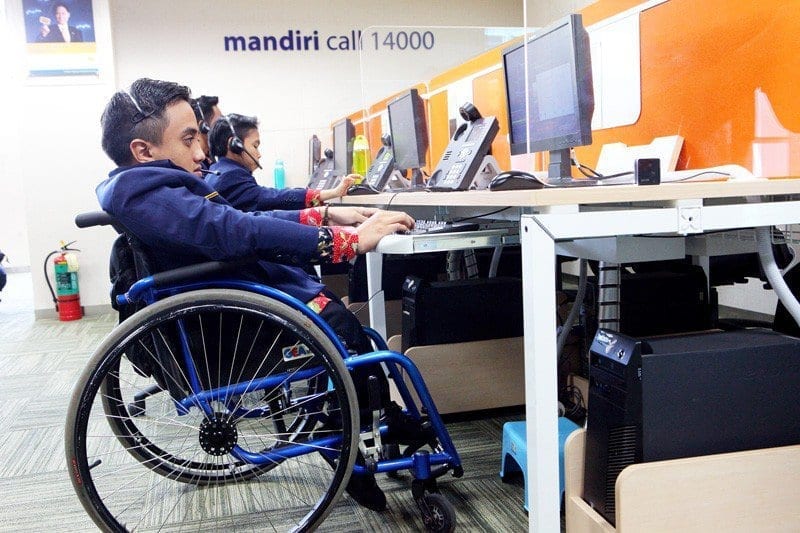
  • Bank Mandiri eyes more disabled employees

    Bank Mandiri eyes more disabled employees

    The family of Rezky Yami Putri, 27, born with an imperfect three-fingered left hand half the size of a normal hand, was skeptical when she landed a job at Indonesia’s largest lender Bank Mandiri.

    They thought she was deceived, because such an achievement would be too good to be true for someone with “my condition”, said Rezky, now a call center officer at the state-owned lender. Her family finally believed her job was legit when she received her first salary last year.

    “Even though it has been a year, it is still like a dream for me, a lengthy dream, which occurs while I am awake,” said the Jakarta resident, who has a bachelor’s degree in public health but has never worked in her field of study.

    “As someone with a disability, we are always underestimated but it turns out that we also can make money for ourselves and for our parents, even though it is not that much,” she added.

    Rezky is among 41 disabled workers employed by Bank Mandiri, which is among over 100 state-owned enterprises in Indonesia, which, following a 2016 law on people with disabilities, are required to have disabled people account for at least 2 percent of their staff.

    “Our target is to hire 120 people and we’ll keep recruiting depending on the availability of the applicants,” Bank Mandiri human capital engagement senior vice president Aminarti Widiati said. The lender started recruiting disabled employees last year.

    Bank Mandiri, which has five branch offices in Jakarta and Semarang, Central Java, employing disabled people currently has a total of 38,376 employees nationwide with 2,505 branch offices spread across the country.

    Disabled people in the lender work on three-year contracts and are reviewed each year. They also have the chance to become permanent employees, Aminarti said.

    Tri Handayani, diagnosed mute when she was only 10 months old, was eager to advance at Bank Mandiri. The back-office worker used to work at a supermarket, checking and replacing price tags on products.

    “This new job makes me feel more enthusiastic about working and being more successful in the future,” said Tri, who graduated
    with a computerized accounting degree.

    To communicate, the 27-year-old tries to speak as much as she can or writes the sentences down if they are too complicated. She is able to understand her interlocutors by reading their lips.

    Her colleague Kuntum Mukminin, 24, who is also deaf-mute, works at the same division at Bank Mandiri in the back office.

    “I might be deaf but I work hard and keep improving myself. I have to do my best to be a success,” said Kuntum, a high school graduate who used to work at a supermarket bakery.

    The Social Affairs Ministry has pledged to oversee the implementation of the 2016 law that requires disabled people account for at least 2 percent of state firms’ staff. There are around 6 million disabled people in Indonesia, according to 2012 ministry data.

    “However, we won’t impose sanctions on companies that cannot meet the minimum requirement because we know that sometimes it cannot be fulfilled because of a lack of competency,” the ministry’s director of social rehabilitation Bambang Sugeng said.

  • Bank Mandiri Partners with LINE for E-transactions

    Bank Mandiri Partners with LINE for E-transactions

    State-owned lender Bank Mandiri has joined hands with chat app operator LINE Indonesia to integrate its Mandiri e-cash product with LINE pay service. The partnership is aimed at facilitating LINE users in carrying out electronic transactions.

    “E-cash transfer can now be done as easy as sending a text in chat app LINE,” Director for Banking & Technology Bank Mandiri Rico U. Frans said in a written statement on Monday.

    Rico claimed that the service can be enjoyed by both Mandiri customers and non-customers. For Mandiri e-case users, the service can be accessed by integrating their Mandiri e-cash number with LINE Pay. Whereas those who do not have Mandiri e-cash, may create an account in LINE Pay menu.

    “The collaboration is based on shared market target, i.e. youth with digital lifestyle,” he said. LINE Pay e-cash would enable Bank Mandiri to provide easy service to over 90 million LINE users in Indonesia.

    Meanwhile, LINE Indonesia Managing Director Ongki Kurniawan said that the cooperation will help develop financial technology and a cashless society. As well as to help unbanked users to be able to carry out transactions.

    LINE Pay e-cash, Ongki said, is the easiest way to open a bank account. People can download LINE app in Google Play Store and Apple Store and register their phone number in LINE Pay e-cash account to do bank transactions.

    “It can be used to buy phone credit, electricity tokens, bank transfers, as well as online and offline shopping as easy as chatting on LINE,” he said.

  • Mandiri prepares syndicated loans of Rp4 trillion

    Mandiri prepares syndicated loans of Rp4 trillion

    State lender Bank Mandiri is preparing a syndicated loan of Rp4 trillion to build five airports in Indonesia in the fourth quarter of 2016, the banks corporate banking director, Royke Tumilaar, said.

    Bank Mandiri will lead the syndication of loans to state airport operator PT Angkasapura I which will develop the five airports, Royke stated here on Monday.

    “Syndicated loans worth Rp4 trillion will be extended for the purpose. The Kulonprogo airport in Yogyakarta will be among these five airports,” he added.

    The loans will be used to build new airports and expand the existing ones. The five airports include Ahmad Yani in Semarang, Syamsudin Noor in Banjarmasin and Kulonprogo in Yogyakarta. Also, the Terminal 3 at the Juanda Airport in Surabaya and Sultan Hasanuddin Airport in Makassar are to be developed with these loans.

    Other debtors that will be involved include Sarana Multi Infrastruktur (SMI), PT Bank Central Asia Tbk (BCA), PT Indonesia Infrastructure Finance (IIF) and PT Bank Rakyat Indonesia Tbk (BRI).

    Royke further syndicated loans will also be given in the fourth quarter of 2016 for the construction of toll roads in and around Jakarta.

    “We hope the process can be started in the fourth quarter of 2016, the construction of a new airport in Kulonprogo also begins by then,” he noted.

    Overall, the demand for loans to finance infrastructure development in the second semester of 2016 continued to increase, he noted.

    The state bank has also prepared loans worth Rs 20 trillion for the construction of power plants in the fourth quarter, he disclosed.

    As per the bank’s target, the credit extended to infrastructure development will grow 20 percent year on year by the end of this year.

  • NH Financial Group to Expand into Indonesia

    NH Financial Group to Expand into Indonesia

    NH Financial Group signed a memorandum of understanding (MOU) with Indonesia’s largest bank Bank Mandiri at Mandiri’s main office in Jakarta, Indonesia, on March 1 to cooperate in developing rural areas in the Southeast Asian country.

    Mandiri is the largest lender in Indonesia by assets, capital, loan and deposit balance, and the state-run bank with a 60 percent stake. It also has 2,300 branches and 15,000 automated teller machines nationwide.

    Under the agreement, the two groups will share their financial knowhow and business networks in agriculture, cooperating in a wide range of financial services from banking and insurance to leasing and micro financing in order to develop rural areas in Indonesia.

    In order to do so, NH will offer the group’s knowhow and skills in agricultural finances, such as loans, credit guarantees and insurance for farmers, to Bank Mandiri, boosting financial services in Indonesian agriculture.

    Moreover, Bank Mandiri is aware of the fact that the expansion of NH Financial Group into Indonesia will help developing Indonesian agriculture and has decided to actively cooperate in various sectors.

  • Indonesia’s Bank Mandiri partners ASCO, Tunas for multifinance biz JV

    Indonesia’s Bank Mandiri partners ASCO, Tunas for multifinance biz JV

    PT Bank Mandiri Tbk (BMRI), the largest bank by assets in Indonesia, is planning to tap the growing automotive credit market through a joint venture (JV) with a multifinance firm PT Mandiri Utama Finance (MUF).

    The bank plans to collaborate with automotive distribution company ASCO Automotive and Tunas Group for establishing the JV company. In the new JV, Bank Mandiri will hold 51 per cent, while US ASCO will hold 37 per cent stake and Tunas Group 12 per cent.

    MUF expects the new JV firm to begin operations in September.

    MUF was established in January 2015 as a leasing sub unit of Bank Mandiri, which has 10 subsidiaries, including Syariah lender PT Bank Syariah Mandiri (BSM), securities firm PT Mandiri Sekuritas and life insurer firm PT AXA Mandiri Financial Services.

    Hery Gunadi, Consumer Banking Director for the bank told that Bank Mandiri intends to capture market share of 30 per cent by 2018. Currently, the bank has around 10 per cent market share in the multi finance sector.

    MUF plans to open between five and eight branches (Jakarta, Bandung and Surabaya) in the second half of this year.

    Meanwhile, Mandiri Tunas Finance will provide financing for car, heavy equipment and motorcycles, while Mandiri Utama Finance will focus on new and used car and motorcycle financing, said Gunadi.

    President Director and CEO Group of Bank Mandiri, Budi Gunadi Sadikin added that the potential market for automotive credit could reach Rp200 trillion ($14.93 billion) this year with estimated car sales around 1 million units and motorcycle 8 million units.

    “There are a lot of multifinance firms that are encountering funding difficulties. This creates opportunities for us to enter (the financing) business. At present, income contribution from multifinance business, on average grows, by around 31 per cent per annum; and it is the third largest income contribution from subsidiaries after AXA Mandiri and Bank Syariah Mandiri,” he said.

    ASCO Automotive and Tunas Group are among largest automotive distributors in the country. ASCO Automotive, previously called Adira Mobil, was jointly established by former CEO of PT Astra International Tbk (ASII) Teddy P Rahmat and former CEO of financing firm PT Adira Finance TbkStanley Setia Atmadja in 1989.

    Tunas Group was established by businessman Anton Setiawan in early 1970s. In 1980, he establishedPT Tunas Ridean Tbk (TURI) as holding company of Tunas Group and listed the firm in 1995. In 2009, Bank Mandiri acquired 51 per cent shares of PT Tunas Financindo Sarana, a subsidiary of Tunas Group and later changed the company’s name to PT Mandiri Tunas Finance (MTF).