Tag: MatahariMall

  • MPPA increases stake in MatahariMall.com to 10%

    MPPA increases stake in MatahariMall.com to 10%

    With the acquisition, MPPA hopes to benefit from wider access to e-commerce as its development will remain strong this year. The Company views e-commerce in Indonesia is an enormous market and will continue to grow.

    The investment and partnership with MatahariMall.com is a new opportunity to foster O2O e-commerce components that encourage the sale contribution in the future. The relationship will improve MPPA’s position as the leading multi-format modern retailer in Indonesia, as well as contribute to a sound financial outlook going forward. MPPA takes advantage to secure a new opportunity to display and market the Company’s exclusive brand throughout Indonesia via e-commerce.

  • Lippo Group expands into online wholesaling

    Lippo Group expands into online wholesaling

    After launching its Matahari Mall online shop in October, Indonesia’s Lippo Group is expanding its eCommerce activity into wholesale services.

    It is set to launch Mbiz.co.id next month, targetting businesses and government institutions. It digitises the procurement process, which Lippo Digital Group CEO Adrian Suherman says translates into efficiency.

    To offer its customers more choice, Mbiz is hoping to attract a wide range of vendors to join its platform as suppliers. The aim is to offer an easy alternative to cumbersome conventional procurement, where a business has to find vendors and compare them one by one, negotiate prices and record transactions manually. Mbiz wants to expedite procurement by making vendor information easily available, comparable and transparent, as well as offering flexible payments.

    Meanwhile, the eCommerce site has been selling products from 12 main categories, including electronics, furniture, office supplies and packaging. Its vendors include Asus, HP, Philips, Samsung, Sony and other blue-chip companies.

    Mbiz intends to start selling heavy machinery and agricultural goods as well as maintenance, repair and overhaul items for businesses and government institutions.

    “If we talk about fashion in B2C business, it is going to be the clothing itself, but in B2B or B2G business, the items are yarn, loom, sewing machines, embroidery machines and fabrics,” says Mbiz co-founder Ryn Hermawan.

    As many businesses have their own particular procurement systems, Mbiz uses a direct-selling strategy, giving individual presentations to companies and organising events to introduce its services. A follow-up team is available to train businesses and help them evaluate their performance.

    Mbiz can also offer clients product recommendations and input on when they need to buy goods based on their historical data.

    For the largely untapped government institution market, Mbiz will play the role of vendor by providing its e-catalogue to the Government Procurement Regulatory Body (LKPP). Co-founder Andrew Mawikere says the potential for the procurement of government goods and services in Indonesia last year was Rp31 trillion (US$2.36 billion) without e-tendering.

    Mbiz has fewer than 100 employees and is funded by Lippo, but says it is open to foreign investment in the future. The unit is run by Brilliant E-Commerce, part of the Lippo group. Matahari Mall is run by Global Ecommerce Indonesia, in which Investama Digital Ventura holds a majority stake.


  • Grab to deliver for MatahariMall

    Grab to deliver for MatahariMall

    Taxi and ride app service Grab has formed a strategic partnership with one of the Indonesia’s largest conglomerates to provide logistic services for online shopping.

    It has signed up with Lippo Group’s MatahariMall, launched last year at a cost of $500 million
    – the largest eCommerce investment in Indonesia. A competitor to Sequoia-backed Tokopedia, MatahariMall is aiming for $1 billion in sales within its first few years.

    Formerly under the Singapore brand GrabTaxi, the company rebranded in January to reflect its extra services, including deliveries, beyond its original licensed taxi service.

    “Technology can be a key driver of economic growth, and we are both invested in opening the digital economy to all Indonesians,” says Grab co-founder/CEO Anthony Tan of its deal with Lippo.

    Backed by investors like Didi Kuaidi (China’s largest ride app), GGV Capital and SoftBank, Grab is reportedly valued at more than $1 billion. Its rivals include Uber and Indonesia-based Go-Jek, both of which are also entering the delivery/logistics space.

  • Tough battle brews in Indonesian eCommerce

    Tough battle brews in Indonesian eCommerce

    Three Indonesian eCommerce platforms are about to be launched – by Astra Graphia, CT Corp and a joint venture formed by the Salim and Lotte Groups.

    This comes after forays into eCommerce in the past 12 months by such Indonesian conglomerates Lippo Group (MatahariMall and Venturra Capital), Sinar Mas Group (SMDV) MNC Group (BrandOutlet) and MAP Group (eMall), reports E27, which says Indonesia’s eCommerce market is predicted to grow to US$130 billion by 2020.

    Salim Group has signed an agreement with South Korea’s retail giant Lotte Group to form a joint venture for eCommerce business. Launching next year, it is the second such collaboration followingElevenia.
    Lotte Group’s portfolio in Indonesia includes a department store, 41 retail stores and 31 fast-food franchise outlets. Salim Group owns businesses in the F&B, infrastructure, logistics, telco, media and real estate sectors. It also has 11,000 Indomaret minimart outlets.
    “We expect ourselves to champion the market as soon as we walk into it, says CT Corp founder Chairul Tanjung, who has yet to reveal a launch date for the group’s online venture.

    CT Corp owns hypermarket chain Carrefour, the department store chain Metro, hotels and theme parks managed by TransStudio, media companies Detik and TransTV, and fashion and F&B outlets.

    Its new eCommerce platform will be a separate business entity from the group’s TransRetail subsidiary, which covers its retail businesses.
    Meanwhile, a subsidiary of Astra International specialising in office equipment and services, Astra Graphia has spent about IDR50 billion (US$3.6 million) on developing its Axiqoe platform.
    “The online shop will display thousands of items, initially for business-to-business,” says Astra Graphia’s chief of finance Panji Nurfirman.

  • MatahariMall.com Embraces Foreign E-Commerce Investment in Indonesia

    MatahariMall.com Embraces Foreign E-Commerce Investment in Indonesia

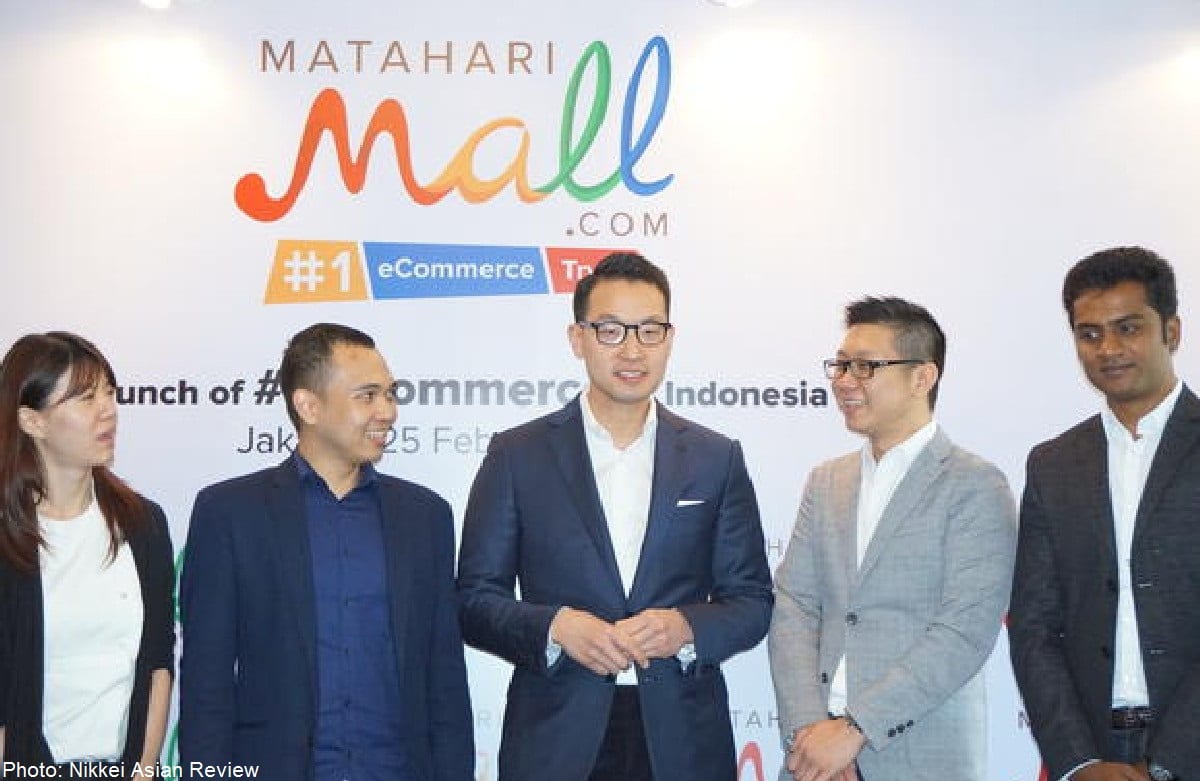
    When asked for his views on the issue, Hadi Wenas, the chief executive officer of MatahariMall.com, told reporters on Wednesday (10/02): “We are very optimistic. It will be business as usual for us, we are not afraid, not shocked or confused.”

    For foreigners, Indonesia is an attractive market for investment, particularly in the e-commerce sector, according to Indonesian E-commerce Association (idEA).

    The association estimated that the number of online shoppers in Indonesia could reach 10 million this year as the country’s middle class continues to grow. The e-commerce business is projected to rake in Rp 20 trillion ($1.49 billion) this year, double from last year’s estimated Rp 10 trillion.

    At the office launch of MatahariMall.com, Wenas noted that the same practice is common in Brazil, Russia, China and India, where local e-commerce firms are able to succeed in the market, supported by global investors, without the companies losing their identity.

    “With the support of Lippo Group, the biggest retail group in Indonesia, and the team we currently have, we are super solid now. Look at our campaign breakthrough. Foreigners won’t match our local taste in our ‘Lu mau apa?’ [(‘What do you want?’)] campaign,” Wenas said, referring to the company’s catch phrase.

    The Jakarta Globe and MatahariMall.com are both affiliated with the Lippo Group.

  • Matahari Department Store ups stake in MatahariMall.com operator

    Matahari Department Store ups stake in MatahariMall.com operator

    GEI is the controlling shareholder of PT Sinar Rekata Earth and PT Lenteng Transcontinental. The two subsidiaries are the principal shareholders of PT Solutions E-commerce Global, which operates MatahariMall.com.

    In a prospectus submitted to the Indonesian Stock Exchange, Matahari Department Store said, it has bought 4.4 million shares of GEI valued at Rp 53.14 billion ($3.88 million).

    LPPF exercised its option to buy the GEI shares at a price of Rp 12,065 per share in accordance with the agreement signed granting option rights on August 15, 2015.

    Prior to the transaction, LPPF’s holding was 2.63 million shares in PT GEI or 1.99%, PT Matahari Putra Prima Tbk (MPPA) 2.63 million shares or 1.99%, PT Duta Wibisana Anjaya 5 million shares, or 3.79%, PT Sinar Mustika Dutamas 10 million shares, or 7.58%, PT Investama Digital Venture 111.65 million shares or 84.64%.

    After the transaction (options were exercised), the ownership of LPPF in PT GEI increased to 5.16%, MPPA at 1.93%, PT Duta Wibisana Anjaya 3.67%, Dutamas Sinar Mustika 7.34% and PT Investama Digital Venture 81.9%.

    In the prospectus, Matahari Department Store said that it carried out the transactions because it considers e-commerce as having high growth potential in the country.

    MatahariMall.com, officially launched its operations in September 2015 to tap Indonesia’s growing online retail space.

    Also Read: Indonesia e-commerce Dealbook : Government mulls five-year roadmap, Mataharimall launches online platform

    Indonesia’s MatahariMall ties up with state postal service for O2O push

  • MatahariMall.com, Pos Indonesia in Tandem to Boost E-Commerce

    MatahariMall.com, Pos Indonesia in Tandem to Boost E-Commerce

    Pos Indonesia will also install MatahariMall.com “eLockers,” allowing customers to physically pick up their items purchased online from lockers located in ten post offices in the Greater Jakarta area and Bandung.

    Using these services, online shoppers can also arrange delivery of their reserved items to these pickup points, instead of their home or office address, to avoid missing goods upon arrival.

    Pos Indonesia also agreed to provide logistic and delivery services to Mataharimall.com for domestic shipments.

    Like MatahariMall.com, the Jakarta Globe is affiliated with the Lippo Group.

  • MatahariMall Sets Its Sights High in Booming E-Commerce Scene

    MatahariMall Sets Its Sights High in Booming E-Commerce Scene

    Since its soft-launch earlier this year, MatahariMall has garnered nearly 200,000 customers with 200,000 different products in its inventory offered by some 1,200 vendors, according to Hadi.

    It has also set up a 10,000-square-meter warehouse located near Halim Perdanakusuma airport in East Jakarta.

    Backed by Lippo, one of the nation’s biggest retail groups, MatahariMall offers an online-to-offline service that would allow customers to order their goods online and collect them at a nearby Matahari department store or Hypermart supermarket.

    Both Matahari and Hypermart are affiliated with the Lippo Group, as is the Jakarta Globe.

    The service will later also be expanded across Lippo’s network, to outlets such as the Books & Beyond bookstore chain, Hadi said.

    “We are very proud of the team,” said the Lippo Group’s John Riady. “The growth numbers are very strong and the team is very focused. Lippo and our other investors are fully committed to doing anything we can to support MatahariMall as it pioneers e-commerce in Indonesia.”

    Undeterred by the current economic slowdown, Emirsyah Satar, the MatahariMall chairman, said the site aimed to capture a 20 percent share of Indonesia’s online retail market over the next five years, banking on the country’s expanding middle-class population.

    “We can see that Indonesia’s e-commerce still lags behind our neighbor countries,” he said. “In fact, we see the economic slowdown as a momentum to boost online retail, because most people are now looking for more affordable products.”

    Lippo’s much-publicized venture has lured in a series of seasoned executives from Indonesia’s tech industry, including Hadi from Zalora, another popular e-commerce site; Emirsyah from Garuda Indonesia; and ex-Google Indonesia head Rudy Ramawy as vice chairman.

    Adrian Suherman, previously the CEO of aCommerce, a Thai e-commerce logistics provider, also recently joined the MatahariMall team as a commissioner.

    The Lippo Group in April appointed Credit Suisse and Bank of America Merrill-Lynch to lead its $200 million first-round financing, with Britain’s Rothschild as financial advisers.

  • MatahariMall aims for 20% of Indonesian e-commerce market by 2020

    MatahariMall aims for 20% of Indonesian e-commerce market by 2020

    MatahariMall, which is planned to be launched next September, is eyeing 20 per cent of the e-commerce market in Indonesia by 2020. That year, the total market volume is projected to reach US$20-30 billion, compared to US$1.3 billion currently.

    It was told by MatahariMall’s Chairman Emirsyah Satar to Berita Satu. He stated that the team uses Alibaba as their role model. As we know, MatahariMall is the first marketplace to use O2O (Online to Offline) concept since the very beginning.

    Satar said, “Currently, the e-commerce market in Indonesia is worth around $1.3 billion. It’s so low, not even one percent of the total national retail sales. In other countries, e-commerce could cover 5-8 per cent of total retail sales. So, we estimate that out market volume would reach around US$20-30 billion by 2020.”

    “Our network footprint is quite strong and well-distributed all over Indonesia. We also have the experience of doing offline retail. Users may inspect their desired products before purchasing them, thanks to the support by Matahari and Hypermart. So, they may touch, feel, and even return the product should they feel that the it doesn’t meet their expectation,” he continued.

    MatahariMall has been accessible at the moment, although it’s still in form of a teaser page. Satar claimed that the number of buyers is already quite significant.

    Challenges of the e-commerce industry

    Satar pointed out two main challenges of the e-commerce industry in Indonesia, which are infrastructure and regulation. Infrastructure refers to the poor distribution of the Internet network, while regulation refers to the government’s law.

    “For instance, the regulation that requires merchants to fill out their TIN or ID number before posting at marketplace. I don’t think it’s urgent, as the industry is still infant. It should be enforced once the right time comes,” he said.

    The government, led by the Minister of Communication and Information Rudiantara, is currently formulating the roadmap for e-commerce in Indonesia, as President Joko Widodo stated in the opening of Indonesia Convention Exhibition (ICE) last Tuesday.

  • Online Retailer MatahariMall Sets 20% Market Share Target

    Online Retailer MatahariMall Sets 20% Market Share Target

    Lippo Group’s new e-commerce unit MatahariMall is embarking on an ambitious expansion plan, aiming for a 20 percent market share of Indonesia’s web-based retail sector by 2020, its chairman said on Wednesday.

    MatahariMall.com chairman Emirsyah Satar said the potential of the e-retailer, which is slated for an official launching in September, is similar to Chinese e-commerce giant Alibaba’s in light of Indonesia’s huge untapped e-commerce market.

    Indonesia’s  e-commerce market is currently worth around $1.3 billion, constituting only 1 percent of the national retail market.

    “The e-commerce markets of other countries can reach between 5 and 8 percent of total retail sales, so we are confident the market volume can expand to between $20 billion and $30 billion by 2020,” Emirsyah said at the MatahariMall office in Jakarta.

    Unlike other online retailers, MatahariMall will offer the O2O, or Online to Offline, system that would allow customers to order products online and see the products first-hand at a nearby Matahari or Hypermart store, both of which are affiliated with the Jakarta Globe through Lippo Group.

    “We have a very solid footprint network in Indonesia and we have the experience in offline retailing through Matahari and Hypermart,” said the former president director of Garuda Indonesia.

    MatahariMall, Emirsyah added, is also partnering with various top brands in the lifestyle, fashion, automotive and electronics sector to enrich the array of products available to customers.

    “We believe MatahariMall.com will be the [region’s] best and biggest online retail store,” he added.

    Emirsyah is also urging the government to support the online retail industry through Internet infrastructure and regulations that support a growing local industry.

    MatahariMall has appointed Credit Suisse and Bank of America Merrill Lynch to lead its first round of financing for an amount expected to be between $200 and $250 million. This financing would make MatahariMall the most valuable e-commerce company in the country.

    The online retailer has also built a main warehouse of 10,000 square meters in Halim, East Jakarta, that can accommodate thousands of products.

    Lippo Group, one of Indonesia’s largest business conglomerates, has committed to invest $500 million for the next three years in its e-commerce arm.

  • MatahariMall snares Zalora’s Hadi Wenas to steer online retail plans

    MatahariMall snares Zalora’s Hadi Wenas to steer online retail plans

    Lippo Group, one of Indonesia’s largest business conglomerates, has appointed seasoned technology entrepreneur Hadi Wenas to head its online venture MatahariMall, highlighting its commitment to tap into the growing e-commerce industry.

    Educated in the US’s Stanford University, Hadi was previously the co-chief executive of aCommerce, an end-to-end e-commerce logistics and service provider for Southeast Asia. He was also one of the founders of local online shopping platform Zalora Indonesia in 2012.

    Lippo has brought on board several additional top executives to its latest enterprise, including Emirsyah Satar, former president director of national flag carrier Garuda Indonesia and former Google Indonesia country director Rudy Ramawy as chairman and vice chairman, respectively.

  • Giant Matahari Mall online planned

    Giant Matahari Mall online planned

    Indonesian industrial conglomerate Lippo Group is to invest US$500 million creating “the Alibaba of Indonesia”.

    The Indonesian mall will bear the Matahari department store brand name, MatahariMall replicating and expanding the nation’s largest department store’s bricks and mortar offer online.

    Lippo Group is one of Indonesia’s largest and diversified corporations, which owns Matahari hypermarkets, department stores and some 60 shopping centres. It says it will invest the internet funds into the Matahari Mall online over a two to three year period as it strives to create the nation’s largest eCommerce site, turning over US$1 billion annually.

    Lippo Group representative John Riady described eCommerce in southeast Asia as “a US$100 billion opportunity”.

    “We want to become ‘the Alibaba of Indonesia’,” he told a media briefing.

    “Indonesia is the last remaining, large underpenetrated eCommerce market in Asia. MatahariMall is the single largest eCommerce opportunity today.

    “Our vision is to build the most powerful ecosystem that brings together buyers and sellers to do business anytime and anywhere.”

    Five years from now, Lippo wants to achieve US$25 billion in sales from its Matahari operations, 80 per cent of that from its bricks & mortar stores, 20 per cent online.

    Tech In Asia reports that prior to Lippo’s announcement the largest single commitment to eCommerce in Indonesia was $100 million from SoftBank and Sequoia Capital into Tokopedia.

    Lippo is effectively putting MatahariMall will into head-on competition with Rocket Internet’s Lazada, southeast Asia’s strongest online retailer.

    MatahariMall will sell goods spanning the fashion, beauty, electronics, home, groceries, books and entertainment categories, and more. Customers will be able to purchase online and collect in a Matahari store.

    Matahari Department Stores CEO Michael Remsen says Indonesian eCommerce will grow 10-fold over the next five years.

    “Together with MatahariMall, we are committed to the future of ecommerce. All of our suppliers and partners are 100 per cent behind us,” he said.

    The site will go live in March.