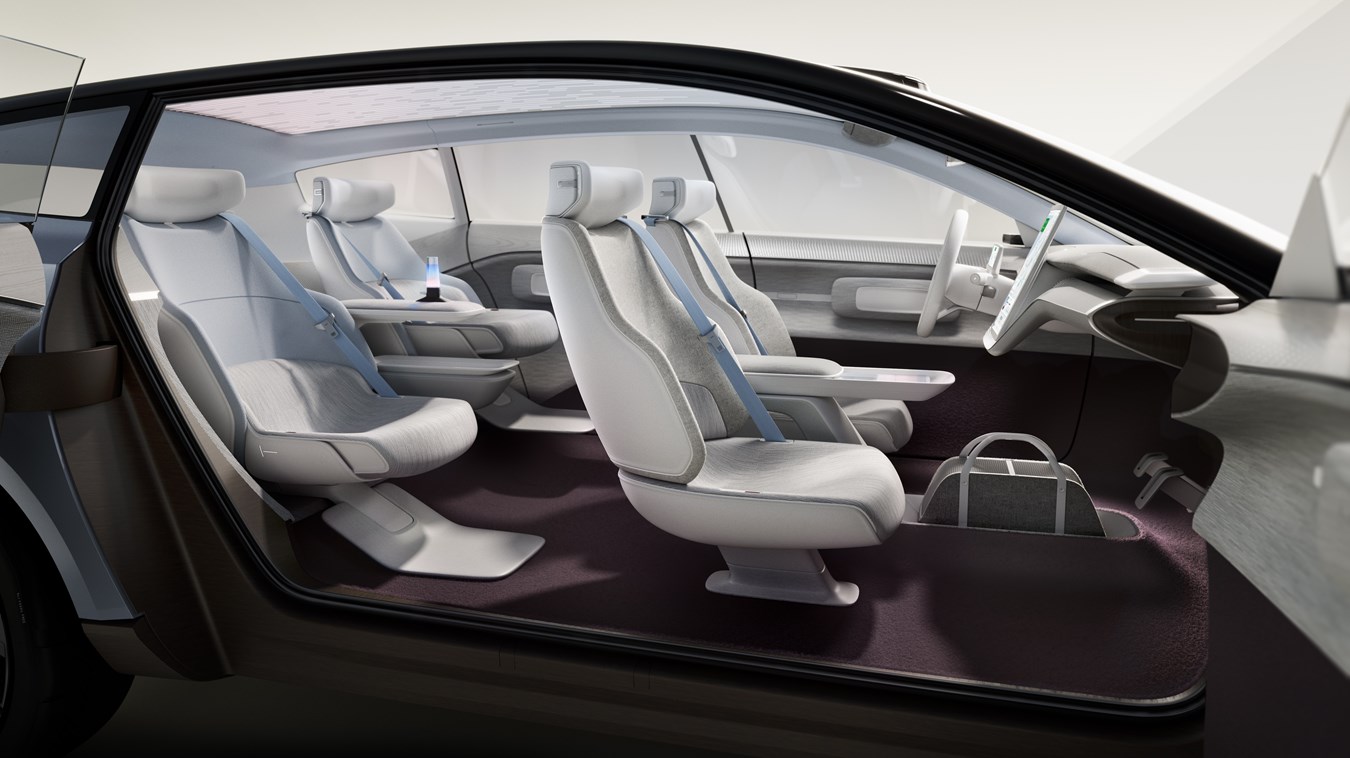
With the Concept Recharge, Volvo Cars demonstrate the steps it will take in all areas of pure electric car development to reduce its cars’ and its overall carbon footprint. The company plans to sell only fully electric cars by 2030 and aims to be a climate-neutral and circular business by 2040. By using sustainable materials inside the car, equipping it with tyres from recycled and renewable material, improving aerodynamics, and through other measures, Volvo Cars can take huge steps to reduce its carbon impact through the car itself.
When combining those steps with the use of clean energy throughout a decarbonized supply chain, manufacturing process, and use phase of the car, Volvo Cars believes it can reduce a car’s lifecycle CO2 impact by 80 percent versus a 2018 Volvo XC60, without losing the inherent premium qualities that Volvo cars have become known for.
This would mean that the Concept Recharge would have an overall lifecycle CO2 impact below 10 tonnes when charged with 100 percent renewable energy.
Volvo Cars is in the forefront when it comes to working with sustainable and natural materials in its cars, and the Concept Recharge is another proof point of its commitment to push forward with this ambition.
The interior design is rich in sustainable materials, both natural and recycled materials – think of responsibly sourced Swedish wool, environmentally responsible textiles and lightweight composites created from natural sources.
Sourced Swedish wool is transformed into fully natural breathable cloth, free from additives. This warm and soft material is used in the seat backrest and instrument panel top. Meanwhile, the floor and lower doors are covered by a rich carpet of 100 percent wool. The seat cushions and touch surfaces on the door are made from an environmentally responsible material that contains Tencel fibers from cellulose. This fabric has great durable strength and is soft to the skin. By using Tencel fibers, which have been produced through high water- and energy-efficient processes, Volvo designers can reduce the use of plastics in interior parts.
The seatbacks and headrests, as well as part of the steering wheel, use a new material created by Volvo Cars called Nordico. It is a soft material made from bio-based and recycled ingredients that come from sustainable forests in Sweden and Finland, providing a CO2 footprint that is 74 percent lower than leather.
Elsewhere in the interior, including in the lower storage areas, back of the headrest, and the footrest, the Concept Recharge uses a flax composite, developed by Volvo Cars in collaboration with suppliers. It uses fibers from the linseed plant, which are mixed with composites to provide a strong and lightweight, yet attractive and natural, aesthetic.
On the exterior, the front and rear bumpers as well as the sill moldings also consist of flax composite. Using a flax composite both inside and out in this way results in a significant reduction of plastics used.
With the internal combustion engine making way for the pure electric powertrain, tires play an even more important role. Not only are they crucial for safety, but they also contribute largely to the vehicle’s battery range. This means tires for electric cars always have to be on top of technology development.
Hence the Concept Recharge features special tires made by Pirelli, which are completely free from mineral oil and are made from 94 percent fossil-free materials, including recycled and renewable materials such as natural rubber, bio-silica, rayon, and bio-resin. This reflects the circular approach shared by Volvo Cars and Pirelli, with a focus on reducing resource consumption and environmental impact.
Beyond its sustainable materials, electric powertrain, and special tires, Concept Recharge also improves the environmental credibility of SUVs through efficiency and aerodynamics.
With the Concept Recharge, Volvo Cars envision the future of aerodynamics. It incorporates innovative aerodynamic features such as exterior design details that smooth the airflow, a new wheel design, a lower roof, and a more upright rear end.
As such, it takes the classic SUV shape and improves airflow to increase range, while offering the incredible space opportunities that come naturally with an electric car and its lower floor.