
Tag: measurement

  • ANA Introduces Framework to Standardise Retail Media Measurement

    ANA Introduces Framework to Standardise Retail Media Measurement

    The Association of National Advertisers (ANA) has unveiled a new framework designed to tackle measurement challenges within the rapidly expanding retail media sector. This initiative comes as over US$100 billion is now invested globally in commerce media, with retail media networks struggling to provide consistent and comparable performance metrics across platforms.

    The ANA’s Retail Media Measurement Standardization report proposes a path towards a unified measurement ecosystem. It advocates for common standards across diverse retail media networks, increased transparency in performance calculations, and a greater reliance on independent third-party measurement providers. Leading brands, including PepsiCo, Hershey’s, Clorox, Kimberly-Clark, Mondelez, Bayer, and Intel, contributed to the framework’s development through the ANA’s Retail Media Working Group.

    Addressing Fragmentation in Retail Media

    Retail media has become one of the fastest-growing segments in the media mix, attracting significant brand investment. However, the fragmented nature of the ecosystem makes it difficult for marketers to compare the effectiveness of their spending across different platforms. This new framework seeks to establish a foundational measurement standard, allowing brands to better understand what truly drives results and to optimise their media strategies more effectively.

    For retailers and brands operating in Asia-Pacific, where e-commerce and digital retail media are also experiencing explosive growth, standardisation is crucial. As platforms like Lazada, Shopee, and regional supermarket chains expand their advertising offerings, consistent measurement practices would enable brands to allocate budgets more strategically and demonstrate clear returns on investment across diverse Asian markets. This move by the ANA provides a potential blueprint for similar efforts in the region, helping to mature the retail media landscape.

    Call For Transparency And Independent Verification

    The framework highlights three key areas for improvement: the establishment of common measurement standards that all retail media networks can adopt, enhanced transparency regarding how performance metrics are calculated and presented, and a wider acceptance and use of independent third-party measurement solutions. These recommendations aim to instill greater confidence among advertisers and foster healthier competition within the retail media space.

  • Adobe designs new video measurement model

    Adobe designs new video measurement model

    Adobe has launched a new video analytics offering that promises to provide marketers with new and improved measurement for both content and ads.

    “As video measurement grows increasingly important for marketers to drive major decisions, the significance of these metrics comes into focus daily,” said Chris Wareham, the senior director of product management at Adobe in a blog entry.

    “The ability to obtain data such as time spent, ad performance, device, geography, bounce rates, impressions, and more is now a crucial piece of the pie.”

    New video measurement model

    A key update would be the measuring of video engagement with substantially greater granularity than in the past. This is done by sending “heartbeats” packets every 10 seconds during a video playback or during a live event.

    On top of the initial start server call that Adobe Analytics receives whenever a video is played, a new processing layer will now aggregate all heartbeats until the viewer ends the session – either by completing the video, closing the browser, or switching to a new video. This data is then transmitted as part of a final server call to complete the playback data set.

    “The 10-second heartbeat measurement eliminates the blind spot and offers a much more thorough view of how content is being consumed,” explained Wareham. “By analyzing video streams, rather than just starts and stops, brands can gain a more complete picture of how content is being consumed.”

    A move away from simple monitoring milestones that is based solely on server calls means that stream can not only provide standardization across basic video performance metrics, but is also able to provide deeper insights into media consumption, said Wareham.

  • Lotte Department Store to Introduce 3D Foot-Measuring Device

    Lotte Department Store to Introduce 3D Foot-Measuring Device

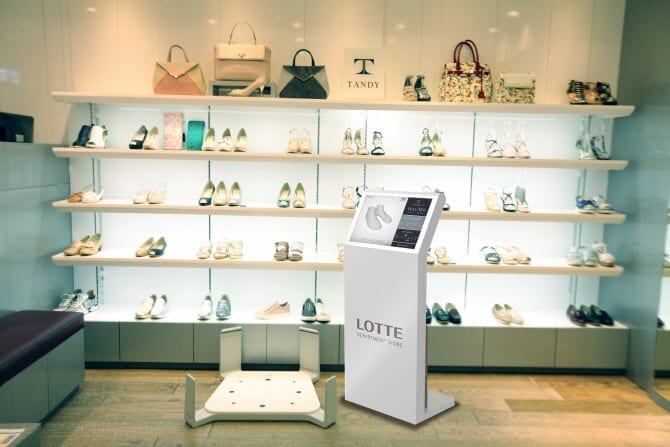
    Korean retail giant Lotte Department Store revealed Thursday that it will implement a new 3D foot-measuring device at its stores starting Friday, to provide quick and accurate measurements for custom shoe orders.

    By placing his or her foot on the device, a customer will able to obtain not only their foot’s length, but its overall shape, including width and height, to gather more accurate sizing information.

    The conventional foot-measuring process can make customers feel uncomfortable, and usually takes two to three minutes. But the new device will shorten the process to two seconds using 3D scanning technology, according to a Lotte official.

    After having their feet measured, customers will select the shoe design of their choice, and a final pair of handmade shoes will be delivered to their doorstep in about two weeks. Upon request, customers can even have their foot size information mailed to them or saved in the store’s computer system, so they can place more orders in the future without having to re-measure their feet.

    The 3D device was developed in collaboration with Swedish start-up Volumental, and will first make its debut at the Tandy shoe store in Lotte’s flagship department store in Myeongdong. The service will expand to other shoe brands in department stores across the country starting July 29.

    Lotte Department Store also plans to launch a 3D virtual fitting service in the latter half of the year. The service uses a special mirror that provides a virtual reflection of the customer wearing clothing by applying a 3D image of the product to the customers’ body.