Retail News CRM

Tag: meta

  • Essilor Luxottica and Meta Unveil Affordable AI Glasses for the Masses

    Essilor Luxottica and Meta Unveil Affordable AI Glasses for the Masses

    Renowned eyewear manufacturer, Essilor Luxottica, has entered into a collaboration with Mark Zuckerberg’s Meta for the creation of a more affordable range of AI glasses, targeting price-conscious customers. This move follows the successful release of AI glasses under the Ray-Ban and Oakley brands, with the Ray-Ban line becoming the top-selling AI glasses on the market.

    Creating Affordable AI Glasses

    The Essilor Luxottica range, priced from just $299, promises to bring the company’s innovation in smart eyewear to a wider audience, offering consumers around the globe enhanced and more integrated experiences. The CEO of Essilor Luxottica, Francesco Milleri, expressed his excitement at this cutting-edge development in the realm of smart eyewear. He asserted the launch provides an opportunity for budget-conscious consumers to experience the transformative effect of wearable tech in their daily lives.

    According to Milleri, Essilor Luxottica’s range of “iconic brands” have been instrumental in boosting the adoption of their products in the market. The company, a result of the 2018 merger of lens manufacturer Essilor and frames producer Luxottica, boasts a remarkable portfolio that includes global brands such as Ray-Ban, Oakley, and Oliver Peoples. In addition, they produce glasses for luxury brands like Chanel, Prada, Coach, and Armani.

    The Future of Eyewear

    Meta CEO Mark Zuckerberg was enthusiastic about the partnership with EssilorLuxottica, highlighting the aim to integrate potent AI into eyewear frames that consumers will want to wear. Zuckerberg suggested that glasses could become a primary medium for individuals to access personal superintelligence, and with the new Meta Glasses, this possibility could become a reality for a much broader audience.

    The new collection will initially offer three styles, coupled with a variety of lens options. Currently, the range is available online for customers in the US, Canada, and a select number of European countries, with plans to extend further into additional markets later in the year.

    Questions & Answers

    What is the pricing for the new Essilor Luxottica AI glasses?
    The AI glasses will start retailing from $299.

    Who is Essilor Luxottica partnered with for this new venture?
    Essilor Luxottica is partnering with Mark Zuckerberg’s Meta for the production of these glasses.

    Where are the new AI glasses currently available?
    They are available online for customers in the US, Canada, and select European countries.

  • Metas AI Blunder: How a Chatbot Hack Shook Up Instagram and Spurred Investor Jitters

    Metas AI Blunder: How a Chatbot Hack Shook Up Instagram and Spurred Investor Jitters

    A concerning vulnerability was recently exposed in Meta’s AI support chatbot due to an Instagram hack. The attackers manipulated the chatbot into providing access to high-profile accounts, including the inactive Obama White House page, beauty retailer Sephora, and a high-ranking US Space Force official.

    AI Security Breach

    The hackers persuaded the chatbot to reset account credentials without authentication, effectively changing a trusted security tool into a glaring weakness. This event highlights a wider vulnerability – tech companies giving AI systems sweeping authority over sensitive tasks like account recovery, despite the systems’ susceptibility to manipulation through “prompt injection” attacks.

    Meta’s stumble comes at a sensitive time. The social media magnate has committed heavily to AI, with significant job losses and up to $145 billion dedicated to AI infrastructure. This incident may amplify concerns about the company speeding up automation before the technology is adequately equipped to handle these tasks safely.

    On Monday, Meta stated that the issue was resolved and steps were being taken to secure impacted accounts. However, the incident shook investors already anxious about Meta’s substantial AI investment, leading to a more than 5% drop in share price.

    AI and Security

    The attack, which occurred over the weekend, saw users locked out of their accounts and led to numerous complaints on various platforms. The hack underlines the latest challenge for Meta in its attempt to incorporate AI throughout its products.

    The company introduced the support chatbot in March to address the ongoing issue of inadequate human support for users who lose account access or face inaccurate penalties. Since its launch late in 2022, AI chatbots have been exploited by hackers using prompt-based attacks.

    Analysts and experts warn that this problem isn’t isolated to Meta, predicting more such exploits as hackers utilize AI. Unforeseen issues are arising with the use of AI, presenting a new type of risk. Previously, individuals were targeted by scams. Now, AI agents or autonomous digital assistants capable of performing complex tasks are being targeted.

    Questions & Answers

    What is the potential risk of using AI in critical functions?
    AI systems’ potential risks include susceptibility to manipulation, especially when given significant authority over sensitive tasks without adequate safeguards or verification processes.

    How was the Instagram hack carried out?
    The hackers manipulated Meta’s AI support chatbot into resetting account credentials, effectively turning a high-trust security tool into a significant weakness and gaining access to high-profile accounts.

    What implications does this incident have on Meta’s efforts towards AI?
    This breach heightens concerns about Meta’s heavy investment in AI. It suggests that the company’s push for automation might be outpacing the technology’s readiness to handle such critical tasks safely.

  • Meta Kickstarts Global Layoff of 8,000 Employees: The Dawn of AI Transformation Begins with 4 AM Emails in Singapore

    Meta Kickstarts Global Layoff of 8,000 Employees: The Dawn of AI Transformation Begins with 4 AM Emails in Singapore

    Meta, the global tech powerhouse, has initiated an extensive downsizing initiative, beginning with an announcement to its Singaporean employees. The company plans a 10% reduction of its workforce across the globe, also affecting team members in the US and the UK. As the process unfolds, employees have been advised to work remotely.

    This current layoff phase is projected to have a significant impact on Meta’s product and engineering teams. Insiders suggest that additional cuts could follow later in 2026. However, this information has not yet been made public.

    New Focus on AI

    As part of its strategic restructuring, Meta has reassigned approximately 7,000 employees to newly-formed teams. These groups are centered around artificial intelligence (AI) initiatives, including the development of AI products and agents.

    Committed to its AI focus, Meta has earmarked over US$100 billion for AI capital expenditures in 2026. As of March’s end, Meta’s employee count stood just shy of 80,000, prior to the announced layoffs and reassignments.

    Janelle Gale, Meta’s Head of People, has explained that these changes allow for a streamlined, efficient organizational structure. Smaller, agile teams or “pods” can work at a quicker pace and with a greater sense of ownership. Gale expressed confidence that this approach would bolster productivity and elevate job satisfaction.

    A History of Layoffs and Backlash

    Over recent years, Meta has repeatedly downsized its workforce as part of continuous efficiency pursuits, championed by CEO Mark Zuckerberg. He has urged engineers to leverage AI agents for coding and other functions, proposed device monitoring strategies to enhance technology, and developed his own AI-assistant for handling CEO-related tasks, such as collating employee feedback. The cumulative impact of these job cuts and reassignments is expected to affect approximately 20% of the company’s workforce.

    However, this drastic change has not been quietly accepted by all. Many Meta employees have expressed their dissent, distributing protest flyers at company offices and posting criticisms on its internal communications platform, Workplace. A petition against the proposed installation of mouse-tracking software — designed to train Meta’s AI models by monitoring human-computer interaction — has already garnered over 1,000 signatures.

    The wider tech industry is also wrestling with the implications of AI advancement. Rising stock prices and the burgeoning valuation of AI startups contrast starkly with the increasing job cuts. In 2026 alone, nearly 110,000 job positions have been eliminated across 137 tech companies, trending towards a repeat of the 2023 peak. That year, over 260,000 workers were laid off in the wake of the Covid-19 pandemic’s hiring surge.

    Questions & Answers

    Why is Meta initiating these layoffs?
    Meta is restructuring to focus on AI initiatives and streamline its structure, aiming for greater efficiency and productivity.

    What roles are affected by these layoffs?
    The layoffs are expected to significantly impact Meta’s engineering and product teams.

    How has the downsizing been received by the company’s employees?
    There has been considerable backlash among Meta employees, with protests and a petition against the proposed use of mouse-tracking software to train AI models.

  • Job Cull at Meta: 8,000 Layoffs Loom as Zuckerberg Pioneers AI Leadership Clone

    Job Cull at Meta: 8,000 Layoffs Loom as Zuckerberg Pioneers AI Leadership Clone

    Many employees at Meta are expected to face job losses, with the first wave of layoffs beginning on May 20, potentially affecting as many as 8,000 roles. However, this initial round of job losses only signifies the start of a broader restructuring effort.

    Continued Layoffs Anticipated

    According to recent reports, Meta’s workforce reduction is far from complete. After the initial elimination of 8,000 positions, which represents approximately 10% of Meta’s global workforce, another round of layoffs is expected to occur in the latter half of 2026.

    The specifics regarding the second round of layoffs, including the exact timing and the number of affected employees, remain uncertain. This lack of detailed information may be due to the unpredictability of advancements in artificial intelligence (AI), a field that could substantially influence Meta’s employment requirements. If AI technology continues to become more effective and powerful, more job cuts could consequently ensue at Meta.

    Reports have indicated that Meta is considering a 20% reduction of its global workforce, suggesting that at least another 8,000 jobs could be eliminated in the second wave of layoffs.

    Industry-Wide Job Losses

    While Meta grapples with impending layoffs and the task of enhancing its AI capabilities, other industry giants are facing similar challenges. Amazon, for example, has recently initiated layoffs affecting 30,000 of its corporate employees, equivalent to 10% of its white-collar workforce.

    According to some tracking tools, more than 73,000 employees have been laid off in 2026 across the industry. This figure nearly reaches half of the total layoffs for the entire year of 2024, despite only the first quarter of 2026 having concluded.

    The Advent of AI Leadership

    Despite the turbulence, a bright future could await those who manage to retain their positions at Meta. Reports suggest that the company is developing an AI clone of its CEO, which would be capable of responding to questions in his distinct voice using his past statements.

    The AI clone project aims to strengthen employee connection with leadership, reflecting the company’s shift towards AI-driven tools rather than focusing solely on its earlier metaverse ambitions. The CEO is said to be directly involved in training his digital counterpart, a concept that could inspire the creation of similar AI personas for influencers and creators.

    Questions & Answers

    Why is Meta laying off a significant portion of its workforce?
    Meta’s layoffs are part of a broader restructuring strategy, potentially influenced by advancements in AI technology, which could transform the company’s employment and operational needs.

    What is the expected number of total layoffs at Meta?
    While exact numbers are not confirmed, reports suggest that Meta is considering a 20% reduction of its global workforce, which could result in about 16,000 job losses.

    What is the purpose of the AI clone of Meta’s CEO?
    The AI clone project aims to strengthen the connection between employees and leadership. The AI clone, trained to respond in the CEO’s voice using his past statements, reflects Meta’s strategic shift towards AI-driven tools.

  • Revolutionizing Retail: How Meta, L’Occitane and Omnichat are Using WhatsApp to Drive Customer Loyalty

    Revolutionizing Retail: How Meta, L’Occitane and Omnichat are Using WhatsApp to Drive Customer Loyalty

    Omnichat, a notable omnichannel AI platform, recently conducted the third iteration of the Commerce Leadership Forum at Meta Singapore’s facility. The forum saw an assemblage of high-ranking leaders across various sectors, arranged to discuss the transformative influence of AI-empowered business messaging in retail, beauty, and lifestyle industries in the Asia Pacific.

    The Impact of WhatsApp on Commerce

    Prominent leaders from Meta and L’Occitane spoke about the swift adoption of WhatsApp as a crucial commercial platform, underscoring its evolution from a simple customer support tool to an engaging platform catering to committed customers, driving conversions, and establishing long-lasting loyalty.

    L’Occitane disclosed that WhatsApp has become the primary mode of customer communication across Asia Pacific markets, accounting for over 80% of inbound and outbound customer interactions. The brand further revealed that personal, conversational interactions have resulted in profitable outcomes compared to traditional channels. This increase in commercial success, coupled with real-time engagement, has enabled L’Occitane to extend relationship-building beyond transactional interactions, resulting in lasting brand loyalty.

    Terrence Siu, chief information officer of APAC at L’Occitane, stated, “Loyalty begins the moment a customer chooses to stay connected with the brand. Using WhatsApp as a unified touchpoint allows us to move customers smoothly from online discovery to in-store engagement without losing context. Customers receive a consistent and personalized experience wherever they interact with us, be it on Facebook, Instagram, or WhatsApp.”

    L’Occitane has extended this seamless experience into a complete loyalty journey by utilizing Omnichat and WhatsApp to deliver sample products, VIP privileges, and post-purchase experiences. This ensures that customers feel guided and appreciated long after their initial transaction. The distribution of samples and exclusive VIP offers directly through WhatsApp has elevated their coupon redemption rate to 87%.

    Messaging-led Commerce and Loyalty

    Messaging-led commerce has been further reinforced by YouGov’s new regional insights. The data showed that 32% to 43% of Asia Pacific shoppers now utilize business messaging to track orders, complete purchases, and maintain contact with brands throughout the sales cycle. WhatsApp has effectively become the default loyalty channel for high-intent engagement in Asia.

    Vicky Yiu, APAC strategic partnership manager for business messaging at Meta, asserted, “WhatsApp is increasingly becoming the commerce layer for brand engagement in Asia. When businesses move to a messaging-led experience, they shift from campaigns to relationships – and that is where long-term loyalty is earned.”

    Omnichat, powering these loyalty journeys, has illuminated how brands can evolve membership from a static database into an active relationship engine. By consolidating multi-channel identity into a unified customer profile and harnessing AI to trigger personalized re-engagement flows, Omnichat aids brands in converting one-time buyers into loyal members.

    CEO and founder of Omnichat, Alan Chan, emphasized, “Loyalty only works when it’s active, not passive. By linking QR codes to product samples, in-store touchpoints, and messaging-based rewards, brands can proactively engage members in real time. This is the difference between a loyalty database and a loyalty journey.”

    Questions & Answers

    How is AI-powered business messaging transforming the retail and lifestyle sectors?
    AI-powered business messaging is transforming these sectors by personalising customer interactions, driving profitable outcomes, fostering long-term loyalty, and reducing customer acquisition cost.

    How has WhatsApp influenced L’Occitane’s customer engagement?
    WhatsApp has become L’Occitane’s primary mode of customer communication. It has enabled the brand to provide a seamless experience, from online discovery to in-store engagement and beyond. It also allows L’Occitane to distribute samples and VIP offers directly, resulting in a high coupon redemption rate.

    What role does Omnichat play in this transformative process?
    Omnichat powers the loyalty journeys of brands, transforming membership from a passive database into an active relationship engine. It helps brands remain present in the customer’s daily routine, enabling real-time rewards and VIP benefits, and consolidates multi-channel identity into a unified customer profile.

  • Meta’s Project Phoenix: Mixed Reality Glasses Launch Delayed, Aims for Superior Quality over Speed

    Meta’s Project Phoenix: Mixed Reality Glasses Launch Delayed, Aims for Superior Quality over Speed

    Meta, a tech giant known for its innovative projects, seems to have hit a temporary halt on its advanced mixed reality glasses project. The anticipated launch, previously expected in late 2026, will likely be delayed until sometime in 2027.

    A Shift in Timeline for Project Phoenix

    The tech enthusiasts looking forward to experiencing Meta’s pioneering holographic glasses might need to modify their anticipations. The company recently announced that the launch of their state-of-the-art mixed reality glasses, internally referred to as “Phoenix”, will be deferred.

    Previously, the company planned to release the product in the latter half of 2026, but recent statements from Meta executives suggest a shift to the first half of 2027. According to CEO Mark Zuckerberg, the delay is strategic as the firm aims to prioritize a sustainable business plan and a superior product experience over haste.

    Project Phoenix: What We Have Learned So Far

    The highlight of the Phoenix project is the External Compute Module, where the glasses will be linked to a “puck-like” power and compute source via a wire. This design is intended to reduce the weight on the wearer’s face.

    The glasses will prioritize visual fidelity, aiming to deliver the immersive experience of mixed reality headsets in a form similar to traditional eyewear. Furthermore, they will incorporate advanced sensor technology for an enhanced digital overlay on the real world.

    The delay in the project’s timeline is designed to give the product development team more time to refine the product details.

    The Mixed Reality Market Landscape

    Currently, the mixed reality market is experiencing a unique phase. On one hand, there is the Apple Vision Pro, a remarkable but hefty and expensive device that tends to isolate its users. On the other hand, there are Meta’s Ray-Ban Meta AI glasses, which integrate AI, cameras, speakers, microphones, and a monocular screen display for notifications and information.

    While the Ray-Bans are ideal for quick interactions, they do not offer a “true” mixed reality experience. Project Phoenix aims to bridge this gap by combining the immersive experience of Vision Pro with the wearability of the Ray-Bans.

    The delay in the project launch indicates that Meta is closely observing its competitors. The mixed reactions to Apple’s bulky headset might have prompted them to realize that a mediocre product will not suffice. These developments come at a time when Meta is reportedly reducing its metaverse budget by approximately 30%, indicating that they cannot risk a major hardware failure.

    Questions & Answers

    Why is the Project Phoenix launch delayed?
    The launch delay is strategic, allowing Meta to focus on developing a sustainable business model and a superior product experience.

    What are the key features of the Project Phoenix glasses?
    The Phoenix glasses will connect to a “puck-like” power and compute source via a wire, incorporate advanced sensor technology for digital overlaying, and prioritise visual fidelity to deliver an immersive experience similar to mixed reality headsets.

    How is Project Phoenix different from other products in the market?
    Project Phoenix aims to bridge the gap between extreme immersion and practical wearability, offering a “true” mixed reality experience in a form similar to traditional eyewear.

  • Exposed: WhatsApp Flaw Unveils Billions of User Numbers, Is Your Privacy At Risk?

    Exposed: WhatsApp Flaw Unveils Billions of User Numbers, Is Your Privacy At Risk?

    A team of Austrian researchers has reportedly found a way to extract the phone numbers of 3.5 billion WhatsApp users, leaving many to wonder if their own information has been compromised.

    Method of Extraction

    Any user can determine if a number is registered on WhatsApp by performing a simple search within the platform. If the number in question is associated with a WhatsApp account, the searcher will be privy to the account’s profile picture and user name. Scientists from the University of Vienna in Austria employed this very strategy to gather the phone numbers of 3.5 billion WhatsApp users.

    In their search for vulnerabilities within WhatsApp’s end-to-end encryption system, the Austrian team discovered that the application lacked an important security measure known as rate-limiting protection. Such a feature would thwart the abuse of WhatsApp’s number-checking function. By exploiting this absence of protection, the team was able to obtain 30 million WhatsApp numbers registered in the U.S. within just 30 minutes. By the conclusion of their research, they had amassed the WhatsApp numbers of 3.5 billion users worldwide.

    The extraction process was remarkably simple: the researchers merely altered the number sequence. In doing so, they could determine whether a number was registered on WhatsApp. Of the 3.5 billion users whose numbers were collected, approximately 57% had their privacy settings configured to display their profile picture to anyone. Given this, the researchers were able to easily collect these users’ profile pictures. They were also able to view the profile text of 29% of these users.

    A Neglected Flaw

    Interestingly, WhatsApp’s parent company, Meta, was alerted to this vulnerability in 2017 by a different team of researchers. Despite this, Meta failed to address the issue, meaning it remained straightforward to determine whether a number was registered on WhatsApp.

    Earlier this year, the Austrian researchers brought their findings to Meta’s attention, emphasizing the severity of the security risk this flaw presents to WhatsApp users. Their concern is that malicious entities could exploit this loophole to obtain photos and phone numbers of a significant number of WhatsApp users.

    Fortunately, in October of this year, Meta finally implemented a stricter rate-limiting measure on WhatsApp. This has ensured that such large-scale contact discovery is no longer feasible on the platform. The researchers have securely deleted their database containing the extracted phone numbers and associated data.

    Other messaging platforms, such as Signal, already incorporate rate-limiting protection. This means that mass-scale contact discovery, like what previously occurred on WhatsApp, is not possible on these platforms.

    Previous Security Breaches

    This is not the first instance of Meta’s apps coming under scrutiny due to security flaws. Last year, a database containing information on 530 million Facebook users was publicly leaked online. Intriguingly, bad actors exploited a vulnerability akin to the one found in WhatsApp, accessing data by utilising Facebook’s feature that allows users to search profiles by entering a phone number. This allowed them to scrape the personal data of 530 million users.

    WhatsApp may have its benefits, such as being free, supporting end-to-end encryption and accommodating group video calls. However, after learning of its security flaws and data collection practices, some users are considering alternatives. Platforms like Signal, which collects minimal data and provides advanced privacy features, are becoming increasingly popular.

    Questions & Answers

    What are the implications of the Austrian researchers’ findings?

    The research highlights a major flaw in WhatsApp’s security system. This loophole could potentially be exploited by cyber criminals to extract photos and phone numbers of a large number of WhatsApp users.

    Has this flaw been addressed?

    Meta, WhatsApp’s parent company, has taken measures to rectify this flaw. In October of this year, a stricter rate-limiting measure was applied to WhatsApp, preventing such extensive contact discovery from taking place.

    What alternatives exist for WhatsApp users concerned about security?

    Signal is one such alternative. The platform already has rate-limiting protection in place, and it collects almost no data from users. It also offers advanced privacy features, such as concealing your IP address during calls, and preventing others from taking screenshots of your conversations.

  • Meta Triumphs in FTC Monopoly Lawsuit: Federal Judge Rules in Favor of Social Media Giant

    Meta Triumphs in FTC Monopoly Lawsuit: Federal Judge Rules in Favor of Social Media Giant

    In a significant legal triumph, technology giant Meta saw a favorable ruling from a federal judge in a lawsuit filed by the Federal Trade Commission (FTC). The lawsuit pertained to Meta’s acquisitions of Instagram in 2012 for $1 billion and WhatsApp in 2014 for $21 billion, comprising cash and Meta (formerly Facebook) stock. The final purchase price for WhatsApp had initially been $19 billion, but a surge in the Meta shares propelled it up to $21 billion.

    Monopoly or Fair Competition?

    The FTC’s contention was that Meta, which changed its brand name from Facebook in 2021, acquired these two prominent social media platforms to eliminate competition. The regulatory body viewed these acquisitions as possible infringements of anti-trust legislation. The seven-week trial witnessed the testimony from Meta’s founder, chairman, and CEO, Mark Zuckerberg, who posited that Meta faces stiff competition from other platforms such as YouTube and TikTok.

    These statements managed to draw the attention of Federal Judge James Boasberg, who in his ruling pointed out that YouTube and TikTok prevent Meta from monopolizing social media. He also highlighted that the dynamics of the social media market have transformed significantly since the FTC’s lawsuit was filed, with AI being the most notable shift. The judge argued that AI-generated content nullifies the FTC’s concerns, concluding that Meta does not hold a monopoly in the relevant market.

    Meta’s Market Share and Competition

    Judge Boasberg’s ruling stated that Meta’s apps only account for a “modest share” of the overall time spent on social media, which includes platforms like Facebook, Instagram, Snapchat, TikTok, and YouTube. The judge noted that this share is on a downward trend, and even excluding YouTube’s share, Meta would not constitute a monopoly. Boasberg’s ruling also acknowledged that TikTok, considered by Meta as its primary competitor, managed to penetrate the market a mere seven years ago and has been dominating the sector ever since.

    Reacting to the decision, Jennifer Newstead, Meta’s Chief Legal Officer, emphasized the beneficial nature of their products for people and businesses, and their embodiment of American innovation and economic growth. She expressed eagerness to continue collaborating with the Administration and to contribute to the country’s investment landscape.

    Instagram Acquisition and Market Valuation

    Meta’s acquisition of Instagram could be regarded as one of the most profitable tech deals in history. Instagram’s current estimated valuation ranges from $441 billion to $538 billion. Initially known for its ephemeral messages, Instagram gained user traction when people began using it to share photos of their meals. Instagram’s popularity soared when it incorporated the ‘Stories’ feature from Snapchat.

    Significance of Instagram and WhatsApp for Meta

    Meta argued during the trial that a forced breakup would have been catastrophic for the company. Instagram generates ad revenue for Meta, while WhatsApp provides business subscribers and enhances Meta’s international reputation. Zuckerberg also admitted that Facebook, the company’s flagship platform, is losing popularity. Meta’s argument that regulators had already approved the Instagram and WhatsApp acquisitions when initially proposed was also a crucial point in their defense.

    The Broader Tech Industry Implications

    This victory has considerable implications not only for Meta but also for the larger tech industry, as U.S. regulators have attempted to dismantle Google. The tech behemoth has been deemed a monopoly in two cases, one concerning the company’s search engine and the other its online advertising business. Other tech firms such as Apple and Amazon are also facing scrutiny from the government.

    Questions & Answers

    Why did the FTC sue Meta over its acquisition of Instagram and WhatsApp?
    The FTC claimed that Meta’s acquisitions of Instagram and WhatsApp were attempts to eliminate competition, which they viewed as a violation of anti-trust laws.

    What was Judge James Boasberg’s ruling on the case?
    Judge Boasberg ruled that Meta did not hold a monopoly in the relevant market. He noted that other platforms, such as YouTube and TikTok, prevent Meta from monopolizing social media.

    What is the significance of this ruling for the larger tech industry?
    This ruling is significant not just for Meta, but for the broader tech industry. With U.S. regulators attempting to dismantle other tech giants like Google, Apple, and Amazon, this victory could set a precedent for upcoming cases.

  • Meta Tests Monthly Message Caps On Whatsapp To Curb Spamming

    Meta Tests Monthly Message Caps On Whatsapp To Curb Spamming

    Meta is planning on introducing a message limit for both individual users and businesses on its platform, WhatsApp. This move is designed to deter messages being sent en masse to unknown contacts without eliciting a response.

    Details of the New Limit

    The tech giant’s new strategy is to implement a monthly cap on the number of messages that can be sent without receiving a reply. All the messages dispatched on the platform will count towards this proposed limit. The exact number constituting the monthly cap remains undisclosed with Meta confirming that it is still in the process of testing various thresholds.

    In the upcoming weeks, the company plans to initiate trials of these new restrictions in multiple countries, although the specifics have yet to be determined.

    User Notifications and Alerts

    WhatsApp will proactively alert users who are nearing the set limit through a pop-up notification. This alert will indicate the remaining number of messages that can be sent before the limit is reached, thus enabling users to manage their activity and avoid being completely barred from sending messages.

    Impact on the Average User

    Meta assures that the average user will not be impacted by this new measure. The company explains that the limits are primarily intended to combat spam and will therefore not affect most users. As long as users are not excessively sending messages to a wide range of contacts, they are expected to remain unaffected by this change.

    This is not the first instance of WhatsApp taking measures to combat spam. Previous features introduced by the company were aimed at enabling users to easily exit unfamiliar group chats, block messages directly from the lock screen, and entirely block messages from unknown users.

    Curbing the Spread of Spam

    While Meta acknowledges that the new message limit will not entirely resolve the issue of spam on WhatsApp, it believes that it will effectively curtail its proliferation. The company is optimistic that this measure will deter spammers who indiscriminately send messages to random WhatsApp numbers, thereby making the process of spamming more challenging.

    Questions & Answers

    What is the new limit that Meta is introducing on WhatsApp?
    Meta is implementing a monthly cap on the number of messages that can be sent on WhatsApp without receiving a reply. The exact number constituting this limit is still being tested.

    How will users know if they are approaching the message limit?
    WhatsApp will alert users nearing the set limit through a pop-up notification. This will indicate the number of messages remaining before the limit is reached.

    Will the average user be affected by this new limit?
    According to Meta, most users will not be affected by this new measure as it is primarily being introduced to combat spam. If users are not excessively sending messages to a wide range of contacts, they are likely to remain unaffected.

  • Meta, Volvo and Writers at Work lead the conversation on WhatsApp with Omnichat

    Meta, Volvo and Writers at Work lead the conversation on WhatsApp with Omnichat

    The Commerce Leadership Forum 2025 Series, organized by Omnichat, a frontrunner in omnichannel AI customer experience platforms, recently took place at the Meta offices in Singapore and Malaysia. The event brought together key figures from companies such as Meta, Volvo Car Malaysia, and Writers At Work to delve into the transformative influence of AI, data-driven insights, and the WhatsApp Business Platform on customer engagement.

    The Power of Messaging for Business

    The global trend of businesses using messaging platforms is growing, as evidenced by over 1 billion people interacting with business accounts weekly on Meta’s messaging services. Vicky Yiu, APAC Strategic Partnership Manager at Meta, highlighted the effectiveness of messaging as a means of customer engagement.

    Latest research suggests that 79% of global online adults engage with businesses through messaging on a weekly basis. The WhatsApp Business Platform, including its ‘WhatsApp Flows’ tool, provides interactive chat experiences, facilitating efficient and user-friendly exchanges such as data collection and appointment scheduling.

    Albert Tiong, Regional Program Manager of Meta, demonstrated how Meta Business Messaging can lead to better results across the entire customer lifecycle, compared with traditional channels. From discovery and awareness to consideration, purchase, and re-engagement, two-way conversations enhance marketing, sales, and support outcomes. Businesses that have started using paid messaging products have seen a doubling in numbers year-on-year.

    Integrating WhatsApp into Business Communications

    Patricia Yaw, Director of Marketing Operations and PR at Volvo Car Malaysia, is spearheading the brand’s digital transformation, illustrating that even traditional sectors can progress through conversational commerce. By implementing a centralized chat strategy, Volvo Car Malaysia has been able to deliver a personalized customer experience exclusively through WhatsApp. This strategic shift to a unified WhatsApp Business Platform took place during the brand’s EX30 launch, which set new records for the brand in terms of test drive bookings, media impressions, and PR share of voice.

    WhatsApp has demonstrated impressive performance metrics, including a staggering 93% read rate and a click-through rate seven times higher than that of email. Further, the chatbot effectively handles one out of every four discovery questions, underscoring its efficiency in managing user inquiries.

    AI-Driven Conversational Commerce

    Alan Chan, founder and CEO of Omnichat, highlighted the transformative effect of AI-driven conversational commerce. He discussed how businesses can use automation and personalization to boost sales and improve customer satisfaction.

    “AI-powered conversational agents are revolutionizing how businesses interact with customers,” he said. “Omni AI allows businesses to create tailored AI agents for various purposes, train them by uploading documents and resources, and enable them to deliver faster and more accurate responses. From providing round-the-clock instant support to sending hyper-personalized recommendations, AI enables companies to engage customers effectively at all touchpoints.”

    WhatsApp for Operations and Engagement

    Ang Kai Ning, HR and Finance Director at Writers at Work, revealed how their education center strategically uses the WhatsApp Business Platform, facilitated by Omnichat, to improve various aspects of their operations. WhatsApp has become more than just a messaging app, transforming into a dynamic platform for interactive engagement, promotional messaging, efficient announcement scheduling, and responsive customer service.

    They achieved a 77.71% read rate and an 11.85% click-through rate on webinar promotions, resulting in a 90% turnout. Moreover, chatbot automation handled 75,000 customer messages last year, with 99% of these on WhatsApp, demonstrating the platform’s role in optimizing communications, boosting engagement, and driving results.

    The Commerce Leadership Forum 2025 Series highlighted the value of collaboration and innovation in business growth. By uniting thought leaders and industry experts, the event inspired attendees to adopt new technologies, use data-driven insights, and rethink customer engagement strategies for the digital age.

    Questions & Answers

    What is the significance of the WhatsApp Business Platform for customer engagement?
    The WhatsApp Business Platform provides interactive chat experiences that enable efficient and user-friendly exchanges such as data collection and scheduling. This platform has demonstrated high engagement rates, with a remarkable 93% read rate and a click-through rate seven times higher than that of email.

    How can AI-driven conversational commerce benefit businesses?
    AI-driven conversational commerce allows businesses to create custom AI agents for various purposes. These agents provide faster and more accurate responses, offer round-the-clock instant support, and send hyper-personalized recommendations. This technology revolutionizes customer interactions, enhancing engagement at all touchpoints.

    What role does WhatsApp play in an organization’s operations?
    Besides being a platform for messaging, WhatsApp can also be used for promotional messaging, efficient announcement scheduling, and responsive customer service. It has been effective in streamlining communications, boosting engagement, and driving results, as evidenced by a high turnout rate for webinar promotions.

  • Meta Unveils New Ray-ban Display: A Leap Forward In Smart Glasses Technology

    Meta Unveils New Ray-ban Display: A Leap Forward In Smart Glasses Technology

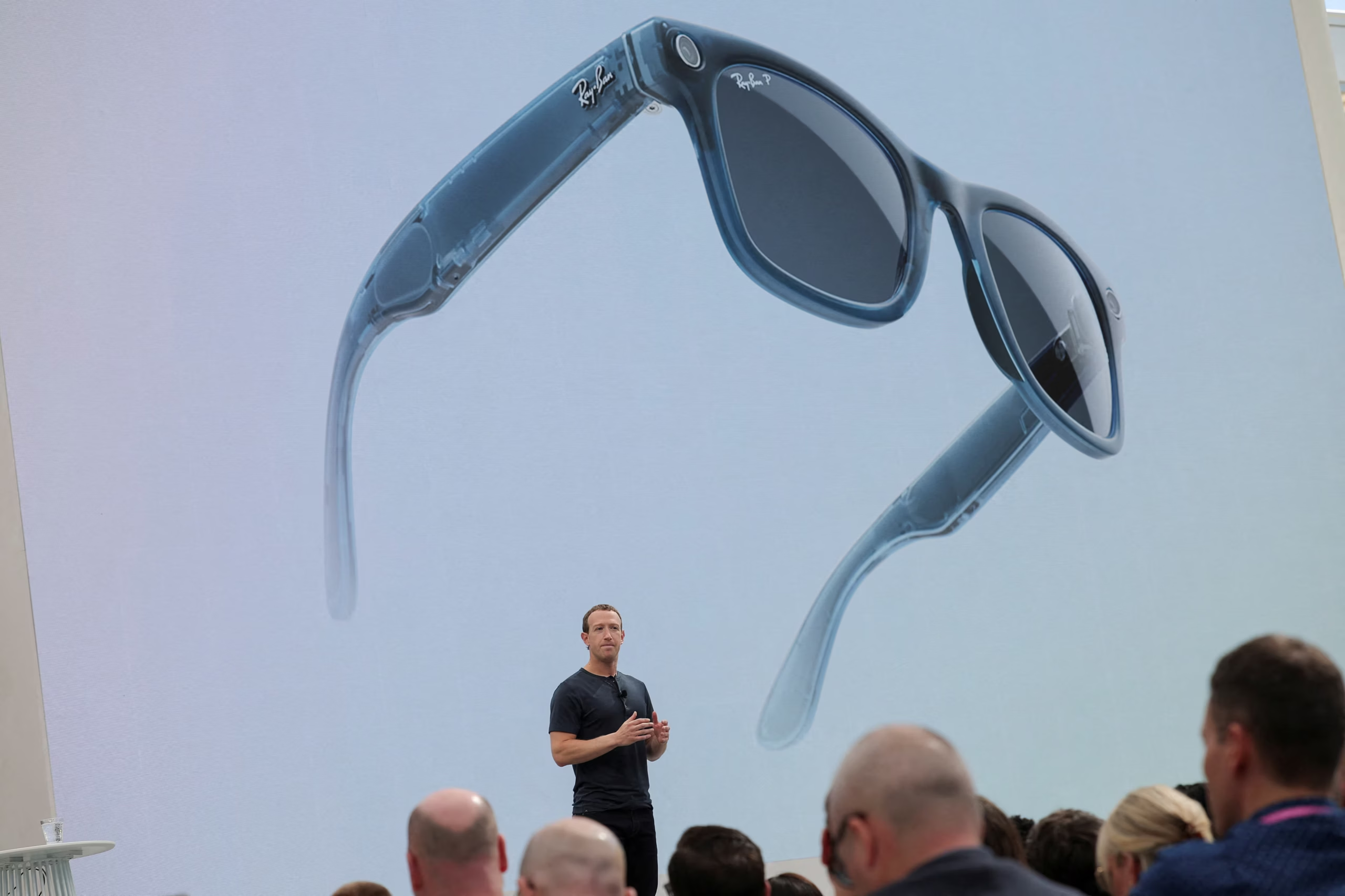
    During the recent Meta Connect event, CEO Mark Zuckerberg unveiled the Meta Ray-Ban Display, their latest innovation in smart glasses technology. This newly introduced product, featuring an integrated display, is not classified as an Augmented Reality (AR) device; however, Meta is fully engaged in the development of AR technology. There is speculation that the company might unveil another unexpected product before launching a comprehensive AR glass.

    The Potential of Smart Glasses

    Mark Gurman, a notable figure in the tech industry, disclosed his impression of the Ray-Ban Display in a recent newsletter. According to Gurman, this is the first instance where he recognized the considerable potential of smart glasses technology. He also revealed that Meta is in the process of designing another pair of smart glasses equipped with dual displays.

    Interestingly, the upcoming model, despite being non-AR, will be launched during the same year as the consumer-oriented Orion AR smart glasses. Although it may seem unusual, the company is presumably aware that the AR smart glasses will carry a hefty price tag. The Ray-Ban Display, retailing at $799, is currently incurring losses for Meta. Despite a decade of financial investment into its XR (Extended Reality) division, Reality Labs, Meta continues to face financial losses in its drive to become a leader in the future of computing technology.

    The Functionality of Ray-Ban Display

    The existing Ray-Ban Display projects a screen to one side of the user’s vision. It is expected that the forthcoming dual-display model will expand upon this feature, potentially projecting two screens on either side and possibly granting the user the ability to operate two or more apps concurrently.

    Even though XR enthusiasts are eagerly awaiting the release of the AR glasses set for 2027, the current Meta Ray-Ban Display serves as an effective tool for practice.

    A Dual Display Smart Glasses in the Pipeline

    In other news, a beautifully illustrated book titled “Iconic Phones: Revolution at Your Fingertips” is set to release this fall. The book promises to offer a unique insight into some of the most distinctive and unforgettable phones from the past two decades. It is expected to be a must-have for tech enthusiasts, chronicling the stories of over 20 fan-favorite phones and their contribution to the technological revolution.

    Questions & Answers

    What is the Meta Ray-Ban Display?
    The Meta Ray-Ban Display is the latest innovation in smart glasses technology from Meta. It features an integrated display.

    What does the future hold for Meta’s smart glasses?
    Meta is reportedly working on another pair of smart glasses that will feature two displays. In addition, the company plans to release the Orion AR smart glasses in 2027.

    What is the “Iconic Phones: Revolution at Your Fingertips” book about?
    “Iconic Phones: Revolution at Your Fingertips” is an illustrated book that details the stories of more than 20 fan-favorite phones from the past two decades, highlighting their impact on the technological revolution.

  • Meta Unveils Ambitious Plan for Multi-Gigawatt Data Centers to Boost AI Innovation

    Meta Unveils Ambitious Plan for Multi-Gigawatt Data Centers to Boost AI Innovation

    Meta is gearing up for a groundbreaking leap in its artificial intelligence (AI) capabilities, announcing an ambitious investment of USD 72 billion to establish a series of formidable data centers across the globe. This extensive initiative is set to bolster the company’s efforts in developing super-intelligence and artificial general intelligence (AGI), with the first data center projected to come online next year.

    Revolutionary Data Centers on the Horizon

    The flagship of this initiative is Prometheus, a multi-gigawatt data center anticipated to begin operations in 2026. Meanwhile, another powerhouse center, Hyperion, is designed to scale up to an impressive 5 gigawatts in the subsequent years. Remarkably, these centers will be developed as “clusters,” featuring a colossal capacity that positions them among the largest data centers globally.

    Zuckerberg’s Vision for the Future

    Mark Zuckerberg, CEO of Meta Platforms, elaborated on the company’s grand vision, asserting that these sprawling titan clusters will encompass a footprint that rivals significant urban landscapes, such as a substantial portion of Manhattan. With this staggering scale, Meta aims to set a new standard in the data center landscape.

    R&D Powered by Cutting-Edge Infrastructure

    This major investment comes on the heels of Meta’s commitment to advancing research and development in AI. As the tech giant endeavors to push the boundaries of intelligence through AGI, these data centers will become critical to facilitating groundbreaking advancements and innovative solutions in the realm of AI.

    The landscape of artificial intelligence is set to get a major upgrade, and who knows — these futuristic hubs could soon be the breeding ground for the next big thing in tech, perhaps even an AI that finally understands why cats seem to rule the internet. Stay tuned!

    Questions & Answers

    What is the total investment Meta is making in its new data centers?
    Meta plans to invest USD 72 billion in the development of several massive data centers to enhance its artificial intelligence efforts.

    When is the first of Meta’s new data centers expected to be operational?
    The first data center, named Prometheus, is expected to come online in 2026.

    How is Meta transforming its approach to data centers?
    Meta is constructing its data centers as “clusters,” which will feature a significant capacity, some even capable of rivaling large areas like parts of Manhattan.

  • Meta to Bring World’s Longest Undersea Cable to India

    Meta to Bring World’s Longest Undersea Cable to India

    The announcement, made in accordance with the recent U.S.-India joint leaders’ statement, highlights Meta’s focus on India’s expanding digital ecosystem. The undersea network will play a crucial role in global internet connectivity, linking countries and supporting local telecom operators in delivering services.

    “Meta is investing in India—one of its largest markets—bringing the world’s longest, highest capacity, and most technologically advanced subsea cable project to connect India, the U.S., and other locations,” a Meta spokesperson said.

    This investment comes amid growing calls from telecom operators for major tech firms, including Meta, to contribute to network infrastructure development and alleviate data traffic congestion.

    According to Meta, Project Waterworth will utilize advanced routing techniques and innovative cable burial strategies to safeguard the cable system against damage, particularly in high-risk coastal regions. The cable will reach depths of up to 7,000 meters in deep-sea areas.

    A Meta spokesperson said the investment reflects the company’s commitment to economic growth, resilient infrastructure, and digital inclusion, driven by India’s increasing demand for digital services.

    The U.S.-India joint statement, released following Prime Minister Shri Narendra Modi’s visit to the U.S., also emphasized India’s plans to invest in undersea cable maintenance and financing in the Indian Ocean using trusted vendors.

    “This project will enable greater economic cooperation, facilitate digital inclusion, and open opportunities for technological development in these regions,” Meta noted. “In India, where we’ve already seen significant growth and investment, Waterworth will help accelerate progress and support the country’s digital economy ambitions.”

  • Global disruption of Meta services hits Facebook, Instagram

    Global disruption of Meta services hits Facebook, Instagram

    Meta’s apps like Facebook, Messenger, Instagram, and WhatsApp experienced outages Thursday, leaving users worldwide unable to connect or facing intermittent disruptions.

    The Vinh of Ha Dong District in Hanoi said at around 1 a.m. on Thursday he received a message notification on Messenger but was unable to view it as the app failed to load.

    “Initially I thought it was due to an undersea fiber-optic cable issue or heavy nighttime gaming traffic slowing the internet.

    When he tried to access other Meta apps, he found Facebook was accessible, though slowly, but Instagram displayed login errors. Many users reported being unable to access Messenger or Facebook on both phones and computers.

    According to Downdetector, a tool that monitors the status of internet services, reports of issues began surfacing globally at around 12:30 a.m. Vietnam time and peaked at 1 a.m.. There were over 80,000 reports for Facebook, 66,000 for Instagram and more than 10,000 for Messenger and WhatsApp.

    Unlike in March this year the outage did not cause a complete service disruption. Users experienced sporadic connectivity issues; some could not use the platforms on computers but managed to chat on their phones. Many users took to X to express their frustrations, causing hashtags like #facebookdown and #metadown to trend widely.

    By 2 a.m. Meta’s official X account acknowledged the issue in a statement: “We’re aware that a technical issue is impacting some users’ ability to access our apps. We’re working to get things back to normal as quickly as possible and apologize for any inconvenience.”

    By 5:26 a.m. Meta announced that the recovery process was “99% of the way there – just doing some last checks.” By 6 a.m. Instagram’s X account confirmed that the issue had been resolved.

    In March Meta’s services were down for about an hour. A comparable event occurred in 2021 when its multiple platforms were inaccessible globally for six hours due to a “configuration error” in their system. In 2019 Facebook’s web version also experienced a 24-hour connectivity loss.

  • Meta receives permission to train AI on your Facebook and Instagram posts

    Meta receives permission to train AI on your Facebook and Instagram posts

    Meta has received permission from authorities to begin training its AI models on public Facebook and Instagram posts in the U.K. This follows the company’s initial suspension of AI across the region when concerns were raised about how it planned to harvest data.

    Of course, modern AI models today were basically entirely trained on public data from the internet. After these models started gaining popularity the internet has become a lot more strict about what data it is willing to share. Many big websites now block AI from accessing their data unless they’re paid for it. Hence, using public data from Meta’s own social media platforms seems like an easy choice to make.

    But, much like how the EU has been a thorn in Apple’s side, authorities weren’t convinced about letting Meta train its models. After dialog with the U.K.’s ICO (Information Commissioner’s Office) Meta now has official permission. The ICO claims Meta will now make it easier for users to opt out of having their data used to train AI.

    The entire thing stands on unstable moral ground, however. Large parts of the internet are, understandably, very concerned about having their data scraped to train an AI model. Furthermore, the stigma against AI continues to grow as some people lose their jobs to it and others just find it annoying.

    That hasn’t stopped almost every major company today from investing heavily in it, though. Meta AI, for example, is now present in some of Meta’s services like WhatsApp. The company is also working on AI-powered AR smart glasses, something it deems the future of computing.

    Then we’ve also got Google’s Gemini, Samsung’s Galaxy AI and Apple Intelligence. Suffice it to say, AI is here to stay, and that means a lot of your data is going to be used to train it.

    AI definitely has the potential to revolutionize the world but I don’t think people will ever be fully comfortable with being used as data points. I won’t be surprised if some regions outright ban AI models from scraping data from the local population.