Tag: mobile payments

  • Seoul launches zero-fee digital payment system

    Seoul launches zero-fee digital payment system

    The city of Seoul has moved to ease the transaction-fee burden on small and medium-sized businesses (SMBs) by launching the “Zero Pay” zero-fee digital payment system. The system has been set up in partnership with banks and fintech firms in response to shop owners paying excessive proportions of their monthly sales into credit-card transaction fees.

    Twenty banks and digital payment firms – with the notable exclusion of KakaoPay, South Korea’s most popular mobile payment service – are participating in the zero-fee digital payment system, which is digital-wallet activated via QR codes through which money is transferred directly between bank accounts.

    Businesses with annual sales less than KRW800 million (US$708,820) will not be charged transaction fees, while those with higher takings will be charged fees well below the credit card industry standard of 2.2 per cent.

    “If consumers and citizens use Zero Pay whenever possible, it will be a great help for self-employed businessmen,” said Seoul city mayor Park Won-soon.

    Around 16,750 stores have signed on to the Zero Pay program so far.

  • Security concerns inhibiting m-payment adoption in Hong Kong

    Security concerns inhibiting m-payment adoption in Hong Kong

    More than half (53%) of Hong Kong residents polled during a recent survey conducted by the Hong Kong Internet Registration Corporation (HKIRC) said concerns over cybersecurity and privacy risks are major barriers to greater adoption of mobile payments.

    Other barriers that have been cited in the survey include technical instability and the lack of support for mobile payment from most local merchants in the city

    In speaking about the survey, HKIRC deputy CEO Bonnie Chun allayed the primary fear of using mobile payment, pointing out that the government ‘has already put a lot of regulations in place to ensure the industry strictly follow their guidelines. We suggest the government promote its policies via different channels such as social media among others,” said Chun.

    She added that the government should keep on educating the public about the different ways of maintaining safe online hygiene such as changing one’s passwords regularly, using two-factor authentication, not using public Wi-Fi connections for making payment transaction and downloading mobile apps only from reliable sources.

    “Also, mobile payment providers should increase their transparency on how they handle personal data. They should try not to collect too much personal data during the registration process to increase users’ confidence.”

    Mobile payment gets a foothold in Hong Kong

    The survey polled 1,200 residents in the city between the ages of 18 and 65, who belong to various industry sectors.

    Survey results showed that mobile payment is now gaining a foothold in the city with 23% of respondents using mobile payment and is now in the top three payment methods in Hong Kong after credit cards (37%) and Octopus Card (25%).

    While 93% of respondents between the ages of 18 to 25 have used it before, a high percentage – 77% – of older respondents aged 56 to 67 have also used mobile payments.

    More than a quarter of respondents or 28% have been using mobile payments two to three times a week. About 88% of respondents use their mobile phone for transactions of less than HK$500 ($64).

    The survey showed that respondents want to be able to use mobile payment in three areas: public transport, government bills and clinic,

    “The future of mobile payment in Hong Kong is very positive. When we start using mobile payment in public transport, people will become more familiar with it and the adoption rate will increase,” Chun said

  • M1 will launch Apple Pay in Singapore

    M1 will launch Apple Pay in Singapore

    The operator will allow its customers to use the mobile payment service to make purchases at M1 Shop outlets and branches.

    Apple has meanwhile revealed it has extended the reach of Apple Pay to include holders of credit and debit cards issued by five banks in the country – DBS Bank, OCBC Bank, POSB Bank, United Overseas Bank (UOB) and Standard Chartered Bank.

    The five banks combined account for more than 80% of credit and debit cards issued in the country.

    Apple Pay, which launched last month in Singapore, was previously only available to holders of credit cards issued by American Express in the nation.

    The service is currently available in six markets – Australia, Canada, China, United States, United Kingdom and Singapore, with planned launches for Hong Kong and Spain this year.

    The service can be used on Apple’s iPhone SE, iPhone 6s, iPhone 6s Plus, iPhone6, iPhone 6 Plus and Apple Watch devices for payments at physical retail outlets.

    Banks are likely hoping Apple Pay transactions will increase adoption of contactless payments and eat into a chunk of the small payments pie currently dominated by cash transactions.

    OCBC Bank Singapore is offering its credit and debit card customers a 3% rebate for Apple Pay transactions island-wide in the first month of activation, with a cap of up to S$15 ($11).

    UOB is meanwhile aiming to lift the S$100 transaction limit for contactless payments at all its POS terminals island by the end of next year. The limit has been removed from 2,000 of the bank’s 10,000 terminals so far.

    Figures from a recent MasterCard study have revealed an appetite for digital wallets among consumers in the Asia Pacific, with 19.5% using such wallets, a two-fold increase from two years ago.

  • Mobile money service launched in Bangladesh

    Mobile money service launched in Bangladesh

    Financial inclusion in Bangladesh just took a stride closer to reality with the launch of a new international remittance receiving service via a partnership between MasterCard, Western Union, bKash and BRAC Bank.

    The new service enables bKash’s registered customers to use their mobile phones to receive remittances from abroad directly into their bKash accounts.

    A subsidiary of BRAC Bank and a joint venture between BRAC Bank and Money in Motion LLC of USA, bkash serves the low income masses of Bangladesh to achieve broader financial inclusion by providing services that are convenient, affordable and reliable.

    With 70% of the population living in rural Bangladesh many of whom have no access to formal financial services, it is also the eight largest receiver of international remittances in the world. Under 15% of Bangladeshis are connected to the prescribed banking system whereas over 68% have mobile phones.

    World Bank South Asia Financial Inclusion Index 2014These phones are not only devices for talking, but can be used for more useful and difficult processing tasks. bKash was conceived primarily to use these mobile devices and the universal telecom networks to extend financial services in a protected manner to the under-served distant population of Bangladesh.

    By using the new service, bKash’s registered customers can receive remittances from every Western Union send market and channel directly into their bKash account, 24 hours a day.

    MasterCard’s Matthew Driver said: “This relationship is another step towards achieving our global commitment to make the financial system accessible to 500 million more people by 2020. Working with companies such as bKash and Western Union is crucial to taking advantage of the latest technology; digitizing money transfers and supporting financial inclusion efforts in the South Asia region and worldwide. The choice, flexibility and convenience of this new bKash service will help to expand financial inclusion to some of the most remote parts of this thriving nation.”

    Western Union’s Jean Claude Farah said international money transfers over mobile phones will accelerate financial inclusion in Bangladesh where there are currently more mobile phones than there are customers with bank accounts.

    In 2011, the Bangladesh Bank, the country’s central bank, issued the Mobile Financial Services (MFS) Guidelines and mandated that the model where MFS must be bank-led but also clearly indicated that partnerships with mobile operators must be forged to reach customers. The first two MFS providers to emerged as leaders early on were BRAC/bKash and Dutch Bangla-Bank/DBBL.

    Like many parts of developing Asia, financial inclusion is part of the government via the central bank’s strategic plan, aimed at ensuring these products meet the needs of the traditionally underserved segments of society. Among the services on priority list include expanding access to financial services to women, poor and rural populations; and formalizing financial services by promoting registered transactions.

  • Banks take up Visa Token Service

    Banks take up Visa Token Service

    An extra layer of security for mobile and digital payments has been introduced by Singapore’s United Overseas Bank (UOB) and Australia’s National Australia Bank (NAB).

    As well as making transactions safer, the new Visa Token Service also makes instore shopping easier.

    Credit or debit cards are no longer necessary under the Australian bank’s new mobile payment service,NAB Pay, which lets customers use their mobile phone for purchases.

    For UOB customers, the Visa Token Service has been integrated into the UOB Mighty digital wallet. It allows UOB Visa credit or debit card users to make contactless payments via an app on NFC-enabled Android smartphones at selected outlets in Singapore and overseas.

    Visa’s new technology replaces sensitive account information found on payment cards with a unique digital identifier or “token” that does not expose account details during the payment process. Tokenised cards are also domain controlled, meaning they link to the user’s phone or wallet application and are validated in real time by the global payment-processing platform VisaNet.

    Launched in the US, the Visa Token Service is being rolled out in several markets across Asia Pacific over the coming months. As payments shift from plastic to digital, Visa is working with financial institutions, merchants and technology partners to offer consumers a secure and easy way to buy.

    A key benefit of the service is that tokens do not carry the user’s primary account number, so there is less risk of storing them on mobile devices, online (eCommerce merchants) or in cloud-based mobile applications.

    Using ISO standards, the tokens can be processed and routed by merchants, acquirers and issues in the same was a traditional card payments.

    Tokens tied to lost or stolen mobile devices can be instantly reissued, and multiple tokens can be used for a single primary account, each tied to a specific device or service. Tokens can also be exclusive to specific merchants, mobile devices, transactions or transaction categories.

    VisaNet is capable of handling more than 65,000 transaction messages a second, with fraud protection for consumers and assured payment for merchants.

  • Smartphones outpace tablets in Asian eCommerce

    Smartphones outpace tablets in Asian eCommerce

    For the first time, 34 per cent of browser-based online transactions globally are now made on a mobile device, compared to slightly more than 30 per cent last quarter.

    And smartphones are starting to outpace tablets.

    These were key findings of the fourth quarter edition of the Mobile Payments Index by Global payments technology company Adyen, which tracks mobile payment data from browser-based transactions across its client base and monitors Asian eCommerce shopping patterns.

    It also found that many consumers in Asia are increasingly using mobile devices to shop online. This is being driven particularly by such major payments methods as Alipay, JCB and UnionPay. JCB had the highest share (54 per cent) of mobile payments on the Adjen platform, up from 47 per cent the previous quarter. Alipay increased to 44 per cent (up from 35 per cent) while UnionPay reached 31 per cent (from 23 per cent).

    “The checkout stage of the shopper journey is not the end, but the beginning of an on-going relationship with the consumer,” says Adyen Asia Pacific president Warren Hayashi. “Merchants with a frictionless mobile checkout experience are driving repeat traffic, especially in Asia.”

    For the first time, the index shows that smartphones have overtaken tablets as the preferred device for online shopping – 17.5 per cent on smartphone against 16 per cent on tablet, compared to 14 per cent and 17 per cent respectively the previous quarter.

    When it comes to mobile payments globally, the trend to use smartphones rather than tablets continues for the 10th consecutive quarter. Last quarter this share was up 2 per cent to 68 per cent on smartphone versus 32 per cent on tablet.

    Smartphone use far outweighed tablet in Asia, with 29.5 per cent of online payments on a smartphone compared to 4.5 per cent on a tablet.

    In terms of average transaction value, iPad led the way for the first time at $107, edging out not just smartphones but also desktop/laptop, the traditional leader (at $106). Following were Android tablets at $86, iPhone at $83 then Android smartphones at $73.

    Adyen has been tracking the evolution of mobile payments since June 2013. The index is based on its global browser-based mobile payment transaction data. It does not track in-app mobile payments. With its headquarters in Amsterdam and San Francisco, Adyen serves more than 4500 businesses, customers including Airbnb, Booking.com, Crocs, Dropbox, Facebook, KLM, Mango, Netflix, Spotify and Yelp.

  • Mobile payment race intensifies

    Mobile payment race intensifies

    From smartphone-makers to retail firms, more companies are jumping on the mobile payment bandwagon in a bid to take the initiative for hassle-free digital payments.

    As there is no single dominant player or set of standards yet, the mushrooming mobile payment market is flooded with more than 20 related applications in Korea and may look like a hodgepodge of technologies for some.

    Many industry officials, however, had a positive outlook on the fledgling market, anticipating that the mobile payment systems would further proliferate and one day kill plastic cards.

    “There will be a tenfold increase in the mobile payment services next year, and it is highly likely considering the great growth potential with most websites requiring online payment solutions,” forecast Park So-yeong, chief executive of electronics payment PayGate and chairperson of the Korea Fintech Forum, an organization for the financial technology sector.

    She added that the market needs a set of standards in order to enhance convenience for consumers, and small retailers that may want to adopt the contactless payment technology in the coming years.
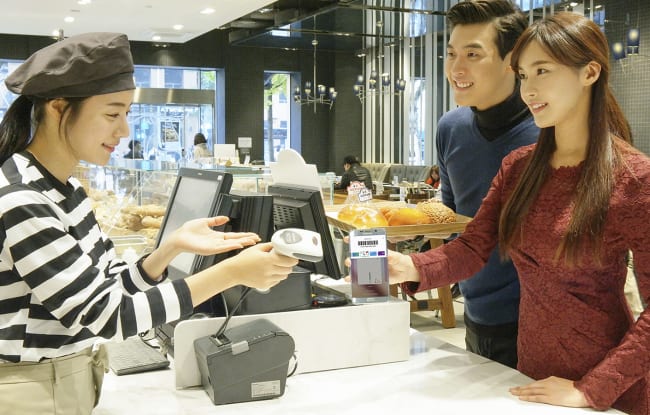
    Users try to use mobile payment system Samsung Pay. (Samsung)

    Some said that the growing number of mobile payment apps ironically cause inconvenience due to the lack of standardized technologies, arguing new payment services will come and go until the emergence of strong market leaders.

    “Even Kakao, operator of Korea’s most used mobile messenger, has not been able to rule the mobile payment market,” said an industry source, adding that the firm’s KakaoPay takes up less than 10 percent of payments on Baedal Minjok, the largest food ordering app in Korea.

    Other mobile payment services providers include retail colossuses Shinsegae and Lotte, as also Internet giant Naver and LG Electronics.

    The Korean mobile payment market more than quintupled to 5.7 trillion won ($4.9 billion) in the second quarter this year from 1.1 trillion won in the first quarter of 2013, according to state-run statistics organization Statistics Korea.

    Highly considered as one of the potential market leaders, Samsung is gaining momentum to win the mobile payment race.

    After U.S. tech giant Apple launched contactless mobile payment system Apple Pay last year, Seoul-headquartered Samsung Electronics rolled out its own system in August.

    Despite its somewhat belated start, Samsung Pay has been garnering quite an upbeat response from reviewers and users around the world.

    Accumulative payments crossed the 100 billion won mark with the number of Samsung Pay subscribers exceeding 1 million in two months since its launch in Korea.

    Samsung Pay is often said to have a competitive edge over Apple Pay thanks largely to its better compatibility with the Magnetic Secure Transmission and Near Field Communications technologies.

    Apple Pay allows users to make purchases only with NFC terminals while Samsung Pay is compatible with both magnetic swipe and NFC terminals.

    “Some even say Samsung Pay is the last hope for the Korean tech giant’s mobile business unit, which is being squeezed hard between Apple in the premium handset segment and Chinese upstarts in the low end,” a market official said.

    The tech behemoth is also beefing up partnerships with credit card firms and banks to allow Samsung Pay users to use ATMs with the mobile service.

    Some of the global financial firms include Chase, Visa, American Express and MasterCard.

    Local investment firm BNK Securities anticipated the shipment of Samsung smartphones equipped with Samsung Pay worldwide will reach 22.5 million units — 11.4 million in Asia and 11.1 in North America — next year.

    The increasing popularity of the Samsung payment solution and the expanding mobile payment ecosystem has become a boon for Samsung’s partners and component makers for biometric sensors — used in smartphones to authenticate users.

    Among the beneficiaries are the Korea Information Certificate Authority, which develops user authentication solutions, and Amotech.

    KICA provides fingerprint identification solutions for Samsung Pay and the latter supplies chip modules used for the payment system.

    KICA’s share price doubled to 21,000 won in the two months that Samsung Pay was released, and is now hovering between 12,000 won and 14,000 won.

    It is also expected that Samsung would install its payment solutions in a variety of its products, including smart TVs, mid-range and low-end smartphones, running on the Tizen operating system.

    The Tizen OS has been jointly developed by a group of global tech firms including Intel.

    Fingerprint scanners will be more widely deployed in budget Samsung smartphones to beef up security of the mobile payment app.