Premium brand Moleskine is setting its eyes on Asia as a major potential growth market, planning expansion both online and offline and integrating more smart technology into its product range.
In an interview with Inside Retail Asia, recently appointed CEO Daniela Riccardi says one of the core priorities of a five-year plan she has drafted for Moleskine globally will be to create greater brand awareness among Asian consumers.
“We want to share with them the Moleskine heritage and values in order to develop brand presence and overall business throughout this very important region.”
Moleskine was founded 23 years ago in Milan, Italy. It began with a little black notebook with rounded corners and ivory-hued pages inspired by those used by great writers and artists of the past – prodigious note-takers who would inspire generations with their creative genius. Since then, it has evolved into a whole ecosystem of notebooks, diaries, bags and accessories, and smart tools and services.
The conspicuous quality and style of Moleskine products notwithstanding, these kinds of items have become rather commoditized in many parts of Asia. Riccardi believes the brand is up for the challenge of building a premium brand in such a context.
“I believe that what has made Moleskine so unique is that what Maria Sebregondi and the founders of the brand created was more than a bundle of pages within two covers: what was created was a tool for the creative community,” Riccardi explains.
“Every detail of the notebook was carefully looked at when it was designed: the quality of the paper, the “in case of loss” label, the pocket on the back cover to hold bits and bobs, the rounded corners that allow it to slip effortlessly into a pocket, the elastic band closure. It was first distributed in bookstores and labeled “the book yet to be written”, because a Moleskine notebook becomes meaningful once our customers start filling its pages. It is quite simply more than a notebook and our ever-growing community embraces that.”
Overcoming the Covid-19 era
While the onset of the Covid-19 pandemic has disrupted business throughout the world, Ricccardi is confident Moleskine will ride out the storm and remains committed to its growth agenda.
“Clearly Covid has been difficult for all businesses worldwide and Moleskine has also inevitably suffered, but I am working alongside all the people in the company to implement a long-term plan that will ensure that Moleskine will ride this extraordinarily difficult wave and overcome what I am certain is a moment.”
The five-year plan she created soon after taking office on April 1 is based on the belief that a brand can never rest on its laurels.
“Any evolving company needs to constantly look at itself in order to renew and continue to grow, which is why building this plan was my first order of business.”
The plan includes equal focus both on- and off-line in order to optimize the customer experience for all of its customers.
We have also partnered with some of the most significant institutions and brands worldwide and will continue to do so with a focus on bigger strategic partnerships with cultural institutions such as universities and museums. Partners with whom we share a like-minded ethos. Learn more about Moleskine’s co-branding project.
The shift to digital
As the world moves increasingly to digital – with less reliance on paper and physical (rather than virtual) note taking – Moleskine is mindful of adjusting its business model to adapt.
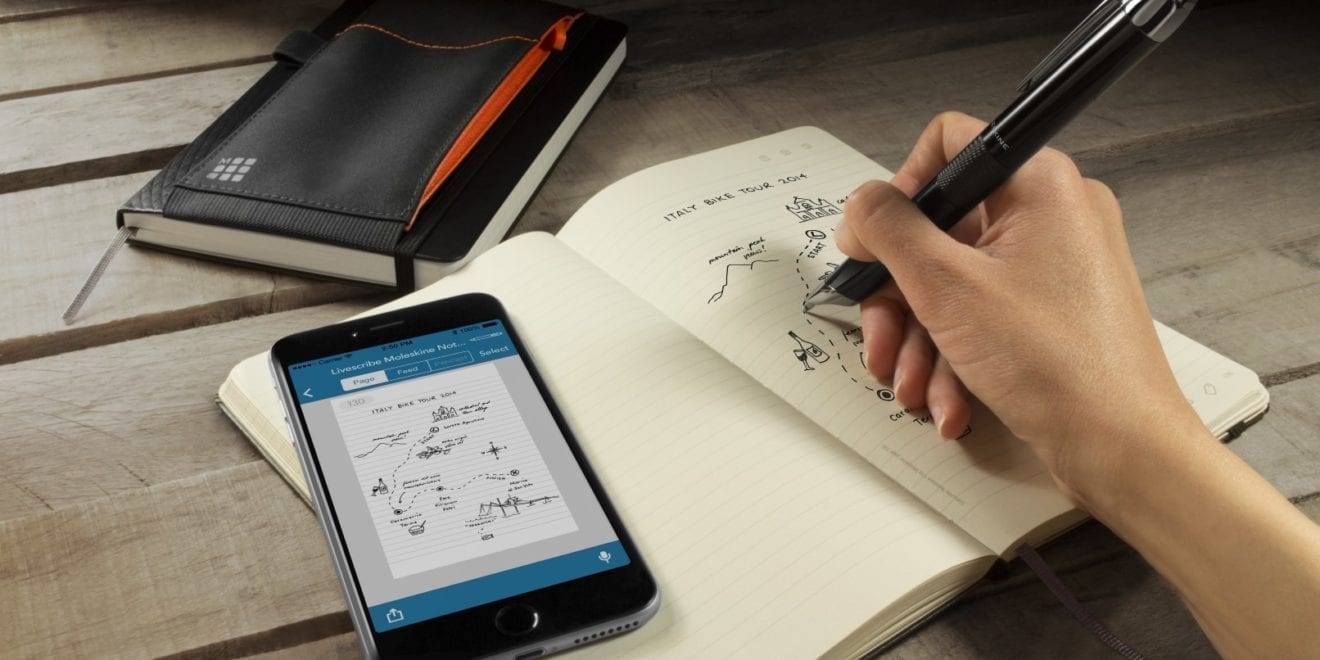
“Moleskine has grown alongside the internet and when our founders created the brand, the importance and the relevance of the digital world was very clear in their minds. We create objects that live together with the digital world, that complement each other. The Smart Writing System is a perfect example of this: it is composed of a smartpen and centers around a specially created paper that when written or drawn on recognizes pen strokes. The system allows for all notes and thoughts to appear in real-time on digital devices as they are written on this almost “magical” paper,” says Riccardi.
“We have always embraced technology as it is an essential part of everyone’s lives.”
Alongside its digital foray, Moleskine continues to work on new products and designs to remain relevant to today’s consumers.
“We have a small in-house team that has worked on creating new ideas and designs. This is one of the areas I intend to better develop going forward. The Moleskine aesthetic is very clear and staying true to those values is what makes the brand so authentic and appreciated by our customers.”
Such a focus will help the brand build greater market share in existing markets as well as expanding into relatively new frontiers like Asia and Africa.
“In terms of product categories, I believe that we have a great richness in our original and iconic notebook from where it all started. It is a small but great tool that we hope contributes to the development of creativity, culture, and knowledge and I would like to see a return to our origins as the first step to future growth.”
Taking the reins
Taking over the helm of Moleskine in a world where borders were closed was a surreal experience for Riccardi, an executive with previous management experience in companies including Procter & Gamble and fashion brand Diesel in 2010, where she was CEO, before taking over as CEO of 250-year-old French crystal maker Baccarat in 2013.
“Taking over the helm of a company without meeting the team in person was an extraordinary experience to say the least. Not being able to travel to see the markets myself was initially a challenge. But as the saying goes, where there is a will there’s away, and I am confident that together with the team we will overcome this difficult time and move forward as a stronger company and brand.”
Riccardi’s greatest achievement in business to date, she tells Inside Retail Asia, is building gender diversity within the companies she has led.
“Gender diversity has always been important to me and throughout my career, I have sought to inspire and empower women, particularly in circumstances where age or social or religious factors can be a challenge.”
At Moleskine she wants her legacy to have grown the brand to greater heights and recognition than when she took over this year.
“I am very careful about the projects I decide to undertake and the brands I decide to work with. It is important to me that I have the utter conviction of the strength of a brand and its unique values. Moleskine has these qualities in spades, and I see in it untapped opportunities that are the cornerstone of my work for developing a framework for growth in the years to come.”
Based in her native Italy, Riccardi has several directorships in addition to her Moleskine role. She is on the board of French luxury-goods powerhouse Kering, of Comité Colbert, an association of French Luxury Brands and cultural institutions, and the world’s largest communications and advertising company, London-based WPP.
If there is a common element to the companies which Riccardi commits her time to it has to be style and creativity – not to mention heritage – a group into which Moleskine fits perfectly.
“Moleskine at its core celebrates the power of creativity and has a unique connection to paper where human genius has always given its best. We provide tools for empowerment and spaces for ideas to grow, with the idea of unleashing the limitless human potential,” reflects Riccardi.
“After all creativity is universal and timeless and will always be relevant to the world.”