Retail News CRM

Tag: MWC

  • ZTE reveals innovative 5G devices at MWC 2021

    ZTE reveals innovative 5G devices at MWC 2021

    ZTE Corporation, a major international provider of telecommunications, enterprise, and consumer technology solutions for the mobile internet, today has revealed its next-generation 5G Indoor CPE MC8020, and shared its plans for the next under-display camera smartphone at Mobile World Congress 2021. Also, ZTE’s much-awaited devices can be seen at Mobile World Congress from 28 June through 1 July 2021 at 3F30, Hall 3, FIRA GRAN VIA.

    ZTE is integrating its capabilities and expertise across handsets, mobile broadband, terminal chipset modules, and peripheral products to create a smarter 5G ecosystem. A variety of 5G products will be applied into four major application scenarios, specifically health, travel, education and entertainment.

    During Mobile World Congress, attendees can experience the connected 5G ecosystem through products on display, including the ZTE 5G Portable CPE MU5001, ZTE 5G Indoor CPE MC8020, ZTE Watch GT, ZTE LiveBuds and more.

    ZTE is globally recognized for industry-leading 5G terminal devices and technical innovations such as its flagship smartphone ZTE Axon Series.

    The newly launched ZTE Axon 30 Ultra ushers in the next era of mobile imaging technology with its Trinity Camera System, consisting of three 64MP cameras and an 8MP periscope zoom camera. Its high-powered system leverages the triple cameras to achieve new possibilities, such as capturing simultaneous shots for narrative-level storytelling, taking full-focus photos from long, medium, and close-up distance with one click.

    Soon, ZTE will unveil the second-generation under-display camera smartphone, marking another breakthrough in under-display technologies that aims to enhance the display experience.

    The third-generation ZTE 5G Indoor CPE MC8020 supports both 5G SA and NSA modes, as well as Sub-6GHz and mmWave spectrum bands. Featuring the exclusive zlink Boost technology, the device enables dual-path convergence of 5G and wired broadband, allowing dual gigabit access.

    Additionally, the ZTE 5G Indoor CPE MC8020 employs the latest Wi-Fi 6 AX5400 access technology, delivering 200 percent faster access speed than that of the previous generation. The four-way omnidirectional high-gain antenna provides a high-speed 5G network for up to 128 Wi-Fi users simultaneously.

    Since the official appointment of Ni Fei as the new CEO of ZTE Mobile Devices, ZTE has gathered customer and industry insights to address pain points and ride big industry trends, accelerating the rollouts of innovative and highly-recognized products.

    ZTE also integrated its three major smartphone brands, ZTE, Nubia and RedMagic. The integration brought the Nubia Z30 back to market with its heritage of innovation. Furthermore, in partnership with Tencent, ZTE has rolled out the new RedMagic 6, one of the most powerful gaming smartphones in the market.

    ZTE has been investing in its brand with an eye set on next generation and the use of 5G. Most recently, ZTE has collaborated with the Director Zhang Yimou to produce high-quality television spots and appointed the famed Liu Haocun as ZTE’s new brand ambassador.

    ZTE plans to strengthen its direct-to-consumer relationships through offline retail sites. The company is stepping up construction of offline channels with plans to build 5,000 retail sites by the end of 2021. ZTE has completed construction of 3,000 ones to date. Shoppers can visit ZTE’s first 5G experience store in Shenzhen this summer.

    In Q1 2021 , ZTE’s consumer business has achieved year-on-year revenue growth of more than 60% largely driven by the integration of brand, product, and channel – a reply to ZTE’s strategic return to the terminal market.
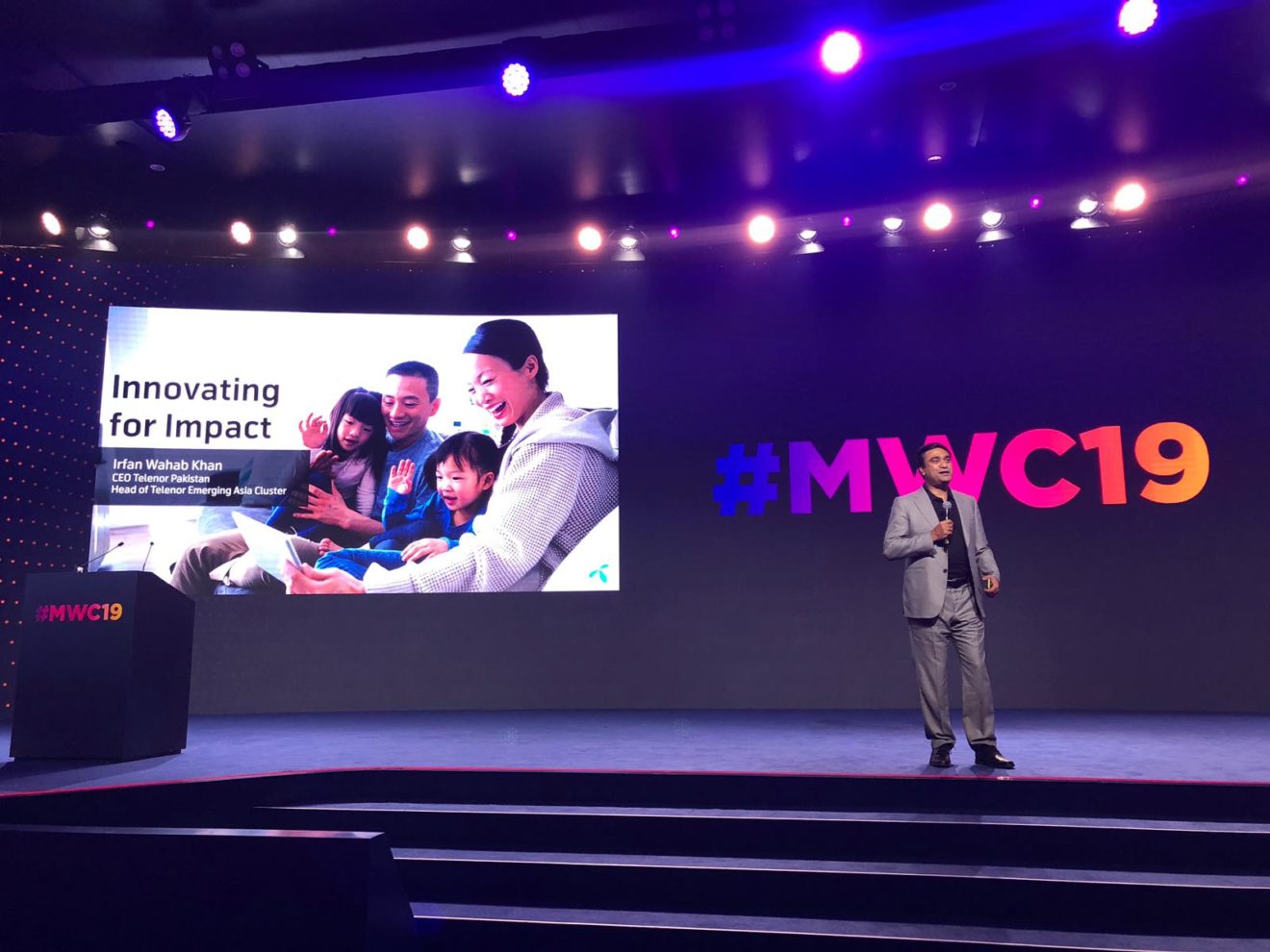

  • Irfan Wahab Khan at MWC Shanghai 2019

    Irfan Wahab Khan at MWC Shanghai 2019

    Telecommunications has accelerated development of key sectors, spurring economic growth and opening countless avenues to empower individuals and societies, said Irfan Wahab Khan, Head of Telenor Group’s Emerging Asia Cluster and CEO of Telenor Pakistan, at the Mobile World Congress (MWC) in Shanghai. His keynote at MWC, ‘Pioneers of Intelligent Connectivity’, also shed light on how intelligent connectivity and Telenor Group’s disruptive innovation are transforming lives of millions, enabling basic civic rights through mobile birth registration and equipping the unbanked with mobile financial services, among others.

    MWC Shanghai 2019 highlighted how ICT-powered solutions and services are creating strong socioeconomic impact. Irfan highlighted the advent of the Asian Century and role of Telenor Group in transforming health, financial services and agriculture in Asia. In particular, he listed innovative mobile-based solutions like Bangladesh’s ‘Tonic’, Myanmar’s ‘WaveMoney’, and Thailand’s ‘Smart Farmer’, which are providing a myriad of digital health services, safe money transfers, and IoT farming solutions respectively to millions of people.

    In addition, he shared how Telenor Group is using big data to help predict outbreak of chronic diseases like dengue in Pakistan and malaria in Bangladesh. The partnership between Telenor Microfinance Bank in Pakistan with its Malaysian counterpart Valyou has also introduced Pakistan’s first blockchain-based cross-border remittance service, powered by industry-leading blockchain technology developed by Alipay of the Ant Financial Services Group.

    “Mobile connectivity and the internet are the greatest equalisers of our day. They impact nearly every aspect of life today, driving social interactions and creating new business opportunities. Through the power of connectivity, Telenor Group has been connecting people to what matters most for the past 160 years. We will continue to do so through disruptive innovation that empowers societies and improve lives, in order to secure a better future for all,” said Irfan.

    MWC Shanghai 2019 is focusing on technologies of the future that include 5G, IoT, AI, big data, blockchain and beyond. The event features the most influential and industry dominating companies and organizations coming together to explore the depths of Intelligent Connectivity. Through the MWC19 Shanghai platform, leading companies take charge of industry-focused discussions, influence the future of connectivity, and unveil new intelligently connected technologies. In addition to his keynote and other MWC engagements, Irfan is also set to hold meetings with global tech leaders, partners and innovators in technology to explore opportunities through the technology-driven ecosystem.

  • Sony’s days in the smartphone Industry are Ending

    Sony’s days in the smartphone Industry are Ending

    Sony has never been able to obtain success in the smartphone industry the way it once controlled the mp3 market, the video game console market, and the television market. Trying to differentiate itself, this year’s Xperia 1 flagship, unveiled at MWC in February, features a 6.5-inch 4K AMOLED display with a 21:9 aspect ratio. Despite what would appear to be a great screen for watching streaming video on, the pricing is sure to turn some away.

    For the second time in six years, a particular hedge fund is building up a stake in Sony hoping to influence its business decisions. Those familiar with the plans say that Third Point LLC, run by Daniel Loeb, is looking to implement its own turnaround strategy for Sony. Loeb’s fund reportedly has $14.5 billion in assets and is believed to be raising money ($500 million to $1 billion) for a fund dedicated to the purchase of more Sony shares.

    The parts of Sony that Third Point wants to take a hard look at include the semiconductor and insurance businesses and the movie studio, which some believe that Amazon and Netflix could be interested in. And while the report from Reuters doesn’t mention the mobile phone business, it most likely would be a division that Loeb would prefer to see Sony jettison. Last month, the company folded its mobile unit into the same business segment that includes its TV, camera and audio products. And a report published in March stated that by next year Sony will cut the head count in its smartphone division in half.

    Jefferies analyst Atul Goyal told clients in a note sent out last week that Sony needs to exit the mobile phone business. Sony will no doubt want to gauge the reception to the Xperia 1 before it decides whether or not to stop producing smartphones. But if Third Point LLC builds a big enough stake in Sony, the decision whether to cut its losses in the smartphone industry might be taken out of the company’s own hands.

  • Connectivity is not an asset, MWC told

    Connectivity is not an asset, MWC told

    Serial telecoms entrepreneur Alexey Reznikovich says that building an “enabled gateway” to customers is the key to survival for traditional telecoms players, who need to stop relying on the diminishing returns from connectivity.

    Speaking at a keynote session at Mobile World Congress in Barcelona last week, Rezhikovich outlined how his company VimpelCom, now re-branded at VEON, planned to build that “enabled gateway” as he announced a free downloadable app which was a platform combining payments, entertainment and information services.

    NASDAQ listed but headquartered in Amsterdam, VEON has more than 200 million global customers. VEON is both the new name for VimpelCom and for the “new personal internet platform” which integrates data analytics and artificial intelligence and includes partnerships with brands such as Mastercard, Deezer, and STUDIO+.

    The company claims the app, which is free from data charges on VEON’s mobile networks, “tears down the archaic and inefficient bricks and mortar service model.”

    In his keynote, Reznikovich painted a dark vision of the current state of the telecoms industry, claiming that its “corporate and bureaucratic” culture was scaring away young talented people, who much preferred to work at internet companies such as Google and Amazon.

    “Young people don’t want to work for us,” he said.

    The telecoms industry had worked “very very hard” in the last five years but “nothing has moved the needle.” He likened the industry to a “squirrel in a wheel” that was going as fast as it could, but not getting anywhere and was now exhausted.

    “What are the three big lies of the telecoms industry?” Reznikovich said.

    “The first lie is that data monetisation is coming. Well we are still waiting.

    “The second is that we have billions of customers. Well are they really our customers or are they people who just tolerate us and are really customers of someone else?”

  • Hong Kong’s mobile penetration grows to 95%

    Hong Kong’s mobile penetration grows to 95%

    Hong Kong’s mobile subscriber base has reached saturation point, with a population penetration of 95%, according to mobile industry body the GSM Association (GSMA).

    The company’s new report into APAC’s mobile economy, published at Mobile World Congress Shanghai this week, shows that there are around 6.9 million mobile subscribers in Hong Kong.

    While the penetration rate has grown from 90% as calculated in last year’s study, the report notes that there is little room for growth.

    But in terms of the percentage of subscribers to 4G services it is another story, with only around 40% of Hong Kong subscribers having made the switch to the faster technology as of 2015. The GSMA expects this to increase to 71% by 2020.

    The report finds that as of 2015 62% of the APAC population was subscribed to a mobile service. The GSMA predicts that the region will add another 600 million new subscribers by 2020, increasing the penetration rate to nearly 75%.

    Mobile accounted for an estimated 5.4% of APAC’s GDP last year, equivalent to $1.3 trillion in economic value.

    “More than half the world’s mobile subscribers are based in Asia Pacific and the region will be the main engine of global subscriber growth for the remainder of the decade,” said Mats Granryd, GSMA Director General.

    “Rising subscriber penetration, alongside accelerating migration to faster networks and more advanced services, continues to fuel innovation and digitisation across both advanced and emerging markets in this highly diverse region. Mobile is helping Asia build digital societies that allow its citizens to access services, anytime and anywhere – and these mobile-powered digital societies are becoming major drivers of social and economic development.”