Tag: Nguyen Kim

  • Vietnam to celebrate its new retail sales highest record US$129 billion

    Vietnam to celebrate its new retail sales highest record US$129 billion

    Spurred by a rising middle class and influx of international retailers, Vietnam retail sales hit a record US$129.6 billion last year.

    This was growth of 10.9 per cent over 2016, according to the Vietnam General Statistics Office (GSO).

    Vietnam’s largest real estate company, Vingroup, starting expanding its Vinmart Plus convenience store chain in 2016 and has already topped 1000 stores – it opened 100 last month alone. It is predicted the store network could reach 3000 this year.

    Meanwhile, Vietnam last year saw the arrival of a slew of foreign retail brands, headed by Japan’s Seven & I Holdings opening its first Vietnamese 7-Eleven convenience store in Ho Chi Minh City in June.

    Swedish fast-fashion brand H&M followed in September with a store in the same city, while Zara, the chain of Spanish rival Inditex, opened its second Vietnam location in Hanoi in November (its first store, covering two levels, launched at Vincom Centre Dong Khoi in Ho Chi Minh City in September 2016).

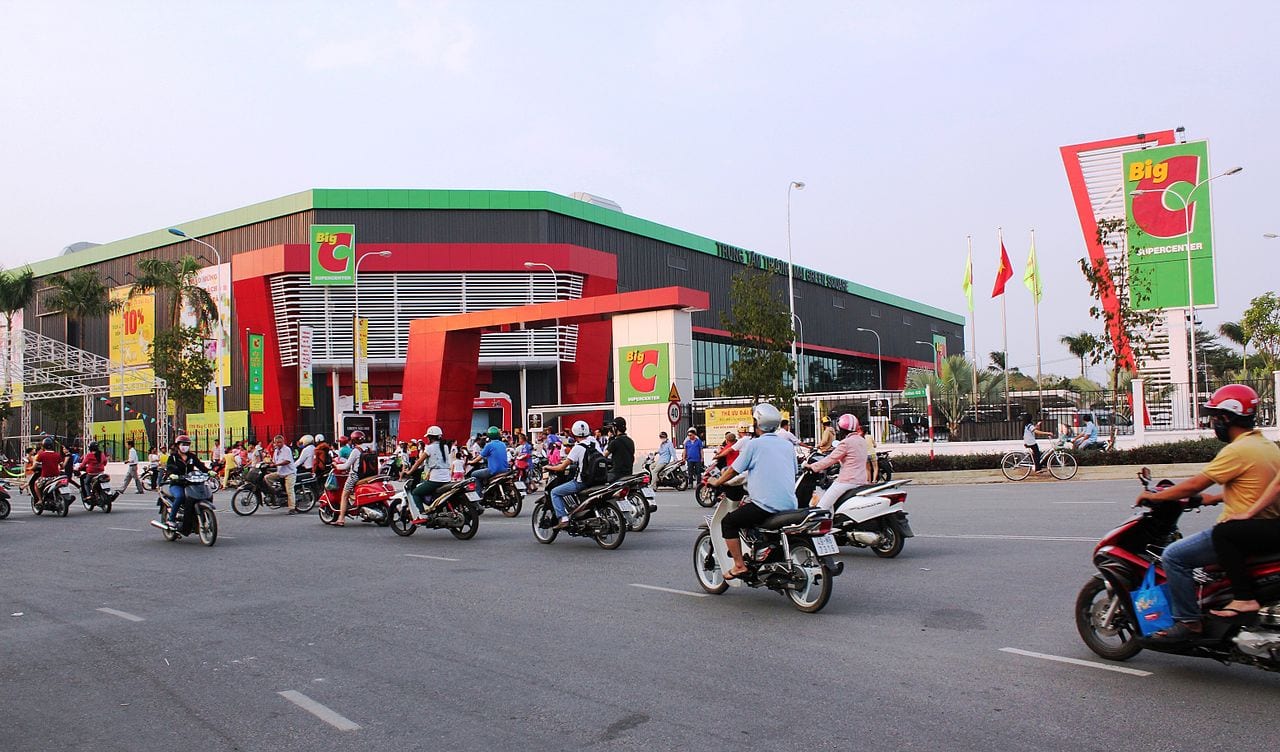
    Thailand’s Central Group has made several acquisitions in Vietnam, including the Big C supermarket chain and electronics retailer Nguyen Kim Trading. It also launched its first stationery and office supplies store in Vietnam last year.

    South Korea’s GS Retail partnered with Vietnam’s Son Kim Group 12 months ago to open the first of their convenience stores in Ho Chi Minh City this month. They plan to open 2000 locations within 10 years.

    Double-digit growth

    Since joining the World Trade Organisation in 2007 and opening up to foreign goods and businesses, Vietnam has seen continued double-digit growth, led by a 31.5 per cent spike in 2008. With the Association of Southeast Asian Nations Economic Community taking full effect this month, Vietnam has eliminated nearly all tariffs on goods from within the region.

    Meanwhile, supermarkets and convenience stores are selling meat and vegetables at prices that are 20 to 30 per cent higher than at traditional markets, and the number of specialty shops selling organic vegetables is growing.

    Spending on cars, home electronics and other consumer durables is also brisk, with 70 per cent of Vietnam’s GDP coming from personal consumption.

    The GSO says auto sales grew by 14 per cent in value, gemstone and precious metals by 13.2 per cent, food and foodstuffs by 11.1 per cent, cultural and educational products by 10.2 per cent, apparel by 9.6 per cent, and home products by 8.5 per cent.

    Vietnam still has room for growth as modern retail channels like supermarkets and shopping centres account for only a quarter of total retail sales, and most of these businesses are in big cities, reports VIetnamNet. By 2020, the proportion of modern retail channels is forecast to rise to 45 per cent.

  • Central Group turns focus to e-commerce

    Central Group turns focus to e-commerce

    hai retail giant Central Group aims to raise the share of its e-commerce sales to 15 per cent over five years, up from the present 1 per cent.

    Presenting the company’s annual business plan, CEO Tos Chirathivat says the group will aggressively pursue expansion in the digital realm this year.

    About 10 per cent of the 45.53 billion baht (US$1.3 billion) capital investment allocation this year will be devoted to online business. The funds will mainly go toward developing a logistics network and an omni-channel platform, with capital spending on that front to double from next year.

    Central Group’s retail portal, Central Online, will be overhauled this year. The conglomerate acquired the Thai business of fashion e-tailer Zalora last year, and will adapt its know-how for Central Online’s makeover.

    The group is also eyeing markets outside of Thailand, including an online re-entry into China, from where it retreated two years ago. Central Group president Yol Phokasub says it aims to collaborate with a partner this time.

    Vietnam is another promising market. The group has two department stores there and is also a stakeholder in electronics retailer Nguyen Kim.

    Meanwhile, Central says its group sales last year increased 17 per cent to 332.7 billion baht. The refurbishment of key assets such as Bangkok’s Central Plaza Pinklao helped boost sales, along with Zalora and the acquisition of Vietnamese supermarket chain Big C.

    Central aims to reap sales of 382.2 billion baht this year, with a heavy reliance on overseas business, which accounts for 30 per cent of sales, as well as developed online business.

  • Central Group Vietnam plans $30m investment

    Central Group Vietnam plans $30m investment

    Thailand’s Central Group plans a $30 million investment for its Vietnam expansion in the next five years.

    Central Group Vietnam will double the number of supermarkets as well as develop 13 commercial complexes by 2021.

    The Thai-based retailer has been expanding rapidly in Vietnam since 2013 targeting middle class customers.

    Since then, the group has acquired several operations to gain a strong foothold there.

    Last year, it acquired 49 per cent of electronics retail chain Nguyen Kim, followed by fashion eCommerce marketplace Zalora Vietnam.

    This April, Central bought out Big C Vietnam from the French group Casino in a deal worth $1.14 billion. The retail chain has 33 supermarkets nationwide which serves more than 50 million customers annually.

    With the population of more than 90 million, Vietnam has the world’s second-fastest growth per person since 1990, behind only China. In terms of retail growth, the country ranks in the top five in Asia and 11th globally.

  • Việt Nam retail market attracts international investors

    Việt Nam retail market attracts international investors

    Việt Nam’s growing retail market has attracted the attention of foreign retailers. A series of famous retailers from Japan, Thailand, South Korea and France have flocked to the country, hoping to penetrate the market, a recent JLL Việt Nam report said.

    As penetration of foreign retailers into the country has increased, fierce competition in the retail space has become more intense. This will put the retail market to the test and only retailers with the right positioning to meet market demand will gain market share.

    In 2014, the Berli Jucker acquisition of Metro Cash & Carry Việt Nam for an enterprise value of 655 million euro (US$700 million) – the largest-ever Merger & Acquisition deal in Việt Nam at that point – signalled entry of the Thailand retailer into the country.

    Later, another Thailand giant, Central Group, acquired Nguyễn Kim Trading – Việt Nam’s top electronics retailer, and BigC Việt Nam- the second largest supermarket chain in terms of store number in the nation.

    In October 2015, Emart – the leading South Korean retailer – officially marked its entrance with a US$60 million shopping centre in north HCM City. Also from South Korea, Lotte Mart is quite successful with 11 supermarkets, a number expected to increase to 60 stores by 2020.

    Most Japanese investors consider the success of Aeon in Việt Nam a praiseworthy case in overseas investment. Aeon has four malls and expects to reach 20 malls before 2020. Also from Japan, Takashimaya arrived in July 2016 as anchor tenant of downtown HCM City’s Saigon Centre retail mall.

    Adding to three Simply Mart stores in HCM City, AuchanSuper, a major retail brand from France, is planning to open another 17 supermarkets by end-2017 in the city and 20 stores by 2020 in northern Việt Nam.

    Thanks to increasing disposable incomes, big fashion brands such as Gap, Mango and Topshop have become the top choice of many young Vietnamese. In September 2015, Zara opened its first flagship store in HCM City. H&M will reportedly enter Việt Nam early next year.

    With 90 million people, Việt Nam has attracted retailers with its relatively young population – 70 per cent are aged between 15 and 64 years – who promise to be a key driver of robust market growth. Việt Nam’s urban population is expected to grow 2.6 per cent annually from 2015 to 2020, the highest rate among regional peers.

    “Increasing disposable incomes, rapid urbanisation and rising living standards make Việt Nam one of the most dynamic emerging economies in South East Asia,” says Bùi Trang, Commercial Leasing Director at JLL Việt Nam.

    According to the Boston Consulting Group, Việt Nam has the fastest growing middle and affluent class (MAC) in the region, which will double in size between 2012 and 2020, from 12 million to 33 million. MAC consumers, whose income is VNĐ15 million (US$700) or more a month, will be a key group of potential customers for retailers.

    Việt Nam e-commerce is set for strong growth thanks to its growing consumer and online population. According to the Nielsen’s report, nine out of ten consumers in Việt Nam (91 per cent) own smartphones, compared to 82 per cent in 2014, and the rapid up-take of connected devices, especially smartphones and tablets are instrumental in media consumption shifting.

    “Significantly increasing the amount of the credit card holders has also had an impact on the change in consuming behaviour. It is observed that people now are more willing to spend as they can afford more with credit and it tends to make shoppers less canny,” she said.

    Additionally, increasing international arrivals and continuously improving infrastructure are also factors that make Việt Nam an alluring market for retailers.

  • South Korean retailer E-mart to invest $200m for retail chain ops in Vietnam

    South Korean retailer E-mart to invest $200m for retail chain ops in Vietnam

    A memorandum of understanding between E-mart and Vietnam’s Ho Chi Minh City was signed on September 9. Emart will make the investment over the next four years.

    The investment is expected to be used for building new supermarkets and commercial facilities, as well as local social development. E-mart opened a supermarket worth $60 million in Ho Chi Minh City last year, in addition to a toy library in the city.

    The Korean company had earlier said it planned to open 52 stores in Vietnam by 2020.

    E-mart is betting the country’s rapid growth, averaging 5.2 per cent since 2013, driven by a young and urban demographic with higher spending power.

    Vietnam’s growth was the highest among Southeast Asian peers featured in the 2016 Global Retail Development Index conducted by US management consulting firm AT Kearney. Vietnam was seen as the 11th fastest emerging retail market, up from 28th spot two years ago.

    Government data showed that retail sales in the country rose 7.4 per cent year-on-year in August 2016. Consumer spending rose to $116.2 billion, while the retail market was forecast to be worth $109 billion in 2017.

    Free trade pacts signed by Vietnam have encouraged foreign retailers to tap into this liberalizing market. Vietnam fully opened its retail industry in 2015, which is coupled with a lot of tax preferences for investors.

    Japan’s Takashimaya and Miniso have set up retail shops in Vietnam in July. Meanwhile, 7-Eleven is planning a local presence through the franchising route.

    Existing players are opening new outlets, as well as acquiring local businesses. Vingroup, the most active domestic company which launched over 90 stores in 2015, aims to introduce twice as many in 2016. It acquired Maximark and Vinatexmart, two Vietnamese operators, as part of this strategy.

    Thailand’s Central Group had acquired Big C Vietnam for $1.05 billion, along with electronics store chain Nguyen Kim and e-commerce site Zalora Vietnam. Other M&A deals include TCC Holdings buying Metro Cash&Carry Vietnam, and AEON acquiring Fivimart and Citimart.

    Central has since announced that it has halted further investment in  the country and would focus on consolidation.

  • Central Group Vietnam halts buying spree

    Central Group Vietnam halts buying spree

    Thai retailer Central Group Vietnam is putting the brakes on its acquisition spree to focus on consolidating profit, according to media reports.

    Deputy group CEO Prin Chirathivat says Vietnam is shaping up as a second home for the Central Group, with the company having established three Robins Department Stores there, acquired a 49 per cent stake in electronics retailer Nguyen Kim, taken over fashion eCommerce site Zalora Vietnam from Germany’s Rocket Internet, and bought out Big C Vietnam for $1.1 billion.

    Prin has told The Nation that he realises it is time to reap profit from the businesses in Vietnam, with the depreciation of fixed assets putting pressure on profitability despite positive cash flow.

    But while Central has decided to pull back on buying, he says it does not want to miss any interesting inorganic growth opportunities.

    Its biggest equity investment has been taking over 30 Big C Vietnam supermarkets, for which it secured a bridging loan from Bangkok Bank, according to the Bangkok Post. Central will use Zalora to strengthen the channels of local partner Nguyen Kim as well as its Robins stores.

    The Thai group still considers Vietnam as an important market, buoyed by a growing economy and high purchasing power. But it still has plans for Indonesia, including opening five more department stores in Jakarta and Surabaya by 2017.

    Back in Thailand, Central Group no longer owns Big C SuperCentre, but has acquired the Zalora business there.

  • Central Group halts its acquisition spree in Vietnam, gets bridge loan for Big C deal

    Central Group halts its acquisition spree in Vietnam, gets bridge loan for Big C deal

    The recent forays in Vietnam include the establishment of three Robins Department Stores, the acquisition of a 49 per cent stake at Vietnam’s largest electronics retailer Nguyen Kim, the takeover of fashion e-commerce site Zalora Vietnam from German group Rocket Internet, and a $1.1 billion buyout of Big C Vietnam.

    Vietnam was now shaping up as a second home for Central, Prin Chirathivat, deputy group CEO, reportedly said.

    He realised it was time to reap profit from the businesses in the neighbouring country, adding that the depreciation of fixed assets was enough to put pressure on profitability, despite the positive cash flow, according to a report on The Nation.

    However, according to the executive, Central Group will not want to miss any interesting inorganic growth opportunities in Vietnam even as it has decided to slow down the buying pace.

    Its biggest equity investment in Vietnam was the $1.1 billion deal to own over 30 Big C Vietnam supermarkets, which was reported to be accommodated by the sale of Big C Thailand unit to rival TCC Holding and its subsidiary Berli Jucker. But the 50 billion baht realisation from offloading the remaining 25 per cent in Big C Thailand will be used for other purposes, while Central Group secured a bridge loan from Bangkok Bank to finance the Vietnam deal, according to the Bangkok Post.

    Meanwhile, it will use Zalora to strengthen the channels of its local partner Nguyen Kim and Central Marketing Group’s unit in Robins, the media reports said.

    Despite the halt in further acquisitions, the Thai group still considers Vietnam as a very important market, buoyed by a growing economy and high purchasing power.

    “In Indonesia, we don’t have an opportunity to acquire retail businesses because there are no sellers unlike in Vietnam. Our expansion in Indonesia is slower than in Vietnam,” The Nation cited Prin as he compared Vietnam with Southeast Asia’s largest market.

    However, he also revealed the group’s plan to have five more department stores in Jakarta and Surabaya by 2017, as the retailer is currently operating only one store in the capital city.

    In Thailand, Central Group no longer has ownership in Big C Supercentre but has also acquired Zalora business in the country.


  • Vietnam electronics retailer Nguyen Kim buys Zalora’s local operations

    Vietnam electronics retailer Nguyen Kim buys Zalora’s local operations

    Zalora, one of Southeast Asia’s biggest online fashion marketplaces, has completed a deal to sell its Vietnamese operations electronics retailer Nguyen Kim, reported Sunday, quoting Zalora Group.
    The subsidiary of Germany’s Rocket Internet has also sold its unit in Thailand to Thai retail giant Central Group, the website said, adding that the value of the deals has not been revealed.
    Last month news website TechCrunch cited multiple sources as saying that Central Group would acquire them for US$10 million each.

    Central owns a 49 percent stake in Nguyen Kim, which has 21 stores around Vietnam, through its subsidiary Power Buy.

    The selloff in Vietnam and Thailand is part of Rocket’s efforts to reduce costs and focus on other markets where Zalora has a better chance to make profits, according to TechCrunch.

    With a presence in 11 countries across the Asia Pacific, including Australia and Indonesia, Zalora’s revenues rose 78 percent last year to around $234 million, but its net loss increased 36 percent to $105 million, it said.
    Last month, the German company, which has been struggling to cash on the Southeast Asian market, sold more than half of its stake in Lazada, which it founded in 2012 to target the regional e-commerce market, to China’s Alibaba for $137 million. Rocket retains an 8.8 percent stake.
    In December Rocket sold off food ordering website Food Panda for an undisclosed price to local competitor Vietnammm after three years of operations, citing financial issues.