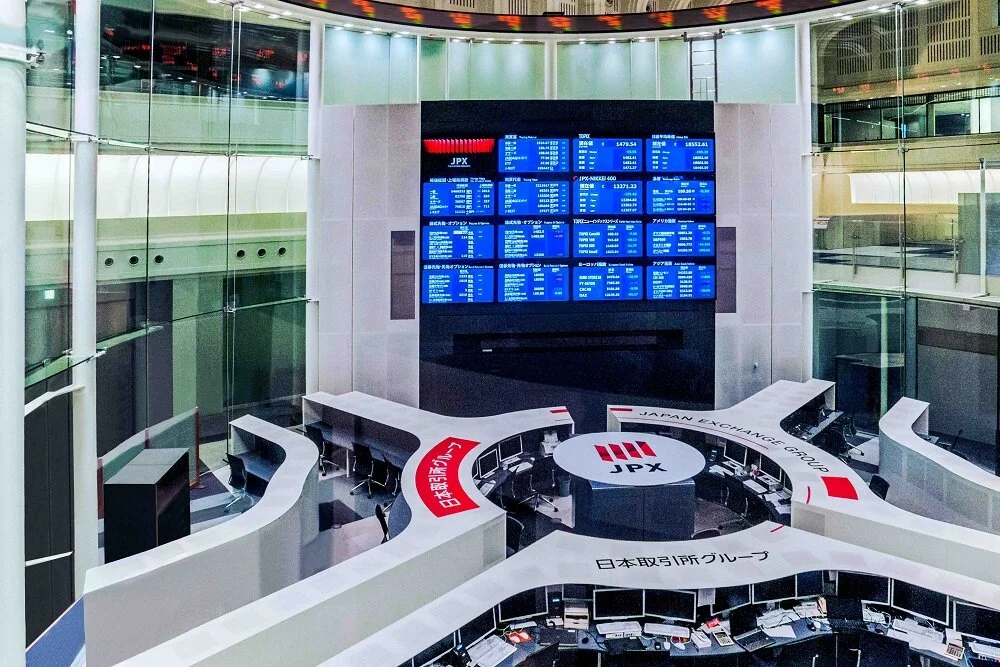
Asian equity markets retreated across the board on Tuesday as South Korea’s benchmark index tumbled 3.61 per cent ahead of major global technology earnings.
The MSCI Asia ex-Japan index fell 0.93 per cent while Tokyo’s Nikkei 225 dropped 1.28 per cent, reflecting investor hesitation across key regional hardware and semiconductor hubs.
Seoul and Tokyo Lead Stock Declines
Selling was heaviest in South Korea, where tech heavyweights dragged the KOSPI down sharply during morning trade. Market debutant Elice Group, a South Korean artificial intelligence infrastructure provider, opened 16 per cent below its initial public offering price after raising 201.1 billion won ($151.12 million) in its listing.
European index futures pointed lower as well. Euro Stoxx 50 futures fell 0.71 per cent, DAX futures slipped 0.40 per cent and FTSE futures lost 0.44 per cent, while S&P e-minis held flat at 7,734.25.
AI Spending Faces Heavy Scrutiny
Investor attention is shifting toward corporate balance sheets as market participants demand direct evidence that enterprise software demand and consumer spending justify elevated capital commitments. Meta platforms, scheduled to report quarterly numbers on Wednesday, is one of five major hyperscalers projected by Goldman Sachs to push collective capital expenditure to $1.2 trillion next year.
Hardware suppliers face an immediate test as results arrive from Tesla, Lam Research and Texas Instruments later in the week, alongside private operator SpaceX.
The market is happy to cover shorts and unwind defensive trades, but that’s very different from having the conviction to rebuild aggressive exposure to AI.
For component suppliers and contract manufacturers across East Asia, the stakes are elevated because regional valuations have priced in continuous quarterly gains. If hyperscalers signal any moderation in data centre buildouts, Asian memory and chip assembly vendors will bear the initial brunt of order adjustments.
Institutional funds have begun pulling back from aggressive tech exposure, rotating into defensive holdings until earnings prints validate revenue conversion rates. The sharp discount on new market listings like Elice Group reflects shrinking risk tolerance for loss-making infrastructure plays across the region.
Energy Markets and Trade Directives
Crude oil prices ticked upward as energy traders tracked political developments in Washington and unrest in Europe. Brent crude rose 0.21 per cent to $109.78 a barrel, while US West Texas Intermediate gained 0.15 per cent to trade at $103.82 a barrel.
An executive order issued by US President Donald Trump on Friday waived selected sanctions and tariffs on Russian energy exports, including duties on crude shipments and refined goods. Trump stated on Saturday that a final policy determination remains pending, leaving refiners and logistics providers uncertain about trade enforcement rules.
Gold prices retreated from recent highs, with spot gold slipping 0.51 per cent to $4,118.71 an ounce.
Currency Flows and Central Bank Signals
Currency trading showed safe-haven positioning following weekend civil unrest in France that prompted municipal curfews in Paris, Lille and Nice. The euro traded at $1.12 after recovering 0.06 per cent from Monday’s slide, while the British pound held at $1.33 and the Japanese yen weakened marginally to 158.57 per dollar.
Comments from US Federal Reserve officials, including Chair Kevin Warsh, indicated that monetary authorities see sustained domestic economic momentum and feel little urgency to adjust policy rates immediately. Digital assets followed equity markets lower, with bitcoin dropping 0.67 per cent to $81,386.40 and ether falling 0.54 per cent to $2,385.75.
Traders now look to upcoming policy speeches from European Central Bank officials Martin Kocher and Olli Rehn, followed by Bank of England policymaker Megan Greene in London, ahead of Meta’s earnings release on Wednesday.