
Tag: Nitori Holdings

  • Japanese Retailers Lock in FX Contracts as Weak Yen Hits Profits

    Japanese Retailers Lock in FX Contracts as Weak Yen Hits Profits

    Japanese retailers are overhauling supply contracts and turning to financial derivatives as the yen hovers near 159 per dollar, driving up import costs across food and consumer goods.

    The currency has shed more than 30 per cent against the greenback over the past five years, eroding buying power for domestic store operators that rely heavily on overseas agricultural products, raw materials and finished goods.

    Supermarkets Shift Supply Terms

    Takara MC, which runs 43 supermarkets south of Tokyo, has abandoned monthly price negotiations with overseas suppliers in favour of quarterly and annual agreements. Chief executive Taku Ueno said securing terms for up to a year on imports such as US beef, Spanish olive oil and Italian tomatoes allows the chain to shield shoppers from immediate price increases on store shelves.

    Securing supply deals has grown harder as rival buyers from China and Thailand consistently outbid Japanese grocers for commodity shipments.

    Bankers report that small and mid-sized store operators, which previously absorbed modest currency swings, are now turning to futures, forwards and options contracts to limit their balance sheet exposure.

    Corporate Hedging Stretches Further

    Nitori Holdings, the country’s largest furniture retail chain, estimates that every 1 yen drop against the US dollar reduces its operating profit by roughly 2 billion yen ($12.5 million). While the company has avoided direct hedges to date, it is reviewing forward contracts if currency weakness continues.

    Brokers in Tokyo say hedging volume is expanding well beyond traditional tenors. Daiwa Securities noted that client requests to lock in exchange rates have stretched from the usual few months out to as long as five to 10 years, while Bank of America expanded its Tokyo foreign exchange sales team over the past two years to handle the surge in corporate demand.

    For retailers across East Asia, Japan’s currency predicament shows how sustained foreign exchange weakness can upend long-standing retail pricing models. Competitors elsewhere in the region, operating with firmer currencies, continue to snap up global agricultural allocations that once went routinely to Tokyo buyers.

    Market participants at JP Morgan project the dollar-yen rate will persist in the 155 to 165 corridor, keeping the pressure firmly on Japan’s store operators as contract renewals approach in the coming quarter.

  • Ikea Japan launching online store

    Ikea Japan launching online store

    Ikea Japan will make a full-fledged entry into internet sales, offering nearly all store items through a dedicated website to launch in late April.

    Plans call for selling 9000-odd products, excluding food and plants. They will initially be shipped from the nation’s nine Ikea stores. When coverage expands there will be direct shipping from warehouses.

    While customers in certain regions have been able to order items via e-mail, the company has not had an official online store.

    The local unit of the Swedish furniture retailer has tested the online service in southwestern Japan’s Kyushu and Yamaguchi prefectures since January, charging a minimum of ¥3990 (US$35.40) for shipping and handling. This may be reduced, depending on the delivery destination and items bought.

    Ikea Japan has a logistics centre in Yatomi, Aichi prefecture. Spanning 54,000 sqm, it opened in 2008. A 31,000 sqm section dedicated to online shopping will be added and launch next year.

    Ikea Japan aims to have online sales account for half of its revenue in 10 years. Its sales shrank 2 per cent to ¥76.7 billion for the year ended August. The company will add the online push to an ongoing initiative of increasing smaller stores to gain momentum toward a sales target of ¥140 billion in 2020.

  • China expansion plan for Nitori Holdings

    China expansion plan for Nitori Holdings

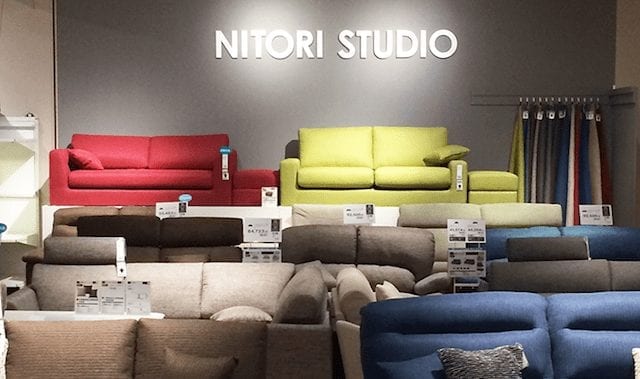
    Japanese furniture and home-accessory retailer Nitori Holdings is ramping up its presence in China to kick-start its global expansion.

    It plans to open add more than eight outlets in 2018 to its present 10.

    Nitori aims to have 2000 stores overseas as well as 1000 at home by 2032. It now has 41 stores abroad and 420 in Japan. Nitori opened its first overseas outlet in Taiwan in 2007, where it now has 26 stores. It also has five stores in the US.

    China is the main focus of its international expansion strategy, with plans for 1000 to 1500 outlets. It intends to initially concentrate in the cities of Shanghai and Wuhan to quickly boost its brand profile and establish dominance.

    Other options are also being explored in China, including online retailing and package offerings of home furniture.

    nitori-studio-1

    Monthly sales in China, where its first store was opened in Wuhan in 2014, have continued to exceed year-earlier levels by about 20 per cent for past several months. The Chinese outlets have prices similar to those in its Japanese stores as the company does not add tariffs to price tags and economises on logistics.

    In Taiwan its stores took six years to achieve profitability, while its business in the US is still in the red.

    Meanwhile, a new outlet in Tokyo’s Takashimaya Times Square commercial complex in Shinjuku is targeting overseas tourists, serving as “a starting point of our brand recognition” among overseas customers, says Nitori Holdings senior MD Fumihiro Sudo.