Retail News CRM

Tag: no brand

  • Shinsegae’s No Brand Burger stores dominating Korean market

    Shinsegae’s No Brand Burger stores dominating Korean market

    The No Brand Burger from Shinsegae Food, the food manufacturing arm of South Korean retail giant Shinsegae, are dominating the South Korean hamburger market.

    Analysts say that Shinsegae’s cost-effectiveness strategy for its new No Brand Burger restaurants is behind such growth.

    The company managed to lower the price by more than 1000 won (US$0.84) compared to its competitors while maintaining similar quality.

    Driving on without a stop, Shinsegae Food is planning to expand its stores and even pursue a franchise business. As of the end of last month, sales at No Brand Burger exceeded 350,000 units.

    In other words, four stores have sold more than 100,000 burgers a month on average, including the first No Brand Burger store in Seoul, which opened in August. Each store has between 1000 and 1500 daily sales.

    In particular, the Hongdae branch has become a popular place with customers waiting in line for more than an hour before eating, as No Brand hamburger has proven to be a draw among younger customers.

    The secret to the popularity of No Brand Burger is reasonable prices combined with good taste and quality. The company focused extensively on research and development of the menu. Some 20 chefs from the affiliated food research institute developed the company’s burger offerings over a period of three years.

    In addition, the company made the most of its know-how in distributing and manufacturing food products to the fullest extent possible to lower the price.

    The price of the No Brand Burger is between 1900-5300 won for a burger and 3900-6900 won for a ‘set’ that includes fried potatoes and a beverage.

    Its flagship burger, NBB Signature, which costs 3500 won (US$2.93) for the burger alone and 5300 won for a set, is also cheaper than the 6200 won cheeseburger set at Lotteria, the nation’s number one hamburger franchise.

    What is making such prices possible is so-called ‘joint orders’.

    Considering that it is not easy to secure a competitive edge in price by placing individual orders for each ingredient, Shinsegae Food placed orders for of all the ingredients at once with the food ingredients managers of each business unit and lowered the prices of the most basic ingredients.

    Moreover, it also used its own ingredient factory to secure hamburger patties and pre-prep
  • Emart’s No Brand to open first overseas store

    Emart’s No Brand to open first overseas store

    Emart is taking its No Brand line to the Philippines, the first overseas expansion for the label. The chain announced Monday that it signed a franchise agreement with Robinsons Retail, the No. 2 retail company in the Philippines, to roll out No Brand and Scentence in the country. Both are Emart in-house lines.

    “Under the deal, 50 No Brand and 50 Scentence stores will be established in main shopping malls and department stores at the Philippines by 2020,” Emart said in a statement.

    Robinsons will be in charge of store operations, while Emart will be paid a licensing fee and profit from the export of products to the stores.

    No Brand is an Emart label that sells daily necessities and some food items. Around 70 percent of No Brand goods are manufactured by local small enterprises. Although it was started as an in-house line, No Brand has been so successful that stand-alone stores have been opened.

    Emart has established stores overseas, but this is the first time No Brand has been taken abroad. With partner Robinsons, the local retailer plans to co-develop No Brand products for the Philippine market and possibly export them for sale at Emart stores in Vietnam and Mongolia.

    For Scentence, Emart’s in-house beauty brand, the Philippine project is the brand’s second overseas move. It opened in Saudi Arabia in July. Emart says it plans to develop Scentence beauty products that fit well with the climate of the Philippines.

    No Brand and Scentence are both part of Shinsegae Vice President Chung Yong-jin’s strategy to develop “specialized stores” that focus on a particular product category instead of selling a little of everything as is done in discount chains.

    The discount chain market is saturated in Korea and is facing mounting regulations.

    “The deal to launch No Brand and Scentence in the Philippines is meaningful to us in that it diversifies our global portfolio for specialized stores,” said Lee Joo-ho, who heads Emart’s global business.

  • Private-label deal for E-mart Korea

    Private-label deal for E-mart Korea

    Discount seller E-mart Korea has signed an agreement to supply its private-label items to Metro China.

    It is introducing four items from its No Brand range, to be sold from next month. It is the first time for E-mart to export to an overseas offline store.

    E-mart’s private-label products already sell in Mongolia and Vietnam. Sales of its No Brand range at its Ulaanbaatar branch, which opened last month, have already reached 600 million won (US$533,000), accounting for about 7 per cent of total sales. No Brand contributed 3 per cent of sales at its Vietnamese outlet, which opened in December.

    Introduced in April last year with nine items, No Brand now has more than 300 products, from butter cookies to car window wipers, and posted 63.8 billion won turnover in the first half of this year.

    Metro is a German retailer that is the third-largest franchise globally following Walmart and Carrefour. It has more than 2200 outlets in 33 countries, with 88 in China.

  • Emart teams with SM Entertainment

    Emart teams with SM Entertainment

    South Korea’s Emart has launched private brand products created in collaboration with SM Entertainment.

    The products went on sale at Emart Mall and 140 Emart stores nationwide from Thursday (March 3).

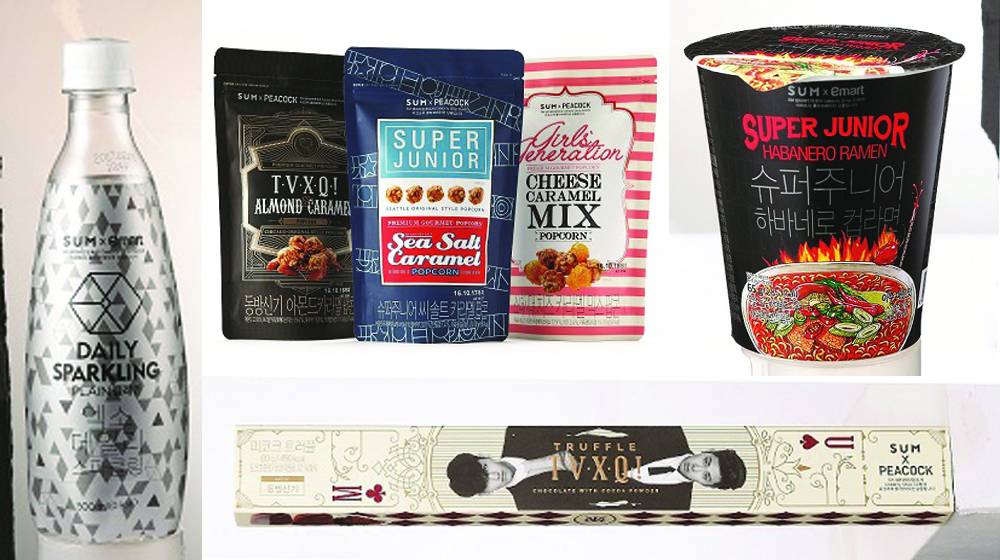
    The new products include EXO Jajangmyeon (jajang-flavored instant noodles), Super Junior Habanero Ramen Noodles, TVXQ Truffle Rose Chocolates, Girl’s Generation Popcorn and Shinee Carbonated Water.

    In collaboration with SM Entertainment, Emart plans to increase the number of products on offer to 40 during the first half of the year.

    Emart rolled out a new initiative dubbed ‘Invention Project’ in August 2015, and launched two new private brands, Peacock and No Brand. After the collaboration with SM Entertainment, the two parties plan to look into further projects involving a wider range of products and even intangible merchandise based on SM Entertainment’s artists.

    Emart anticipates that the merchandise will attract not only domestic consumers in their teens and 20s, but also foreign tourists who visit Korea. Officials hope that the new products will be souvenirs to remember Korea, and that Emart will be established as a ‘must-visit’ shopping site when visiting Korea.

    The retailer is also in discussion with SM Entertainment with regards to bringing the new products to overseas markets.

    Marketing executives at Emart claim that they have created a series of completely new products through the collaboration of two very different but powerful platforms. They hope to continue to make innovative progress through their ‘Invention Project’ group.