Tag: old navy

  • Gap, Old Navy power parent company’s sales growth in first quarter

    Gap, Old Navy power parent company’s sales growth in first quarter

    Gap, a leading global retailer, has demonstrated an impressive performance in its first quarter. The company’s success is primarily attributable to the robust results from its principal brands, Gap and Old Navy.

    First Quarter Sales Surge

    The company reported a 2% increase in net sales for the quarter ending May 3, amounting to a total of $3.5 billion. Comparable sales, which are a critical measure of a retailer’s health, also followed the same upward trend.

    Increased Income

    Gap also saw a substantial rise in its financial earnings. The firm’s operating income, which offers insight into the company’s profitability from core operations, experienced a notable 26.8% increase, reaching $260 million. Meanwhile, net income, an essential indicator of a business’s profitability after all costs and taxes, jumped by 22%, totaling $193 million.

    The Gap and Old Navy Shine

    Despite the challenging trading environment triggered by a cold start to the spring season that disrupted new season apparel sales and cautious consumer behavior, Gap Inc. still saw significant sales uplift. The Gap brand was the star performer, reporting a notable 5% increase in comparable sales. This progress validates the company’s strategy of revamping the Gap brand to make it more relevant and inject it with fresh appeal and interest.

    Questions & Answers

    What was the net sales increase for Gap Inc. in the first quarter?
    The net sales for Gap Inc. in the first quarter increased by 2%, totaling $3.5 billion.

    How much did the operating income and net income increase?
    The operating income rose by 26.8%, amounting to $260 million, while the net income increased by 22%, totaling $193 million.

    Which brand performed the best in this quarter?
    The Gap brand delivered the best performance, demonstrating a 5% increase in comparable sales.

  • Costs cited as Gap cancels Old Navy spinoff plans

    Costs cited as Gap cancels Old Navy spinoff plans

    Gap has nixed plans to spin off its Old Navy subsidiary, saying that after further investigation the costs involved outweighed the benefits.

    “The plan to separate was rooted in our commitment to value creation from our portfolio of iconic brands,” said Robert Fisher, Gap Inc’s interim president and CEO. “While the objectives of the separation remain relevant, our board of directors has concluded that the cost and complexity of splitting into two companies, combined with softer business performance, limited our ability to create appropriate value from separation.

    “The work we’ve done to prepare for the spin shone a bright light on operational inefficiencies and areas for improvement,” he said.

    Meanwhile, the company is now searching for a new CEO to oversee the full portfolio of brands.

    Neil Fiske, president, and CEO of Gap brand who previously led Billabong before moving to Gap in 2018 has left without explanation. Last November, former long-term CEO Art Peck left Gap on the eve of the announcement of the Old Navy spinoff.

    Meanwhile, four of the company’s senior leaders have taken on additional responsibilities reporting to Fisher. Mark Breitbard, president and CEO at Banana Republic, will now lead Gap Inc’s specialty brands, including Gap, Banana Republic, Athleta, Janie and Jack, Intermix and Hill City; Sonia Syngal, president and CEO at Old Navy, will continue to lead that business; Teri List-Stoll, executive VP and CFO, will lead corporate operations related to finance, supply chain, technology, and real estate; and Julie Gruber, executive VP, global general counsel, corporate secretary and chief compliance officer, will lead corporate administrative functions including legal, corporate facilities and services, human resources and communications, loss prevention, sustainability, government affairs and foundation.

    Fisher said the company had “learned a lot” from the preparations to spin off Old Navy and intends to operate Gap Inc in “a more rigorous and transformational manner” in future in a way that empowers its growth brands, Old Navy and Athleta, and appropriately focuses on profitability for Banana Republic and Gap brand.

    “Our board is focused on supporting this work and appointing new leadership with the appropriate experience necessary to lead a portfolio of retail brands and to support our transformation efforts.”

    Meanwhile, as a result of better-than-anticipated promotional levels during the holiday period, particularly at Old Navy, the company now expects its adjusted the fiscal year 2019 earnings per share to be moderately above its previous guidance of $1.70 – $1.75.

    “We are working aggressively to stabilize and improve business results,” said List-Stoll. “We are committed to sharpen strategic focus, tailored operating strategies and operational discipline and accountability that can strengthen the health and profitability of our brands.”

  • Gap spinning off Old Navy business

    Gap spinning off Old Navy business

    Gap plans to spin off and float its Old Navy business, creating two independent publicly traded companies. Old Navy will operate only its own brand, while the as yet unnamed company – dubbed NewCo for now – will own the Gap brand, Athleta, Banana Republic, Intermix and Hill City.

    “It is clear that Old Navy’s business model and customers have increasingly diverged from our specialty brands over time, and each company now requires a different strategy to thrive moving forward,” said Gap’s chairman Robert Fisher in a statement.

    “Recognising that, we determined that pursuing a separation is the most compelling path forward for our brands – creating two separate companies with distinct financial profiles, tailored operating priorities and unique capital allocation strategies, both well positioned to achieve their strategic goals and create significant value for our customers, employees and shareholders.”

    NewCo will launch with about $9 billion in annual revenue and a strong balance sheet.

    Old Navy, a value-focused brand which is currently one of the fastest-growing apparel labels in the US, will have annual revenue of about $8 billion.

    In a statement, Gap said separating Old Navy would allow it to capitalise on its scale, broad customer awareness and unique positioning to extend its category leadership and deliver profitable growth as an independent company.

    “Through this separation, Old Navy will have the flexibility, focus and control needed to increase customer access by further applying its strategic real estate strategy, evolving its omni-channel model and expanding its product categories to continue to successfully resonate with value-focused customers. Old Navy will be well positioned to invest in capabilities and initiatives that will continue to grow its market share.”

    After the split, Gap Inc’s current president and CEO Art Peck will hold the same position with NewCo.

    Sonia Syngal, current president and CEO of Old Navy, will continue to lead the brand as a standalone company.

  • GAP sales report slumps in Q3

    GAP sales report slumps in Q3

    Gap brand sales fell 7 per cent globally in the last quarter as the US apparel retailer fails to re-engage consumers.

    However Gap Inc increased its overall sales by 6.5 per cent to US$4.09 billion on the back of solid growth in its Old Navy business and a modest 2 per cent improvement of the more upmarket Banana Republic banner. Net income rose to $266 million, up $37 million year on year.

    “Old Navy is doing all of the heavy lifting while the Gap brand languishes,” observed retail analyst Neil Saunders, MD of GlobalData Retail.

    “When it comes to Gap the numbers are particularly bad. Despite protestations from management that improvements to the range and inventory are coming through, we do not buy the story of recovery. Gap’s brand image is still lacklustre and it is not bringing anything new or exciting to the market. Products are still samey and boring and they are still being discounted because Gap is unable to sell them at full price.”

    Saunders said the sales results testify to the deep-seated problems at the Gap brand – especially when they are delivered against the backdrop of a robust consumer economy in which people are spending more on clothing than they have done for many years.

    “Our consumer data still shows that shoppers see Gap as bland and increasingly irrelevant in the apparel space. This is not healthy and it underlines the fact that Gap still has an enormous amount of work to do before it can even start down the road to recovery.”

    In contrast, Old Navy’s fashion edits and the brand’s ability to put out well-curated collections are attracting the attention and spend of family shoppers.

    “The strong economy is giving consumers a little more money to spend and we believe that Old Navy is benefitting from this as consumers buy more treats for themselves and their families. The strength of Old Navy’s brand is evidenced by the fact that all categories and channels have benefitted from growth.”

    Gap Inc will end the year with a net gain of about 70 new stores, including outlets in Canada and Mexico, where the brand continues to perform well.

    Banana Republic turns a corner

    Meanwhile, Banana Republic achieved a 9.2 per cent uplift in US sales due to store openings and a 2 per cent increase in comp sales.

    “The work to re-engineer the brand is paying off,” said Saunders. “Fall and winter collections were stronger than they have been for many years and there is now more cohesion between marketing and assortments. While the recovery remains in its early phases, Banana Republic is moving in the right direction.”

    Overall, said Saunders, despite poor Gap brand sales figures, the business is in a reasonable state. “However, the ongoing issues at the Gap brand are raining on what would otherwise be a sunny parade.”

  • Why you should adopt more diverse influencers?

    Why you should adopt more diverse influencers?

    Diversity, or lack thereof, is at the forefront of fashion industry discussions, with runways and advertising campaigns constantly—and rightly—scrutinised. Less has been said about diversity among prominent influencers, the new drivers of sales who are celebrated for their authenticity and ability to connect with customers.

    Thin, light-skinned women aren’t the only clothing shoppers, so why are so many of them the go-to for brands as they put together campaigns?

    Now several influencers, and a handful of talent agencies that represent them, are leading the charge to shake up the staid and stale landscape.

    They’re creating their own campaigns to highlight opportunities and content possibilities—along with #YouBelongNow, there are the hashtags #SupersizeTheLook and #ChicAtAnyAge — putting together initiatives to encourage and celebrate new voices in a greater range of ethnicities, sizes, and ages.

    The problem, many say, stems from the fact that the people organising the campaigns are not thinking about diversity when it comes to casting. It’s a continuation of the narrow view of beauty historically depicted in advertising, contends Jennifer Jean-Pierre Maull, a Haitian-American blogger and photographer from Washington, D.C with almost 16,000 followers on Instagram. “We need to change what we consider beautiful, we need to change what we consider marketable,” she said.

    Consider trendy online retailer Revolve: known for its influencer trips to far-flung corners of the globe, documented glamorously and exhaustively for its 2.6 million Instagram followers.

    Last January, as its squad took to the beach in Thailand, the attention turned from glowing to heated over the lack of diversity in its ranks. A shot of more than a dozen light-skinned swimsuit-clad slender women garnered more than 700 comments. A commenter tagged the picture #RevolveSoWhite.
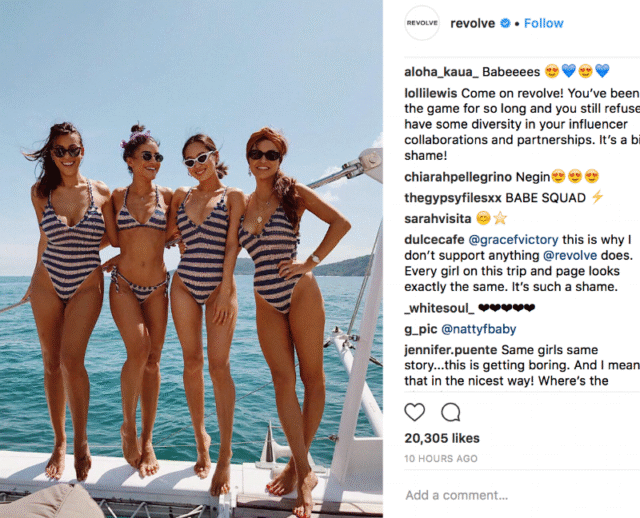
    Revolve, which recently filed for an IPO and generated sales of $400 million last year, has never been a brand to highlight diversity, but whether or not that has had an effect on its sales is unclear.

    Revolve’s earned media value (EMV) dropped during the controversy to the brand’s lowest for the year, at $83.8 million. That cannot be solely attributed to the controversy, however, but “to the natural ebb and flow of events and campaigns.” And the dip was temporary: Revolve’s EMV bounced back to more than $140 million in each of the subsequent two quarters.

    In the firestorm, Valerie Eguavoen saw an opportunity.

    As the moment drew headlines, the North Carolina-based blogger and social justice advocate seized the chance to launch a new Instagram handle, @YouBelongNow, designed to celebrate people of all ethnicities, religions, sexualities and clothing sizes.

    “There are so many women who I could have seen on that trip, who belong in this space,” she said. “We have to get rid of this narrative that we don’t exist or it’s hard to find us.”

    Jean-Pierre Maull has kept tabs on what talent agencies she booked gigs with and which ones she hasn’t. In the latter camp was Fohr, based in New York and co-founded by James Nord. Over the summer, Nord addressed the Revolve controversy in a YouTube video, calling the retailer out for its practices while also suggesting it could be intimidating for brands to reach out to new influencers. Jean-Pierre Maull penned her response in a lengthy blog post. “Our POC (people of colour) community is not an alien force,” she wrote. “It is not hard to send a POC blogger the same pitch email that you send to others.”

    She emailed Nord, requesting to talk with him, one of many ongoing discussions Nord has had in recent months. “I leaned on this group of amazing women who did call me out,” he said.

    “Sometimes we just need to open up the conversation instead of just being angry,” Jean-Pierre Maull said. “Those in power must be self aware enough to see where they may be lacking or not doing enough.”

    One result of the chats Nord has had is a new mentoring program, called Freshman Class, to promote underrepresented influencers. More than 1,600 influencers applied, and 85 finalists were chosen. The ten winners include Alysse Dalessandro, queer plus-size fashion blogger; Ali Hemsley, a fashion influencer with a focus on chronic illness and mental health; and Destin Grayson, a menswear blogger. The winners will be flown to New York for three days of educational and networking opportunities.

    Nord hopes to help newer and lesser-known influencers build a network that can serve as sounding board, to discuss opportunities and pay rates.

    Jean-Pierre Maull said she was worried the initiative would seem like “someone need to swoop in and save” POC bloggers.

    The result, she says, has been anything but; it’s helping establish even more of a sense of community.

    “There is no lack of diversity in influencers, there is a lack of diversity in influencer campaigns,” Nord said.

    Relatability is a crucial part of influencer effectiveness, which is all the more reason why influencer campaigns should feature a more diverse range.

    Old Navy, a division of Gap Inc., looks for a range of sizes and family compositions in its influencer casting, then features them as models in its social feeds and digital marketing.

    “We’re looking for someone who people can see themselves in,” said Liat Weingarten, Old Navy’s vice president of brand communications.

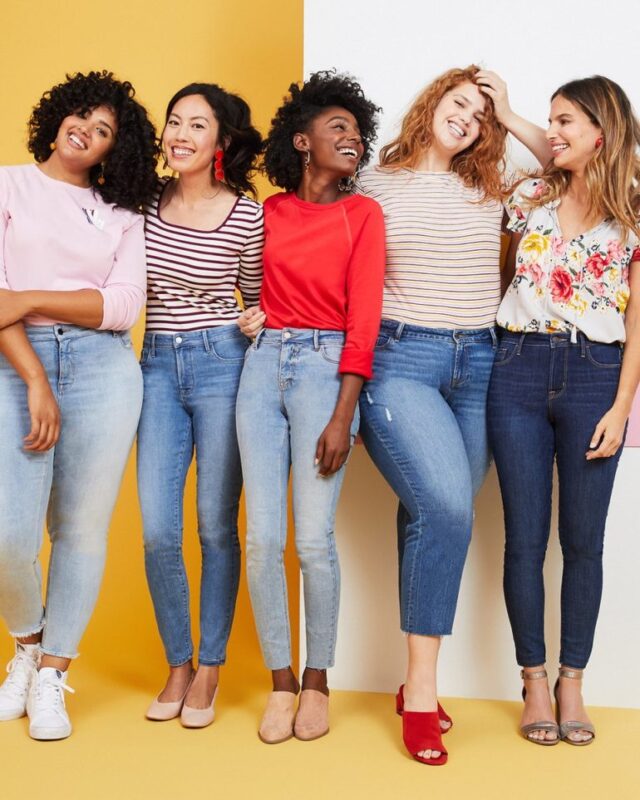
    So far this year, Old Navy’s top two performing social posts featuring people (not just product), based on number of likes, comments and shares, are diverse group shots of influencers.

    One, highlighting dresses from its #SizeYES campaign, received more than 11,000 likes and more than a hundred comments. “My first thought when I saw this was: love this beautiful, diverse group of models!” wrote one commenter. “More of this, please!”
    And then there’s Revolve competitor Fashion Nova, which uses its Instagram account to highlight women of all ethnicities and sizes in its barely-there clothing.

    Its influencer hashtag, #NovaBabe, drove $54.1 million in earned media value from the second half of last year through the first half of this year.

    Mentions for @fashionnovacurve, the account for its plus-size line, generated $61.5 million in EMV.

    Followers are watching what brands are doing closely, too, said Scout the City blogger Sai De Silva.

    “When I go to events, I feel like there’s no one like me,” said Silva, whose followers have asked why she was the only woman of colour or woman with curly hair at a party “I live in New York City, how could there not be one other Puerto Rican [influencer]?”

    Influencers are finding that being proactive is the only way to move the conversation forward.

    Max Stein, founder and chief executive of agency Brigade Talent, said some of his clients will ask who else is participating before agreeing to a campaign, in the context of making sure a brand or company aligns on values—not just aesthetic. “It’s important to them that [diversity] is a value of the brand that they choose to partner with,” he said.

    However, not all brands are responsive in the way an influencer might want them to be.

    “There is sometimes a lack of cultural awareness and cultural sensitivities,” said Jaia Thomas, co-founder of The Presley Group, a management agency promoting diversity within the influencer space.

    Thomas, an entertainment lawyer, pointed to the time one of her African American clients was asked to do a post about watermelon. “There’s a long history of racial tropes and stereotypes associated with African-Americans, an affinity for watermelon being one of them,” Thomas said. “It’s important for there to be African-Americans in the room when creating social media campaigns so they can quickly and easily identify these stereotypes and ensure companies steer clear of them.”

    So, when will brands wise up? The enthusiasm that comes with a highly-engaged, targeted follower base is a big selling point in today’s noisy marketing field.

    “I don’t have a million followers,” said Katie Sturino, the force behind the handle and site The 12-ish Style. “What I do have is an audience that believes in what I’m saying and believe that if I’m showing them something, I like it.”

    Sturino’s best-performing content comes from two popular hashtags on her own account, both calling attention to sizing deficits within the industry. She recreates stars’ ensembles in #SupersizetheLook, with photographs of herself in similar outfits, performing 77 percent better than her average posts.

    Sturino also started the #MakeMySize hashtag, pairing pictures of herself in garments that are too small with captions asking brands to make a broader range of sizes, performing 65 percent better than her average posts.

    Sturino wishes more brands would take the time to find new personalities, and involve those newcomers earlier in the product-development process. “You pay them to wear the clothes, why don’t you pay them for their opinions, too?” she said.
  • Old Navy Drives Growth for Gap in First Quarter

    Old Navy Drives Growth for Gap in First Quarter

    The tried-and-true formula of trendy casual wear at a bargain price was the right formula for Old Navy, a division of Gap Inc.

    In its first-quarter earnings report for the period ending May 5, Gap Inc. said that Old Navy’s same-store sales were up 3 percent, but that was still off from the same period last year when Old Navy comps showed a strong 8 percent increase.

    Still having trouble was the San Francisco company’s principal nameplate, Gap. Gap’s same-store sales declined 4 percent in the first quarter compared with the same period last year.

    The Gap stores have been experiencing a lack of depth in some products and inventory overstock, left over from last year. The excess inventory led the company to slice prices to get rid of excess merchandise, said Teri List-Stoll, Gap’s chief financial officer and executive vice president, who was speaking on a May 24 earnings call. “During the quarter, we cleared inventory through sell-offs and cut prices,” she said. “It does set us up for cleaner stores in the second quarter and a better inventory position for the back half of the year.”

    Gap stores have been going through a difficult year. In February, the company fired its Gap brand president, Jeff Kirwan, and replaced him with Brent Hyder, who is the acting Gap brand president.

    In a welcome change, the company’s Banana Republic division saw comp-store sales rise 3 percent compared with last year’s negative 4 percent. Art Peck, Gap’s president and chief executive officer, said the company has been investing in quality yarns and fabrics for its Banana Republic clothing, which has been well received by customers. Items that sold well included sweaters, bottoms and dresses.

    Overall, same-store sales for the company were up 1 percent across the board compared with 2 percent last year.

    Gap Inc. reported that net income for the first quarter totaled $164 million, up from $143 million in the first quarter of 2017. Net sales came in at $3.8 billion, a 10 percent rise over last year.

    At the end of the quarter, Gap Inc. had 3,617 stores in 45 countries, of which 3,171 were company-operated. Gap executives said they continue to invest in stores such as Old Navy and its activewear brand store Athleta while closing less profitable Gap and Banana Republic stores, located mostly in malls.

  • Gap looks to Old Navy to gear up sales numbers

    Gap looks to Old Navy to gear up sales numbers

    Gap is ramping up its roll-out of Old Navy stores as the budget brand drives growth for the embattled US apparel giant.

    Gap Inc says it will open 60 new stores this year in the US, Canada and Mexico – twice the number of new stores it opened last year. It will refurbish a further 150 stores, upgrading fitting rooms, bathrooms and checkout facilities.

    The new focus on Old Navy, revealed last September, comes at the same time about 200 underperforming Banana Republic and Gap-bannered shops will be closed. Over a three-year timeframe, Gap Inc plans to open about 270 new Old Navy and Athleta stores, leaving a net network growth of 70 shops.

    Old Navy sales rose 9 per cent in the last quarter, on top of a 5 per cent rise a year earlier. Gap expects Old navy to reach US$10 billion in annual sales within the next few years, and its athleisure brand Athleta, to reach the $1 billion threshold.

    Analyst Retail Dive observes that while Gap store sales are showing signs of stabilising, lower-priced Old Navy has been hitting a stride that the flagship banner has failed to do for years now”.

    “Old Navy is the jewel in the portfolio,” added Ray Hartjen, director of marketing at RetailNext.

    “Shoppers have shown their preference for value across the board, and off-price retail has been one of the few consistent bright spots for the industry the last several years,” he said. “Moreover, Old Navy repeatedly resonates with its loyal core shopper, season after season, with its merchandise assortment.”

  • Gap watching Old Navy for growth

    Gap watching Old Navy for growth

    Gap is ramping up its roll-out of Old Navy stores as the budget brand drives growth for the embattled US apparel giant.

    Gap Inc says it will open 60 new stores this year in the US, Canada and Mexico – twice the number of new stores it opened last year. It will refurbish a further 150 stores, upgrading fitting rooms, bathrooms and checkout facilities.

    The new focus on Old Navy, revealed last September, comes at the same time about 200 underperforming Banana Republic and Gap-bannered shops will be closed. Over a three-year timeframe, Gap Inc plans to open about 270 new Old Navy and Athleta stores, leaving a net network growth of 70 shops.

    Old Navy sales rose 9 per cent in the last quarter, on top of a 5 per cent rise a year earlier. Gap expects Old navy to reach US$10 billion in annual sales within the next few years, and its athleisure brand Athleta, to reach the $1 billion threshold.

    Analyst Retail Dive observes that while Gap store sales are showing signs of stabilising, lower-priced Old Navy has been hitting a stride that the flagship banner has failed to do for years now”.

    “Old Navy is the jewel in the portfolio,” added Ray Hartjen, director of marketing at RetailNext.

    “Shoppers have shown their preference for value across the board, and off-price retail has been one of the few consistent bright spots for the industry the last several years,” he said. “Moreover, Old Navy repeatedly resonates with its loyal core shopper, season after season, with its merchandise assortment.”

  • Gap results to be saved by Old Navy

    Gap results to be saved by Old Navy

    At headline level, the latest Gap Inc results are not too bad. Overall revenue rose by 1.1 per cent, a respectable increase that is some way above that posted over the last two quarters. Net income also increased by 12.3 per cent compared to the previous year.

    Unfortunately, behind the headline, it is the same old story. Old Navy is driving group performance while the other two leading brands are struggling. Admittedly, the 0.8 per cent US revenue decline at Gap and the 2.6 per cent dip at Banana Republic are better than recent reporting periods, but neither demonstrates a fully-fledged recovery.

    Management has been keen to emphasise the changes that are being made to revitalize the challenged brands. On the ground, there is some evidence of this happening. At Gap, for example, there have been marginal improvements in quality and greater emphasis has been placed on in-demand products like athletic wear. However, the majority of the offer remains samey, as do things like store environments and point of sale material. In our view, Gap has very little newness to communicate and, as such, is still finding it difficult to inspire customers.

    The new marketing campaign, ‘Meet me in the Gap’, is not terrible, but neither is it particularly compelling. As such, while it has helped rather than hindered sales, it has not succeeded at pulling in new shoppers or getting lapsed shoppers to take a fresh look. Given the offer has not shifted very much, perhaps this is just as well.

    In essence, the change at Gap is lacklustre – especially when compared to a brand like Abercrombie & Fitch which has ripped up the rulebook and completely reinvented itself. Gap needs to emulate this bravery and do something radical to put the business back on a sustainable growth trajectory.

    Stuck in a rut

    If Gap has made some progress, Banana Republic still seems stuck in a rut. Despite a change of leadership, the proposition still lacks energy and focus. As such, it is hard to understand who the brand is targeted towards or what needs it is trying to address. Until these things are resolved, Banana Republic will remain on the back foot. To be fair, management always said that the latter part of this year would be about stabilising the brand rather than reinventing it, but this could amount to a tacit admission of not knowing what changes to make or how to make them.

    Fortunately, Gap Inc has been able to rely on Old Navy to push up performance. While sales growth moderated this quarter, the brand remains a popular destination for younger and family shoppers. The new winter and fall collections are compelling, which should benefit sales over the holiday quarter.

    There has been good progress within Gap’s stable of smaller brands like Athleta and Intermix. Both of these concepts have significant potential, with Athleta in particular positioned to grow its market share. Unfortunately, the revenue contribution of these divisions is insufficient to make a material difference to the group’s overall numbers.

    In summary, Gap has become a more stable business and sales declines appear to be starting to bottom out. However, the company has no real sense of direction or ambition for two of its major brands.

  • Old Navy Vietnam opens second store

    Old Navy Vietnam opens second store

    Old Navy Vietnam has opened its first store in Hanoi, three months after its debut in the country.

    The 655sqm store is located in Vincom Nguyen Chi Thanh and offers collections for men, women, kids and babies.

    Melissa Fehlman, GM of Old Navy Vietnam, said the brand aims to open more stores throughout Vietnam in coming years, with Ho Chi Minh City’s second shop scheduled this month.

    Acknowledging that Vietnamese customers are trendy, Old Navy commits to refreshing 70-80 per cent of its products every three months, alongside core, long-term lines such as denim wear.

    Old Navy came to Vietnam under a franchise agreement between Gap Inc and Vietnam IPP’s subsidiaries ACFC and CMFC, which also hold the Gap and Banana Republic franchises in Vietnam.

    The nation’s fashion market is booming, buoyed by the recent arrival of international brands, including Pull&Bear and Stradivarius on September 1.

    H&M opens its first store in Ho Chi Minh City on September 9 and Zara will open its first Hanoi store next month.

  • RSH launching Old Navy in Malaysia with KL store

    RSH launching Old Navy in Malaysia with KL store

    With distributor RSH, fashion label Old Navy will open its first store in Malaysia at the end of this month.

    RSH regional marketing and communications manager Roy Lan says the brand will launch a “robust” integrated campaign to raise awareness among consumers of the arrival of Old Navy in Malaysia.

    Its store will be in the 1 Utama Shopping Center in Kuala Lumpur.

    Launched in 1994, Old Navy offers fashion essentials for families. It became the first retailer in the US to reach $1 billion in annual sales in less than four years, and is part of the Gap portfolio of brands, which also includes Athleta, Banana Republic and Intermix.

    With an 800 sqm layout, the new store will offer apparel and accessories collections for men, women, children and babies.

    Its launch in Malaysia follows its entry into Indonesia this year.

    “In the next five years, if everything goes according to plan, we should have 10 stores in Indonesia and five stores in Malaysia,” says Lan.

    Malaysia is the seventh franchise market expansion for Old Navy. In launched its first franchised stores in the Philippines two years ago, and has since opened in four Middle East countries. Its move into Southeast Asia builds on the success Gap and Banana Republic have experienced since entering the market in 2007.

  • Old Navy Opening Doors At First Store in Malaysia

    Old Navy Opening Doors At First Store in Malaysia

    Global apparel brand Old Navy announced today that it is opening its first store in Malaysia at 1 Utama Shopping Center, the fifth largest mall in the world, which is located in the heart of MSC Malaysia Cybercentre Township Bandar Utama. Old Navy makes current American fashion essentials accessible for every family, with a focus on fashion, family, fun and value. The brand launched in 1994 and quickly became one of the top apparel brands in the United States, making history in 1997 as the first retailer to reach $1 billion in annual sales in less than four years. Old Navy is part of the Gap Inc. portfolio of brands, which also includes Gap, Banana Republic, Athleta and Intermix.

    The brand’s entry into Malaysia marks another milestone in Old Navy’s continued global growth strategy. The first store will feature the same great product that the brand has become known for in the United States and will offer apparel and accessories collections for men, women, kids and babies. It will also provide a fun and energizing shopping experience for customers, featuring a spacious 800 square meter layout and Old Navy’s newest store design.

    The store will open its doors on September 30 at 5:00 pm and will be open until 10:30 pm. To celebrate the opening, customers can enjoy fun activities, meet special guests, and receive RM60 back when they spend RM200 and above. Additionally, the first customers in line will receive a free limited edition Old Navy Malaysia tote bag with any purchase, and the first 100 customers will be eligible to win a RM1000 shopping spree.

    This is the seventh franchise market expansion for Old Navy. In March 2014, the brand opened its first franchise-operated stores in the Philippines and has since opened stores in Qatar, Kuwait, Saudi Arabia, the UAE, and most recently, Indonesia. The brand’s move into Southeast Asia builds on the success that Gap and Banana Republic have experienced since entering the market in 2007.

    Franchise partner RSH Limited has a 39-year history of delivering seamless brand experiences to customers in Southeast Asia, the Middle East and South Pacific. Today, RSH Limited’s portfolio includes more than 70 international brands with over 700 stores and shops-in-shop in 11 countries.

  • What lies behind the Gap sales decline

    What lies behind the Gap sales decline

    That the overall pace of the Gap sales decline has moderated since both last quarter and last year is the only – very small – crumb of comfort for Gap Inc in its latest set of results.

    Gap last week reported a profit of US$125 million for the quarter, down from $219 million a year earlier. Total revenue declined 1.2 per cent to $3.85 billion.

    The total sales decline in the US is actually worse than last year with much heavier declines at Banana Republic and flat growth at Old Navy dragging down performance.

    Looking in stores it is not hard to see why this is the case. The Gap brand has no sense of newness and heavy discounting and constant promotion still appear to be the only tools the company has to drive trade. From Conlumino’s data it is clear that in the US Gap is not only losing customers but the customers it has retained are visiting less and spending less – mostly thanks to taking advantage of offers and deals. This is a dangerous position that erodes sales and profit, and suggests Gap has not even begun to remedy its underlying problems.

    Although it is clear the company is serious about creating a step change at its main brand, and while the autumn “#DoYou” campaign and its associated merchandise represent a small step forward, Gap has failed to convince it has done enough to correct the problems in its business.

    While Gap has troubles, Banana Republic is even more problematic. Over the quarter total sales in the US fell by 7.1 per cent, and on a global basis comparable sales for Banana shrunk by 9 per cent off the back of a 4 per cent decline in the prior year. The assortment is at the heart of Banana’s issues and symbolises a brand that has simply lost its way. The spring and summer collection is best described as predominantly bland with a generous sprinkling of oddness thanks to garments with strange cuts and patterning. Customers are confused and, of course, increasingly unwilling to pay the premium that Banana Republic once commanded. As a consequence the brand is falling into exactly the same trap as Gap as it resorts to discounting and deals to shift merchandise.

    Banana Republic is a smaller part of the group, but it is one in which a turnaround will be difficult to engineer. For this reason, it is getting set to completely shutter its UK, and possibly European, operations. As much as this retrenchment is an admission of failure, it is a necessary contraction given the parlous state of the business.

    Old Navy, which once delivered consistently positive numbers, spluttered again this quarter with flat growth in the US. While this brand is in a much better position than its siblings, it has become much less consistent in its marketing and instore merchandising, something which is reflected in its choppier sales numbers.

    Gap Inc is a troubled retailer without much of a plan – a plan that is desperately needed as its net profit decline of 43 per cent in this quarter aptly shows.

  • Gap Japan to axe Old Navy

    Gap Japan to axe Old Navy

    Gap Japan will close its 53 Old Navy stores as its parent narrows its focus in Asia.

    But CEO Art Peck says the company “remains committed” to growing its brands in regions where it has a structural advantage.

    The relatively down-market Old Navy brand will focus on the Mainland China market and the Gap brand will remain in Japan, he announced, at the time of revealing a first quarter sales decline of US$$3.44 billion, down 5 per cent.

    “Japan remains an important market for Gap Inc’s portfolio, with a continued strong presence of more than 200 Gap and Banana Republic stores,” said Peck.

    A further 22 international stores will close, but the company has not revealed where or which brands.

    “As the pace of change across the apparel industry increases, now is the time to accelerate our

    transformation by scaling our product and operating capabilities across our global portfolio,” said Peck.

    Asia accounted for 11 per cent of Gap’s global sales, 1 per cent more than during the same quarter of last year. Across the region it no has 312 Gap-branded stores (up seven), 69 Old Navy stores (up four) and 51 Banana Republic stores (no change).

    Globally, Gap stores sales decline 3 per cent – which was better than last year’s 10 per cent; Banana Republic sales fell 11 per cent compared with 8 per cent and Old Navy fell 6 per cent, compared with 3 per cent.

    Neil Saunders, CEO of Conlumino, described the quarter as “disastrous” for Gap, “ one during which all of its main engines stalled and went into reverse”.

    “Gap Inc is now retailer without any star brands and with seemingly little vision to move itself forward. Unless it takes radical action to overhaul its businesses the outlook will only darken still further,” said Saunders.

    “Most worryingly, while the latest April numbers are likely impacted by the earlier Easter, they nevertheless show that all brands failed to gain any momentum as the quarter progressed. Indeed, in the case of Old Navy the sales slip accelerated.”

    Saunders says the central issue for Gap is that it is “creatively dull” and does very little to change collections from season to season or year to year.

    “As a result it has become increasingly reliant on customers buying on a replacement cycle rather than being inspired to buy new products. This, in turn, leads to it stimulating sales by the use of extensive discounting which then discourages consumers from buying at full-price. Gap shows no signs of getting out of this viscous cycle.”

    He said its Banana Republic brand has gone into reverse since the departure of Marissa Webb.

    “While Webb’s attempts to revitalise the chain did not bear immediate fruit, that she was not given sufficient time in the job and, much like the departure of Rebekka Bay, her leaving signifies Gap has both a problem with change and with giving competent people the scope to get on with the job in hand.”

    Old Navy’s decline is more recent, he argues.

    “While the brand has been the star of the show for many quarters, the past few collections have been dull and uninspiring. Stores are also looking more fragmented with no clear merchandise or brand story to entice shoppers. Coupled with excess inventory this has made for a less than pleasant shopping experience – something that has diluted the impact of the various flash sales and offers Old Navy has traditionally relied on for growth.

    “As problematic as sales are, there is no doubt that margins are equally troubled. All Gap brands have resorted to heavy discounting in order sales and, even so, the company still has an excess of inventory. The final profit position for the quarter is very poor with net income down by a sharp 47 per cent over the prior year.

    “All of this bodes badly,” Saunders concluded.

  • Old Navy Indonesia makes debut

    Old Navy Indonesia makes debut

    American apparel and accessories brand Old Navy Indonesia has opened its first retail outlet at the Central Park Mall in west Jakarta.

    Offering American-style basic clothing items, Old Navy is part of the Gap portfolio alongside Athleta, Banana Republic and Intermix. The brand has more than 700 stores and shops-in-shop in 11 countries, including the Philippines.

    Old Navy Central Park mall Indonesia

    “Indonesian customers understand the international retail scene very well,” says Old Navy senior director of franchise buying Michele Chinn Fahey. “There’s a really a high awareness of international retail brands and a growing demand for American fashion.”

    For its Indonesian debut, Old Navy is collaborating with Armaan Retail Indonesia.

    Old Navy Central Park mall Indonesia 1

    “With 250 million people living across 15,000 islands, and three different time zones, Indonesia has huge potential,” says Armaan Retail CEO Benjamin Handradjasa.

    Old Navy’s store covers 1200 sqm and offers clothing and accessories for men, women, children and babies. There is also a special section for maternity clothes.

    Among the store’s first customers on its opening day was Indonesian actress and singer Ana Octarina.