Retail News CRM

Tag: online booking

  • Indonesia’s Traveloka Co-Founder Resigns

    Indonesia’s Traveloka Co-Founder Resigns

    Indonesian unicorn startup Traveloka announced the resignation of its co-founder, Derianto Kusuma, from his position as chief technology officer on Tuesday. Derianto was one of three persons involved in the establishment in February 2012 of the online ticketing and hotel booking service, which has since become one of the leading tech companies in Southeast Asia.

    “Deri has played an unparalleled role in Traveloka’s development and success by building, scaling, and making not only sustainable technology capability and systems but also a sustainable organization,” said Ferry Unardi, chief executive and co-founder of Traveloka.

    Following his exit from the company, Derianto took to online publishing platform Medium to write about his journey. In his post, he wrote about what drove him to start the company and the actual implementation of different business models throughout the nearly seven years since Traveloka was founded.

    He also touched on why he decided it was best for him to leave.

    “A few years ago, the battle started to show trends towards being more commercially than innovation-driven, predatory than productive, perception-oriented than fundamentals-oriented,” Derianto wrote.

    With these new trends, Derianto felt that his duty – building the technological foundation – had been fulfilled.

    “Two years ago, I ensured Traveloka had strong technological, organizational foundations built for scale and sustainability, and put in place a solid senior team that can take them forward,” Derianto wrote.

    Though Derianto wrote that he would be spending more time with family and friends after resigning, he said he “yearns” to develop a new venture in a noncompeting category, a technology that would “fundamentally transform society.”

    “I’m glad that we have finally reached this milestone where I believe it’s a win-win for everyone involved,” Derianto wrote.

  • Malaysia is Airbnb’s fastest growing market in Southeast Asia

    Malaysia is Airbnb’s fastest growing market in Southeast Asia

    Malaysia, one market in the region which has not stifled the growth of short-term accommodation, is Airbnb’s fastest growing market in Southeast Asia, welcoming over two million guests in the past 12 months as of July 1, marking a 99% growth year on year. Airbnb head of public policy for Southeast Asia Mich Goh said that Airbnb, as a platform, is not illegal in Malaysia and there is no clear consensus on what the policy is for short-term rental here as it is a new phenomenon.

    There are now 44,000 listings in Malaysia on Airbnb, which is almost a 60% year-on-year increase.

    Goh said the Malaysian government has been consultative and open to dialogue with the home-sharing platform, where there has been willingness to listen to insights and to hear about how it could help Malaysia to evolve its tourism industry.

    “We treat every country differently. We’ve seen countries all around the world where they reach a moment when they decide whether or not they need to regulate short-term rental. Where we see these discussions go well is where governments are open to discussing this with multiple stakeholders, not just us but open to speaking with hosts, guests, hotel group, local communities and neighbourhoods.

    “Where these discussions have been holistic and involve multiple stakeholders, we’ve seen it reach a stage where smart and innovative policies are implemented that allow the short term rental activity to continue and to thrive to the benefit of the community while making sure any concerns that groups may have are addressed through the regulatory framework,” said Goh.

    Airbnb has signed a memorandum of collaboration (MoC) with the Malaysian Productivity Council (MPC) and a memorandum of understanding (MoU) with Malaysia Digital Economy Corp (MDEC) to drive inclusive, sustainable development of tourism in Malaysia.

    As part of the MoC with MPC, Airbnb will share relevant data and best practices to inform recommendations on short-term accommodation policy in Malaysia, and will assist MPC in shaping national policy plans related to the development of Malaysia’s tourism industry and infrastructure, as well as local communities.

    Airbnb’s MoU with MDEC is focused on promoting digital inclusion and empowering local hospitality entrepreneurs in Malaysia, while building capacity in both homes and experiences throughout the country.

    In Malaysia, Airbnb is having discussions with authorities including the Ministry of Finance, the Royal Malaysian Customs and the Ministry of Tourism and Culture to discuss the implementation of Voluntary Collection Agreements (VCAs) to collect and remit tourist tax.

    The VCA is a tool designed by Airbnb to collect taxes from its host and guest community and remit them on their behalf. This helps to facilitate a streamlined process and lighten the administrative burden for local and state governments, as well as Airbnb hosts.

    Asked on plans by the government to tax e-commerce, Goh said Airbnb will comply once it is implemented. “We’re waiting to see how it would apply in Malaysia and how we would comply when the time comes.”

    In 2017, the Airbnb community contributed RM200.4 million to the local economy. Its typical host earned US$1,200 (RM5,200) renting out their space 19 nights a year. The top five inbound markets for Airbnb in Malaysia are Singapore, China, the US, Indonesia and Australia. Seniors (aged 60 and above) make up Airbnb’s fastest growing age group of guests in Malaysia.

  • Korea’s FTC orders Booking.com, Agoda to change rules

    Korea’s FTC orders Booking.com, Agoda to change rules

    Hotel booking sites Agoda and Booking.com have been ordered to revise their no-refund policies or potentially face legal action. Korea’s Fair Trade Commission (FTC) announced on Wednesday that it has ordered the two global travel platforms to revise the terms and conditions which allow them to unfairly deny refunds for products and services.

    Customers are currently unable to get refunds on some hotel bookings or additional services, like hotel meals, reserved through Agoda and Booking.com even if reservations were made well in advance. Agoda and Booking.com have the same parent company, Booking Holdings, which also operates travel platforms Kayak and Priceline.

    “Though we recommended that Agoda and Booking.com revise their no-refund clauses last November, the companies failed to take heed without any particular reason,” read an FTC report. “We decided last month to issue an order forcing them to make the necessary revisions.”

    The FTC is not asking them to ban all no-refund products, but to at least accept refund requests made long before reservation dates.

    “The companies will still be able to deny refunds on highly discounted products or bookings made just before the reservation date,” said a spokesman. “But it is unreasonable for them to deny refunds for reservations made months ahead.”

    “The probability that a booking platform will be able to resell a product after a consumer cancels a reservation long before reservation date is very high,” he added. “The platform operators will face few losses if they resell the products.”

    The Act on the Regulation of Terms and Conditions gives the FTC the right to take “measures necessary to correct the terms and conditions” of a business that incurs losses to “several customers because the business person fails to comply with the recommendation” to revise “unfair terms and conditions.”

    According to the Act, the FTC also has the right to report the case to prosecutors if companies fail to respond accordingly within 60 days.

    The two companies have yet to give an official response. Agoda’s Peter Allen, who serves as the head of the company’s external relations department Agoda Outside, was in Seoul on Wednesday to give a talk at a leadership forum organized by the company.

    Agoda and Booking.com are not the only booking platforms that have been flagged for having policies that potentially harm customers.

    From 2016 through October 2017, the FTC reviewed the terms and conditions of major hotel booking sites operating in Korea and found that seven, including Agoda and Booking.com, had unfair refund policies.

    Unlike Agoda and Booking.com, Interpark, Hana Tour, HotelPass, Hotels.com and Expedia have since revised their terms and conditions.

    The number of consumer complaints against international travel platforms grew in Korea last year.

    According to the Korea Consumer Agency, consumers filed a total of 5,721 complaints in the first half of 2017 against international travel and accommodation platforms, or 46.4 percent more compared to the same period in the previous year.

  • Online Travel Booking Grows in China, But Traditional Agents Still Dominate

    Online Travel Booking Grows in China, But Traditional Agents Still Dominate

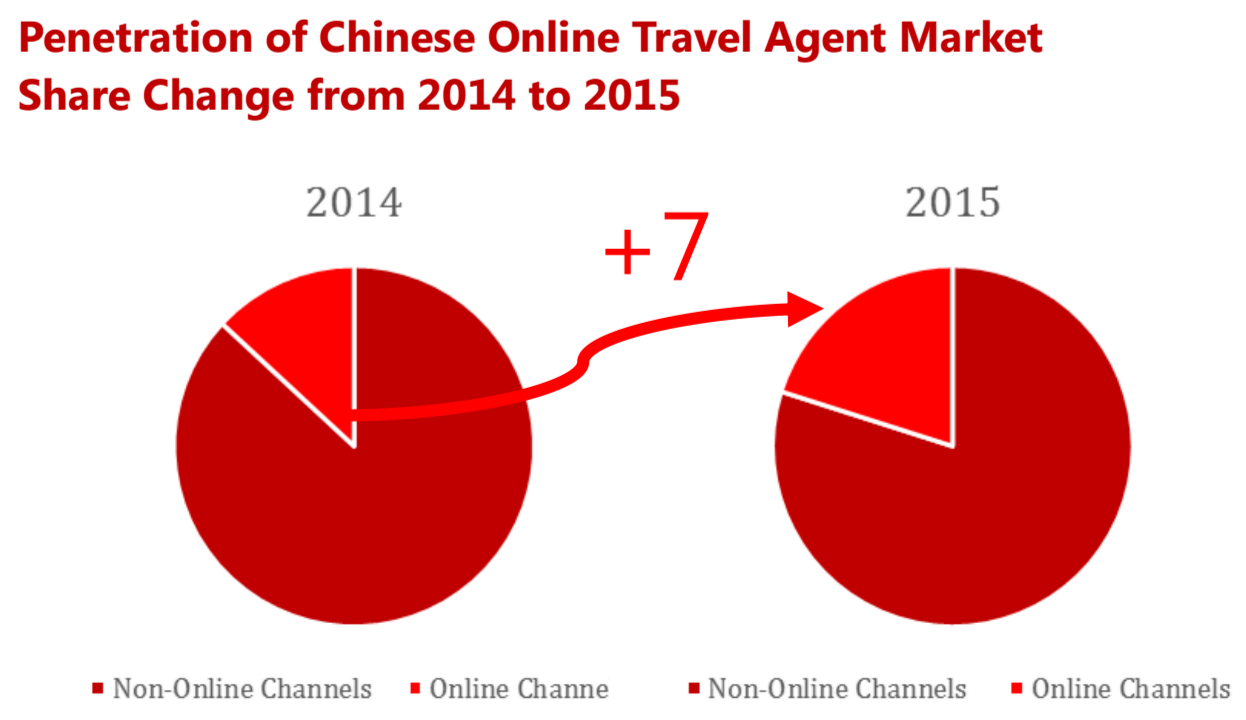
    Chinese travelers still trust and use traditional travel agencies more than online booking sites in 2016. But the percentage of online travel agency penetration in China reached a record high level last year.

    According to a Chinese outbound market report from the Chinese Outbound Tourism Research Institute (COTRI), 20 percent of the 120 million Chinese outbound travelers booked travel using an online travel agency in 2015. That’s a seven percent increase over 2014 and the strongest indicator that booking sites continue to be more accepted throughout China.

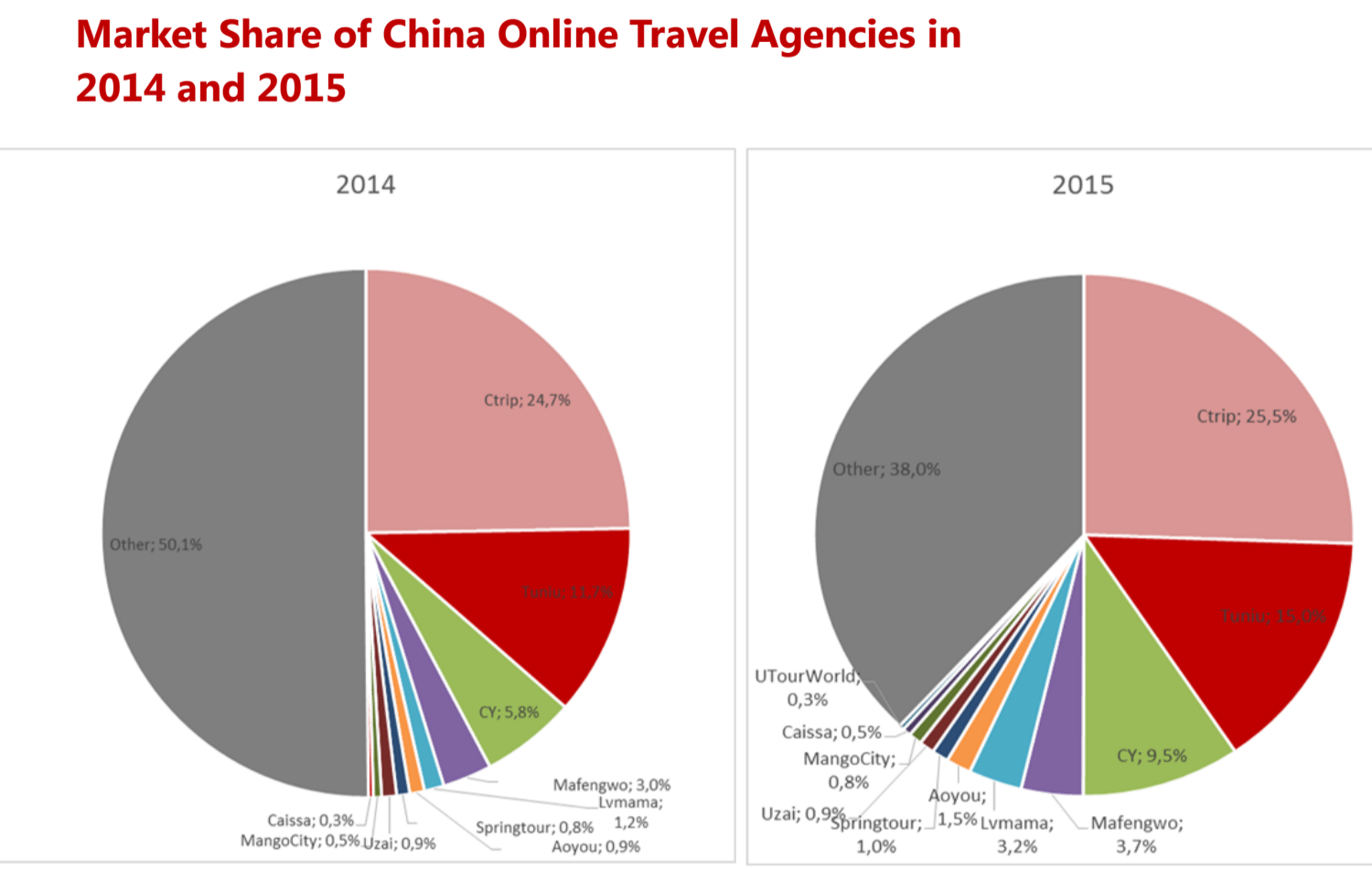
    Chinese consumers felt less pressure from pricing wars late last year when Ctrip took a stake in Qunar and began working together, a powerful alliance among two of China’s largest booking sites. That’s likely one factor swaying more consumers towards booking sites, COTRI said.

    Still, 80 percent of Chinese travelers booked offline and used one of the more than 27,000 brick and mortar travel agents in China last year. The number of travel agencies in China has increased by 50 percent since 2006 and shows little signs of slowing, and COTRI projects Chinese outbound travelers will spend nearly $80 billion at travel agents this year.

    Chinese consumers spent about $56 billion at travel agencies in 2015. They also booked $11 billion worth of travel through online travel agencies last year, a 70 percent increase over 2014.

    While offline travel agents in China have closer relationships to consumers than their foreign counterparts have with markets elsewhere, they also have competition besides the growing popularity of Chinese booking sites like Ctrip and Qunar.

    “In China, the line between retail travel agents and tour operators (also known as tourism wholesalers in other countries) is somewhat blurred. It is not uncommon for tourism wholesalers to not only create tour packages, but to also sell directly to customers through newspaper advertisements, websites and even their own retail shops,” the report states.

    Chinese travel agencies can contact and work with inbound tour operators directly without wholesalers, “which can be attributed to the mind-set of disliking intermediaries. In cases when a travel agency does not have enough customers for a specific trip, for example, it will pass on its customers to a larger wholesaler and gain from the associated commission,” according to the report.

    Many Chinese travel agencies operate illegally, which Wolfgang Arlt, director of COTRI, says is one of the greyest areas in the Chinese tourism industry. Around 10 percent of these travel agents have obtained outbound tour operation licenses in their own names, which allow them to sell various kinds of travel, and the rest use a license or sub-license from another company.

    Online travel agencies in China face barriers that offline travel agents don’t worry about. More than half of Chinese citizens (668 million people) don’t use the Internet. China’s Communist Party also exerts a lot of control over the web which leads most consumers to feel they can trust a brick and mortar travel agent more than an online one.

    And when traveling internationally for the first time–which describes a large swath of world’s largest outbound market–Chinese consumers often prefer to speak with a travel agent in person, the report points out.

    “In Chinese travel media, the exposure and discussion of online travel agencies can be compared to that of Hollywood stars. Almost every day, the industry’s e-newsletters and reports provide news on Chinese online travel agencies’ volatile relationships (price wars and partnerships), weight gains and losses (share sales and acquirements) and red carpet highlights (obtaining capital investment),” the report states.

    Screen Shot 2016-05-17 at 3.21.08 PM

    chinese travelers

    Source: Chinese Outbound Tourism Research Institute