Tag: Optimus

  • Tesla Audits Chinese Suppliers Ahead of Optimus Robot Launch

    Tesla Audits Chinese Suppliers Ahead of Optimus Robot Launch

    Tesla officials and engineers have begun auditing Chinese suppliers as Elon Musk’s company prepares to ramp up production of its Optimus humanoid robot ahead of its global release later this year.

    The audits target component manufacturers based in eastern China’s Zhejiang province, including heat-control maker Zhejiang Sanhua Intelligent Controls, auto parts supplier Ningbo Joyson Electronic, and chassis producer Tuopu Group, two corporate executives told the South China Morning Post.

    Most of the vendors being examined already supply automotive parts for Tesla’s electric vehicles, and the inspections come as the company plans to place additional orders before mass production begins at its plant in Fremont, California.

    Vendors selected for the audit round operate under strict non-disclosure agreements carrying breach penalties worth millions of dollars. The inspections examine whether high-volume auto manufacturing lines can pivot quickly to produce actuators, thermal sensors, and structural frames designed for humanoid robotics.

    Zhejiang Supply Hub

    Concentrating component qualification in Zhejiang exploits an established industrial supply cluster that already builds high-precision electric vehicle parts at scale. Actuator maker Tuopu Group saw its stock rise 2.8 per cent following news of the audits, while Sanhua and Joyson Electronic each advanced more than 1 per cent. Drawing from existing electric car component supply lines allows the manufacturer to bypass years of tooling development.

    Specialised Chinese component makers hold structural pricing power that Western suppliers struggle to match. As Chen Jinzhu, chief executive of Shanghai Mingliang Auto Service consultancy, observed: “They enjoy cost and technological advantages over their domestic and overseas rivals.”

    Factory Reallocation in Fremont

    Sourcing hardware from mainland China reveals how closely the company’s robotics ambitions mirror its early electric vehicle manufacturing strategy. While software development and final assembly remain in California, the physical bill of materials depends on Asian supply chains to achieve viable unit economics. Sourcing mechanical actuators and thermal hardware from Chinese suppliers reduces capital intensity, yet exposes output volumes to cross-border logistics lanes and geopolitical friction.

    For regional manufacturers, robotics supply contracts offer a crucial hedge against tightening margins in the domestic electric vehicle market. Intense price competition among Chinese automakers has squeezed Tier 1 suppliers, driving component producers to seek higher-margin hardware contracts in industrial automation and embodied artificial intelligence.

    Rival Makers Accelerate Schedules

    Chinese electric vehicle brands are moving on parallel tracks to commercialise bipedal machines for retail, logistics, and assembly work. Xpeng secured 900 million dollars in private funding to accelerate development of its Iron humanoid robot, backed by its own vehicle manufacturing network. Domestic competitors operate with direct access to local supply chains, eliminating transpacific shipping delays that affect US assembly lines.

    Tesla began reshaping its production footprint in January by halting assembly of Model S and Model X vehicles in Fremont to convert factory floor space for robotics manufacturing. That retooling followed statements in April from Tesla China president Allan Wang Hao, who confirmed the Shanghai Gigafactory retains the industrial capacity to manufacture complete humanoid robots once global rollout begins.

    Assembly Timelines

    Final component allocations depend on audit sign-offs scheduled across Zhejiang over the coming weeks. Factory engineers in Fremont require validated parts deliveries before the targeted commercial rollout date at the end of the year.
  • Elon Musk Faces Skeptics As Tesla Gets Ready To Unveil ‘Optimus’ Robot

    Elon Musk Faces Skeptics As Tesla Gets Ready To Unveil ‘Optimus’ Robot

    Tesla Chief Executive Elon Musk blamed overreliance on factory robots for sending the electric carmaker to “production hell” four years ago, saying humans were better at certain jobs.

    My, how times have changed.

    Musk’s Texas company now is floating ambitious plans to deploy thousands of humanoid robots, known as Tesla Bot or Optimus, within its factories, expanding eventually to millions around the world, according to job postings. Buzz is building within the company as Tesla is having more internal meetings on robots, a person familiar with the matter said.

    Longer term, Musk said at a TED Talk robots could be used in homes, making dinner, mowing the lawn and caring for the elderly people, and even becoming a “buddy” or a “catgirl” sex partner.

    The robot business eventually may be worth more than Tesla’s car revenue, according to Musk, who is now touting a vision for the company that goes well beyond making self-driving electric vehicles.

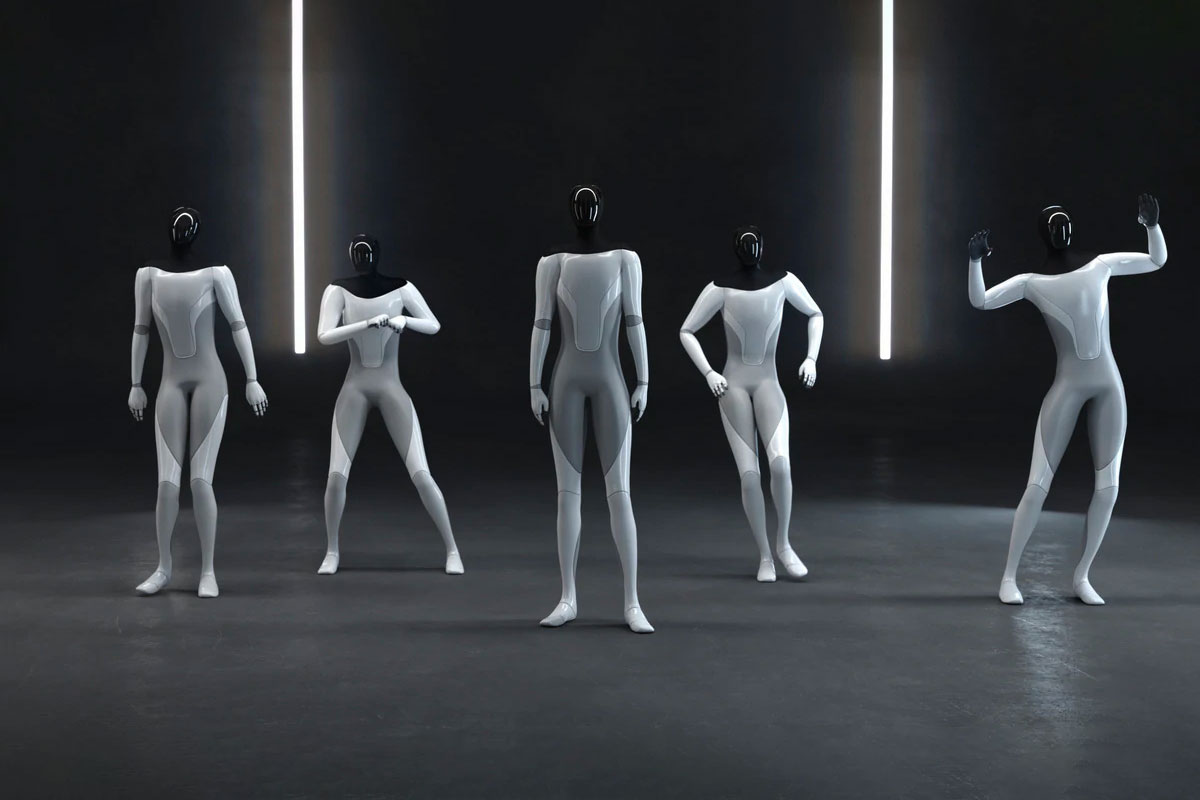
    At its “AI Day” on Sept. 30, Tesla will unveil a prototype from its project Optimus, an allusion to the powerful and benevolent leader of the Autobots in the Transformers series. Production could start next year, Musk said.

    Tesla faces skepticism that it can show technological advances that would justify the expense of “general purpose” robots in factories, homes and elsewhere, according to robotics experts, investors and analysts interviewed by Reuters.

    Tesla already employs hundreds of robots designed for specific jobs for production of its cars.

    Humanoid robots have been in development for decades by Honda Motor Co and Hyundai Motor Co’s Boston Dynamics unit. Like self-driving cars, the robots have trouble with unpredictable situations.

    “Self-driving cars weren’t really proved to be as easy as anyone thought. And it’s the same way with humanoid robots to some extent,” the lead of NASA’s Dexterous Robotics Team, Shaun Azimi said.

    “If something unexpected happens, being flexible and robust to those kinds of changes is very difficult.”

    At an “Autonomy” event in 2019, Musk promised 1 million robotaxis by 2020 but has yet to deliver such a car.

    Musk’s robots may be able to demonstrate basic capabilities at the event, but it would be hard for them to impress public expectations of robots that are as capable as humans, experts say.

    To succeed, Tesla will need to show robots doing multiple, unscripted actions, said Nancy Cooke, a professor in human systems engineering at Arizona State University. Such proof could boost Tesla stock, which is down 25% from its 2021 peak.

    “If he just gets the robot to walk around, or he gets the robots to dance, that’s already been done. That’s not that impressive,” she said.

    Tesla did not respond to Reuters’ request for comments, but Musk in the past proved skeptics wrong, jump-starting the electric car market and building a rocket company, SpaceX, although some product launches were behind schedule.

    Initially, Optimus will perform boring or dangerous jobs, including moving parts around its factories, according to Musk.

    Musk acknowledged that humanoid robots do not have enough intelligence to navigate the real world without being explicitly instructed.

    But he said Tesla can leverage its expertise in AI and key components to develop and produce smart, yet less expensive, humanoid robots at scale.

    He tweeted on Monday that its Autopilot team is also working on its Optimus robot, when asked about fixes of what it calls Full Self-Driving beta – a test version of its new automated driving software.

    Tesla is on hiring spree for people to work on humanoid bi-pedal robots, with about 20 job postings on “Tesla Bot” including jobs for designing key robot parts like “actuators”.

    “The code you will write will at term run in millions of humanoid robots across the world, and will therefore be held to high quality standards,” one of the job postings said.

    Tesla has over 2 million vehicles on the road.

    Jonathan Hurst, chief technology officer at Agility Robotics, a humanoid robot firm founded in 2015 said the technology “is right now starting to turn the corner.”

    “Certainly, an important measure of success is do they make money from it,” he told Reuters, referring to Tesla’s humanoid robot efforts.

    Analysts see more pageant than product. “It’s all part of distracting people and giving them the next shiny object to chase after,” Guidehouse Insights analyst Sam Abuelsamid said.

    “Investors are not excited about Optimus,” said Gene Munster, managing partner at venture capital firm Loup Ventures, which holds Tesla stocks. “It’s just such a low probability that it works at scale,” he said, saying it is “infinitely harder than self-driving cars.”

    And then there is Musk’s own experience with robots in the factory.

    During the 2018 production hell, Musk specifically noted the problems of the “fluff bot,” an assembly robot that failed to perform simple tasks that human hands can do – picking up pieces of “fluff” and placing them on batteries.

    He said the cost of having technicians maintain the complicated robot far exceeded that of hiring someone to do the assembly.

    The fluff bot is “a funny example but drives home the point that autonomy often doesn’t generalize well, and so handling soft fluffy material that isn’t as predictable as a rigid part was causing a huge problem,” Aaron Johnson, a mechanical engineering professor at Carnegie Mellon University, said.

    “Human hands are way better at doing that,” Musk said.