Retail News CRM

Tag: penetration

  • India’s internet population to reach 600m by 2020

    India’s internet population to reach 600m by 2020

    India’s rapidly expanding digital population is expected to double to approximately 600 million users by 2020 from 343 million users today, a new study reveals.

    The joint study, conducted The Associated Chambers of Commerce & Industry of India (ASSOCHAM) and Deloitte, also showed that of India’s over one billion mobile subscriptions, smartphone users account for approximately about a fourth or 240 million subscriptions. This is expected to grow to 520 million by 2020.

    While India is the second largest mobile phone market globally, the study noted that over 55,000 villages remain deprived of mobile connectivity, largely because providing mobile connectivity in these locations is not commercially viable for service providers.

    Spectrum availability in Indian metros is also just about a tenth of the same in cities in developed countries, which is a major roadblock to providing high-speed data services.

    The study noted that public Wi-Fi penetration remains low, with only about 31,000 hotspots available. For India to achieve the global average of one Wi-Fi hotspot for every 150 citizens, the country needs over eight million hotspots.

    Rural adoption of data-enabled devices, however, is expected to increase with the BharatNet initiative under the Digital India program, which itself has been hampered by many challenges including a lack of technical skills and capabilities or competent organizations to support the program.

    Other factors include lack of awareness of internet services among Indian consumers and non-availability of most of these digital services in local languages. Moreover, with the proliferation of cloud-based services like DigiLocker, data security has also emerged as a major challenge.

    The recent data breach in August 2016, in which debit card data for more than 3.2 million subscribers was stolen, highlights the importance of implementing foolproof security systems.

    The study recommends that the government should make efforts to make additional spectrum available to telecom service providers for deployment of high-speed data networks and must effectively collaborate with the private sector to develop the digital infrastructure.

    Moreover, it noted that in rural and remote areas, private sector players should be incentivized to provide last mile connectivity. Satellite communication solutions could also be used to speed up broadband access in rural and remote areas. For instance, banks can use VSAT technology to connect remote ATMs, remote branches which need instant access to customer data.

    “In order for the benefits of the Digital India program to reach all sections of the population, improving digital literacy is imperative. A strong skill base is required to support the initiatives and services that are envisaged under the Digital India umbrella,” the study concluded.


  • Durex maker looking for greater penetration in Indonesia

    Durex maker looking for greater penetration in Indonesia

    Reckitt Benckiser is aiming to expand its presence in Indonesia’s consumer market as the British multinational company plans to introduce several new brands.

    “We’re looking for an aggressive product and portfolio expansion. We’ll continue to work on building brands, entering new categories. The products will come in the near future,” Reckitt Benckiser Indonesia president director Ratanjit Das said during a recent interview.

    Das, however, declined to provide details regarding the brands or their expected launch schedule. The new brands will add to its list of 20 brands already being marketed in Indonesia, such as Durex condoms, Dettol antiseptic, Vanish stain remover and Strepsils throat lozenges.

    To deepen its presence, the company will meet head-to-head with its major competitors, namely Anglo-Dutch Unilever, American SC Johnson and Son and Japan’s Kao.

    Das said he was confident in the Indonesian market, citing the country’s relatively higher disposable income on the back of falling inflation and greater media use.

    “Consumers are becoming more and more aware of household products through the media. Therefore they’re ready to spend and more willing to experiment. So in the future, I would say it will be good for the FMCG [Fast Moving Consumer Goods] business, as well as for us,” he said.

    Data from the World Bank show that Indonesia’s GDP per capita rose significantly in the 2004-2014 period. GDP per capita stood at US$3,491.9 in 2014, an increase of more than three times from $1,150.3 in 2004.

    The Boston Consulting Group has also projected that 8 to 9 million people are expected to enter the middle-income bracket every year in Indonesia, until the total reaches 141 million in 2020.

    According to Reckitt Benckiser, the use of digital media has increased, especially social media like YouTube, and has helped the company advertise its products. At present, it primarily uses digital media to advertise its Durex products due to existing restrictions on condom advertising on television.

    Despite the company’s growing preference for digital media, offline activities still dominate Reckitt Benckiser’s marketing activities. For instance, it partners with the Health Ministry and the Indonesia Doctors Association (IDI) in its Healthy Life Mission campaign to introduce Dettol antiseptic at community centers.

    The company currently operates two factories in Cileungsi, West Java, and Semarang, Central Java.

    In terms of costs, Das said the exchange rate remained one of its biggest business challenges as many products were still imported. High logistics costs amid a lack of proper infrastructure are also two items of concern.

    No specific financial details are available regarding the company’s operations in Indonesia. However, its latest financial report reveals that 31 percent of its £719 million ($956.68 million) revenues in the first quarter of 2016 were generated from developing markets, including Indonesia.

  • Hong Kong’s mobile penetration grows to 95%

    Hong Kong’s mobile penetration grows to 95%

    Hong Kong’s mobile subscriber base has reached saturation point, with a population penetration of 95%, according to mobile industry body the GSM Association (GSMA).

    The company’s new report into APAC’s mobile economy, published at Mobile World Congress Shanghai this week, shows that there are around 6.9 million mobile subscribers in Hong Kong.

    While the penetration rate has grown from 90% as calculated in last year’s study, the report notes that there is little room for growth.

    But in terms of the percentage of subscribers to 4G services it is another story, with only around 40% of Hong Kong subscribers having made the switch to the faster technology as of 2015. The GSMA expects this to increase to 71% by 2020.

    The report finds that as of 2015 62% of the APAC population was subscribed to a mobile service. The GSMA predicts that the region will add another 600 million new subscribers by 2020, increasing the penetration rate to nearly 75%.

    Mobile accounted for an estimated 5.4% of APAC’s GDP last year, equivalent to $1.3 trillion in economic value.

    “More than half the world’s mobile subscribers are based in Asia Pacific and the region will be the main engine of global subscriber growth for the remainder of the decade,” said Mats Granryd, GSMA Director General.

    “Rising subscriber penetration, alongside accelerating migration to faster networks and more advanced services, continues to fuel innovation and digitisation across both advanced and emerging markets in this highly diverse region. Mobile is helping Asia build digital societies that allow its citizens to access services, anytime and anywhere – and these mobile-powered digital societies are becoming major drivers of social and economic development.”

  • Indonesia’s Low Internet Penetration Rate Curbs Economic Growth

    Indonesia’s Low Internet Penetration Rate Curbs Economic Growth

    Each day the world’s Internet users watch an average of 8.8 billion YouTube videos, share 186 million photos on Instagram, make 152 million Skype calls, purchase 36 million products through Amazon, send 207 billion emails, post 803 million Tweets, and make 4.2 billion searches on Google.

    Although digital technologies have spread rapidly across the globe, the World Bank says digital dividends have lagged behind for part of the global population. The Washington-based financial institution defines digital dividends as “the broader development benefits from using these technologies”. For example, the business community can use digital technologies to expand their business, people can use these technologies to find jobs and the government can use it to enhance services. In other words, digital technologies support financial inclusion, job creation, and overall economic growth.

    However, the fruits of these dividends are unevenly distributed. One of the key solutions in order to let all people enjoy the benefit of digital technologies is to enhance Internet connectivity. But the World Bank also states that well developed Internet access alone is not enough. “Countries also need to work on the ‘analog complements’ by strengthening regulations that ensure competition among businesses, by adapting workers’ skills to the demands of the new economy, and by ensuring that institutions are accountable.

    In essence, two factors are the cause that digital dividends cannot be enjoyed by part of the world population. Firstly, almost 60 percent of the world population still lacks Internet access, hence cannot participate in the digital economy in a meaningful way. Secondly, some of the perceived benefits of digital technologies are offset by emerging risks.

    The first factor should be combated by governments by encouraging (affordable) access to the Internet (and other digital technologies) for its citizens, while creating conducive regulations for the Internet and mobile operators.

    After India and China, Indonesia has the highest amount of people who are not connected to the Internet. The World Bank report stated that the Indonesian government is on the right track to address these aforementioned issues. For example, the Indonesian government is currently finalizing an e-commerce road-map that aims to improve and develop the country’s e-commerce industry. Previously, the Indonesian government said it may allow foreign investors to own a 100 percent stake in Indonesian e-commerce companies in this road-map.

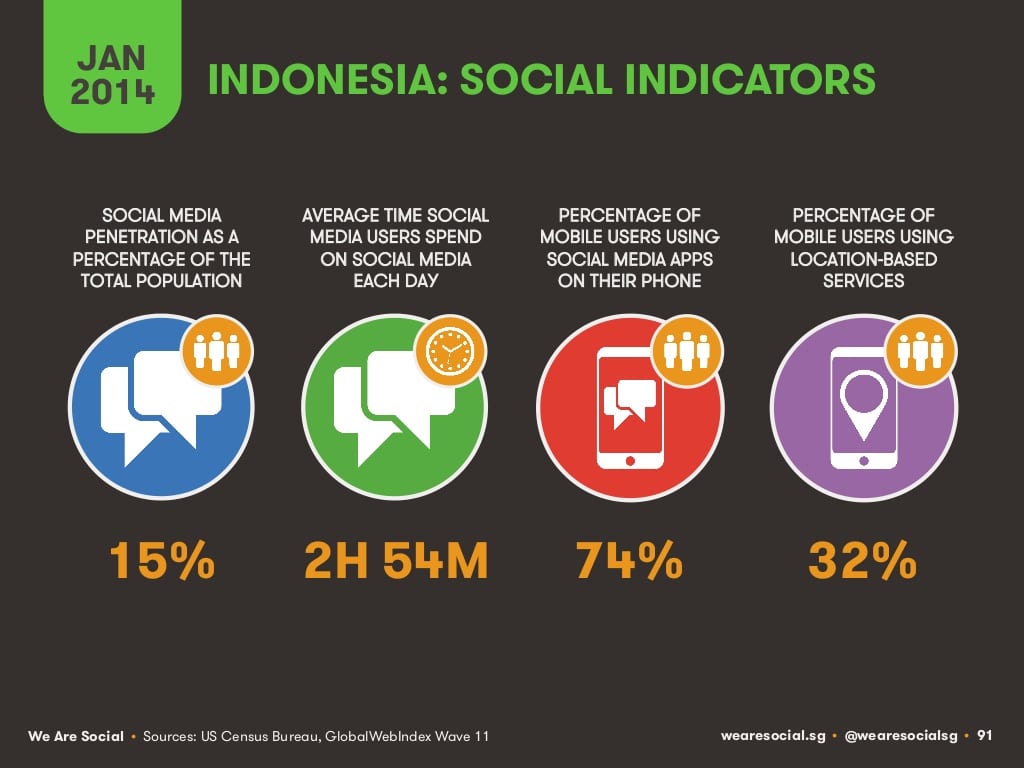
    According to the Association of Internet Service Providers in Indonesia (APJII), Indonesia had around 88.1 million Internet users in 2014, up 22 percent (y/y) from 71.9 million in the preceding year. Given that the total population of Indonesia numbers more than 250 million individuals, Indonesia’s Internet penetration ratio stood at around 35 percent in 2014. This low rate implies there is still ample room for growth in the online business industry.