Retail News CRM

Tag: peugeot

  • Peugeot launches joint venture to build cars in Algeria

    Peugeot launches joint venture to build cars in Algeria

    Peugeot maker PSA Group signed a joint venture agreement with three Algerian partners on Sunday to build cars in the North African country.

    The French carmaker said it would invest around 100 million euros ($117 million), equalling 49 pct of the joint venture’s capital.

    The joint venture will set up a plant in the western Algerian city of Oran, where French automaker Renault opened a plant in 2014.

    The Algerian partners are Condor Electronics, Palpa Pro and Entreprise Nationale de Production de Machines-Outils (PMO), PSA said in a statement.

    The plant will start some production next year and be fully operational in 2019, PSA said.

    The agreement was signed in Algiers as part of the France-Algeria joint economic committee (COMEFA), in the presence of French Foreign Minister Jean-Yves Le Drian and French Economy, Finance and Industry Minister Bruno Le Maire.

    They said France was seeking to boost investment in its former colony after losing ground to countries including China, Turkey and Italy.

    French firms including Renault, Alstom, and Sanofi were expected to sign deals in Algeria in the near future, Le Maire said.

    Algerian ministers present at the signing also said they hoped France would boost its investment in the North African country.

    “We need to point out the weakness of the partnership in our economic relations, including FDI (foreign direct investment),” Algerian Foreign Minister Abdelkader Messahel said.

    The agreement will enable PSA to achieve its goal of selling 700,000 vehicles in the Middle East and Africa region by 2021, PSA Executive Vice President, Africa-Middle East, Jean-Christophe Quemard said in the statement.

    Groupe PSA said it sold 383,504 vehicles in the region in 2016.

  • Peugeot sets new profitability record on pricing gains

    Peugeot sets new profitability record on pricing gains

    PSA Group increased sales and profit in the first half, the maker of Peugeots and Citroens said, beating analyst expectations with a new profitability record at its core manufacturing division.

    Net income rose 3.6 percent to 1.26 billion euros ($1.46 billion) on a 5 percent increase in revenue to 29.17 billion, the French carmaker said on Wednesday, as stronger pricing more than made up for weaker sales volumes in Europe and China.

    The core automotive operating margin jumped from 6.8 percent to 7.3 percent, setting a “new historic high” for the carmaker, Chief Financial Officer Jean-Baptiste de Chatillon said on a conference call with reporters.

    The Paris-based carmaker rebounded from near-bankruptcy and a government-backed bailout in 2014 to a 6 percent automotive operating margin last year on the strength of cost-cutting, a pared-down lineup and determined efforts to lift prices.

    Weaker first-half vehicle sales in Europe and a sharper slowdown in China had sparked concerns about the pace of PSA’s recovery just as it prepares to acquire Opel from General Motors , in a deal closing later this year.

    But the first-half numbers squarely beat analyst expectations of 28.92 billion euros in sales, 1.3 billion in automotive profit and a 1.06 billion-euro net profit, based on the median of nine estimates polled for Reuters.

    PSA also raised its full-year European auto-market growth forecast to 3 percent from one percent and its Latin American and Russian growth forecasts to 5 percent from 2 percent and flat, respectively.

  • Renault, Peugeot commit to raise orders from troubled parts maker

    Renault, Peugeot commit to raise orders from troubled parts maker

    French car makers Renault and Peugeot have committed to increasing their orders from ailing components-maker GM&S Industry after their chief executives spoke with Economy Minister Bruno Le Maire, his ministry said on Sunday.

    The future of the company, which employs 277 people in central France and is facing liquidation, was a priority of President Emmanuel Macron’s new administration, a government spokesman said on Wednesday.

    Renault agreed to raise its orders by 5 million euros to 10 million while PSA committed to lifting its purchases by 2 million euros to 12 million, the ministry said in a statement.

    “These commitments will allow the firm in 2017 to reach a turnover close to 25 million euros, and make it possible for it to continue operations and pursue takeover discussions,” it said.

  • Opel to build new Corsa model with Peugeot technology

    Opel to build new Corsa model with Peugeot technology

    Car maker Opel, which PSA Group has agreed to buy from General Motors, will use the French carmaker’s technology in the next generation of its best-selling Corsa model, a company spokesman said, confirming a report.

    The current Corsa model is built with GM technology. Opel had previously said its new Corsa, slated to be launched in 2019, would also be built with GM technology but has now decided to use Peugeot technology, allowing for higher margins, Allgemeine Zeitung Mainz reported in its online edition on Monday.

    PSA, which agreed to buy Opel in March, was not immediately available for comment.

    The new Corsa will be Opel’s fourth joint project with PSA after Opel models Crossland X, Grandland X and Combo. The Corsa will be built at Opel’s largest manufacturing site, in Saragossa, Spain.

  • Peugeot gears up with nuTonomy for self-driving car test

    Peugeot gears up with nuTonomy for self-driving car test

    French carmaker Peugeot is partnering with Boston, Massachusetts-based tech firm nuTonomy to test self-driving cars in Singapore. NuTonomy’s software, sensors and computing platforms will be installed in Peugeot 3008 models as part of plans to develop the technology needed for large fleets of autonomous cars, PSA and nuTonomy said in a statement on Wednesday.

    The latest PSA Group project seeks to work on “level 5” autonomous capable vehicles, which require no driver input, and will allow both companies to study how an “on-demand autonomous vehicle mobility service” performs, they said.

    The combination is the latest between technology and automotive companies after Daimler, which owns Mercedes-Benz, last month unveiled an autonomous cars development partnership with supplier Robert Bosch, while BMW has announced an alliance with chip maker Intel and Israel’s Mobileye.

    Autonomous driving in urban areas requires a more radical approach to vehicle design, particularly for software and sensors, to help a car navigate inner city obstacles, said Anne Laliron, Head of the Business Lab at PSA Group.

    “That is the reason we jump on the opportunity to work with nuTonomy,” Laliron told.

    PSA Group will use the project to learn about what components make sense, and which suppliers are available, Laliron said.

    Following the initial phase of this partnership, the companies will consider expanding their on-road AV testing initiative to other major cities.

    nuTonomy, a software company founded by Massachusetts Institute of Technology (MIT) academics and McKinsey management consultants was the first to begin on the road testing of driverless taxi services in Singapore last year.

    It raised $16 million last May in a funding round led by Highland Capital Partners and has backing from Singapore government authorities and Samsung Ventures, among others.

  • Peugeot first quarter revenue rose 4.9 percent as new models offset forex impact

    Peugeot first quarter revenue rose 4.9 percent as new models offset forex impact

    French carmaker PSA Group’s first-quarter revenue rose 4.9 percent, the maker of Peugeot, Citroen and DS models said on Wednesday, as new models helped offset the effect of weak sales growth and a negative exchange-rate impact.

    Revenue rose to 13.63 billion euros ($14.92 billion) from 13 billion a year earlier, the Paris-based company said. Revenue at the core automotive division rose 2.5 percent to 9.02 billion euros.

    PSA also lifted its full-year market outlook to a 1 percent expansion in Europe and 2 percent in Latin America, having previously forecast flat demand in both regions.

  • Peugeot poised to buy GM’s Opel, creating a car giant

    Peugeot poised to buy GM’s Opel, creating a car giant

    France’s PSA Group is set to announce a deal to buy Opel from General Motors (GM.N) on Monday after striking an agreement with the U.S. carmaker and winning the blessing of its board for the acquisition.

    The maker of Peugeot, Citroen and DS cars said on Saturday it would hold an early Monday press conference with GM, at which the transaction is expected to be presented after Reuters reported that a deal had been struck between the two automakers.

    By acquiring Opel, the French group will leapfrog rival Renault (RENA.PA) to become Europe’s second-ranked carmaker after Volkswagen (VOWG_p.DE) by market share. Between them, PSA and GM Europe recorded 71.6 billion euros ($76 billion) in revenue and 4.3 million vehicle deliveries last year.

    The tie-up was approved on Friday by the PSA supervisory board, on which the French government, Peugeot family and China’s Dongfeng (0489.HK) are represented as shareholders, one source with knowledge of the matter said.

    Spokespeople for PSA and Opel declined further comment.

    The two carmakers, which already share some production in an existing European alliance, confirmed last month they were negotiating an outright acquisition of Opel and its British Vauxhall brand by Paris-based PSA, sparking widespread concern over possible job cuts.

    In their jointly issued invitation to a Paris press conference at 0815 GMT on Monday, PSA and GM gave no indication of its subject. Separate briefings for the German press and Opel unions are expected to be held the same day.

    Sources close to the talks had reported progress on Thursday after the carmakers narrowed differences on a near-$10 billion Opel pension deficit and other issues. GM’s European arm recently posted a 16th consecutive year of losses.

    The negotiations had encountered problems over GM demands that a PSA-owned Opel be barred from competing against its own Chevrolet lineup in markets including China, they said.

    But the “non-compete” issues were finally resolved as GM agreed to inject “substantially more” into the pensions than the $1 billion to $2 billion it had initially offered, another person said. The sources declined to give further details. Detroit-based GM, which came close to selling Opel to Magna (MG.TO) in 2009, has faced investor pressure to offload its struggling European arm and focus on raising profitability rather than chase the global sales crown currently held by VW.

    After fending off 2015 merger overtures by Fiat Chrysler with support from her board, GM Chief Executive Mary Barra agreed to target a 20 percent minimum return on invested capital and pay out more cash to shareholders.

    For PSA, the Opel deal caps a stellar two-year recovery under cost-cutting CEO Carlos Tavares, who said on Feb. 23 he would apply the same methods to Opel if the deal went through. PSA averted bankruptcy by selling 14 percent stakes to France and Dongfeng in 2014, to match a diluted Peugeot family holding.

    The acquisition offered an “opportunity to create a European car champion” and quickly exceed 5 million annual vehicle sales, Tavares told analysts as he presented full-year earnings. PSA also expects savings of up to 2 billion euros ($2.1 billion) from the tie-up, sources have said.

    Tavares also told his board that PSA would redevelop the Opel lineup with its own technologies to achieve rapid savings, according to people with knowledge of the matter.

  • European Markets Dropped On Renewed China Worries

    European Markets Dropped On Renewed China Worries

    The European markets ended Monday’s session in negative territory, as renewed concerns over China weighed on investor sentiment. Concerns over the upcoming snap elections in Greece and the likelihood of a near-term U.S. interest rate hike also contributed to the negative mood at the start of the new trading week.

    The Financial Times reported that the Chinese government has decided to abandon attempts to boost the stock market through large-scale share purchases. Senior regulatory officials told the Financial Times China’s leaders feel they mishandled their efforts to rescue the stock market.

    The Chinese government resumed large-scale stock buying late in the trading day last Thursday to help the Shanghai Composite Index finish sharply higher, but officials said the government will refrain from further large-scale buying of equities.

    The Euro Stoxx 50 index of eurozone bluechip stocks decreased by 0.52 percent, while the Stoxx Europe 50 index, which includes some major U.K. companies, lost 0.30 percent.

    The DAX of Germany dropped by 0.38 percent and the CAC 40 of France fell by 0.47 percent. The SMI of Switzerland finished higher by 0.45 percent, but the FTSE of the U.K. was closed for a banking holiday.

    In Frankfurt, Volkswagen decreased by 1.14 percent. Japan’s Suzuki Motor Corp said that it would buy back the 19.9 percent stake it sold to the German automaker after an international court settled a dispute between the automakers over their soured partnership.

    BMW fell by 0.90 percent and Daimler lost 0.97 percent.

    Insurer Allianz rose by 0.18 percent, on reported that its infrastructure arm is weighing bids for London City Airport.

    RWE sank by 4.25 percent and E.ON dropped by 1.60 percent.

    In Paris, Renault surrendered 2.28 percent and Peugeot weakened by 1.19 percent. Car parts maker Valeo also decreased by 1.45 percent.

    Total tumbled by 0.91 percent and Technip lost 0.99 percent.

    Givaudan gained 0.73 percent in Zurich, after it agreed to acquire Induchem Holding, a cosmetic ingredient producer.

    Shares of NeuroVive Pharmaceutical AB plunged by 39.13 percent in Stockholm after the mitochondrial medicine company announced that it would not pursue development of CicloMulsion in the indication of acute myocardial infarction.

    Eni SpA climbed by 1.53 percent in Milan. The company announced over the weekend that it has discovered a massive natural gas discovery off the coast of Egypt.

    Eurozone inflation remained unchanged at a very low level in August as further fall in oil prices curbed its ability to move upward. Inflation came in at 0.2 percent in August, the same rate as seen in July and June, preliminary data from Eurostat showed Monday. It was forecast to ease to 0.1 percent.

    Germany’s retail sales rebounded in July to grow at the fastest pace in nine months, signaling that consumer spending boosted economic growth at the start of the third quarter. Retail sales advanced 1.4 percent on a monthly basis in July, Destatis reported Monday. This was the fastest growth since October 2014, when sales climbed 1.8 percent.

    Italy’s retail sales dropped for the second straight month in June, figures from the statistical office Istat showed Monday. Retail sales fell a seasonally adjusted 0.3 percent month-over-month in June, following a 0.2 percent decrease in the previous month. In April, sales had risen 0.7 percent.

    Greece’s retail sales declined in June after rising in the previous month, preliminary figures from the Hellenic Statistical Authority showed Monday. The volume of retail sales decreased 0.4 percent year-over-year in June, in contrast to a 4.1 percent sharp gain in May, which was revised down from 4.2 percent. In April sales had fallen 1.8 percent.

    China’s trade deficit in services widened in July, the State Administration of Foreign Exchange said Monday. The deficit on trade in services increased to $17.6 billion in July from $14.9 billion in June. At the same time, the merchandise trade showed a surplus of $46 billion in July.

    Business activity in the Chicago area unexpectedly grew at a slower rate in the month of August, according to a report released by MNI Indicators on Monday. MNI Indicators said its Chicago business barometer dipped to 54.4 in August from 54.7 in July. While a reading above 50 indicates growth, economists had expected the index to inch up to 54.9.
  • Peugeot and China Changan Automotive in joint venture

    Peugeot and China Changan Automotive in joint venture

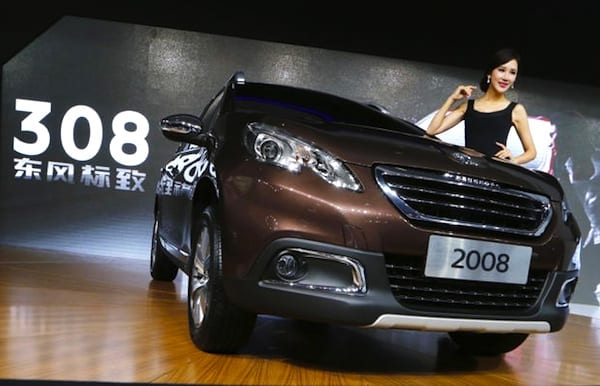
    French car giant Peugeot has agreed a new joint venture to manufacture light commercial vehicles and cars in China.

    Peugeot has signed an initial agreement with domestic carmaker China Changan Automotive Group. If it goes ahead, the deal will give Peugeot a bigger foothold in the fast-growing Chinese car market.