Tag: Philippine Stock Exchange

  • PLDT Auditor Resigns After Nearly 24 Years over Impaired Independence

    PLDT Auditor Resigns After Nearly 24 Years over Impaired Independence

    SyCip Gorres Velayo & Co. Resigned as auditor to PLDT after nearly 24 years, withdrawing its audit opinions on the Philippine telecom company’s 2024 and 2025 financial statements prepared for international reporting.

    The Ernst & Young member firm informed PLDT on October 31 that its independence had been impaired under US Securities and Exchange Commission regulations and auditing oversight rules. PLDT appointed Isla Lipana & Co., the Philippine member firm of PwC, as its new external auditor effective Monday, November 2.

    The departure follows accounting errors PLDT acknowledged in August tied to deficiencies in controls over structured hedge arrangements, with SGV finding a material weakness in internal control over financial reporting as of December 31, 2025.

    Flawed Hedges and Control Failures

    The auditor rupture follows internal accounting errors that surfaced earlier this year. In August, PLDT reported control deficiencies tied to structured hedge transactions designed to manage currency exposure, misstating how gains and losses from those contracts were recognized on its books.

    SGV concluded that a material weakness existed in PLDT’s internal control over financial reporting as of December 31, 2025. The auditor had initially granted clean opinions for both 2024 and 2025 before withdrawing them on October 31, stating the 2025 findings could no longer be relied upon while an assessment of 2024 data remained incomplete.

    PLDT told investors the revisions will not materially alter its net income, EBITDA, earnings per share, cash flows, or operating metrics. The Philippine Stock Exchange halted trade in PLDT shares for one hour on August 14 following the initial hedge disclosure, after which the stock closed down 4.49 per cent at 1,170 pesos.

    Scrutiny for Telecom Capital Markets

    For regional institutional investors, the breakdown creates immediate friction in valuation and debt covenants. Telcos across Southeast Asia carry high use to fund network upgrades, making absolute confidence in treasury and derivative controls essential for bondholders and banks.

    The resignation deepens regulatory vulnerability because PLDT maintains American depositary shares on the New York Stock Exchange. While Isla Lipana took over the Philippine accounts, PLDT has not yet secured an accounting firm to audit its international financial statements and sign off on internal control reporting mandated by US regulators.

    Overrun Precedents Dog Balance Sheet

    This is the second major breakdown in PLDT’s financial administration in four years. In December 2022, the group disclosed a 48 billion peso capital expenditure overrun accumulated between 2019 and 2022, prompting an internal overhaul of its procurement protocols even after an external review found no fraud.

    The hedge accounting breakdown shows those spending overhauls failed to insulate broader treasury management from control failures. SGV’s sudden withdrawal of two years of audit statements leaves PLDT operating without verified baseline books for international market compliance.

    PLDT must now install a US-registered independent accounting firm to complete the international audits, while investors monitor whether restatements ripple across its upcoming quarterly earnings reports.

  • AllHome and AllDay Cut Store Counts to 34 and 13 Outlets

    AllHome and AllDay Cut Store Counts to 34 and 13 Outlets

    Villar-owned retail companies AllHome and AllDay confirmed store network contractions on Wednesday, October 7, following financial losses and stiff retail competition.

    Separate disclosures to the Philippine Stock Exchange show home improvement chain AllHome cut its store count to 34 as of September 29, 2026, down 26 percent from 47 at the end of 2025. Grocery operator AllDay Marts reduced its network by 50 percent over the same period, dropping from 26 locations to 13.

    Network shrinkage across home and grocery formats

    The retrenchment represents a steep reversal for two retail chains that expanded aggressively across Villar residential developments over the past decade. AllHome operated 72 outlets at its peak across 2023 and 2024, after starting with just four branches in 2013 and listing on the local bourse in 2019. Its current 34 locations include large mall-based, large free-standing, and small specialty outlets.

    AllDay opened its first grocery branch in late 2016 and expanded to 40 supermarkets by 2024. The current fleet of 13 stores leaves the grocery operator with less than a third of its peak footprint. The company told the exchange it will reorient remaining operations toward smaller mini-mart formats to lower overhead and protect liquidity.

    Earnings collapse and anchor space turnover

    Financial results explain the sudden retreat from large-format retail. AllHome posted a net loss of 36.4 million pesos for the first nine months of 2025, swinging from a net profit of 384 million pesos during the prior-year period. AllDay saw full-year 2024 net profit decline 27 percent to 268 million pesos as revenue fell 9.2 percent to 9.25 billion pesos, citing intense competition in low-performing catchment areas.

    Mall landlords within the group are already reallocating space to outside operators. The Philippine Stock Exchange questioned both companies after reports surfaced that Gokongwei Group brand Shopwise will take over the anchor space previously occupied by AllHome at Vista Mall in Santa Rosa City, Laguna. Inventory clearance sales across Cavite, Laguna, Mandaluyong, Taguig, and Pampanga preceded the closures, with promotional markdowns reaching 75 percent.

    Rethinking township retail integration

    The contraction exposes structural limits in relying on captive housing developments for retail foot traffic. The Villar group built more than 500,000 residential units nationwide and positioned its retail chains as natural amenities for those master-planned subdivisions. While property integration gave AllHome and AllDay fast access to commercial land, it insulated both brands from direct competitive pressure only temporarily.

    Rival operators with stronger supplier terms, deeper private-label assortments, and more efficient logistics chains have consistently pressured independent township stores. When housing construction slowed and consumer spending tightened, foot traffic inside standalone township malls failed to generate the volumes required to support big-box home depots and premium supermarkets. Handing anchor tenancy to external chains such as Shopwise indicates that property management now prioritizes stable rental yield over internal ecosystem synergy.

    Leadership departures and operating reset

    Management instability accompanied the downturn well before the latest round of store shutdowns. The shared president and chief operating officer of AllHome and AllDay resigned in September 2025 as earnings began to deteriorate. That executive exit followed earlier public statements from chairman Manny Villar and former AllValue president Camille Villar celebrating record sales figures from the post-pandemic reopening.

    Both companies now face the task of defending their remaining assets while containing operating debt. AllDay is adjusting store layouts to focus on working capital optimization, cash conservation, and smaller-format convenience retailing. Investors and suppliers will monitor third-quarter 2026 financial statements and upcoming lease filings to see whether the network consolidation stabilizes operating margins or triggers further asset impairments.

  • Philippine Regulator Clears GCash Parent Mynt for $1.48 Billion IPO

    Philippine Regulator Clears GCash Parent Mynt for $1.48 Billion IPO

    The Philippine Securities and Exchange Commission has approved the initial public offering of Mynt, Inc, the parent company of GCash, for up to $1.48 billion (P92.32 billion).

    The company will list on the Philippine Stock Exchange with an expected initial market capitalization of $10.71 billion (P668.96 billion) under regulatory guidelines established in 2026 for large-scale issuers.

    Under the approved terms, Mynt will issue up to 1.61 billion primary common shares, while a selling shareholder will offer up to 6.42 billion shares, alongside an overallotment option of up to 1.20 billion shares priced at up to $0.16 (P10) each.

    Share structure and float relief

    Regulators granted Mynt permission to list with a 12 percent initial public float rather than the standard 15 percent requirement. SEC Memorandum Circular No. 11 allows this lower threshold for issuers valued above $3.2 billion at listing. With an anticipated market capitalisation of 668.96 billion pesos, Mynt easily surpassed that statutory mark.

    That regulatory waiver protects existing shareholders from heavy dilution while injecting fresh liquidity into the local bourse. The secondary share sale gives early backers a clean exit route. It also keeps excess cash off the operating balance sheet.

    Valuation and market impact

    A $10.71 billion listing immediately reshapes index weightings on the Philippine Stock Exchange, where conglomerates, real estate developers, and traditional lenders dominate trading. The float gives fund managers a direct, liquid proxy for domestic consumer spending and fintech transaction volumes. It also tests local capital depth by absorbing funds that might otherwise flow across regional equities.

    Across Southeast Asia, the float provides a pricing benchmark for consumer fintechs moving from venture capital to public markets. Digital payment operators in Indonesia, Vietnam, and Thailand face similar profitability pressures. Yet Mynt’s multibillion-dollar domestic valuation shows local exchanges can absorb large tech listings when profitability metrics line up.

    Path to the trading floor

    Clearance follows years of rapid expansion for GCash, which grew from a basic telco money transfer tool into an everyday payment utility for Philippine merchants, transit routes, and small businesses. Backed by Globe Telecom and Ant Group, the platform built a lead over domestic rivals by capturing both banked and unbanked retail transactions during the pandemic shift to digital settlement.

    Bookbuilding and domestic retail offer periods will set the final strike price within the approved 10-peso ceiling before trading begins in Manila.

  • First Metro Securities sees mobile technology driving up retail investing in the Philippines

    First Metro Securities sees mobile technology driving up retail investing in the Philippines

    Stock broker First Metro Securities Brokerage Corp. said the number of individual investors will increase on rising income of Filipinos, growing awareness of opportunities in the stock market and the emergence of online and mobile platforms that make investing easier and more convenient.

    Gonzalo Ordoñez, the company’s president, said the market for retail investing is still young as the Philippine economy is only starting to expand.

    “As we see the growing trend of more retail investors participating in the stock market, we also see the volume increasing over the coming years. With this in mind, we will continue to move forward to help change the way people invest and save money,” Ordoñez said.

    According to the 2014 data of the Philippine Stock Exchange (PSE), less than 1 percent of the estimated 100 million Filipinos invested in the stock market.

    The Philippines still has a long way to go before achieving widespread domestic investor participation in the stock market, the broker said.

    It said, however, the number of online investor accounts, which are mainly individuals, are increasing.

    Based on the PSE’s 2014 Stock Market Investor Profile reports, online investor accounts registered a five-year compounded annual growth rate of 44 percent, compared to the overall investor base, which grew by an average of 6 percent in the past five years.

    Online investors already constitute 27 percent of the total investor accounts base, coming from just 7 percent in 2010.

    With the trend of more retail investors participating in the stock market, the broker earlier launched a service that enables clients to borrow funds to buy stocks online using eligible securities as collateral. This provides clients with the ability to take on more risk in order to take advantage of emerging trends or build a larger portfolio.

    In 2013 the company launched the country’s first exchange-traded fund (ETF), which acts as a mutual fund that mirrors the performance of the benchmark Philippine Stock Exchange index and trades like a stock on the PSE.

    First Metro Securities is the market maker and an authorized participant of the said ETF.

  • Metro surges ahead

    Metro surges ahead

    Last week amid cheers and the beat of drums, Cebuano retailer Frank S. Gaisano – with his siblings Margaret, Jack and Edward by his side – rang the opening bell at the Philippine Stock Exchange (PSE) in Makati.

    The traditional ceremony marked the market debut of Metro Retail Stores Group, Inc., the first for a Gaisano —  an iconic name in Cebu’s retail industry —  and for a Cebu-based company in almost a decade.

    Gaisano said going public, which raised about P3.6 billion for Metro’s expansion, will also enable Metro to “improve margins and operating efficiency, protect our market share, and consequently create value for our investors.”

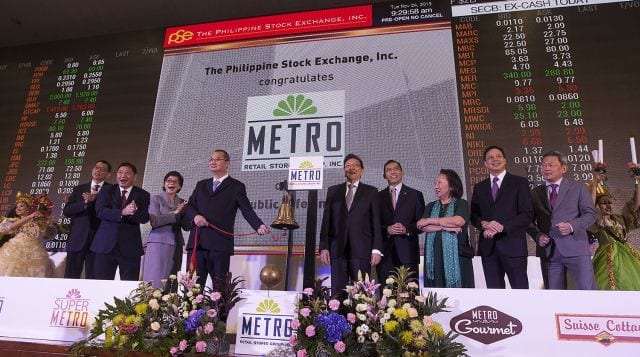
    Frank Gaisano (4th from left), chairman and CEO, leadS the bell-ringing ceremony to mark the listing of Metro Retail Stores Group Inc. on the Philippine Stock Exchange. Joining him on stage are his siblings Jack Gaisano director, Edward Gaisano, chairman and CEO of Vicsal, and Margaret Gaisano-Ang, director. PSE executives witness the milestone led by chairman Jose Pardo, president and CEO Hans Sicat, and directors Vivian Yuchingco, Emmanuel Bautista and Alejandro Yu. (CDN PHOTO/TONEE DESPOJO)

    “We are ready to compete with other industry players in serving our value-conscious market and be a leading and well-admired retailer,” Gaisano said in a statement issued after the ceremony.

    Metro, retail arm of Vicsal Development Corp., is the fourth largest retailer in the country, after SM, Puregold and Robinsons. It is the largest department store and hypermarket operator in the Visayas.

    The company is embarking on an aggressive expansion program that will see 50 to 70 new stores in the next five years, bringing the company’s network to more than 100 stores.

    This will double Metro’s footprint from the current 400,000-square meters for 46 stores, said Metro President and Chief Operating Officer Arthur Emmanuel.

    “About 100,000-square meters have been secured, including stores that will open in partnership with Megaworld and Ayala. These should open in the next two years,” said Joseph Conrad M. Balatbat, investor relations head of Metro, in a press conference after the bell-ringing ceremony.

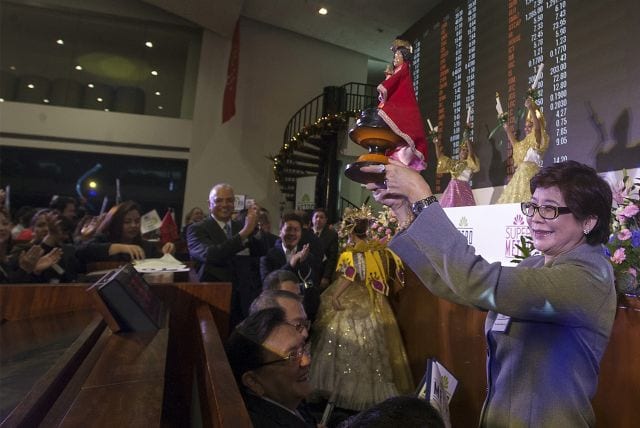
    Margaret Gsaisano-Ang holds up the image of Sto. Nino, Cebu's patron, at the Philippine Stock Exchange in Makati as Sinulog dancers perform a dance offering on stage for a touch of Cebuano culture. (CDN PHOTO/TONEE DESPOJO)

    At least seven stores are slated to open next year, including one in northern Cebu and another in the south. Four other stores will serve as anchor stores of Ayala developments while one will rise at the Megaworld mixed-use complex in Iloilo.

    About half of the 50 to 70 new stores that will open in the next five years will be in the Visayas while the rest will be in Luzon and Mindanao, where Metro has yet to establish its presence.

    “The Visayas is our priority. We see the Visayas growing much faster than Luzon. Based on Euromonitor, retail penetration in the Philippines is only 28 percent. It’s much lower in the Visayas,” Balatbat said.

    The bulk or 67 percent of the IPO proceeds will fund this aggressive expansion. The rest will be used for mergers and acquisitions.

    Balatbat said they were in talks for the acquisition of more neighborhood stores that will be rebranded as Metro Fresh N Easy.

    FIRST TRADING DAY

    The Metro stock, with trading symbol MRSGI, opened strong at P4.30 and closed at P4.13, about 3.5 percent higher than the IPO price of P3.99.

    The listing followed an initial public offering (IPO) that issued 905.4 million common shares and raised about P3.6 billion.

    This milestone occurred 33 years after the first store — then called Metro Gaisano — was opened in Colon Street in  Cebu City in 1982.

    Before the bell-ringing ceremony, Sinulog dancers in colorful costumes performed on the trading floor and on  stage as company representatives waved Metro flaglets.

    Metro Retail is run by siblings Margaret, Jack, Edward and Frank. Their parents Victor and Sally, from whose names Vicsal was coined, started Metro with a store in Colon Street that had to compete with seven others in 1982.

    There are currently 46 Metro stores across three retail formats — department store, supermarket and hypermarket (Super Metro) — in the Visayas and Luzon. Twenty-six of these stores are in Cebu and the Visayas.

    With its listing on the PSE, Metro joined three other Cebu-based companies that have tapped the capital market: Cebu Property Ventures and Development Corp. in 1992; and Cebu Holdings, Inc. and Vivant Corp., both in 1994. Aboitiz Equity Ventures and Aboitiz Power Corp. were still based in Cebu when they went public in 1994 and 2007, respectively. Both are now based in Manila.

    “This reflects our confidence in the capital markets. We believe the Philippine economy is one of the least vulnerable among the emerging economies. We continue to leverage on this positive sentiment on our economy,” Gaisano said during the press conference.