Tag: pi

  • Pi Network-like cryptocurrency mining apps come back

    Pi Network-like cryptocurrency mining apps come back

    Many cryptocurrency mining applications similar to Pi Network are being introduced again on Facebook and Telegram accounts in Vietnam.

    “Starting a business with 0 dong from Peace Network. Having an opportunity like Pi Network, why not try it?,” an account named Ngoc Van posted on a Facebook group about blockchain with more than 100,000 members, with instructions to download an app with pronunciation like Pi Network. He also spammed comments on many other groups with similar content.

    Ngoc Van said in the past month, he has “recruited” about 100 members to “mine” virtual currency.

    Not only Peace Network, he also installed a series of similar applications such as Rubi, StarCoin, LGBT Network, and BNP Network.

    “Compared to Pi, participating in a new project brings more opportunities because the amount of mining is more. Maybe some projects will bring real money,” Ngoc Van said.

    “As long as one or two of the projects go public, I can make some money. Otherwise, I have nothing to lose but a little time to spend every day,” he added.

    Cryptocurrency mining applications have appeared, disappeared and reappeared.

    According to the administrator of a blockchain group with 200,000 members on Facebook, the number of spam posts about cryptocurrency mining applications has increased day by day over the past few months, and they have had to use filters to block similar content.

    “Every day, dozens of such posts are submitted but not approved,” the administrator said. Compared to the craze two years ago, the applications are now more diverse, showing the expected amount of money earned if cryptocurrency mining projects are listed on digital currency exchanges in the future, assigning more tasks for users besides taking attendance.

    Some apps even have white papers and development roadmaps. The apps support web, iOS and Android operating systems.

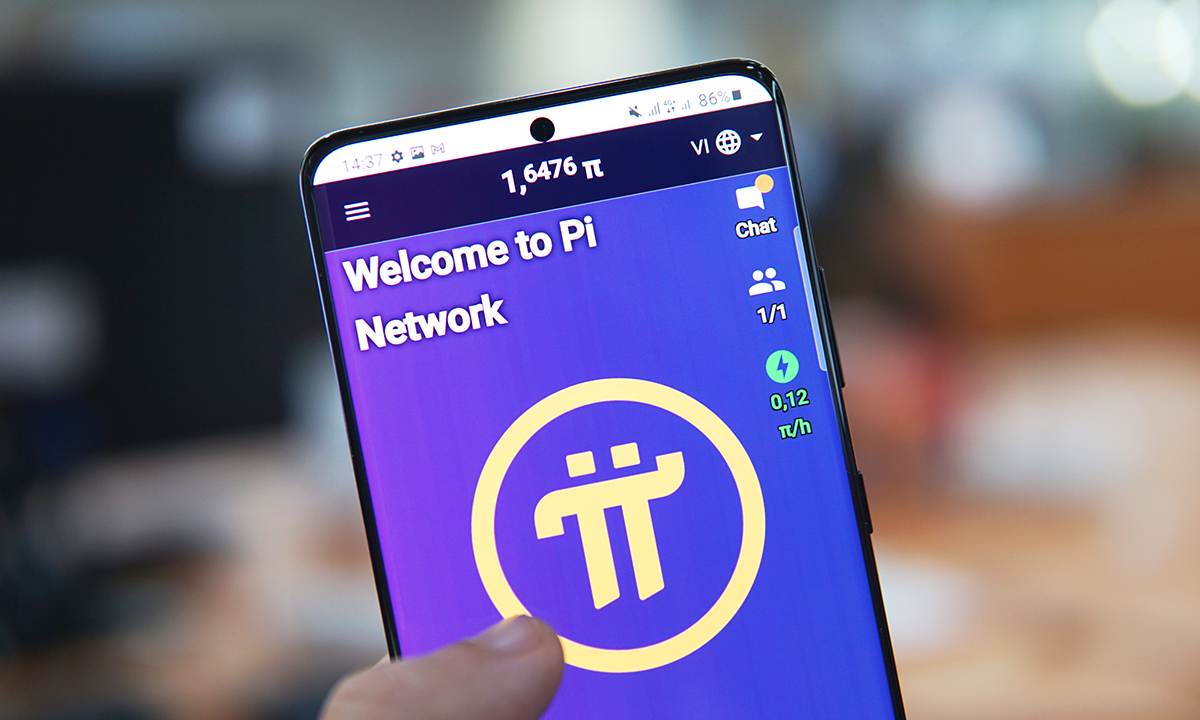
    However, apps are basically the same way the Pi Network works. Users need to download the apps, then register, enter the referral code and “take attendance” every 24 hours.

    The Rubi app was released in May and now has over 100,000 downloads, a white paper but a vague development roadmap.

    “New apps are made professionally and methodically, not as simple as before, making more people trust them,” commented Giang Nam, a cryptocurrency player for more than five years.

    “With the mentality of losing nothing and fear of missing out, hundreds of thousands of people still install the apps and take attendance every day,” Giang Nam said.

    Among 10 such apps, most of which have between 10,000 and hundreds of thousands of downloads.

    When installing, apps require providing a lot of important information, such as accessing location, reading and modifying the contents of memory, reading contacts, and accessing the network.

    Previously, apps needed only users’ names and email addresses or phone numbers.

    Currently, users are required to complete KYC (identity verification) from the beginning, including providing personal information, a photo of ID cards or passports, a selfie portrait, in addition to a phone number and an email address.

    “This is a huge data warehouse that the people behind the apps are targeting. Users think they have nothing to lose, but in reality they face many risks due to the disclosure of personal information, from the making of forged documents to receiving scam calls or messages,” Giang Nam said.

    Vo Do Thang, director of the Athena Cyber Security Center, said most of cryptocurrency mining apps aim to collect user data.

    “There aren’t any apps that give free money,” Thang said, adding that “this trick is actually to entice users to provide personal information.”

    According to him, these data will then be collected to serve many purposes.

    With the data, artificial intelligence (AI) can accurately classify each person, even make “a genealogy” of each person to see who they are related to, what they do, what their habits or hobbies are to perform tricks in a way that makes it difficult for the victims to detect.

    “Before downloading any app, it is necessary to consider who is behind the app, how reputable it is. Avoid clicking and becoming a prey for bad guys”, Thang said.

    Philips Hung Cao, deputy general Director of cybersecurity company VinCSS, said KYC on many unlicensed cryptocurrency mining apps is not managed and supervised by the authorities.

    If KYC is required, users should ask at least three questions: Is personal information protected under privacy laws and regulations? Is the information shared with third parties? If the personal information declared on the app is leaked and used for fraudulent purposes, who will be responsible for compensation? “With these three questions, unlicensed virtual currency mining apps certainly cannot meet and users will understand themselves that they should not do eKYC or KYC,” he said.

    Another source of revenue for cryptocurrency mining apps on smartphones is advertising. Most the apps include ads, forcing users to see before accessing a feature.

    In addition to the risk of information being stolen, experts say such apps also waste time, take up phone resources, and create a feeling of “virtual hope” for participants.

    After five years of being present and receiving many expectations, money earned by using cryptocurrency mining app Pi Network is still worthless now, and the team behind it is almost silent.

    Pi Network has been under investigation after critics said it lacks the transparency associated with blockchain, and could be used for nefarious purposes like fraud and data collection.

    Cryptocurrencies are not recognized as a legitimate means of payment in Vietnam whose central bank has warned that owning, trading and using cryptocurrencies are risky and not protected by law.

  • Stores’ claims of accepting Pi payment turn out to be misleading

    Stores’ claims of accepting Pi payment turn out to be misleading

    Some stores accept payment in cryptocurrency Pi but only partially and require buyers to pay mainly in cash.

    “I saw a post selling a used iPhone 11 and thought I could buy it with a dozen Pi tokens,” Thanh Son of HCMC said.

    But it turned out he could only pay 10 percent with Pi and the remaining VND12.5 million ($535) had to be paid in cash.

    “I can easily buy the same phone for VND12.5 million without spending a single Pi,” he said wistfully, adding it was a trick sellers used to entice Pi owners.

    He later contacted some other sellers and got pretty much the same answer.

    “Some places require a smaller proportion of cash but they undervalue Pi.”

    Some investors had begun to claim they bought food and equipment using Pi on social media since July 13 when the cryptocurrency’s developers allowed it to be traded.

    Cryptocurrencies are not legal tender in Vietnam, and issuing, trading or using one for payment attract fines of up to VND100 million.

    Sellers try to avoid legal risks by calling deals using Pi “exchanges” rather than “transactions.”

    A person who asked not to be identified said they had put down a VND10 million deposit for a car after the dealer made an offer “exclusively for the Pi owner community.”

    But the seller actually does not accept payment using Pi.

    He reportedly told the person: “Once Pi enters the open mainnet phase, you guys, Pi owners, can offer it for legal tender. Then you bring the legal tender to us and take your car.”

    The dealer claimed over 100 people had deposited. It is far from clear when, and if ever, the crypto will become legal tender.

    There is a chance the people would lose their deposits, an expert warned.

  • Pi miners anxiously await monetization

    Pi miners anxiously await monetization

    Vietnamese people are expecting good money from cryptocurrency Pi following developer’s promise of a mainnet launch on June 28.

    The system is making steady progress towards transiting to launch by around Pi2 Day – June 28, the development team announced on the Pi Network app last Tuesday.

    Since Monday night, Pi miners in Vietnam have started to wait for the transition. Many claimed to be business owners and said they will accept the token as a payment method as soon as the coin can be exchanged.

    Pi and other cryptocurrencies are not legal tender in Vietnam, Dao Minh Tu, the deputy governor of the State Bank of Vietnam, has said.

    Huynh Tan of HCMC said he has signed in the app to earn rewards every day for the last three years.

    “I have joined the project since its beta stage. Now it is about to enter the mainnet stage, so I hope to be able to exchange Pi for money or something.”

    He said prices of thousands dollars is “very unlikely” as there are 100 billion tokens, but the ‘consensus price’ may be of any number.

    A poll on a Pi group found 75 percent of nearly 3,400 users believing in a ‘consensus price’ of US$6,700.

    “What will you buy first once each Pi token is worth thousands of dollars?”, a member asked on a Pi group with 100,000 members and attracted over 300 comments.

    Many said they intended to buy a house, a car or give away the money after selling the token.

    But investors will have to wait until developers allow them to transfer the token.

    Last year, Pi announced it had entered mainnet, but that will be split into two phases: closed and open network — the former allows user-to-user transactions, and the latter allows exchanging with other cryptocurrencies.

    Doubts

    Meanwhile, many are skeptical about the developer’s pledges.

    “There is no certainty in the statement, just a general announcement of mainnet launch around the Pi2 Day. They did the same thing last year, but there has yet been any development,” Anh Minh, a Pi miner said.

    Pi Network also made no announcement on its social media accounts on June 28 — an unusual move as most crypto projects constantly provide users new information during key phases.

    Over the last six months, the project has reduced mining rate, required users to lock up part of their token, and started the KYC (know-your-customer) process.

    Some users were allowed to exchange the token internally, but only as a demo.

    Up to date, the token cannot be exchanged with other cryptocurrencies, and mostly remain worthless.

  • Vietnamese regain hope in ‘next Bitcoin’

    Vietnamese regain hope in ‘next Bitcoin’

    People are rushing to mine cryptocurrency Pi prompted by news of new developments including an open mainnet launch.

    Open mainnet, which is said to allow users to trade the token for other cryptocurrencies, “will begin on 2022 Pi Day (14/3) or Pi2 Day (28/6)” depending on “the maturity of the Enclosed Network economy and the progress of KYC (know-your-customer),” its developer announced last year.

    “My two-year wait will finally pay off if everything happens as planned,” Thanh Lam, a Pi investor in HCMC said.

    Like many amateur investors in Vietnam, Lam started investing in the cryptocurrency in 2020 and now has over a thousand tokens. He quit logging into the app daily a while ago after he was disappointed with the delay by the developer.

    But he returned recently after many users were asked for KYC and the fact Pi2 Day was imminent.

    “If Pi can reach the target price of a few hundreds or thousands of dollars, my 1,000 tokens will be enough.”

    He is eagerly waiting for his KYC process, a minimum requirement for most cryptocurrencies to verify users’ legality and prevent money laundering.

    “If I am not verified, my tokens will be useless.”

    Other users take a harsher approach to the cryptocurrency. “If nothing happens by the end of June, I’ll delete the [Pi Network] app,” Ngoc Nhu, 28, from the central province of Binh Dinh said.

    “I don’t expect prices to hit thousands of dollars like others, but hope it will be of some value so that my two years of efforts are not wasted.”

    Pi Browser, the mobile app meant for the KYC, recently became the fourth most downloaded non-gaming app in Vietnam on Apple App Store, and sixth most downloaded on Google Play store.

    The search for ‘KYC Pi’ has also doubled from last December, according to analysis tool Google Trend.

    Phien Vo, an administrator of a Pi group with over 130,000 members, said: “KYC is the most important step. Next steps can only be carried out once the authentication process succeeds.”

    On Monday Pi Network’s developer said the KYC process has been completed for over half the users. There were an estimated 35 million users as of May, and up to 90,000 can be authenticated in a day.

    The developer’s promises have sparked great expectations. A poll on a Pi group found 75 percent of nearly 3,400 users believing in a ‘consensus price’ of US$6,700.

    But it is now worth nothing since it has not been listed on any exchange. Pi and other cryptocurrencies are not legal tender in Vietnam, Dao Minh Tu, the deputy governor of the State Bank of Vietnam, has said.

    “Currently, most forecasts of Pi’s value are baseless,” Vo said, adding that prices would only be determined once it enters the open mainnet phase.

  • Crypto Pi app disappears from Google Play Store

    Crypto Pi app disappears from Google Play Store

    Cryptocurrency mining app Pi Network has disappeared from Google Play Store for Android devices, making investors concerned about the future of the project.

    “I cannot download the app. I am worried all my mining efforts up until now would be thrown away,” said Le Tu in the southern province of Dong Nai.

    The Pi Network app, the main tool for users to “mine” the cryptocurrency by checking in every day, “is currently going through a regular review cycle and is unavailable to download through Google Play Store,” the developers of the coin said on their website.

    “We expect to be back up on the Play Store soon,” they noted, adding users could manually download the app via a link.

    There seems to be no issue with the app on App Store for Apple devices.

    Bang, admin of a group of Pi users, also known as Pioneers, speculated that the project is set to transition to the main phase and was therefore temporarily removed from Google Play.

    The app ranked seventh among downloads in Vietnam on Google Play Store last month.

    Pi has become a controversial cryptocurrency as the developers allow anyone to own it by tapping on their smartphone once every day without any investment or much details about the development phase.

    Some experts have said the project lack transparency and called on people to be careful to avoid being scammed.