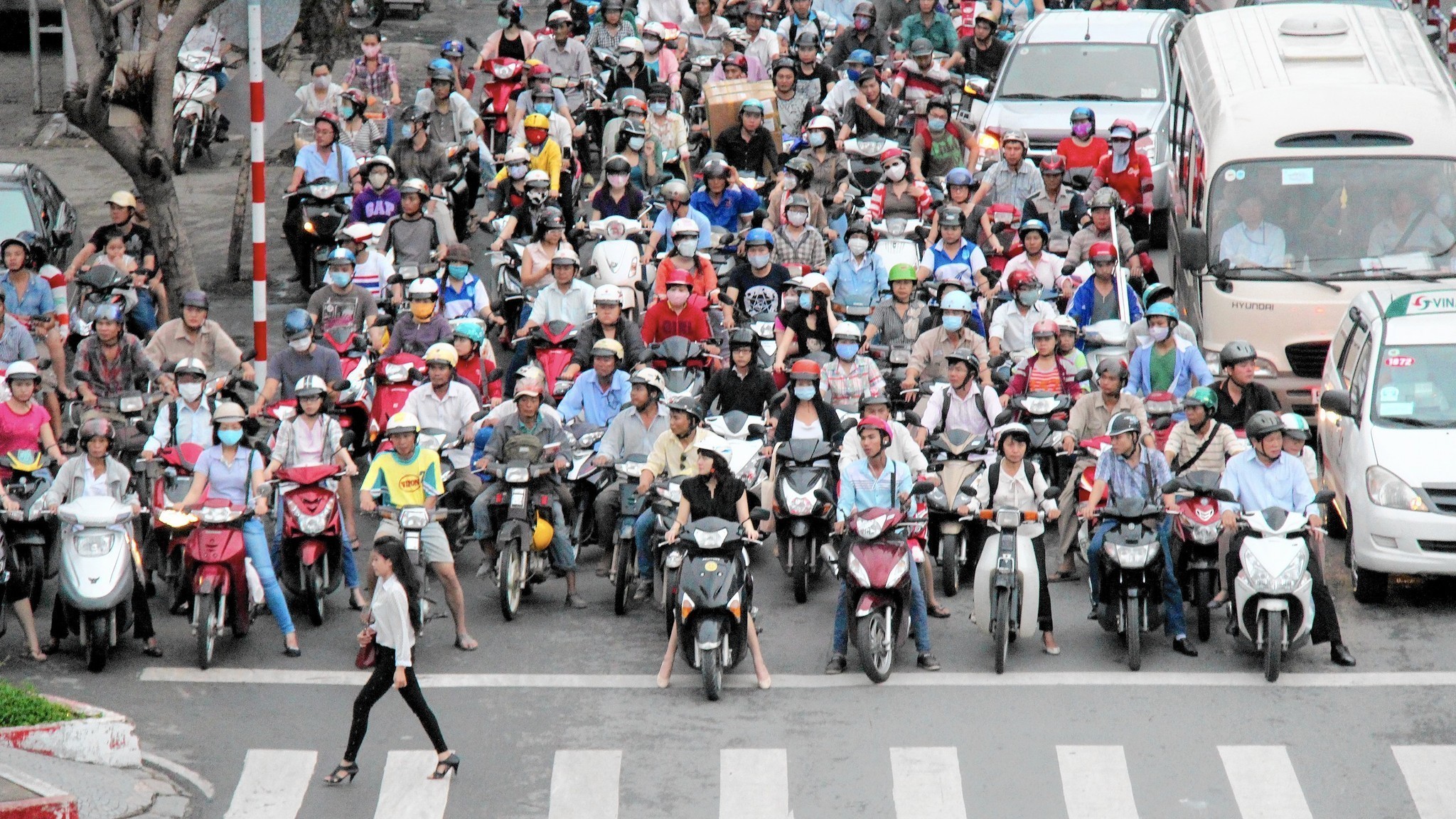
Hanoi is considering limiting the registration of new motorbikes in the downtown area from next year to reduce traffic jams. It will start with the districts of Hoan Kiem, Hai Ba Trung, Ba Dinh, Dong Da, and Tay Ho, and will expand to the districts of Cau Giay, Hoang Mai, Long Bien, Thanh Xuan, Gia Lam, and Dong Anh in 2025.
The city said that a motorbike ban during rush hour would be trialed on a stretch of Nguyen Trai Street in Thanh Xuan District this year or next year. The stretch runs about 2.2 kilometers from the Nguyen Trai – Third Ring Road intersection to the Nguyen Trai – Lang intersection. A similar ban will take effect on Xuan Thuy Street in Cau Giay District when the metro starts operating after 2020. Other roads the city is considering are Giai Phong, Nguyen Van Cu, Le Van Luong, Tran Duy Hung, and Nguyen Chi Thanh Streets.
In 2021-2025 Hanoi plans to ban motorbikes on Friday nights and during weekends on six streets near Hoan Kiem Lake: Hang Dau, Tran Nhat Duat, Tran Quang Khai, Tran Hung Dao, Le Duan, and Phung Hung. In the 2026-2030 the city will limit motorbikes in the area enclosed by the first ring road, an area of 26 square kilometers with a population of 700,000.
From 2030 it will ban motorbikes in most districts and has promised public transport will meet 70 percent of the public’s needs. There will be 180 bus routes with 2,700 buses, nine metro lines, 30,000 taxis, 30,000 contracted vehicles and 10,000 public bicycles available at that time, it has added.
The city will offer to buy used motorbikes less than 10 years old, said the plan, which was issued at a recent meeting. Vu Van Vien, director of the city Department of Transport, said Hanoi has been dealing with traffic jams by limiting cars in some areas since 2013, and the city has recently restricted taxis and technology taxis (such as Grab) on certain streets.
“Motorbikes are just one of the vehicles that will be restricted. Our plan limits and manages all vehicles. We do not want to cause trouble to residents and seek to discuss before implementing.”
The city is still studying the proposal and would consult other authorities, and wherever the ban applies, public transport should be available to meet the public’s needs, he said, adding that the city will seek public opinion on the plan.
In 2017 the city People’s Committee approved a plan to ban motorbikes in downtown districts by 2030 and restrict the use of all private vehicles in areas well served by public transport. The city said it polled 15,000 respondents in 30 districts at that time and 90 percent supported the ban.
The city tried in 2003 to stop the registration of new motorbikes in the districts of Ba Dinh, Hoan Kiem, Dong Da, and Hai Ba Trung, and expanded it to Thanh Xuan, Tay Ho and Cau Giay in 2005. However, it later scrapped the ban since it was not effective.
Hanoi’s plan to ban motorbike has met with opposition from transport experts, who said public transport is inadequate. The capital, with a population of 7.5 million, has 5.6 million motorbikes and around 550,000 cars, besides some 1.2 million bikes brought in from elsewhere, according to police figures.