Tag: playboy

  • Playboy Leaps into Massive China Market: Sells Half-Stake for $122 Million to Local Operator UTG

    Playboy Leaps into Massive China Market: Sells Half-Stake for $122 Million to Local Operator UTG

    U.S. entertainment giant, Playboy, is set to sell half of its Chinese operations to UTG Brands Management Group, a local operator of consumer brands. The deal, worth $122 million, will see UTG take responsibility for managing all operational aspects of Playboy’s enterprise in China, Hong Kong, and Macau.

    Details of the Deal

    The agreed sale price is broken down into various segments. UTG will pay $45 million over the course of two years for a 50% stake in a joint venture for Playboy’s Chinese business. An additional $67 million will be paid as guaranteed minimum distribution payments over eight years. Finally, UTG is set to provide $10 million in brand support payments over the coming three years.

    Playboy, the U.S based company, will retain the remaining stake in the joint venture.

    Investing in the Future

    Playboy has detailed plans to use at least $50 million of the income from the deal to further minimize its financial liabilities. It anticipates an immediate increase in earnings following the completion of the transaction.

    Ben Kohn, CEO of Playboy, stated the collaboration with UTG provides an important opportunity to invest in the brand’s future in China. This strategic move will position Playboy for prolonged, steady growth in one of the world’s most significant consumer markets.

    Wenming Zhang, CEO of UTG Brands Management, explained that the company will utilize a global perspective, coupled with strong local insight, to revitalize and enhance Playboy’s brand appeal. While staying true to Playboy’s roots of gentlemanly leisure, UTG will incorporate the spirit of diversity and innovation that characterizes the modern era.

    The deal is forecasted to be finalized by March 31st.

    Background Information

    Playboy was established in 1953 as a men’s lifestyle magazine before expanding into clothing in 1960. The company entered the Asian retail market in the 2000s. Despite reporting a slight decrease in sales to $29 million in the third fiscal quarter, this new venture promises to bring a fresh approach to its operations in Asia.

    UTG Brands Management is part of the Hong Kong-based United Trademark Group, which manages a portfolio of over 10 brands, such as Jeep, Dickies, and Pierre Cardin, across a dozen countries.

    Questions & Answers

    What does the deal encompass?
    UTG Brands Management Group is acquiring a 50% stake in Playboy’s Chinese operations. The deal, valued at $122 million, involves payments for the acquisition, brand support, and guaranteed minimum distributions over a span of years.

    How will Playboy use the proceeds from this transaction?
    Playboy plans to use at least $50 million of the transaction proceeds to further de-leverage its balance sheet, reducing financial liabilities.

    When is the deal expected to close?
    The transaction between Playboy and UTG Brands Management Group is expected to close by March 31st.
  • Exclusive Playboy nears deal to buy sexual wellness chain Lovers

    Exclusive Playboy nears deal to buy sexual wellness chain Lovers

    Playboy Enterprises Inc is nearing a deal to acquire the parent company of sexual wellness chain Lovers as it seeks to grow its lifestyle brand following the shuttering of its eponymous magazine, people familiar with the matter said on Sunday.

    The acquisition marks Playboy’s latest effort to leverage its famous rabbit silhouette logo to expand in the consumer products arena. It already capitalizes on its brand by selling everything from apparel to art.

    The deal would value Lovers-parent company TLA Acquisition Corp at around $25 million and could be announced as early as Monday, the sources said, requesting anonymity as the details were not yet public.

    In October, Playboy agreed to go public by merging with blank-check acquisition company Mountain Crest Acquisition Corp in a deal that values Playboy at $413 million, including debt.

    Upon closing of the deal, which is expected in February, Playboy will become a publicly-traded company again, having been taken private in 2011 in a $207 million deal led by its late founder, Hugh Hefner, and private equity firm Rizvi Traverse Management.

    Lovers operate online as well as across 41 stores in five U.S. states, selling sexual wellness and health goods including lingerie and intimacy products.

    Playboy last year ceased publication of its magazine, ending a nearly seven-decade run on newsstands that began in 1953 with a debut issue featuring Marilyn Monroe.

  • Bangkok home to Asia’s first Playboy Cafe

    Bangkok home to Asia’s first Playboy Cafe

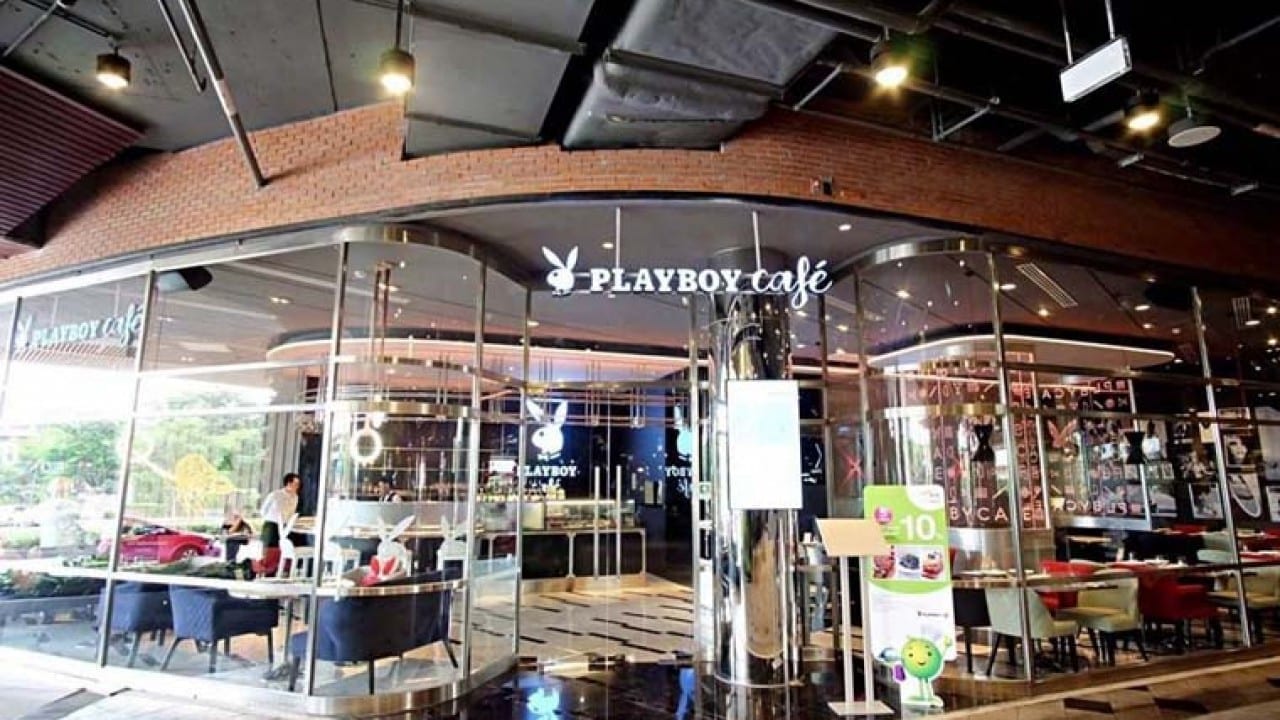
    Lam Yook Millenium Millennium (2002), the distributor of Playboy clothing in Thailand, has opened the first Playboy Cafe in Asia.

    It is in the Central Festival EastVille complex in Bangkok, with a second cafe scheduled to open in Central Marina Pattaya next month.

    Playboy cafe 1

    A budget of Bt30 million (US$856,000) has been earmarked for the opening of about 30 Playboy Cafes across Thailand within five years.

    Flying in from the US to preside over the opening, Playboy heir/chief creative officer Cooper Hefner says about 3000 Playboy outlets sell fashion accessories and clothes in such markets as China, India and Taiwan.

    She says Lam Yook has beenwith Playboy for more than 15 years in Thailand. It is the first company in Asia to gain a licence to run a Playboy Cafe.

    Lam Yook COO Pornpat Wangworawong says his company outlined its plans last year after setting up Playboy outlets in five department stores in Thailand. It plans to open a Playboy outlet at Central Plaza Korat this year and is introducing a business line to mark the Year of the Rooster. A Thai website will be launched in June.

    Playboy cafe 2

    “Before opening the cafe, we ran a market survey and learned that Thais like hanging out with friends and eating,” says Pornpat. Playboy Cafe’s signature item is the Bunny Burger.

    Covering 158 sqm in Central Festival EastVille, the cafe has capacity for 70 customers.

    Sales of the brand in Thailand have risen 30 per cent on average over the past few years, but last year’s growth was only 10 to 15 per cent because the global slowdown affecting the garment industry. To counteract this, the company plans to renovate its standalone shops and turn the outlets in department stores into unisex models.

  • Playboy drops full monty for bigger piece of China

    Playboy drops full monty for bigger piece of China

    Playboy will no longer publish images of fully nude women in its magazine from next spring. You can blame China for that.

    The porn pioneer, which gave generations of pubescent boys around the globe their first glimpse of breasts, earns a surprisingly rock solid 40 percent of its revenues in China.

    Not from its magazine, which is banned in the country, but from the happy returns on licensed merchandise.

    From Heilongjiang to Guangdong, Tibet to Shandong, it’s not uncommon to see men and women wearing t-shirts or carrying handbags donning the ubiquitous bunny logo—a rabbit head wearing a tuxedo bow tie.

    Or upon closer inspection at high-end department stores, dress shirts and suits, women’s apparel, bags and shoes, belts and wallets, and luggage, not to mention bath products and fragrances, liquor and jewelry and a lot of other things Playboy has slapped a logo on.

    “China is one of our most important markets,” Playboy CEO Scott Flanders said in a statement earlier this year. “To achieve this leadership position without ever having a media entity in China is a testament to the tremendous power of our brand.”

    And that brand translates into hard cash.

    Last year, roughly one-third of Playboy’s US$1.5 billion global retail sales came from China, said CNN. Over the past decade, the company has made US$5 billion in retail sales in the country.

    “In China and other Asian markets, Playboy has positioned itself as a lifestyle brand for sophisticated, suave, fashion-conscious consumers by working with strong licensees in premium mass-market apparel, sportswear, eyewear, et cetera,” said Torsten Stocker, greater China retail partner at AT Kearney, in an interview with the Financial Times.

    In recent years, Playboy has partnered with top tier retailers and brands in Asia, such as Lane Crawford (Hong Kong, Beijing and Shanghai), Isetan (Tokyo) and Marc Jacobs (global).

    In May, Playboy announced plans to build flagship stores in major Chinese cities, and expand its retail presence from 3,000 to 3,500 outlets, in partnership with Handong United, a recently formed group.

    While Playboy will continue to feature loads of perfectly airbrushed models in various stages of undress, explicit nudity in the magazine risks complaints from shoppers and tarnishing a brand built over the company’s 20-year history in China.

    Is distributing pictures of naked women really a business liability?

    “You could argue that nudity is a distraction for us and actually shrinks our audience rather than expand it,” Playboy’s Flanders argued last year.

    Besides, despite China’s anti-porn measures, Chinese consumers—and pervs everywhere—can get as much smut as they want on the internet.

    “You’re now one click away from every sex act imaginable for free. And so it’s just passé at this juncture,” said Flanders.

    Playboy will also continue its tradition of investigative journalism, in-depth interviews and fiction, notes the New York Times, a move that will be appreciated by those who buy the magazine “for the articles”.

    The company cleaned up its website last year (stopped showing pictures of naked women) and saw traffic quadruple and the median age of its readers move from 47 years of age to 30, “an attractive demographic for advertisers,” the Washington Post quoted a statement from Playboy as saying.

    Playboy is a household name in China, with 97 percent brand awareness among Chinese consumers, according to research firm Penn Schoen Berland.

    “As one of the most famous and treasured brands in China, Playboy is considered the ‘must-have’ fashion choice by men and women across the Mainland,” said Xiaojian Hong of Handong United.

    Through licensing agreements, Playboy-branded consumer products are now in 180 countries.

  • Ambitious plan for Playboy China

    Ambitious plan for Playboy China

    Playboy is using its massive brand awareness in China to drive an expansion of its apparel range and enter new retail categories.

    US-based Playboy Enterprises has signed a new 10 year licensing agreement with Handong United to manufacture and distribute an expanded assortment of men’s and women’s fashion apparel, including casual fashion apparel, formal and casual footwear, and accessories, such as belts, bags, backpacks, wallets, and travel luggage. Leveraging Handong’s broad distribution network, Playboy is expected to further expand beyond its current reach from 3100 retail touchpoints in China’s mainland to 3500.

    Playboy China boasts a 97 per cent brand awareness among Chinese consumers according to research house Penn Schoen Berland.

    “We’re proud of the fact that the Playboy brand has achieved household status as the one of the most recognised and popular brands in the world’s leading retail market,” said Scott Flanders, CEO, Playboy Enterprises.

    “To achieve this leadership position without ever having a media entity in China is a testament to the tremendous power of our brand. China is one of our most important markets and we’re committed to working with the highest calibre of partners to develop premium quality products to connect our brand to the future generation of Chinese consumers.”

    Playboy has been building its business in China for 20 years – without any of the printed or digital products it may be best known for in its US home market. In China it is purely an apparel brand and has licensing deals for other products.

    Playboy China generated US$5 billion in retail revenue over the last decade and last year achieved $1.5 billion in retail sales worldwide, more than one-third of that in China. The company wants to achieve revenues of $10 billion during the course of its new partnership with Handong United.

    The brand continues to generate momentum through its portfolio of long time partners in apparel, footwear, luggage and accessories, who actively market the brand through its Physical and VIP sub-brands, which have 1000 and 180 points-of-sales respectively.

    “Playboy has demonstrated success in building a loyal consumer base by introducing a variety of modern apparel and accessories with a renewed focus on attracting a younger male and female consumer base,” said Matt Nordby, president, global licensing and chief revenue officer with Playboy Enterprises.

    “We’re enhancing our licensing portfolio with long-term, brand-enhancing partners, and Handong United is a partner that can deliver a premium and superior product quality. We look forward to teaming with Handong to design and create new products to further grow our China presence and reach the younger fashion-conscious Chinese consumer.”

    Xiaojian Hong, executive officer of Handong United described Playboy as “one of the most famous and treasured brands in China” and a “must-have fashion choice” for men and women across the Mainland.

    Elsewhere in Asia and beyond, Playboy has been expanding its existing audience base and attracting a new generation of consumers by revamping and refining its licensing portfolio, partnering with Lane Crawford in Hong Kong, Beijing and Shanghai, Isetan in Tokyo and Marc Jacobs globally.