Tag: PNJ

  • Jewelry firm PNJ eyes 15-pct post-tax profits growth

    Jewelry firm PNJ eyes 15-pct post-tax profits growth

    At its annual general meeting Saturday, it also announced a revenue target of VND21 trillion, up 20 percent.

    But Phu Hung Securities Corporation has forecast revenues of VND18.4 trillion and profits of VND1.09 trillion, explaining that the volatility in gold prices and consumers’ increasing preference for imported jewelry would keep numbers down.

    BSC Securities expected the jewelry industry to recover this year, and forecast PNJ a 22 percent rise in profits to VND1.3 trillion on revenues of VND19.8 trillion (up 13 percent).

    PNJ chairwoman Cao Thi Ngoc Dung said the targets are achievable since the pandemic would be contained this year and the economy would recover.

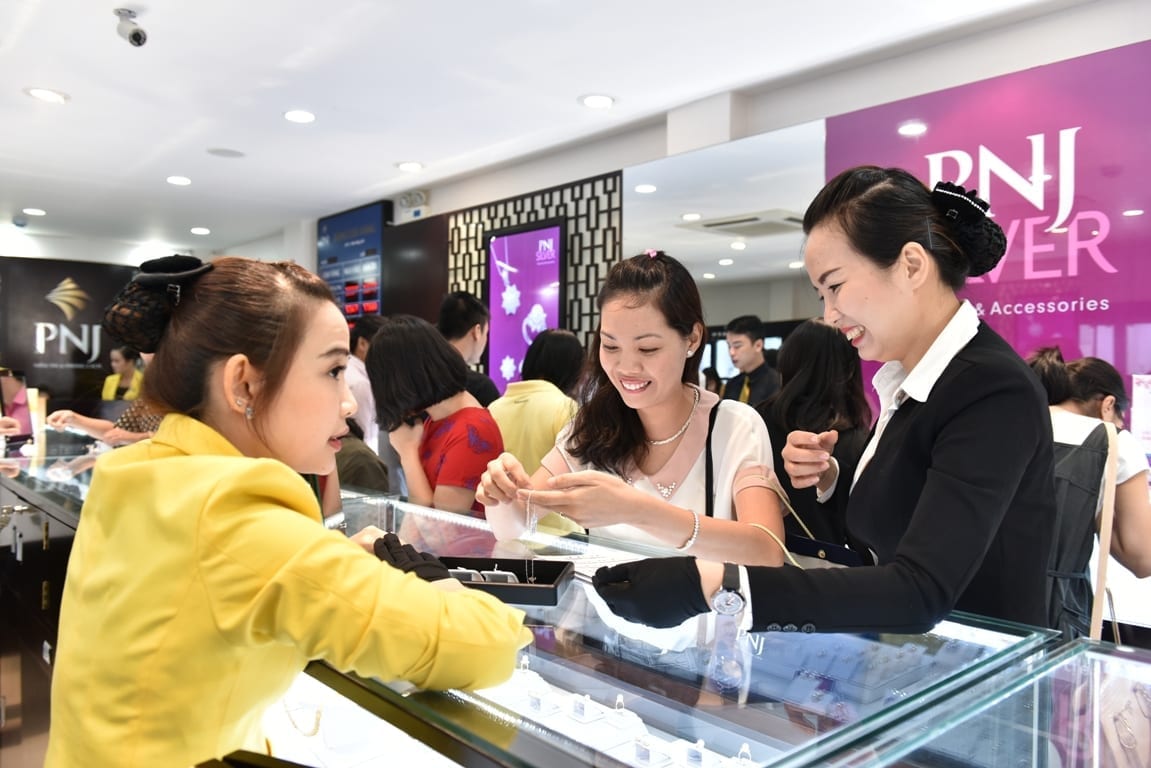
    The company aims to open 40-45 stores in 2021 and buy machinery for its jewelry workshops.

    Its CEO, Le Tri Thong, said demand for jewelry among young people in major cities is high, and this would boost the company’s revenues and profits. Smaller cities and rural areas too however show promise, he said.

    Last year, revenues edged up 3 percent to VND17.5 trillion, but Thong pointed out though the growth was lower than the average of 32 percent in recent years, the fact that PNJ managed to grow its revenues amid the pandemic was a success for it.

    It opened 29 stores and closed 36 existing ones in 2020, most of them were silver jewelry stores in shopping malls with modest business and high rentals.

  • Leading jeweler invests in pawn shop chain

    Leading jeweler invests in pawn shop chain

    PNJ has decided to invest in pawnshop chain Golden Friend, with the stipulation it cannot exceed 30 percent of the latter’s charter capital.

    The Board of Directors of the Phu Nhuan Jewelry Joint Stock Company (PNJ) has entrusted PNJ CEO Le Tri Thong with deciding the value and timing of the investment.

    The Golden Friend Joint Stock Company was founded in 2017 with a charter capital of VND1 billion, which was raised after six months to VND10 billion.

    The company introduced itself as a strategic partner of PNJ. Golden Friend has 21 pawnshops, all of which are located inside PJN stores. It accepts expensive accessories made of gold, silver and diamond, and also luxury watches like Rolex, Hublot and Patek Philippe.

  • Saigon Jewelry plans its privatisation

    Saigon Jewelry plans its privatisation

    Vietnamese jeweller Saigon Jewelry Company (SJC) is set to be privatised next year.

    The company, which has some 200 retail stores across the country, is one of a group of government-owned enterprises set for spin-off, however specific details have yet to be released.

    Established in 1988, SJC posted revenue of US$981.3 million and after-tax profit of US$3.4 million last year.

    The state-owned company also operates in other business sectors, including real estate, financial investment and services.

    SJC is one of the largest jewelry trading companies in Vietnam along with companies like Phu Nhuan Jewellery (PNJ), Bao Tin Minh Chau and Phu Quy Jewelry, all competing in the US$600 million Vietnam jewellery market.

  • Lazada partners with 40 Vietnamese retailers

    Lazada partners with 40 Vietnamese retailers

    Southeast Asian eCommerce giant Lazada has partnered with 40 Vietnamese retailers to expand their businesses.

    The partner businesses include electronics retailers Cho Lon, Tran Anh, Home Center, cookware chain Lock&Lock, and jeweller PNJ.

    Lazada expects the deals will help it cater better to local consumers, developing its business throughout Vietnam market with the message “whatever you buy offline, you can buy it online”.

    Vietnamese retailers, on the other hand, hope to expand their customer bases via the Lazada brand and reputation. Kid Plaza, a baby product supplier, says it has tripled its monthly revenue after selling its items on Lazada.

    Founded four years ago, Lazada Vietnam has become one of the biggest online shopping sites in Vietnam, sharing the US$4 billion worth market last year. Through the new deals, Lazada plans to claim at least 25 per cent of Vietnam’s online shopping spend.

    Lazada’s plan seems achievable when almost 50 per cent of Vietnam’s 93 million population are using the internet. Research predicts that by 2020, 30 per cent of the population will regularly buy goods and services online, with an average spend of US$350 per year. This will take online retail sales to $10 billion.

  • PNJ sales slightly goes up

    PNJ sales slightly goes up

    Vietnam-based Phu Nhuan Jewelry (PNJ) has recorded US$178 million in sales and a pre-tax profit of VNĐ304.5 billion (US$13.65 million) in the first six months of this year.

    These are increases of 4 and 116 per cent respectively for the same period last year, says a PNJ official.

    During the period, the jewellery manufacturer also opened 13 stores, taking its total to 204 retail outlets, plus more than 3000 wholesalers, according to Viet Nam News.

    PNJ was named Employer of the Year in last year’s JNA Awards, which cover the international gemstone and jewellery sector.

    When PNJ restructured its jewellery workshop two years ago, a 35 per cent increase in productivity followed. It invested US$4.6 million to build a six-storey factory capable of producing four million units a year.

    PNJ launches about 20 jewellery collections a year.

  • Asian retail leaders in Forbes most powerful businesswomen

    Asian retail leaders in Forbes most powerful businesswomen

    Two Asian retail leaders have been added to Forbes magazine’s annual list of 50 most powerful businesswomen in Asia – in The Philippines and Vietnam.

    They are Robina Gokongwei-Pe, the president and COO of Robinsons Retail Holdings, the second-largest multi-format retailer in The Philippines, and chairman/general director Cao Thi Ngoc Dung of Vietnam’s largest jewellery brand, PNJ, which she founded in 1998.

    Robinsons started as a department store in Manila in 1980, expanding into the supermarket business five years later. It entered the DIY business in 1994, the convenience store and specialty store businesses in 2000, and the drug store business in 2012.

    There are six business segments: supermarkets (Robinsons Supermarket and its two new subformats, Robinsons Easymart and Robinsons Selections); department stores (Robinsons Department Store); DIY stores (Handyman Do it Best, True Value, True Home by True Value, and the newly acquired big-box hardware subformat A.M. Builders’ Depot); convenience stores (Ministop); drugstores (South Star Drug and Manson Drug); and specialty stores (from consumer electronics and appliance retailer Robinsons Appliances and Savers Appliances to toys retailer Toys ’R’ Us, one-price-point retailer Daiso Japan, coffee chain Costa Coffee and international fashion brands such as Dorothy Perkins, Topman and Topshop, and international cosmetics brands such as Shiseido).

    Robina Gokongwei-Pe is also a director of Cebu Air, JG Summit Holdings, Robinsons Bank Corporation and Robinsons Land Corporation. She is a trustee of the Gokongwei Brothers Foundation, Immaculate Conception Academy Scholarship Fund and the Ramon Magsaysay Awards Foundation, and is also a member of the University of the Philippines Centennial Commission.

    After attending the University of the Philippines-Diliman, she obtained a Bachelor of Arts degree, majoring in journalism, from New York University in 1984. Pe joined the Robinsons group in 1984 as a management trainee. She is the daughter of the chairman and CEO of the company, John L Gokongwei Jr.

    Cao Thi Ngoc Dung founded PNJ as a store in 1998, and now has a 17 per cent stake of the company, which has more than 3000 employees in 200 stores. The group grossed $350 million in revenue and made a profit of $23 million in its latest trading year.

    Based in Ho Chi Minh City, PNJ opened its own jewellery factory in October 2012. A VND120 billion (US$ 5.38 million) investment, the factory has the capacity to produce 4 million items a year. PNJ’s national expansion started in 1994 with the establishment of a branch in Hanoi.

    This year’s Asia’s Power Businesswomen list represented 14 countries, with China and Hong Kong dominating (14 women), followed by India (8), Thailand (5) and Japan (4). Australia, Indonesia, Singapore and Vietnam each had three, while South Korea and The Philippines each had two. Macau, New Zealand and Taiwan had one each. There were 27 newcomers, about a quarter of them from the tech sector.