Retail News CRM

Tag: power plant

  • Government seeks monopoly over nuclear power

    Government seeks monopoly over nuclear power

    The government wants to retain its monopoly over nuclear power, proposed amendments to the Electricity Law show.

    The government wants to exclusively build nuclear power plants as these are considered critical to national security, Minister of Industry and Trade Nguyen Hong Dien said as he presented the amendments to the National Assembly Monday.

    The construction, operation and decommissioning of the plants and ensuring their safety must comply with the Atomic Energy Law and other relevant regulations.

    The plans for nuclear power generation must be integrated into the national power development plan to ensure energy security.

    Nuclear plants are required to use proven technologies.

    The government will create mechanisms for the investment, construction and operation of the nuclear plants.

    PM Pham Minh Chinh recently instructed government agencies to study the development of nuclear power and make amendments to the National Power Development Plan to include it.

    In 2009 the government had announced plans to build two nuclear power plants in the south-central province of Ninh Thuan at a cost of several billion dollars, but the National Assembly shot down the proposal in 2016 saying they were unaffordable.
  • Vietnam urged to stop building new coal-fired power plants

    Vietnam urged to stop building new coal-fired power plants

    A halt to investment in new coal-fired power plants is required to check the trend of increasing coal consumption, a report warns.

    The report, released on Monday by the Ministry of Industry and Trade in collaboration with Denmark’s Energy Agency, said the country needs early action to reduce future coal demand, which could include taxation on the use of coal or limits on new coal-based power generation.

    Vietnam’s coal imports could triple between now and 2030 as demand for power rises in lockstep with a rapidly growing economy, Jakob Stenby Lundsager, an adviser in Vietnam to the Danish Energy Partnership, said at the release of the Vietnam Energy Outlook Report 2019.

    The figure would rise eight times by 2050, meaning three-fourths of Vietnam’s energy needs would depend on imports, he said.

    Renewable energy could account for 10 percent of total supply by 2030 and 20 percent by 2050, but the country needs to invest in expanding its grid and transmission to absorb the new supply, he said.

    The report noted liquefied natural gas could be used instead of coal in the power sector through at a higher cost, but it would cause less pollution.

    Vietnam became a net importer of coal in 2015 and imports have been rising to meet electricity needs.

    Imports cost $2.27 billion last year, up 71.6 percent year-on-year, with coal bought mostly from Indonesia, Australia and Russia, according to the trade ministry.

    Since power shortages are expected from 2021, the country might need to import 3.6 billion kilowatt-hours of power in 2021 and 9 billion kWh in 2023 from Laos and China to meet demand, the ministry had said in July.

    The World Bank has estimated that Vietnam needs $150 billion for energy sector development by 2030, with electricity demand growing by 8 percent a year in the next decade.

  • Vietnam’s PV Power to list with billion-dollar market cap

    Vietnam’s PV Power to list with billion-dollar market cap

    PV Power, the country’s second largest power producer, will list on the Ho Chi Minh bourse this month with a market capitalization of $1.5 billion. The Ho Chi Minh Stock Exchange (HoSE) has approved that the firm lists 2.34 billion shares (trading code POW) on January 14 at VND14,900 (64 cents) per share. This would bring the market capitalization of PV Power to VND34.9 trillion ($1.5 billion).

    PV Power finished its last transaction on UPCoM, the market for unlisted public companies, on December 27 at VND16,000 (69 cents) per share.

    PV Power was established in 2007 with 100 percent capital from the state. The company finished equitization in the middle of last year with a charter capital of VND23.42 trillion ($1 billion).

    State-owned oil and gas giant PetroVietnam remains PV Power’s largest stakeholder, with 79.94 percent of its charter capital. Foreign investors currently own 14.3 percent. The company is subject to a foreign ownership cap of 49 percent.

    PV Power produces and sells electricity. It also imports and distributes coal and operates five electricity plants. It is the second largest power producer in the country after national utility Vietnam Electricity.

    In the 2016-2018 period, PV Power’s revenues were VND28-30 trillion ($1.2-1.29 billion), 96 percent of which came from selling electricity.

    As of September 30, 2018, its total asset value was VND61.4 trillion ($2.64 billion) and its equity was VND26.55 trillion ($1.14 billion).

    Its dividend rate for last year is expected to be 3 percent and is set at 6 percent this year.

  • PetroVietnam says Tokyo Gas may help with power plant project in Vietnam

    PetroVietnam says Tokyo Gas may help with power plant project in Vietnam

    Tokyo Gas is interested in cooperating with Vietnam’s PetroVietnam Power Corp (PV Power) to develop a natural gas-fired power project in the Southeast Asian country. On Friday, PV Power’s parent said that Tokyo Gas wants to help secure long-term liquefied natural gas supplies and funds for the construction of the Nhon Trach 3 & 4 power plants in the southern province of Dong Nai, state-run Vietnam Oil and Gas Group said in a statement on its website.

    Tokyo Gas did not immediately respond to a request for comment made via its website.

    The statement follows a meeting between senior executives from PV Power and Tokyo Gas in Hanoi this week, PV Power said.

    The two plants, with a combined capacity of 1,500 megawatts, would be operational from 2020, according to PV Power.

  • Government operating marine vessel power plant in North Sulawesi

    Government operating marine vessel power plant in North Sulawesi

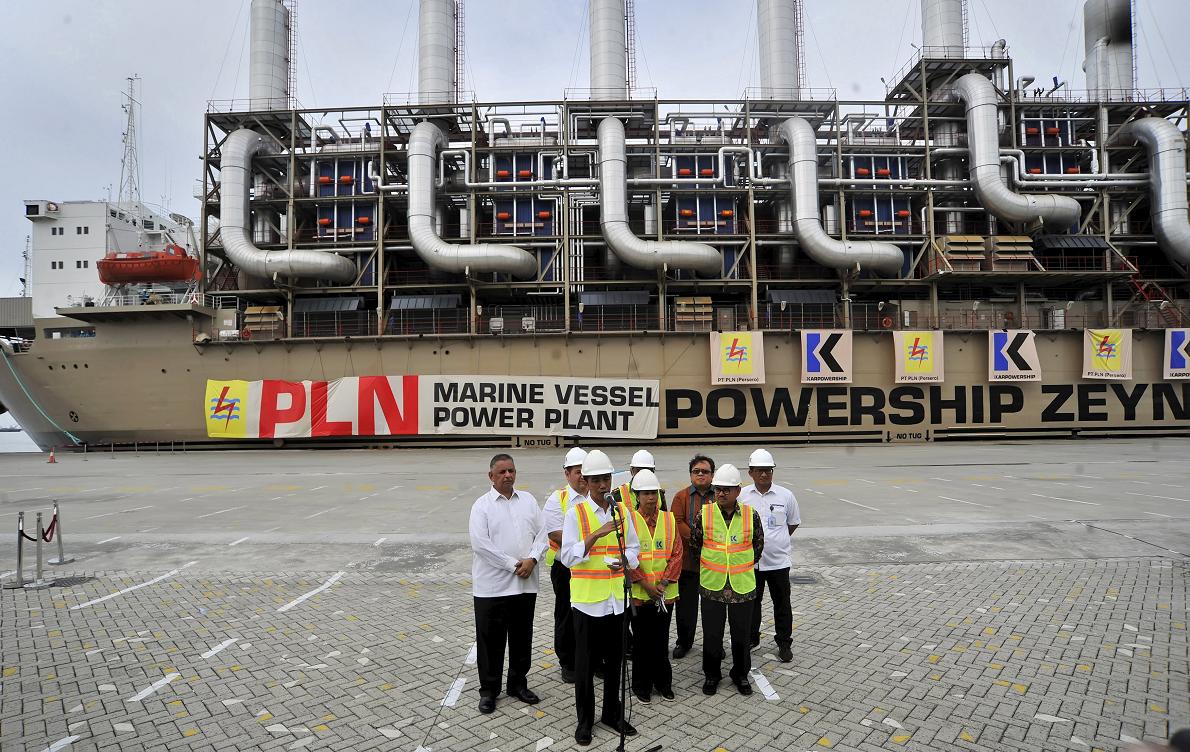
    The Indonesian government is operating a marine vessel power plant (MVVP) called Zeynep Sultan to deal with electrical power deficit in North Sulawesi province.

    “The presence of this vessel is part of the governments attention to the current electrical power deficit affecting various areas (in the country),” acting North Sulawesi governor Sono Sumarsono said while inaugurating the operation of the electrical power supplying vessel in South Minahasa on Sunday.

    The operation of the marine vessel power plant is part of the governments program to develop power plants with a combined capacity of 30 thousand megawatts to overcome electrical power deficit in several regions in the country.

    “Hopefully, this national program will be successful so all areas in Indonesia will have electricity in the future,” he said.

    Sumarsono, who is also director general of regional autonomy at the Home Affairs Ministry asked South Minahasa district head Rene Hosang to help secure the vessel while it is in the district.

    The Santiago military district command 131 will also deploy its personnel everyday to safeguard the vessel, he said.

    He expressed the hope the operation of the vessel will deal with electrical power crisis in the provinces of North Sulawesi and Gorontalo.

    “The power crisis has become cause for major concern in the two neighboring provinces. Mr Habibie (Gorontalo Governor Rusli Habibie) and I have been protested almost everyday in case of power blackout,” he said.