Tag: processor

  • Allegro Funds Invests In Be Campbell: A Strategic Move To Modernise And Expand Operations

    Allegro Funds Invests In Be Campbell: A Strategic Move To Modernise And Expand Operations

    BE Campbell, an Australian pork processing company, has recently obtained an investment from Allegro Funds as part of their growth strategy. The Sydney-based, third-generation family business employs over 750 individuals and provides services to supermarkets, butchers, foodservice operators, and distributors throughout Australia.

    Investment for Expansion

    The capital acquired from Allegro Funds will be utilized to modernise BE Campbell’s processing operations, diversify its product offerings, and enhance its commercial platform. Ted Campbell, the company’s chairman, expressed that the investment is seen as an avenue to fortify the company whilst preserving its legacy and long-standing relationships within the supply chain.

    “Over the past 55 years, our business has seen consistent growth,” he said. “We are eager to continue working closely with our dedicated growers, suppliers, customers, and staff to deliver top-tier products to Australian consumers.”

    Stake Ownership

    Allegro Funds will hold the majority stake in BE Campbell. However, the Campbell family will maintain a significant but undisclosed stake and continue to participate in the company’s management.

    Jeffrey Largier, Managing Director of Allegro Funds, expressed their excitement at the prospect of the partnership with Ted Campbell, the Campbell family, and the entire BE Campbell team. According to Largier, BE Campbell’s established market position and strong track record were key attractors for the investment firm.

    Questions & Answers

    What will the investment from Allegro Funds be used for within BE Campbell?
    The investment will be used to modernise BE Campbell’s processing operations, diversify its product offerings, and expand its commercial platform.

    Who will hold the majority stake in BE Campbell post-investment?
    Allegro Funds will hold the majority stake in the company post-investment.

    Will the Campbell family remain involved in the company’s management post-investment?
    Yes, the Campbell family will retain a significant stake and continue participating in the company’s management.

  • BridgerPay introduces the first agnostic omnichannel payment operations platform

    BridgerPay introduces the first agnostic omnichannel payment operations platform

    BridgerPay, a payment technology pioneer in the payments industry, is proud to announce its transformation into a powerful omnichannel payment operations platform, bringing unparalleled control and flexibility to businesses seeking to streamline their payment processes across all payment channels – e-commerce shops, physical stores and mobile applications.

    The transition to an omnichannel payment operations platform represents a significant positioning as a technology leader for BridgerPay, filling the untapped gap of omnichannel orchestration and payment operations that exists in the world, a pain shared by many enterprise merchants that run a multi-channel business.

    The concept of “omnichannel” used to revolve around a business’s capacity to process transactions across all channels using a single payment provider. Now, envision a world where you have the power to choose your preferred payment service provider for each channel. This is precisely what BridgerPay has crafted – an agnostic omnichannel solution that empowers merchants to optimise processing in any channel, from anywhere.

    Imagine that there are no boundaries restricting your business payments. Both your online and offline operations seamlessly process payments using the most suitable solution for each channel and geographic region. Picture a scenario where all your payments flow through your central management system, ensuring complete automation across all channels. This means you can initiate and process a transaction in a point of sale directly from your management system. Furthermore, you have the flexibility to obtain credit card tokens directly from the point of sale and use them later in your PMS or CRM, with the option to add fallback payment providers to optimise the approval ratio.

    Ran Cohen, CEO of BridgerPay, emphasises the transformative impact of BridgerPay’s platform: “We’re on an exciting journey that’s set to reshape the payment landscape for businesses. In today’s dynamic business environment, it’s essential to provide companies with the tools they need to simplify and improve their payment processes. This milestone development, the first of its kind, was born from a genuine need. Our enterprise clients, who already trust BridgerPay, approached us with a request to expand its functionality offline, for example, in physical stores or hotel front desks. Transforming these client requests into reality is at the core of our mission. As a result, we’ve created a revolutionary omnichannel payment operations platform that promises to fundamentally redefine how businesses navigate and manage their payments.”

    The impact on your business:

    Unparalleled control: Automation across all channels, with your payments flowing through a central management system streamlines your payment processing and enhances operational efficiency.

    Connectivity: Experience the effortless flow of transactions between any payment channel and your systems, ensuring error-free operations. This provides you with precise control to initiate point-of-sale transactions and retrieve tokens from credit cards, guaranteeing accuracy and efficiency in your processes.

    Payment optimisation: Each channel your business operates in will be optimised, tailored specifically to its geographical location. This approach enables you to achieve the highest approval ratios across all your channels, both in physical point of sale and e-commerce.

    Risk mitigation: The freedom to choose the most suitable payment provider for each channel allows you to diversify and spread the risk across various payment providers. This flexibility is crucial for risk management, as not every payment provider for point-of-sale (POS) transactions is ideal for e-commerce.

    Boosted revenue: Along with the tools the BridgerPay platform offers, the freedom to choose the most suitable payment service provider for each channel, whether it’s web, mobile, or point of sale, significantly boosts your revenue.

    PCI & security: By using BridgerPay as your omnichannel payment operations platform, you automatically eliminate your PCI scope. This not only enables the secure transmission of credit card information but also upholds a safe and reliable environment, further enhancing the security of your payment processes.

    The shift to an omnichannel payment operations platform positions BridgerPay as a forward-thinking industry leader dedicated to delivering innovative payment solutions to meet the diverse needs of businesses across all sectors, especially those that handle payments through multiple channels.

    About BridgerPay: BridgerPay is the world’s first omnichannel payment operations platform, built to automate all payment flows with a Lego-like interface, empowering any business to scale their payments, insights and revenue with a codeless, unified and agnostic software.


  • MacBook Air M2 laptop price falls then rises

    MacBook Air M2 laptop price falls then rises

    The retail price of the MacBook Air M2 laptop dropped by VND2.1-3 million (US$89-127) to VND25 million in April and has risen back to VND28 million in May.

    The manager of an Apple distributor in Vietnam said retailers might have hiked the price because currently Air M2 inventories in the country are very low.

    “If the demand … surges retailers … will have to wait for eight to 10 weeks for the product to be shipped to Vietnam.”

    Large retailers such as The Gioi Di Dong, FPT Shop, and CellPhoneS had sold the Air M2 with the minimum configuration, the best-selling version, for VND28 million in early April, VND25.9 million in mid-April, and VND25 million in late April.

    The laptop first sold for VND32.9 million when launched in Vietnam in July last year, but its price declined sharply partly due to competition among retailers to get a larger share of the pie, according to a manager of a The Gioi Di Dong store.

    “Prices of technological products always tend to decrease gradually after launch. However, the continuous up and down with a large amplitude of several million dong in a short period of time shows the instability of the market,” said Nguyen Van Cong, a veteran trader of Apple products.

    According to the manager of The Gioi Di Dong, the big discount of MacBook Air M2 is part of its price competition campaign.

    In early April, during a shareholder meeting, Nguyen Duc Tai, Chairman of The Gioi Di Dong (Mobile World), said: “The price at The Gioi Di Dong was sometimes million dong higher than that at other retailers. However, this phenomenon will stop. We will not let the price difference become an advantage for competitors.”

    Refusing to give the reason for their price fluctuations, managers of CellPhoneS and FPT Shop said MacBook prices have been “actively updated by the stores based on business strategies and the general situation in the market.”

    In fact, the top three Apple device retailers in Vietnam, The Gioi Di Dong, FPT Shop and CellPhoneS, have changed the laptop’s prices frequently in recent days and the prices are almost the same.

    At some Apple stores, it is one of the two best-selling laptops along with the MacBook Air with the M1 chip.

  • The 5G-enabled Honor 60 series to be unveiled on December 1

    The 5G-enabled Honor 60 series to be unveiled on December 1

    It’s been less than a month since Honor launched its mid-range 50 series, and the Chinese company has even more smartphones in the pipeline. And it’s not hard to guess the name of Honor’s upcoming devices since the Chinese company has already teased the official announcement.

    The upcoming Honor 60 series is expected to feature at least three different models: Honor 60, Honor 60 Pro, and Honor SE. Unlike the Honor 50 that packs a Snapdragon 778G 5G chipset, the upcoming phones are expected to be more powerful.

    It’s not yet been confirmed, but the Honor Pro 60 is rumored to pack a high-end Snapdragon 870 chipset. Also, the phone will be powered by a 4,500 mAh battery with 100W fast charging support. The regular Honor 60 model on the other hand will only support 66W fast charging.

    However, considering the Honor 60 series is supposed to be aimed at the mid-range tier, these rumors may be false, and the upcoming phones might end up with the same chipset inside as the Honor 50 series, or perhaps trade it for a MediaTek processor like the Dimensity 900.

    Thankfully, we won’t have to wait long for these important details. Honor confirmed the 60 series will be unveiled in China on December 1, which is less than a week from now.

  • Samsung responds to critics over Exynos 990-Snapdragon 865 performance gap

    Samsung responds to critics over Exynos 990-Snapdragon 865 performance gap

    Just a day or so ago, we told you that some members of Samsung’s chip unit were feeling “humiliated.” That’s because Samsung decided to power its three new flagship models with the Qualcomm Snapdragon 865 Mobile Platform everywhere except Europe. On that continent, the Galaxy S20, Galaxy S20+, and Galaxy S20 Ultra 5G are equipped with the Exynos 990 SoC produced by Samsung. This is the opposite of Sammy’s traditional processor pairings; historically, Galaxy S phones sold in the U.S. and China would be equipped with a Snapdragon chipset while the rest of the world would find an Exynos SoC under the hood.

    The lone exception to this setup (prior to this year) took place in 2015 when the Samsung Galaxy S6 was powered by the Exynos 7420 worldwide. Fears that the Snapdragon 810 was prone to overheating lead Samsung to make this move. So imagine that you work on the Exynos 990 in South Korea for Samsung and you discover that in that market, the only versions of the Galaxy S20 models available are those powered by the Snapdragon 865 Mobile Platform. That might humiliate you.

    Samsung said on Friday that “the Galaxy S20 is a smartphone that’s been reimagined to change the way you experience the world and depending on the region, the Galaxy S20 will either ship with the Exynos 990 or the Snapdragon 865. Both the Exynos and Snapdragon processors go through the same strict and rigorous, real-life testing scenarios in order to deliver consistent and optimal performance over the entire lifecycle of the smartphone.”

    Some Samsung fans in Europe are upset because they feel like they are paying more for what they consider an inferior product. That’s because they don’t consider the Exynos 990 to be a match for the Snapdragon 865. There are some who note that the Exynos 990 has a habit of throttling the GPU, negatively impacting the frame rate when playing a game; that can result in choppy looking animation.

    In addition, the Snapdragon 865 Mobile Platform uses ARM Holdings’ Cortex-A77 CPU cores providing it with a 20% performance advantage over the Exynos 990 chipset which uses the older Cortex-A76 CPU cores. And the GPU paired with Qualcomm’s SoC, the Adreno 650, outperforms the ARM Mali G77 GPU used with the Exynos 990.

    Last month, we told you that a petition was started on the Change.org website asking Samsung to stop selling flagship phones powered by its own Exynos chips. The petition has a goal of 35,000 signatures and as of this morning, it has attracted 34,222 leaving it just 778 short of the target.

    The actual petition reads, “Outside of the US, Samsung sells phones that use their own-branded Exynos SoC chips, instead of using Qualcomm’s Snapdragon. Samsung also use (sic) their own-brand camera sensors, whereas in the US, they use parts from specialists Sony. Based on experience, and studies from numerous sources online, we believe Samsung’s parts to be inferior to their US counterparts. Phones with Exynos SoC chips are shown to perform slower, have less battery life, use inferior camera sensors and processing, overheat and throttle faster, amongst other issues.”

    It goes on to say, “At the very least, we would appreciate if Samsung were transparent about their inconsistencies. Alternatively, for Samsung to ensure we weren’t paying the exact same price or even higher than our US friends. We have had to accept this over many years over different iterations of the flagship phones. Every year we have hoped for Samsung to either give us the same device or make their own parts perform on par with the competition. They have failed to deliver on these requests over and over again and the performance gap only seems to widen over time. In the age of transparency, it is time for a change and for us consumers to have the right to choose what we spend our hard-earned money on.

    Samsung, please hear us! We love your devices and want to be treated fairly so that we can continue to enjoy them.” Even if the manufacturer takes the time to read the petition, there is no guarantee that it will follow through on the request with future flagship models.

  • 2021’s Snapdragon 875 will reportedly be produced by TSMC using its 5nm process

    2021’s Snapdragon 875 will reportedly be produced by TSMC using its 5nm process

    he Qualcomm Snapdragon 865 is expected to be the chip designer’s next top-of-the-line mobile chipset designed for 2020’s high-end handsets. For those unaware, Qualcomm designs its chips but doesn’t own the facilities to manufacture them. For the last two years, it has turned to the world’s largest independent foundry, Taiwan Semiconductor Manufacturing Company (TSMC), to manufacture the Snapdragon 845 and 855 chipsets. Before that, Samsung made the Snapdragon 820 and 835 SoCs.
    Qualcomm is returning to Samsung to produce the Snapdragon 865. The South Korean tech giant will produce the chip using its 7nm EUV process. The 7nm figure relates to the number of transistors that are shoehorned into a chip. The lower that number, the higher the number of transistors that can fit inside a chip; the more transistors in a chip, the more powerful and energy-efficient it is. Moore’s Law, an observation made by Intel co-founder Gordon Moore back in 1965, calls for the number of transistors in integrated circuits (like chips) to double every other year. To show you how far we’ve come, the Texas Instruments OMAP 3430 chip that powered the Motorola DROID back in 2009 was built using the 65nm process!
    The EUV part of 7nm EUV stands for extreme-ultraviolet lithography. This is a technology that uses ultraviolet beams to more precisely mark up the silicon wafers used to create chips with patterns. These patterns determine where the transistors will be placed inside a chip, and when short wave-length beams (like the ones used with EUV) are used to etch these patterns on a wafer, more transistors can be stuffed inside it. Using EUV is expected to provide a performance bump of 20% to 30% and a 30% to 50% improvement in energy consumption for the Snapdragon 865. Those are not numbers to take lightly. The Snapdragon 865 Mobile Platform will probably debut on the Samsung Galaxy S11, which most likely will be unveiled around February 24th when the 2020 MWC show in Barcelona kicks off. The chip was recently spotted on the Geekbench benchmarking site where it produced a multi-core score of 12,496. That compares to the score of 10,946 produced by the Snapdragon 855+ Mobile Platform. The latter is an overclocked version of the Snapdragon 855.
    While 2020’s Snapdragon 865 will be made by Samsung, the report reveals that there will be two different versions of the chipset codenamed Kona and Huracan. Both will support LPDDX5 memory chips (RAM) and the UFS 3.0 flash memory. However, one of them will be integrated with a 5G modem chip and the other one won’t. Last week, Huwaei released a teaser for its upcoming Kirin 990 SoC that will be unveiled on September 6th. The component, expected to power the manufacturer’s next high-end Mate 30 phone line and the foldable Mate X, will also have an integrated 5G modem chip. This removes the need for a separate component and should also lead to improved battery life on devices that employ these chipsets.
    Sina.com says that for 2021’s Snapdragon 875 Mobile Platform, Qualcomm will once again call on TSMC to produce the component. The report adds that the Snapdragon 875 chipset will be manufactured using TSMC’s 5nm process. If that is indeed the case, the chip will sport 171.3 million transistors per square millimeter. Thus, the component should be more powerful and energy-efficient than its predecessor.
    So will Moore’s Law continue to be valid? Last year Samsung revealed a roadmap leading to 3nm production by 2022 and TSMC is also looking for ways to stuff more transistors inside chips. The latter is examining ways to change the packaging of chips and is also looking at stacking transistors vertically instead of side-by-side.
  • Qualcomm’s next Snapdragon processor could take 5G mainstream Easily

    Qualcomm’s next Snapdragon processor could take 5G mainstream Easily

    Support for 5G networks is currently limited to a handful of flagship devices such as the Galaxy S10 5G, LG V50 ThinQ 5G, and Huawei Mate 20 X 5G. This situation is unlikely to change anytime soon, but in order to boost the adoption rate, Qualcomm is apparently developing a 5G-ready chip that’ll make its way into future mid-range smartphones.

    Dubbed the Snapdragon 735, the upcoming chip is expected to succeed the recently-announced Snapdragon 730. Like Qualcomm’s flagship processors, this new one will reportedly be manufactured on the 7-nanometer manufacturing process. Concrete details about this are yet to be revealed, but compared to the older Snapdragon 710 it should result in a performance boost of up to 20% and an increase of 50% in terms of efficiency. Additionally, efficiency gains of up to 20% are to be expected over the Snapdragon 730.

    As mentioned above, the Snapdragon 735 will introduce support for 5G networks. But rather than utilizing the separate Snapdragon X50 modem found inside the Galaxy S10 5G, the Snapdragon 735 will apparently use an integrated 5G modem. This should result in thinner and lighter 5G smartphones. It should also reduce the overall cost associated with the technology.

    Moving on to some of the more technical details, the included CPU will boast an octa-core 1+1+6 setup. This will include six efficiency cores clocked at 1.6GHz, a slightly faster one at 2.4GHz, and a high-performance core clocked at 2.9GHz. There will also be an upgraded GPU in the form of the Adreno 620.

    Lastly, the Snapdragon 735 should allow manufacturers to build mid-range smartphones with as much as 12GB of RAM. Additionally, the chip will support 21:9 displays with 3360x1440p resolutions, 4K video recording at 60FPS, and a dedicated NPU that’ll help with AI features.

    The Qualcomm Snapdragon 735 is expected to arrive during the final quarter of this year, perhaps alongside the flagship Snapdragon 865. In terms of a release, the first Snapdragon 735-powered devices should arrive during the first half of 2020.

  • AMD Ryzen processor box art revealed by Thai retailer

    AMD Ryzen processor box art revealed by Thai retailer

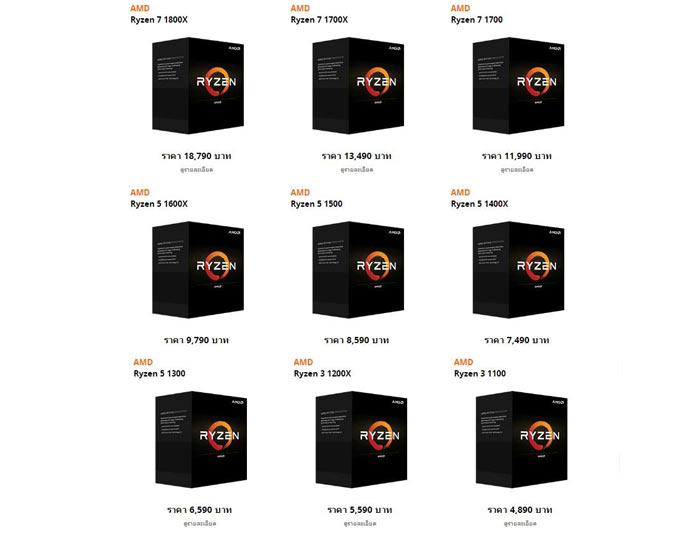
    Another day, another AMD Ryzen leak / rumour / news morsel… or two. Particularly interesting today we see what is claimed to be an AMD Ryzen box art matrix from Thailand. The web images don’t only show the products which will be soon on sale but the prices, in Thai Baht naturally. In a similar vein a Belgian online retailer has let slip its prices for the AMD Ryzen 7 range of CPUs.

    Looking at the single box art close-up we have available, above, via WCCFTech, the box design is rather simple and mainly black. Just because these have appeared on a Thai retailer site doesn’t mean they are representative of what AMD will ship either. It’s hard to know if the retailer images are overcompressed or just shoddily put together as placeholders, maybe by the retailer itself.

    Perhaps more important than the box images, if they are genuine, is another price indication at this time. Looking over the nine CPUs and prices in Thai Baht we see a price range from the Ryzen 7 1800X at 18,790 Baht (£430), down to the Ryzen 3 110 at 4,890 Baht (£112). Its possible to click through the above image matrix on the Thai retail site and get more details. You can find a full set of these pictures in the source article, one is included below for reference.