Tag: property price

  • SK Telecom Q3 profit falls 15.6%

    SK Telecom Q3 profit falls 15.6%

    SK Telecom has reported a 15.6% year-on-year decline in net profit for the third quarter to 322.1 billion won ($281 million), due to factors including the impact of Samsung’s Galaxy Note 7 recall.

    Operating revenue fell 0.4% to 4.24 trillion won due to a decrease in revenues at retail unit PS&M following the recall. ARPU also declined 2.1% year-on-year and 0.8% sequentially to 35,471 won.

    But revenue from SK Telecom and subsidiaries SK Broadband and SK Planet all increased quarter-on-quarter, and net income grew 10.7% over the same period due to equity-method income from semiconductor division SK Hynix.

    The operator added around 301,000 new subscribers during the quarter, taking its total to nearly 29.5 million. Of these, over 20.5 million are LTE subscribers, a penetration rate of 69.8% Monthly churn decreased by 0.1 percentage point to 1.4%.

    SK Telecom revealed that its mobile navigation T Map grew to reach 9.18 million monthly users by the end of September, around three months after its launch

    Looking ahead, the operator said it is focused on strengthening its core competitiveness as a mobile network operator, while using its nationwide LoRa and LTE-M IoT networks to deploy services that enhance customer convenience.

    “We expect that our strategy to fully open up major platforms including T Map and T Phone will lead to a successful outcome in the mid-to long-term,” SK Telecom CFO and head of strategy and planning Hwang Keun-joo said.

    “SK Telecom will accelerate its transformation into a next-generation platform company and keep developing customer-oriented products and services.”

  • Hong Kong Housing Prices to Fall a Further 10%, Nomura Says

    Hong Kong Housing Prices to Fall a Further 10%, Nomura Says

    Hong Kong home prices will fall a further 10 percent as a pipeline of new developments is met by stalling income growth and looming interest rate hikes, Nomura Holdings Inc. said in a report.

    “We are bearish on the physical property market, on a weakening economy, deteriorating affordability, declining retail sales and stagnant real household income growth,” analysts led by Jeffrey Gao wrote in a note Tuesday. Prices will decline over the medium term, the analysts said, without being more specific.

    Gao said in an interview earlier this month that a rebound in property prices during the second quarter was just a pause in a multi-year correction. Hong Kong home prices are 9.4 percent below their September peak, having fallen as much as 12.8 percent at the end of March, according to data from Centaline Property Agency Ltd.

    Mortgage rates in Hong Kong, which are linked to the Federal Reserve rate via the pegged currency, may rise after Fed Chair Janet Yellen said last week the case to raise interest U.S. rates is getting stronger.

    Nomura also sounded a bearish note on Hong Kong’s retail property market, predicting a 5 percent drop in rental returns in fiscal 2017, as tourist arrivals decline and sales fall. Office rents may also fall as much as 5 percent as leasing demand slows, the report said.

    Despite the negative outlook, Nomura remains “positive on HK property names overall,” citing their healthy debt levels, solid balance sheets and potential for share buybacks. The analysts’ top picks are Sun Hung Kai Properties Ltd. and Kerry Properties Ltd., which are both trading at a discount to their net asset value.

    Sun Hung Kai Properties shares have risen 17 percent this year and Kerry Properties have gained 6.9 percent, outperforming an 11 percent increase by the Hang Seng Property Index.

  • Fall of 5-10% in Hong Kong property prices ‘not abnormal’ — Wheelock

    Fall of 5-10% in Hong Kong property prices ‘not abnormal’ — Wheelock

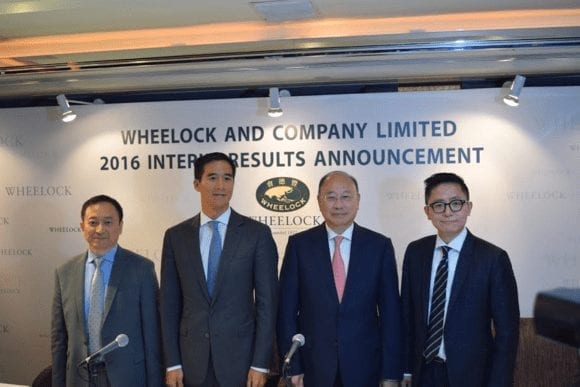
    Hong Kong’s property market has yet to stabilize and could fall by 5-10% in the second half of the year, according to leading developer Wheelock.

    “Given the global uncertainties arising from Brexit and volatility in the currency market and oil prices, a 5-10% fluctuation in [home] prices in Hong Kong is not something abnormal,” said Chairman and Managing Director Douglas Woo Chun-kuen in an earnings briefing on Monday.

    In his late thirties, Woo, an architecture graduate from Princeton University, has become a third-generation owner to take the helm of the Hong Kong-listed property conglomerate after a stint at UBS. He assumed the chairmanship from his father Peter Woo Kwong-ching in 2014.

    Woo’s cautious outlook came after his group reported a 29% plunge in net profit to 5.66 billion Hong Kong dollars ($730 million) in the six months ended June. Underlying profit, excluding the impact of property revaluation, fell 19% to HK$5.13 billion on the year, despite a surge in property sales amid a housing downturn in previous months.

    Contracted sales reached HK$11.8 billion as of mid-August this year, primarily driven by the sale of three residential projects and the en-bloc sale of OneHabourGate East office tower and shops for HK$4.5 billion. The four projects already accounted for nearly 91% of its full-year sales target last year but the group would not say if it had plans to raise its target.

    Wheelock attributed the weaker bottom line to the high base of last year’s earnings, which was boosted by a significant contribution from the sale of One HarbourGate West office tower and shops to the overseas unit of China Life Insurance for HK$5.9 billion.

    The developer’s earnings are affected by the performance of Wharf Holdings, which accounts for a fifth of its core profits. Wharf, a landlord 60%-owned by Wheelock, saw a 7% increase in rental income from its malls despite a retail slump in Hong Kong, caused primarily by a dwindling number of wealthy mainland Chinese tourists to the territory.

    Analysts at Macquarie Securities maintain an “outperform” rating for Wheelock, citing its healthy residential and office sales. Thanks to strong demand and low average vacancy for Grade A-offices in Hong Kong’s central business districts, “we think this is a solid support for Wheelock’s sales due to keen expansion interest from mainland [Chinese] financial institutions,” according to a Macquarie note.

    Asked about competition from mainland Chinese developers on land acquisitions, Woo said Wheelock would “do its own math” and be “selective” in making acquisitions particularly in commercial land sites launched by the government.

    The developer has a land bank of 8.3 million sq ft and of that, 95% is in urban areas. This is however dwarfed by its rivals’ — Sun Hung Kai Properties has 50.8 million sq ft and Henderson Land Development has 24.4 million sq ft.

    Wheelock’s stock closed 0.35% higher at HK$43.3, before its earnings were announced. Its shares have advanced 32.62% since the start of this year, against the Hang Seng Index’s 4.65% gain. It declared a first interim dividend of HK$0.45, up 6% from a year earlier.