Tag: robotic

  • JD.com’s First Robot Restaurant Now Open in Tianjin

    JD.com’s First Robot Restaurant Now Open in Tianjin

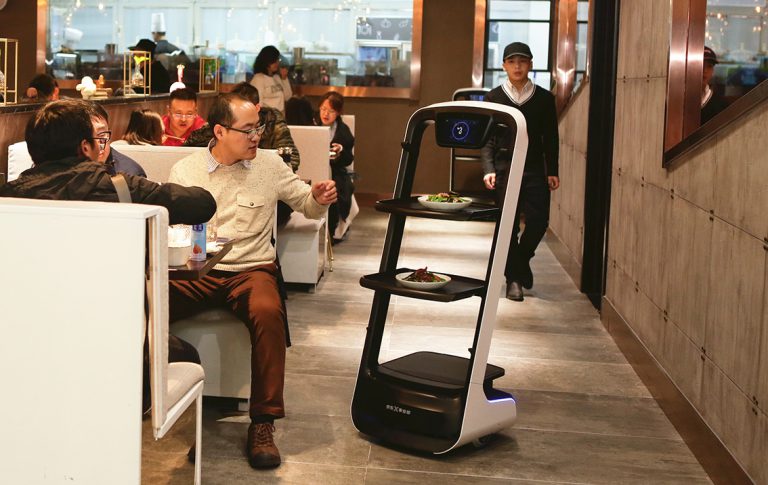
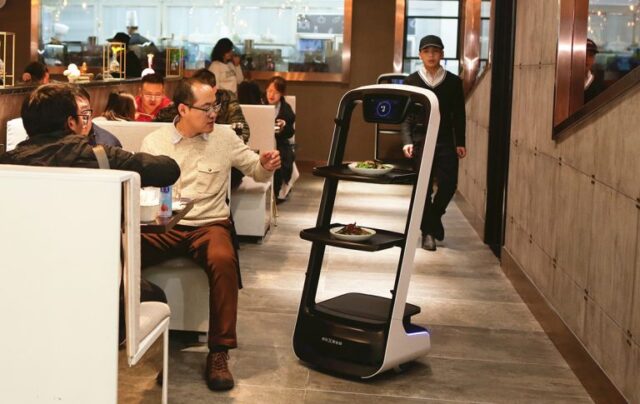
    Chinese online retailer JD has opened its first fully automated robot restaurant in Tianjin. The 400sqm venue has opened as “XCafe” at the Sino-Singapore Tianjin Eco-city, an area of Tianjin dedicated to environmental sustainability. XCafe is the first fully-automated restaurant in China, with all aspects of ordering, preparing, cooking, plating and serving performed by robots, which can work a full day on a single charge. Five or six human staff are still required to refill and position ingredients for the robot chefs.

    XCafe’s manager Tang Siyu said the restaurant can seat about 300 guests for dinner, with a table turnover rate of three turns per table during the lunch or dinner hour. It currently serves around 40 predominantly stir-fry dishes, with a potential full menu of more than 200 offerings.

    The restaurant also features VR interactive games and immersive dining experience areas.

    JD plans to open 1000 robot restaurants by 2020 and is seeking to promote the technology to other catering firms.

  • Incheon Airport tests an unmanned shuttle service

    Incheon Airport tests an unmanned shuttle service

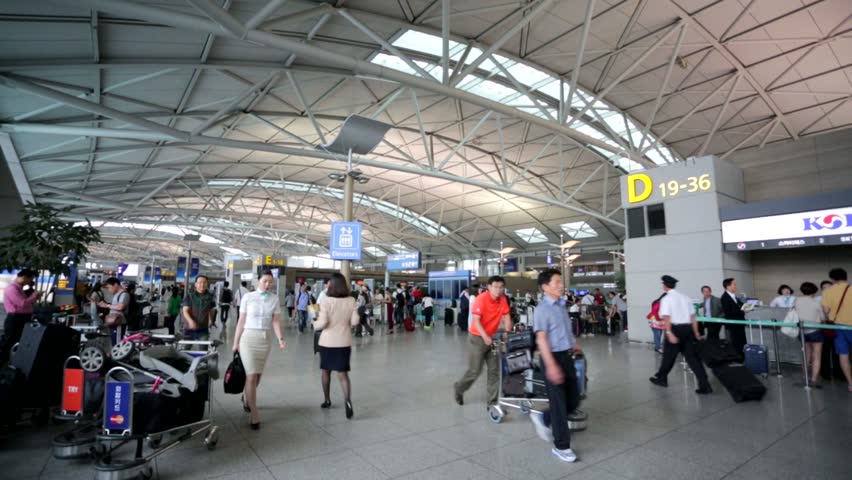
    Incheon International Airport said Sunday that it has successfully tested a self-driving shuttle bus becoming the first Korean airport to do so. The test took place inside its long-term parking lot on Friday, where a driverless bus ran 2.2 kilometers at a speed of 30 kph.

    “The test route has lots of curved lanes and is frequently interrupted by other cars … We have seen that autonomous driving is possible,” the airport said.

    The shuttle bus used in the test has been developed by Korean companies, including KT and Unmanned Solution. It is the country’s first driverless vehicle to obtain a temporary driving license. Last month, the airport signed a memorandum of understanding with KT to cooperate in autonomous driving. It plans to introduce a detailed plan for various self-driving car services.

  • When robot take over Hotel management

    When robot take over Hotel management

    An automated Alibaba hotel is set to open in Hangzhou. The move showcases the e-commerce giant’s technological capacity and serves to diversify its scope of business – with a view to demonstrating and selling its data-driven innovations. The company has claimed the hotel will be more efficient than manned properties within a comparable price range.

    The Alibaba hotel, which has already accepted bookings, features robotics, facial recognition, smart speakers, voice-activated lighting and room service, and automated alerts for cleaning. Hotel guests will be able to purchase any item featured in the rooms on Alibaba’s website.

    The hotel’s features are well in advance of similar voice-command technologies recently offered to the hospitality industry by Chinese search engine Baidu, although a similar hotel was launched by Shenzhen firm Smart LYZ in Chengdu earlier this year.

    A statement from the company read: “The solutions deployed at Alibaba’s Future Hotel can be used to streamline the operation of [China’s] hospitality sector while improving the experience of guests.”

  • Samsung steps up Microsoft cooperation

    Samsung steps up Microsoft cooperation

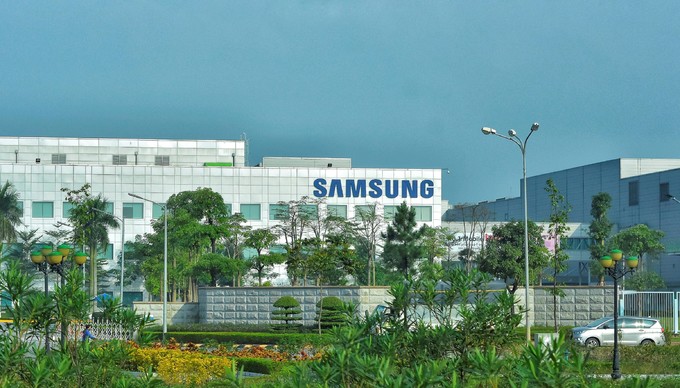
    Samsung Electronics Vice Chairman Lee Jae-yong met with Microsoft CEO Satya Nadella in Seoul Wednesday and vowed to increase cooperation with the U.S. company in artificial intelligence and cloud computing. Nadella is visiting Seoul this week for the first time in four years and delivered a keynote speech at Microsoft Korea’s “Future Now” artificial intelligence (AI) conference Wednesday.

    The two met in the morning before the conference and agreed to step up partnership in artificial intelligence, cloud computing and big data, said a Samsung spokesman.

    Microsoft currently uses Samsung’s semiconductors for cloud servers, and Samsung could sell more of its chips to the American partner in the near future.

    Media reports in Seoul say, as a result of the meeting, some Samsung devices, including smartphones, will be embedded with Microsoft cloud services in the future. Samsung already uses Azure, a Microsoft cloud computing platform, for its system air conditioners to collect data on the surrounding environment, including temperature and humidity, so the machines run more efficiently.

    The two executives might meet on a regular basis and exchange ideas on tech development, according to reports. The two leaders met in Seoul four years earlier.

    During his keynote speech at the conference at a hotel in western Seoul, Nadella mentioned Samsung as one of several Korean companies that had developed offerings based on Microsoft’s Azure platform.

    “Take the example of Samsung Electronics’ IoT [Internet of Things]-based air conditioner that runs on Azure. By taking into account environmental factors, like the number of people, the smart air conditioner can save up to 25 percent in energy and 30 percent in costs,” he said.

    Other sections of the Microsoft CEO’s speech were centered around the need to use artificial intelligence responsibly.

    “We need to ask ourselves not only what computers can do, but what computers should do,” he said, addressing an audience of over 1,500 programmers and businesspeople.

    He also spoke of the necessity to find ways to develop AI for “people who don’t have the ability to participate” in the digital economy.

    As an example, Nadella shared the case of Korea University Prof. Lee Seong-whan using Microsoft’s deep learning Cognitive Toolkit. Lee, who heads the brain and cognitive engineering department, analyzes brain signals in the development of computer systems that amputees can use to move prosthetic arms or robotic arms.

    Earlier on Tuesday, Samsung hosted “Tech Forum 2018,” an event for developers in Silicon Valley. Around 150 developers and designers were invited to the Samsung Research America center there.

    Kim Hyun-suk, president and CEO of Samsung’s consumer electronics division, said in opening remarks that the company was developing many “unfamiliar acquaintances,” which he believes will shape Samsung’s future innovation.

    “Samsung encounters a vast number of customers, rapidly changing technologies and new staff from various backgrounds,” he said. “Our strength is in selling more than 500 million consumer devices a year. We will expand contact points with our customers to reach into the smallest corners of their living spaces and bring innovation to their lifestyles in general.”

    Kim added that in terms of working with various employees, the company will continue to develop a corporate culture where global staff can cooperate and freely suggest ideas. Samsung also introduced the company’s developments in future technologies and held open discussions.

  • LG, E-mart develops smart-cart robot

    LG, E-mart develops smart-cart robot

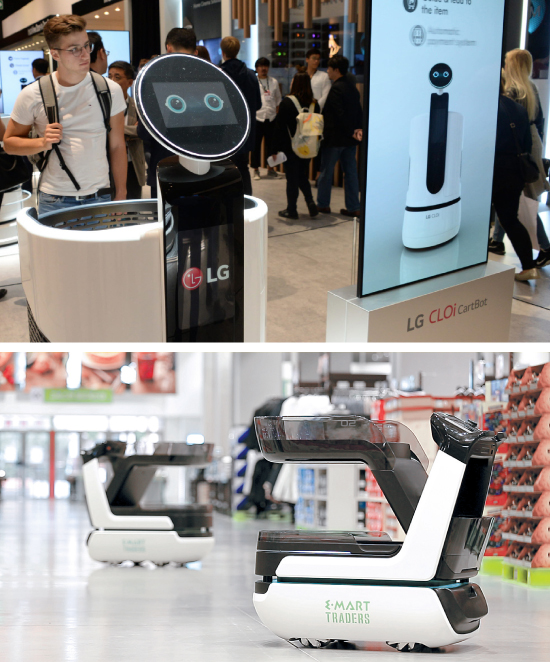
    LG Electronics has signed an agreement with E-mart to develop a new type of service robot that can assist shoppers at its South Korean supermarkets. Under the agreement, the two companies will develop what they call a smart-cart robot that can automatically identify obstacles and follow shoppers as they walk through aisles. LG said the new robot will free visitors from the hassle of pushing heavy carts by themselves.

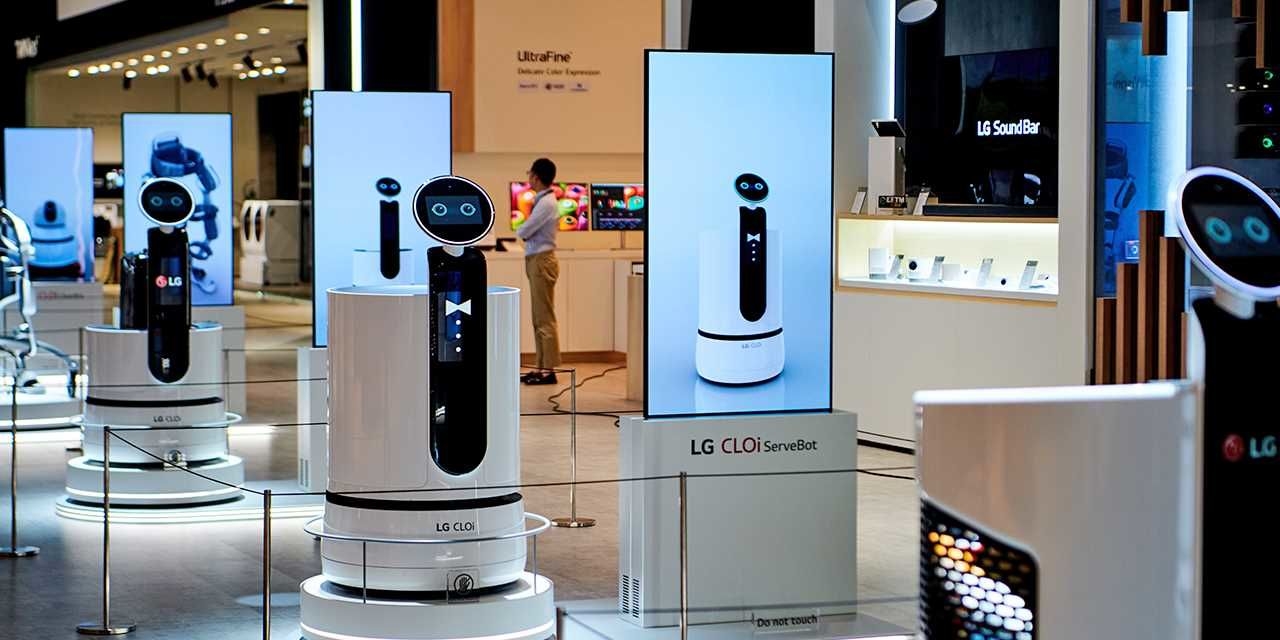
    The South Korean tech giant said the robot will be developed by its research lab, which has been releasing various robots under the CLOi brand.

    So far, LG has released eight different products under the brand, which are suited for different tasks, including guiding, cleaning and even mowing lawns. The company unveiled the CLOi SuitBot, which can help workers lift and move heavy objects easier as well.

    LG said it has been making efforts to bolster its robot business by joining forces with different clients, including airports, bakeries and retail shops.

    CLOi stands for clever, clear, close operating intelligence, LG said.

    The company has been making investments in robotic firms, including Robotis, AI startup Acryl and US-based robot maker Bossa Nova Robotics.

  • Alibaba A.I. Labs Launches Hospitality Robot

    Alibaba A.I. Labs Launches Hospitality Robot

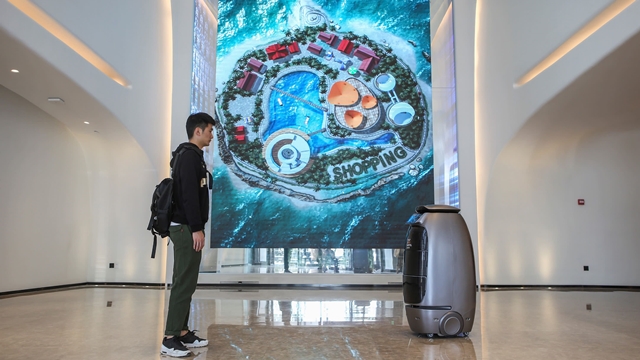
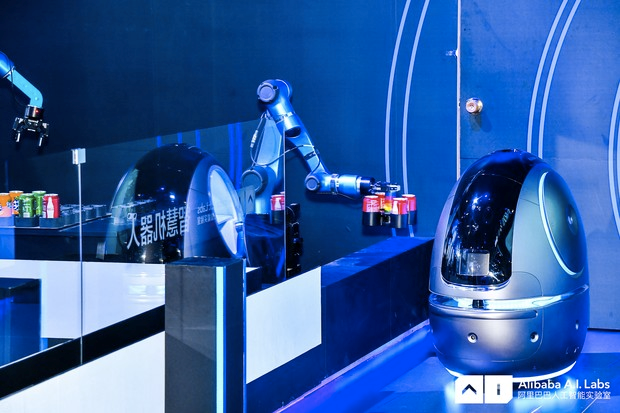
    The robotics industry is revolutionizing the world, and Alibaba A.I. Labs is raising the stakes in this cutting-edge industry with the announcement of launching service robots for the hospitality sector starting in October. Alibaba A.I. Labs is the department leading consumer AI product development at Alibaba.  Hotels have until now depended entirely on human labor. But the Labs’ service robot – from delivering meals to taking laundry to guests – demonstrates what guests can expect at hotels in the future. Guests talk to the robot via voice command, touch and hand gesture, and its responses are driven by AliGenie, the software that powers Alibaba A.I. Labs’ smart speaker, Tmall Genie.

    “We are excited by this tremendous development that is helping us bridge the gap between guest needs and the response time that they expect. Alibaba A.I. Labs’ robot is the next step in the evolution towards smart hotels. In addition, it is solving pain points in the hotel sector, such as enhancing service efficiency, with our leading AI technologies,” says Lijuan Chen, General Manager of Alibaba A.I. Labs. “The robot will be the ultimate assistant for hotel guests who want everything quickly and conveniently at their fingertips.”

    The technology that drives the Labs’ service robot is state-of-the-art, combining aluminum casing with multi-sensor data functionality and parallel computing for lightning quick responses. It also includes a semantic map, autonomous navigation system to identify obstacles, communication systems to control elevators, and identity verification via facial-recognition technology.

    The robot’s height is less than one meter, while its walking speed reaches one meter per second. After a trial at a hotel, Alibaba A.I. Labs will assess its suitability for other areas, including hospitals, restaurants and office services.

    According to the International Federation of Robotics, the global market for service robots are on the rise. The market is expected to grow from 20% to 25% from 2018 to 2020, while the sales forecast 2018-2020 indicates a cumulative volume of around 27 billion U.S. dollars for the professional service segment.

    Following the unveiling of the robot, Alibaba A.I. Labs also announced Tmall Genie Auto, the latest initiative in smart mobility and expanding the Tmall Genie ecosystem.

    Tmall Genie is the most popular smart speaker in China, with over 5 million units sold since its launch in 2017. It ranks number three in total shipments in the global smart-speaker market.

  • South Korea eyes artificial intelligence partners in BC

    South Korea eyes artificial intelligence partners in BC

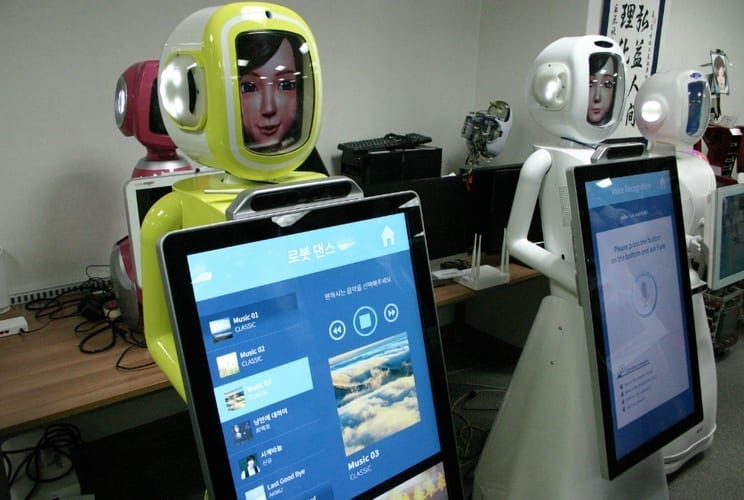
    Future Robot’s latest model at the company’s headquarters in Seongnam, near Seoul, South Korea. The company creates “social AI”: robots that interact with people by interpreting emotional responses, either through facial expressions or tone of speech, and then respond with emotive answers | Chuck Chiang

    At Seoul’s Incheon International Airport – one of the world’s largest international flight hubs – two new “stars” are capturing the attention of passengers who cross their paths.

    They’re not stars of “K-pop,” South Korea’s increasingly ubiquitous cultural exports of boy bands and girl groups that are now household names in most of Asia. Rather, they are robots – one that guides passengers to their flights by scanning their boarding passes, another a giant Roomba-like floor cleaner that asks politely, in Korean and English, to pass pedestrians in the machine’s cleaning path.

    “Where are you going? Have a nice flight!” the robot says cheerfully when a passenger leaves the view of its camera, while another group of travellers inevitably blocks the robot’s path and starts a new wave of photo-taking and hand-waving. (The scene bears a striking resemblance to one of the futuristic scenarios introduced in the Vancouver International Airport’s solicitation for public opinions for its 2037 master plan, although airport representatives said no robots are planned at this time.)

    This is the next industrial revolution as envisioned by leading observers around the world: the advent of artificial intelligence (AI) not only in people’s daily lives, but also in the overall global economy. And South Korea, deeming itself several years behind industry leaders like China and the United States, is looking for like-minded partners such as Canada to help it get back in the race.

    “It’s very hard for Canada and Korea to develop [large-scale] AI technologies in isolation from other markets,” said Kim Deogtae of the Korea Artificial Intelligence Association, who is also a university professor and president of his own AI tech firm DTWARE Inc. “But I do think that there’s an opportunity for companies on the two sides to co-operate, preferably with corresponding government support.”

    That partnership can happen in a number of ways, Kim said. Either Canadian investors can bring Korean-developed technologies like Incheon airport’s robots (made by conglomerate LG) to the North American and European markets through the North American Free Trade Agreement and the Canada-European Union Comprehensive Economic and Trade Agreement  or B.C.-based AI developers and startups can use South Korea’s market access to China, Japan and Southeast Asia to expand.

    B.C. and the rest of Canada can also be the answer for South Korea’s lack of AI-development talent. Kim said the East Asian nation struggles in that area because its traditional education system focuses on memorization rather than critical thinking.

    Canada, in turn, could be a partner in directly supplying AI developers or providing adequate space for Korean students to study the technology.

    “It is difficult to develop high-level AI in the Korean educational environment,” he said. “But Korean students are diligent and fast-learning; that is our strength. So if there’s an environment to learn AI, I believe Koreans will be fast to adopt and excel … and we have to look overseas.”

    The key, Kim said, would be to join forces to overcome each side’s smaller domestic market for sales, capital and talent when compared with the aforementioned “big two,” China and the U.S.

    There are already cases happening in other parts of Canada: a month ago, Korean conglomerate Samsung (KRX:005930) announced it will open its own AI research laboratory in Montreal after three years of working with Canadian teams.

    Major players from other countries have also started moving into Canada to mine its AI-technology talent. Google’s (Nasdaq:GOOGL) DeepMind research team – based in Great Britain – chose Edmonton as its first international lab in July. All this is happening with the backdrop of $125 million in earmarked Canadian federal funding for attracting AI development to Canada, as outlined in the federal Liberal government’s 2017 budget.

    Most of Ottawa’s effort is concentrated in three metropolitan areas: Edmonton, Montreal and Toronto-Waterloo. But one executive from a Vancouver financial technology (fintech) company that uses AI in its proprietary platform connecting lenders and borrowers said B.C. does have its niche in that sector, and it is up to B.C. companies to spearhead collaborations in markets like South Korea.

    “It’s important for anyone who’s not well known in the global market to go out and explain the model and its value proposition,” said Alex Mateesco, CEO of Lendery, which plans to open an office in South Korea to expand its lending platform to Asia.

    “I don’t think we should expect other people to know us more than what we know about ourselves. We have to do our own parts to be present internationally … because if we don’t take initiative on that market [fintech], someone else will go carve it out.”

    Focusing on a niche market to excel is a good idea for Vancouver’s AI sector, said the CEO of one of South Korea’s leading AI startups. Song Sekyong, who has built Future Robot Co. Ltd. from its launch in 2009 to a company with a market valuation of US$20 million this year, said it was able to succeed by carving out a space within AI that’s underserved by American and Chinese companies, which tend to focus on massive, cloud-storage-based systems that process an enormous amount of data over a wide network. Two examples of the latter are Google’s AlphaGo and Amazon’s (Nasdaq:AMZN) AWS.

    Song’s company, however, found its market in creating “social AI”: robots that interact with people by interpreting emotional responses, either through facial expressions or tone of speech, and then responding in kind with emotive answers. In some cases, these “soul-ware” robots even have animated faces to respond with their own emotive reactions.

    Up to 30 of these robots will be deployed at the 2018 Pyeongchang Winter Olympic Games. Other applications could include seniors care, personal organizer/living assistance and front-line customer service in various retail settings.

    “Most people think of AI as one thing,” Song said. “But that’s not true. It’s a lot more than just Amazon and Google, and there are a lot of variations within the potential market. What interests us is how we can apply AI so that people and AI live together and having the technology fill a very human need – a ‘warm’ technology, if you will.”

    Song, whose company employs approximately 35 people, is anticipating Future Robot’s valuation to double next year and hit US$100 million by 2025.

    He is also eyeing an initial public offering in a western market – again, an area that could bring Future Robot’s brand to Canada. But Song also noted that he and other AI developers are aware of some people’s fear of AI and its potential to eliminate human jobs. To those concerns, Song said it’s not that jobs will disappear with AI, but rather they will transform.

    “If you look at history, technology shifts and labour trends have always happened in tandem,” he said, noting AI will require a large number of programmers and technicians to maintain. “A robot can replace human labour, but it can’t replace a human being.”

    Lendery’s Mateesco added that any B.C. companies looking to jump into transpacific AI co-operation deals must always consider the human element to achieve market acceptance.

    “The mistake a lot of companies make is to push a technology and make it a top-down decision, which can be hard on consumers who are not ready. The point of technology is to serve people, to make lives more comfortable; so you have to let people decide what makes them comfortable.”

    cchiang@biv.com

    @BIVnews

    Note: Some interviews conducted for the story were completed at Invest Korea in Seoul, for which the reporter’s airfare and accommodations were provided by the Korea Trade-Investment Promotion Agency.