Tag: room

  • Facebook’s virtual Messenger Rooms allow up to 50 people to video chat simultaneously

    Facebook’s virtual Messenger Rooms allow up to 50 people to video chat simultaneously

    Thanks to the COVID-19 outbreak, people are connecting with their friends and family through video chat apps such as FaceTime, Duo, Houseparty, and Zoom. When Apple released iOS 12.1 in 2018, it updated FaceTime allowing 32 participants in a video chat at one time. Duo has been hiking the number of its simultaneous users to 12. Houseparty can handle eight participants at one time while Zoom’s free tier can handle as many as 100 users at one time.

    Today, Facebook said that some of its properties have seen heavy increases in demand for communicating by video. In many countries, Messenger and WhatsApp video calling more than doubled and more people are watching live streams “broadcast” by Instagram and Facebook users. So today, Facebook introduced Messenger Rooms. You can create a room from Facebook or Messenger and invite up to 50 people to join you in a video chat with no time limit. And you can even invite people to join you even if they do not have a Facebook account.

    Facebook says that it will soon allow users to create such rooms from Instagram Direct, WhatsApp, and Portal. If you’re invited to “enter” a room,  you can join from your phone or computer right away without having to download anything. And those with the Messenger app can spruce up their appearance through the use of Augmented Reality (AR) and Artificial Intelligence. With the former, you can add things like bunny ears, and with the latter, you can place yourself in selected locations using immersive 360-degree backgrounds.

    Those who create a room get to kick people out and can also lock a room if they don’t want any more people to join. In fact, the room creator gets to decide who can see the room and join it. And no one is stuck inside a room; anyone can leave whenever they feel like it. And yes, if you create a room you can block people you don’t like from entering, but you won’t be able to join their rooms. The new Messenger Rooms will be available in some countries this week and will be offered to the rest of the world in the upcoming months.

    Facebook says, “Host celebrations, gather a book club or just hang out on the couch with friends. You don’t need to call someone and hope it’s a good time or checks everyone’s calendar first. You can start and share rooms on Facebook through News Feed, Groups, and Events, so it’s easy for people to drop by.”

    Until we are able to better get a grip on the coronavirus, video chats are the safest way to stay connected to friends and family that don’t live with you. The free tier of Zoom can help 100 people “attend” virtual wedding reception and virtual weddings. Last week, New York Mayor Andrew Cuomo signed an Executive Order allowing people to get married in the state over video chat.

    On its privacy page, Facebook notes that it doesn’t watch your video calls (or listen to your audio calls for that matter). But it does collect data from Messenger Rooms whether you joined via the app or just walked into a room without having an account. The data collected is used to improve the experience of using the feature and Facebook says that it does not show ads in any of the Rooms and that video and audio from these Rooms are not used to “inform ads.” If you “walk” into a room without having a Facebook account, information like the device and browser you’re using is collected to, in the words of Facebook, “improve the Rooms product experience and to help keep Rooms safe and secure.


  • Hyperscale operators to boost colocation market

    Hyperscale operators to boost colocation market

    Synergy Research Group (SRG) says hyperscale operators are the fastest growing customer category for colocation providers. For both wholesale and retail colocation, 2018 revenue from hyperscale customers grew much more rapidly than revenues from other service provider customers and from enterprises.

    While the overall colocation market grew by 10% in 2018, revenues from hyperscale operators grew by 24% in the wholesale segment of the market and by 16% in the retail segment. Enterprise spending on wholesale colocation was relatively flat in 2018 compared to 2017, while enterprise spending on retail colocation grew by 7%.

    Synergy’s Q4 and year-end data shows that the total colocation market grew to over $34 billion in 2018.

    Growth was strongest in the APAC region, with China, Hong Kong, Japan and Singapore showing the highest growth rates in the region. Hyperscale operators comprise the world’s major cloud and internet service firms, including the largest operators in IaaS, PaaS, SaaS, search, social networking and e-commerce. The other service provider category includes telcos, non-hyperscale cloud providers and internet service firms, hosting/outsourcing companies and content & digital media service providers. The enterprise category includes all other industry verticals plus government and the public sector.

    “It comes as no surprise that hyperscale operators are providing a boost to colocation providers, as they are on a charge to rapidly extend their worldwide data center footprint and in 2018 ramped up their capex by no less than 43%,” said John Dinsdale, a chief analyst at Synergy Research Group.

    “In order to support this rapid growth they cannot just build their own data centers, so they also need to rely on colocation providers to lease out both large wholesale facilities and capacity at smaller edge locations. Hyperscale operators are becoming an ever-more important source of business for leading colocation companies such as Equinix, Digital Realty, Interxion, CyrusOne, QTS and GDS.”

  • Vietnam imposes tax duty on foreign room-booking sites

    Vietnam imposes tax duty on foreign room-booking sites

    Firms such as Agoda and Expedia will have to pay a 10 percent duty. The Ministry of Finance has told foreign accommodation booking services to pay taxes if they wish to continue operating in Vietnam.

    A document recently released by the ministry asked booking sites like Agoda, Traveloka and Expedia to pay a combined 10 percent of their total revenue made in Vietnam.

    Vietnamese accommodation providers that have signed contracts with these foreign sites are obliged to fulfill these tax duties on behalf of them.

    The ministry said that the move aims to prevent tax losses from foreign-based companies that are gaining from online business transactions.

    Vietnamese accommodation booking site Vntrip had previously held a press conference and sent a document to the ministry accusing Singapore-based travel agency Agoda and some other sites of tax evasion.

    Vntrip said that the acts of these foreign companies had resulted in huge losses to the state revenue and created unwholesome competition.

    This is not the first time the Vietnamese government has imposed taxes on international businesses operating in the country. Last September, the popular ride-sharing service Uber was officially ordered to pay taxes after two years of providing transport services in Vietnam.

  • Mirus adds 1.5″ to AirAsia knee room, aims high with new options

    Mirus adds 1.5″ to AirAsia knee room, aims high with new options

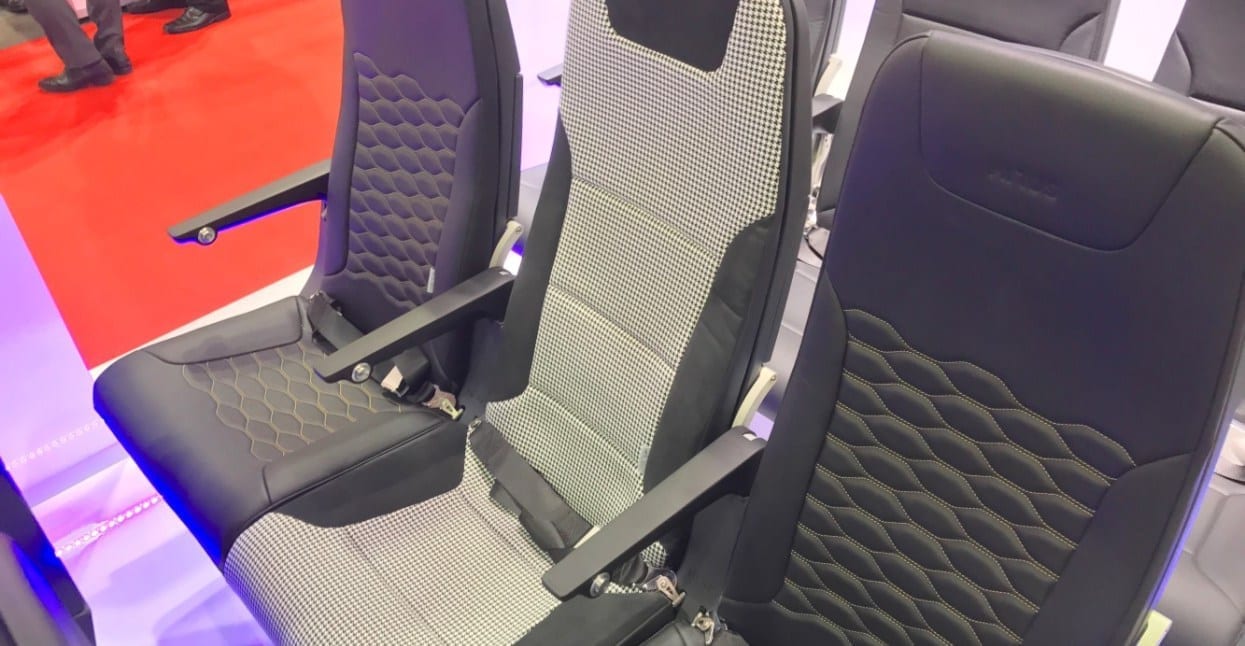
    AirAsia’s seatmaker Mirus made headlines even before the recent Aircraft Interiors Expo Asia started by announcing a partnership with digEcor and IFPL to add USB power to the armrest of its slimline seating. But Mirus isn’t just driving a step-change in the passenger experience for shorthaul LCCs. It’s also offering more fully featured seat options, one including a headrest inspired by a luxury car, which seems appropriate given the company’s automotive heritage. And, perhaps most crucially for the AirAsia passenger experience, it’s using smart design to carve out over an inch and a half of extra knee room — a full five percent extra on AirAsia’s tight seating.

    “This show, we’ve got some different variants of the seat,” Mirus CEO Phil Hall explained as he showed Runway Girl Network around the company’s AIX Asia stand. “We’ve got an entry-level seat, we’ve got a nominal AirAsia spec, and we did a heritage throwback line inspired by a 1970s Porsche. All these airlines have been around a long time, they’ve got a lot of heritage and they should be proud of it, and we’re trying to visualise some of that in the dress covers.”

    Most interesting, though, was the headrest, a snap-on, snap-off cushion. “That’s the S-Class inspired headrest. We’ll roll that out on AirAsia’s Hot Seats. Tony Fernandes said to me, ‘I really love the headrest on the S-Class Mercedes’,” Hall explained. “This is not production final, but I think we’re about 90% of the way there. There’s a small adjustment — you just un-velcro it and lift it up. It’s a similar type of feature to Emirates in their business class. We dressed it with Alcantara highlights just to mix up the textures a little bit, mix up the dress covers, and differentiate the brand. It’s a nice material, a tactile material, and it changes the appearance of the seat a little bit. This is more of a design and styling focus in terms of what we can do.”

    With a simple popper design for attachment, the headrest adjusts using velcro. Image: John Walton

    With a simple popper design for attachment, the headrest adjusts using velcro.

    “We’ve got production versions of the armrests here, and the aisle bumpers are our production spec,” Hall said. “We’ve changed the design language quite significantly, to a more dynamic looking seat. In Hamburg we didn’t have these available. What’s not on these seats is the production version of the backrests. We took a hit on the programme because we found quite a significant benefit to passenger space on the seatback, below the seatback area. Because we have a carbon-fibre frame, it allows us to mould the shape into whatever we want, because the carbon-fibre gives us the strength and the stiffness we need, and gives us the mobility. So we took a period of time to fully exploit that fact. We showed it to AirAsia, and they’re pitching at 28”, 29”, so it’s quite squeezy on there, and it was a genuine benefit to the passenger. That’s not on show here, but we’ll have that in Hamburg. It’s about an inch and a half. It was worth us taking the hit and offering a more competitive product.”

    “We’re looming up to certification and getting the seats in the air,” Hall added. “That’s our main target. All of our tooling has been commissioned, and the first production parts are now coming in. We built the certification seats from those parts. We’ve done all the precertification testing with non-production tool components, so we have a very good confidence level when we go into certification. The flam booth is there. The self-sufficiency aspect of the whole thing is coming together quite nicely. It’s all converging on a point.”

    “We did all the preliminary testing, pre-certification testing — 16G, 4G side, 9G static, 14G down — primarily to test the strength of the product but also to correlate all the virtual simulation that we do,” Hall said, noting that Mirus has succeeded with its head injury criterion (HIC) testing at pitches from 28” to 35”. “We’ve heavily invested in virtual prototyping and virtual product development, both software and process. We do another series of sub-assembly testing to validate those models as well.”

    It’s clear from the company’s level of hardware and testing investment that Mirus isn’t content simply to supply three hundred shipsets of A320 seats for AirAsia: the company wants to be much, much more than that. If Mirus was a seatmaker to watch six months ago when it burst onto the interiors scene, it’s doubly so now.