Tag: Santa Fe

  • IoT-related data breaches on the rise, study shows

    IoT-related data breaches on the rise, study shows

    There has been a dramatic increase in IoT-related data breaches specifically due to an unsecured IoT device or application since 2017, says a study released by The Santa Fe Group.

    The study found these breaches accounted for 26%, up from 15%, and the figures might actually be greater because most organizations are not aware of every insecure IoT device or application in their environment or from third party vendors.

    More alarmingly, organizations surveyed have no centralized accountability to address or manage IoT risks.

    Less than half of company board members approve programs intended to reduce third-party risk and only 21% of board members are highly engaged in security practices and understand third party and cybersecurity risks in general.

    More than 80% of respondents believe their data will be breached in the next 24 months.

    “This study proves it’s no longer a matter of if but when and board members of organizations need to pay close attention to the issue of risk when it comes to securing a new generation of IoT devices that have found their way into your network, workplace, and supply chain,” said Cathy Allen, founder and CEO of The Santa Fe Group, Santa Fe, NM.

    “The study shows that there’s a gap between proactive and reactive risk management. The time to address this issue is now and not later.”

    The study also identifies the following areas in which organizations need to improve:

    • While respondents believe a positive tone at the top is important to minimizing business and third-party risks, few companies represented in this study are making board-level governance an essential part of their risk management program.
    • The IoT threat landscape is expanding rapidly, yet many companies are not assigning accountability or ownership to the management of IoT risks.
    • Staffing and budgets are not adequate to manage third-party IoT risks.
    • Third-party risk management (TPRM) programs should include IoT risks in order to evolve and mature their practices.
    • IoT risk assessment and due diligence must move from trust assurance to verify control validation techniques.
    • Companies should be prepared for IoT regulatory oversight to rise.
    • Most companies do not conduct employee training programs on the risks created by IoT devices. Such training must begin now.
  • Korean SUV sales soar globally

    Korean SUV sales soar globally

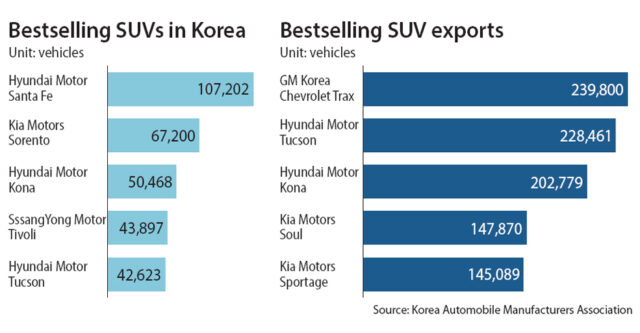
    SUVs have recently grabbed the spotlight in Korea, breaking both local and export sales records. According to the Korea Automobile Manufacturers Association (KAMA), the number of exported SUVs by five local automakers reached a new record of 1.38 million units in 2018, a 6.7 percent increase from the previous year. In just 17 years, the figure rose by 700 percent – exports recorded merely 196,111 units in 2000.

    Over the same period, overall exports of passenger vehicles declined 3.1 percent to 2.34 million units. The share of SUVs also reached an all-time high.

    Compact SUVs from Korea were most popular in export markets.

    GM Korea’s Chevrolet Trax was shipped the most, at 239,800 units, followed by Hyundai Motor’s Tucson at 228,461 units.

    Small-sized SUVs also performed well, with 202,779 units of Hyundai Motor’s subcompact SUV Kona shipped abroad, a 437 percent rise from the previous year.

    Kia Motors’ Stonic exported 58,989 units, increasing 75.8 percent from 2017.

    Much of the enthusiasm surrounding SUVs in markets abroad was also present in the local market.

    Last year, 519,883 SUVs were sold in Korea, passing the 500,000 unit mark for the first time.

    With a 12.7 percent rise from 2017 sales figures of 461,385 units, SUVs currently take up a 40.1 percent share in the overall passenger car sales figures.

    Meanwhile, passenger car sales, excluding SUVs, dropped 6.9 percent last year from the previous year.

    Hyundai Motor’s mid-sized SUV, the Santa Fe, was the most popular in Korea, selling 107,202 units. This was the first time that an SUV model recorded an annual sales figure over 100,000 units.

    The SUV market is expected to grow this year.

    As compact and small-sized SUVs are poised to lead exports and medium and small-sized SUVs the local market, large-sized SUVs are also being rolled out this year.

    Hyundai Motor’s Palisade, unveiled last November, recorded over 25,000 preorders in just three weeks, hitting 62.5 percent of the automaker’s annual sales target of 40,000 units for the model.

    It will likely take customers around seven months to receive the vehicle if ordered now.

    According to Hyundai Motor, the large-sized SUV is popular among older drivers. Customers in their 40s accounted for 37 percent of orders and those in their 50s made up 26.9 percent.

    “As high-quality amenities and vehicle stability that used to be developed through sedans is now applied to SUVs, there was quite a bit of progress,” said Kim Pil-soo, a professor of automotive engineering at Daelim University.

    “This year’s SUV sales and market share will grow as local and foreign SUVs have adopted the advantages of sedans,” added Kim.

  • New Santa Fe designed for China

    New Santa Fe designed for China

    Hyundai Motor premiered the latest version of its Santa Fe SUV at an international auto exhibition in Guangzhou on Friday in its latest move to try and woo Chinese buyers. It also rolled out a reshuffle of its Chinese business. Vice President Lee Byung-ho was promoted to president of Hyundai Motor and Kia Motors’ China Business Division, the carmaker announced Friday.

    The automaker showcased the fourth-generation Santa Fe, which has been strategically modified for the Chinese market. The new edition is the most futuristic Santa Fe on the market anywhere in the world, including the models sold in Korea.

    After hitting rock bottom in the past two years due to diplomatic tension over the deployment of the U.S.-led Terminal High Altitude Area Defense antimissile system in Korea, Hyundai Motor has been slow in recovering sales in China. In the third quarter, it sold 177,000 units, a 6.2 percent year-on-year drop.

    Hyundai Motor said it has installed a fingerprint scanner on the door – a global first – allowing owners to lock and unlock the door without a car key. The fingerprint scanner can also turn on the engine and automatically adjust the seat and side mirror to the owner’s liking.

    The new version is also bigger than the latest Santa Fe that launched in Korea in February.

    The length was extended by 160 millimeters (6.3 inches) and the wheelbase by 100 millimeters, enlarging the space for the second and third row passengers. Other smart car technology included in the vehicle is similar to the version available in Korea.

    The car is equipped with a Rear Occupant Alert system that alerts the driver when a passenger is left behind in the back seat through ultrasound detection. It is the first time Hyundai Motor has installed such a system in cars launched in China.

    The Santa Fe is also equipped with Safe Exit Assist, which prevents collisions with oncoming traffic when exiting the vehicle.

    The car is also equipped with voice recognition through a partnership with Chinese IT giant Baidu.

    “The latest Santa Fe stands in the center of Hyundai Motor’s continuous attempts and innovation toward the ever-changing needs of the customer,” said Beijing Hyundai in a statement. “The Santa Fe will bring about changes in the premium SUV market in China with its top-notch safety and smart car features.”

    The car will go on sale starting in the first quarter of next year in China.

    Hyundai Motor set up a 1,820-square-meter (19,590-square-feet) booth at the Guangzhou International Auto Exhibition where its latest lineup of 18 cars, including a concept version of the large Grandmaster SUV and N series vehicles, such as the Veloster N and i20 WRC, were on display.

    It also showed off its hydrogen-powered Nexo SUV.

    The auto exhibition in Guangzhou runs from Saturday to Nov. 25.