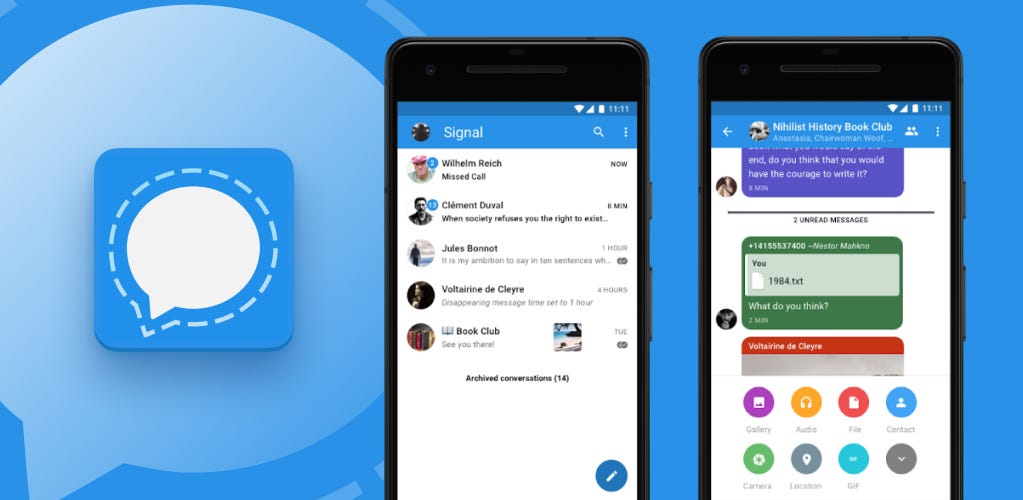
Tag: Signal

  • Signal launches shearable Call Links for easy group call setup

    Signal launches shearable Call Links for easy group call setup

    Signal now allows users to create shareable links for group calls without the need to create a group chat. The new update also introduces an option to raise your hand and react with emojis during group calls, making video conversations more interactive.

    The secure chat app Signal rose in popularity a few years ago. Although now most major messaging apps offer encrypted and secure messages, Signal is still considered to most secure of them all. Signal has quite a lot of cool features like self-destructing messages, message editing, chat backups, group chats, username identification instead of phone numbers, and more.

    The app is also open source. Its latest update focuses on bringing more functionality to its group call features. Now, the platform is introducing shareable meeting links, called Call Links. It works similarly to the solutions offered by WhatsApp and FaceTime.

    Basically, you are able to create a meeting link that can be shared on Signal with whomever you want. They can then join your call by clicking on the link.

    Before the update, if you wanted to have a group call on Signal, you needed to create a new group, add the participants to it, and then start the call. Now, Call Links make it easier to have a group call. The links can be shared outside of Signal as well; however, to join a call you would need an active Signal account.

    Call Links can be created from the Calls section in the bottom panel, where the new option “Create a Call Link” is situated. You can then give the call a title and toggle admin approval on or off. The feature is now available for iOS, Android, and desktop.

    On top of that, Call Links are reusable, which is awesome news if you would have a weekly check-in call. Call hosts can remove participants from a meeting, as well as block users to prevent them from joining again.

    Signal’s maximum capacity for group calls is currently at 50 people. Call Links was previously available in beta last month, and now it’s made it to a public release.

    Additionally, you can now use a raise hand button similar to Google Meet, which will help you attract the attention of the speaker. Emoji reactions are also coming to Signal calls, which add a touch of fun or interactivity without you having to type or speak during the call.

    I really like these updates to the Signal app. Ever since it rose to popularity for its secure messaging, I’ve been a fan of the app. Now, it’s beco
  • Signal announces support for usernames to hide your phone number

    Signal announces support for usernames to hide your phone number

    Signal, the popular messaging app, is introducing usernames to its platform. This optional feature allows you to connect with others without revealing your phone number, enhancing privacy on the app.

    As announced today in its blog, Signal users will be able to head to their settings and select “Profile” to create a unique username. The app will then allow its users to share said username by either generating a shareable QR code or a link. Alternatively, users can connect by typing your username into the new chat bar.

    Traditionally, Signal required the use of a phone number in order to register for an account and use its features. This translated to having to reveal your phone number to others that you exchanged messages with. While the app will still require a phone number in order to create an account, you will now have the option to shield it and instead use a username as your alias.

    Signal is also rolling out other security features, such as the ability to restrict who can find you using your phone number. This means you can prevent people from messaging or calling you on Signal, even if they know your phone number and know you have an account. Additionally, the app will now hide your phone number by default if users don’t already have it in their contact list. You can change this setting within Privacy > Phone Number > Who can see my number.

    These privacy-focused additions come after Signal began testing usernames last fall. Should you choose to go the route of creating a username, that also wouldn’t be visible on your profile details page or in chats unless you actively share it. As Randall Sarafa, Signal’s Chief Product Officer, explains, “Someone will need to know your unique username to start a chat with you on Signal.”

    While these features bolster privacy, Signal is aware of the potential for impersonation and emphasizes safety features like comparing safety numbers for verification. Currently, these features are only available in the app’s beta version, but will be rolling out to everyone in a few weeks. Your move WhatsApp!

  • Here’s why Apple iPhone users need to install Signal even if they don’t use it

    Here’s why Apple iPhone users need to install Signal even if they don’t use it

    It has recently been revealed that Israeli company Cellebrite had nothing to do with the unlocking of the Apple iPhone 5c belonging to alleged San Bernardino shooter Syed Farook back in 2016. That honor and the $900,000 payday reportedly went to a little-known firm named Azimuth, now a part of L3Harris Technologies. But that hasn’t stopped Cellebrite from continuing to crack open iPhones on behalf of law enforcement.

    However, something has stopped Cellebrite dead in its tracks forcing it to stop using its top-of-the-line machine to open iPhone models. Cellebrite’s Physical Analyzer has been called “the industry standard for digital data examination,” but it can no longer be used to collect data from Apple’s iOS-powered smartphones. That’s because messaging app Signal, as detailed in its blog discovered several vulnerabilities in Cellebrite software which corrupted scans of the iPhone.

    These vulnerabilities, if exploited, would not only call into question the results of a current scan but also past and future scans are done with the same machine. It would be a prosecutor’s nightmare and a dream come true-with extra whipped cream on top for defense attorneys. And all Signal had to do was to place a file into the Cellebrite machine.

    With Signal installing the file for all of its users, this has proven to be an incentive for iPhone users to install the messaging app even if they never use it. In its aforementioned blog, Signal explained the process of kicking Cellebrite where it hurts. This is done “by including a specially formatted but otherwise innocuous file in an app on a device that is then scanned by Cellebrite, it’s possible to execute code that modifies not just the Cellebrite report being created in that scan, but also all previous and future generated Cellebrite reports from all previously scanned devices and all future scanned devices in any arbitrary way (inserting or removing text, email, photos, contacts, files, or any other data), with no detectable timestamp changes or checksum failures. This could even be done at random, and would seriously call the data integrity of Cellebrite’s reports into question.

    The ease with which Signal can do this is apparent from its comment that states “Any app could contain such a file, and until Cellebrite is able to accurately repair all vulnerabilities in its software with extremely high confidence, the only remedy a Cellebrite user has is to not scan devices. Cellebrite could reduce the risk to their users by updating their software to stop scanning apps it considers high risk for these types of data integrity problems, but even that is no guarantee.”

    One interesting discovery by Signal revealed that Cellebrite was using Apple DLL files to help it extract data from iOS devices. As Signal says in its blog, it is “unlikely” that Apple would give Cellebrite permission to use these files. The messaging app says that this use of Apple’s files without permission “might present a legal risk for Cellebrite and its users.”

    Explaining how the DLL files are used, Signal notes, “The Cellebrite iOS Advanced Logical tool loads these Apple DLLs and uses their functionality to extract data from iOS mobile devices. The screenshot below shows that the Apple DLLs are loaded in the UFED iPhone Logical.exe process, which is the process name of the iOS Advanced Logical tool.”

    Signal was able to find the vulnerability by getting its hands on Cellebrite’s software, including the powerful Physical Analyzer. Signal found the vulnerabilities it discusses in its blog.

    Signal said that it would be willing to “responsibly disclose the specific vulnerabilities we know about to Cellebrite.” In return, Signal wants Cellebrite to do reveal all of the vulnerabilities that it uses to physically extract data and provide all of its services now and in the future to its “respective vendors.”

  • Uber’s use of encrypted messaging may set legal precedents

    Uber’s use of encrypted messaging may set legal precedents

    Top executives at Uber Technologies Inc used the encrypted chat app Wickr to hold secret conversations, current and former workers testified in court this week, setting up what could be the first major legal test of the issues raised by the use of encrypted apps inside companies.

    The revelations Tuesday and Wednesday about the extensive use of Wickr inside Uber upended the high-stakes legal showdown with Alphabet’s Inc Waymo unit, which accuses the ride-hailing firm of stealing its self-driving car secrets.

    Apps such as Wickr, Signal, Telegram, Confide and Snapchat offer security and anonymity, with features including passcodes to open messages and automatic deletion of all copies of a message after as little as a few seconds.

    There is nothing inherently unlawful about instructing employees to use disappearing messaging apps, said Timothy Heaphy, a lawyer at Hunton & Williams and a former U.S. Attorney in Virginia.

    However, companies have an obligation to preserve records that may be reasonably seen as relevant to litigation or that fall under data retention rules set by industry regulators. In Uber’s situation, chat logs that could help get to the bottom of the trade secrets case are now inaccessible. Uber also faces a criminal investigation over the alleged theft.

    “It’s a knotty question for courts and lawyers on when the obligation arises” to preserve records, said Julia Brickell, general counsel at the legal discovery firm H5. But “if someone uses a communication device to specifically hide information from litigation because you knew it would result in litigation, that would be foul from the start.”

    Richard Jacobs, a security analyst whom Uber fired in April and now consults for the company, testified Tuesday that up to dozens of employees were trained to used ephemeral messaging systems, including Wickr, to communicate so that their conversations would be clandestine and could not surface in any “anticipated litigation.”

    Two officials still at Uber testified Wednesday that multiple teams used Wickr. Among the users, they said, was Anthony Levandowski, a one-time leader of Waymo’s autonomous vehicle efforts who the company alleges brought trade secrets to Uber.

    Wickr key evidence

    It is unclear when Uber began using Wickr, but the company said that in October of last year it began paying for a business version that gave it the ability to preserve messages for as long as a year instead of a maximum of six days.

    While the contents of an individual user’s Wickr account would be impossible to access without the account-holder’s permission, the business version gives the company the ability see whatever information has not been automatically erased.

    In the middle of the contentious court hearing Tuesday, Uber Chief Executive Dara Khosrowshahi tweeted: “True that Wickr, Telegram were used often at Uber when I came in. As of Sept 27th I directed my teams NOT to use such Apps when discussing Uber-related business.”

    U.S. District Judge William Alsup opened the pre-trial hearing by admonishing attorneys that counsel in future cases can be “found in malpractice” if they do not turn over evidence from specialized communications tools.

    An app such as Wickr “could be a way for Levandowski to communicate ‘By the way, how did we do that back at Waymo?’ and all that vanishes in 30 seconds,” Alsup said. “To me it’s plausible that it happened. And the evidence is gone now. Because it was an intentionally set up system to not leave a paper trail.”

    Federal civil court guidelines enable judges to tell jurors that they can presume that information covered up by a litigant and now missing would have been negative for that party, Brickell said.

    Such a declaration could hurt Uber, as its primary defense has been that Waymo has turned up no concrete evidence of the trade-secret theft. Now, Waymo can claim that such evidence was simply deleted.

    “That they were so concerned about covering things up meant that they could have known what they were doing was a crime,” said Nick Akerman, a lawyer at Dorsey & Whitney and a former federal prosecutor in Manhattan. “To me, that’s very powerful evidence.”

    Andy Wilson, chief executive of forensics software maker Logikcull, said it is already common for companies to search for usage of encrypted apps or deleted messages when conducting internal investigations.

    He said his company’s program is used by Salesforce.com Inc and other businesses to scan emails and chat messages. Emails showing a user signed up for a service such as Signal or Telegram are held against them in internal investigations, he said, as are records showing a text was deleted.

    “It’s a huge win for (customers) because it shows ill-intent” on the part of the subject of the investigation, Wilson said.