Tag: Skechers

  • Skechers Scales Southeast Asia Network Past 1,000 Sales Points

    Skechers Scales Southeast Asia Network Past 1,000 Sales Points

    Skechers has pushed its Southeast Asian distribution network past 1,000 points of sale. That footprint started from fewer than 10 stores in 2009.

    Regional executive Zann Lee led the 17-year expansion across key regional markets. The push shifted the footwear brand from niche specialty distribution into major shopping centres, department store concessions, and standalone flagships.

    Scaling regional store networks

    Managing inventory across 1,000 regional locations brings operational headaches that smaller chains avoid. Operators must balance stock allocations against wide gaps in purchasing power. Singapore represents a mature market, while Thailand, Malaysia, and Vietnam offer high-growth retail environments.

    Larger store formats serve as testing grounds for broader category assortments. Floorspace has shifted away from walking shoes toward performance athletic lines and apparel. Maintaining sales productivity per square metre gets tougher as footprints expand in prime malls.

    The biggest change is that consumers today are much more sophisticated and demanding.

    Shifting consumer preferences

    Shoppers across Southeast Asia now favour technical features, comfort engineering, and visible brand differentiation over price discounts. That shift forces footwear retailers to shorten product update cycles. Floor staff in larger formats also need broader training.

    Rival athletic and lifestyle footwear operators are crowding metropolitan capitals. Brands compete directly for prime ground-floor mall units. This rivalry drives up occupancy costs and piles pressure on full-price sell-through rates.

    Channel diversification and store density

    Monobrand store rollouts run alongside wholesale partner doors, franchise outlets, and direct e-commerce channels. Keeping prices consistent across these touchpoints remains a constant operational challenge for multi-market distributors.

    Wholesale accounts deliver immediate volume across provincial cities. Direct flagships anchor brand equity in primary commercial hubs. At this scale, retailers must prune weak concessions while securing high-traffic mall corridors.

    Inventory control across borders

    Cross-border logistics across archipelagic markets like Indonesia and the Philippines add supply chain complexity to regional footprints. Lead times for seasonal footwear collections require precise forward purchasing and regional warehousing support.

    Looking ahead, the brand will focus on refining store productivity, optimising larger footprints, and aligning regional inventory across direct and franchised storefronts.
  • Levi Strauss Hires Skechers Veteran John Vandemore as Finance Chief

    Levi Strauss Hires Skechers Veteran John Vandemore as Finance Chief

    Levi Strauss & Co. Named John Vandemore as executive vice president and chief financial officer on Wednesday. He joins the apparel maker after a nine-year stint at footwear group Skechers.

    Vandemore assumes the post on November 1. The San Francisco-based apparel maker wants to hit $10 billion in annual revenue, up from $6.3 billion recorded in 2025.

    At Skechers, Vandemore helped build the business into the world’s third-largest footwear brand. Net sales there reached nearly $9 billion across more than 180 countries and 5,000 retail locations. In his new role, he will oversee global accounting, financial planning, investor relations, tax, treasury, digital operations, information technology and supply chain logistics. Harmit Singh announced his retirement in April after serving as chief financial and growth officer. Singh stays in office until Vandemore starts, then serves as a special advisor through November 30.

    Building Out Direct Retail Channels

    Levi Strauss currently operates roughly 3,300 retail stores and shop-in-shops across 120 countries. Chief executive Michelle Gass joined from Kohl’s Corp. And has pushed direct-to-consumer sales, mono-brand retail stores, and expansions into women’s tops and athleisure through the Beyond Yoga label. Footwear brands built direct consumer networks faster than traditional denim wholesalers did. Vandemore’s background in retail store expansion fits that jeans strategy directly.

    Mall operators and franchise partners across Asia-Pacific and Europe will see continued real estate spending on full-price flagship stores rather than wholesale distribution deals. Execution costs carry risk. Operating company-owned stores ties up working capital and lifts lease liabilities in volatile retail markets.

    Shifting Away from Pure Wholesale

    Over the last decade, the company pivoted from a wholesale men’s denim supplier into a broader multi-category retailer. Singh and former chief executive Chip Bergh led that transition. They took the company public on the New York Stock Exchange in 2019 and rebuilt profitability.

    Wholesale accounts now share shelf space with company-owned retail stores, digital platforms and regional franchise operations. Hiring a finance chief with direct operational oversight of logistics and store real estate aligns the balance sheet with Gass’s direct-selling push.

    Cross-Industry Executive Shifts

    Before Skechers, Vandemore served as executive vice president and CFO of global brands and commercial sales at Mattel Inc. He previously held finance leadership roles at International Game Technology and The Walt Disney Company, where he was chief financial officer of Walt Disney Imagineering. His early career began at PricewaterhouseCoopers, followed by finance positions at Deloitte & Touche, Goldman Sachs and AlixPartners.

    Gass noted that Vandemore’s operational track record equips him to expand the brand into a broader global lifestyle business. She added that he can deliver that growth while protecting operating margins.

    Targets and Next Filings

    Managing capital expenditure will be the first test as store rollouts continue across international markets. Investors will watch whether Levi Strauss can protect profit margins while moving inventory away from department store partners and into its own shops.

    Singh wraps up his advisory work on November 30. Vandemore then delivers his first full quarterly financial blueprint to Wall Street analysts in early 2027.

  • Skechers Expands Asian Performance Lines 1 Year into Private Ownership

    Skechers Expands Asian Performance Lines 1 Year into Private Ownership

    Skechers is pushing deeper into performance categories across Asia as it evolves from a footwear brand into a broader lifestyle and sportswear business. In an interview with Inside Retail in September 2026, Cedrick Tan explained how the company adapts its strategy across diverse regional markets.

    The push comes 1 year into life as a privately held company. Skechers is expanding its focus beyond footprint expansion to deepen customer relationships through retail experiences, sports, entertainment, communities and local partnerships.

    Tan said the company sees room to grow across running, golf, football and emerging sports like pickleball, supported by proprietary technologies such as Hands Free Slip-ins, Arch Support and Glide-Step. The assortment also incorporates apparel, accessories and market-specific items like sports hijabs across Southeast Asia.

    Splitting Performance and Mass Retail

    Sportswear growth in Asia requires a divided merchandising model. Mature metro markets demand technical running and convenience-oriented shoes. Developing hubs, meanwhile, require sharper entry price points and everyday utility.

    Rivals like Nike and Adidas have faced inventory clearing cycles across Asia when pushing uniform global performance lines into secondary cities. Skechers aims to avoid those markdowns. It pairs its walking foundation with sport-specific entry models, lowering the price barrier for recreational runners and weekend athletes.

    Shifting Channel Strategies for Mall Landlords

    For shopping centre operators across Southeast Asia, the broader sportswear lineup alters floor space requirements. Skechers stores now compete for larger inline units instead of standard footwear bays. That footprint growth pressures traditional multibrand sports retailers that depend on basic sneaker sales.

    Growth should not be about expansion for its own sake. It needs to be relevant, sustainable and grounded in consumer demand.

    Apparel and sports accessories carry different margin profiles than molded footwear, raising supply chain demands for regional franchisees. Localized collections like modest athletic wear give the company an edge. The approach targets shoppers in Indonesia and Malaysia whom Western performance brands often overlook.

    Transition to Private Operations

    This merchandise pivot builds on a restructuring completed in September 2025, when Skechers shifted to operate as a privately held entity. Free from quarterly reporting pressure, regional managers recalibrated distribution networks. They moved away from door-count growth to focus on experiential stores and category-specific sports marketing.

    Distribution speed will test operations next as autumn performance collections roll out to flagship stores in Singapore, Bangkok and Jakarta.

  • Skechers Opens 8,650-Square-Foot Superstore at Sunway Pyramid in Malaysia

    Skechers Opens 8,650-Square-Foot Superstore at Sunway Pyramid in Malaysia

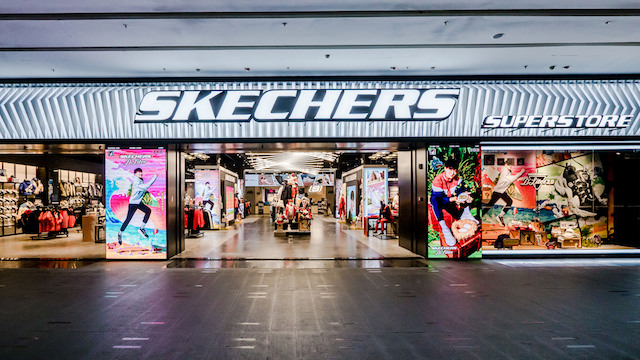
    Skechers opened an 8,650-square-foot Superstore at the Sunway Pyramid mall in Subang Jaya, expanding its physical presence in Malaysia.

    The relocated store is nearly six times larger than the brand’s previous 1,453-square-foot unit at the same shopping centre. It is the company’s first Superstore format in Subang Jaya. The launch lifts its nationwide network to 120 doors.

    Zoned layout and digital fitting

    Dedicated zones divide the catalogue into sections for walking, running, trail, pickleball, performance apparel and children’s collections. The store also includes SafeSize 3D foot-scanning hardware to generate personalised sizing data. Alongside the scanners, an in-store customisation station lets shoppers modify selected shoes and garments.

    Footwear retailers across Southeast Asia continue to trade standard mall units for large experiential spaces. The bigger layouts capture higher basket sizes and accommodate specialized athletic lines that boutique footprints cannot hold.

    Expansion pipeline across Malaysia

    Malaysia is a key sales volume driver for the American brand. Cedrick Tan, president of Skechers Southeast Asia, Hong Kong and South Korea, said the group will maintain its brick-and-mortar investment pace to keep up with domestic demand.

    More outlets will launch across the country over the coming months to build on the 120-store base.

  • Skechers Reports Strong Q2 Growth Of 13.1%, Bolstered By International Market Success

    Skechers Reports Strong Q2 Growth Of 13.1%, Bolstered By International Market Success

    Skechers, the global footwear leader, reported its financial results for the second quarter of 2025, reflecting an overall positive growth across its various business channels. The company’s total revenue for the quarter was recorded at US$2.44 billion, marking a 13.1% increase compared to the same period in the previous year. This growth is primarily attributed to robust demand in both its wholesale and direct-to-consumer channels.

    A Closer Look at the Financials

    The net income of Skechers witnessed a significant surge of 21.5%, reaching $170.5 million, up from $140.3 million registered in the corresponding period of the previous year. The wholesale revenue for the quarter was also on an upward trajectory, accounting for $1.30 billion, a 15% increase from the prior-year period. Direct-to-consumer sales also followed suit, with an increase of 11% totaling $1.14 billion, compared to $1.03 billion noted a year earlier.

    In terms of domestic sales, the figures remained relatively stable, registering a marginal decrease of 0.2%. While wholesale sales experienced a decline of 7.5%, direct-to-consumer sales offset this with a 7.6% rise.

    International Market – A Strong Growth Driver

    The international market emerged as a key growth driver for Skechers with international sales constituting about 64.6% of the total revenue in Q2, a noticeable increase from approximately 60% a year earlier. This growth was spurred by a significant 29.6% increase in wholesale international sales and a 13.3% rise in direct-to-consumer international revenue.

    Despite a decline in China sales, which dropped 8.2% to $287.2 million, sales in the Asia Pacific region rose by 5.5% to $595.5 million. The Americas division witnessed a slight increase of 1.1% with sales amounting to $1.11 billion. However, the Europe, Middle East & Africa (EMEA) region showed the most robust regional growth, with sales surging 48.5% to $731.5 million.

    Looking Back at the First Half of 2025

    For the first half of 2025, Skechers reported total sales of $4.85 billion, signifying a 10% increase from the previous $4.41 billion in the prior year. The regional growth trends were similar to those of Q2, with EMEA witnessing an increase of 29.4%, Americas growing by 4.6%, and the Asia Pacific region recording a modest growth of 1.4%.

    Currently, Skechers operates over 5200 stores globally, which include both company-owned and third-party-owned locations. The company is confidently marching towards its goal of establishing 10,000 stores across the globe.

    Questions & Answers

    What was the total revenue of Skechers in Q2 2025?
    The total revenue of Skechers in the second quarter of 2025 was US$2.44 billion.

    Which region showed the strongest growth for Skechers?
    The Europe, Middle East & Africa (EMEA) region showed the strongest growth for Skechers, with sales jumping 48.5% to $731.5 million.

    How many stores does Skechers currently operate worldwide?
    Skechers currently operates more than 5200 stores worldwide.

  • Skechers opens world-first Performance Flagship

    Skechers opens world-first Performance Flagship

    Skechers has unveiled its first-ever Performance Flagship at West Edmonton Mall in Canada, offering an interactive retail experience space incorporating a half-court layout staging a range of performance products.

    Featuring half-size pickleball and basketball courts, the 700sqm store houses an extensive sales floor and the brand’s innovative athlete-worn technology performance products of footwear, apparel, and accessories.

    “Our new performance store offers competitors at every level the complete experience: from our largest-ever offering of performance footwear, apparel and accessories to Skechers specialists and educators for our diverse sports technologies, and courts where consumers can discover how our product performs without ever leaving the store,” said Michael Greenberg, president of Skechers.

    In addition, customers can explore the latest performance products for any level player, including golf, soccer, training, hiking, running and trail, supported by a roster of elite athletes. The Edmonton store also showcases signature technologies like Hyper Burst Pro, Performance Fitknit, Hands Free Slip-ins, Max Cushioning, and Arch Fit.

  • Skechers granted an injunction against Dockers for alleged patent infringement

    Skechers granted an injunction against Dockers for alleged patent infringement

    In August, Skechers sued nonslip shoemaker Laforst Shoes over the alleged infringement of the slip-in-heel design. These shoe styles were the subject of high-profile Super Bowl ads earlier this year featuring Martha Stewart and Snoop Dogg, and Skechers says it’s sold millions of pairs of the hands-free shoe.

    On October 5, the Düsseldorf Regional Court in Germany found that Dockers had infringed on one of Skechers’ heel pillow designs, per the Skechers release.

    In a news release on the ruling, Skechers President Michael Greenberg said the company would “continue to aggressively police and enforce” its proprietary rights for the sneaker design.

    “While the ruling can be appealed, we are very pleased that the German court in the first instance acknowledged Skechers’ rights and immediately stopped the sale of the offending shoe style throughout the European Union,” Greenberg said. “Skechers invests tremendous resources into product development to introduce fresh, unique, and exciting footwear to its customers year in and year out.

    While Skechers always prefers to compete in the marketplace rather than the courtroom, the Company has no choice but to seek legal recourse when competitors infringe on our intellectual property rights.”

    Skechers’ legal complaint against Laforst is ongoing, though court documents show the parties have engaged in settlement discussions. As of Sept. 26, a judge in the United States District Court Central District of California gave Skechers 30 days to finalize its settlement with Laforst.

    In April, Skechers settled a patent dispute with French luxury brand Hermès over its Massage Fit sole.

  • Skechers takes control of Philippines operation

    Skechers takes control of Philippines operation

    Skechers parent, The Comfort Technology Company, has transitioned the operations of the footwear brand in the Philippines from its third-party distributor, Trendworks International, to Skechers USA Philippines.

    The company said the move is to maximize the brand’s growth in the region. Trendworks International will continue to sell Skechers products through the end of this year.

    In addition, Skechers USA Philippines will expand the brand’s presence in the country, opening 10 to 12 additional concept stores during the first half of next year, including those in key department and specialty stores such as Planet Sports and The SM Store.

    “The Philippines has immense potential for Skechers, and with our dedicated team focused on growth and delivering the integrated capabilities of Skechers,” said David Weinberg, COO at Skechers USA. “We believe this step accelerates that potential.

    “With Skechers’ appealing lifestyle collections, groundbreaking comfort innovations and our corporate support, we believe the Philippines can become a key market for us in Southeast Asia.”

    According to Suzette Pasustento, country manager for Skechers USA Philippines, the company is currently under the first phase of re-establishing the brand in the market, including setting up new offices in Manila and opening a distribution centre. The company has also opened its first new store this month.

    “With this new dedicated approach, we will be able to reach more of the 100 million men, women and children in this country and offer them a wider selection of great Skechers products through expanded channels,” said  Pasustento.

    “In 2022, we will introduce new product categories, open more retail locations and expand our door count with new retailers, as well as launch a comprehensive marketing campaign.”

  • Skechers opening more outlets in Singapore

    Skechers opening more outlets in Singapore

    Skechers Singapore has accelerated its expansion plan in the city despite the Covid-19 situation.

    Since July, the footwear brand has rolled out five new stores in the territory, taking its store count to 30, employing 40 additional staff to man them.

    While many retailers are struggling to remain commercially viable during the Covid-19 crisis, and some closing stores, Skechers’ is bucking the trend. One of the latest victims of Covid-19 in Singapore is fashion retailer Topshop which has announced it will quit all its physical stores in the city and move entirely online.

    “It is without a doubt (that) in the retail industry, it is quite challenging,” VP at Skechers Southeast Asia, Zann Lee, told Channel News Asia. “This is a good time for us to actually enter into a market with good locations.”

    Besides expanding its physical presence, the brand is also developing its own online store as shoppers are shifting to online shopping. Although opening its own e-commerce store may seem like a late response to Covid-19, Skechers is already selling its products online via third parties such as Shopee or Lazada.

  • Skechers China growth drives optimism for global sales recovery

    Skechers China growth drives optimism for global sales recovery

    Skechers China sales growth has fuelled optimism for the shoe brand after it reported a huge slump in sales for the June quarter due to stores being closed in other regions under Covid-19 lockdowns.

    The company reported group-wide sales of US$729.5 million, a 42 percent year-on-year decrease, and a net loss of $68.1 million during the three months to June 30.

    But sales in China rose 11.5 percent and sales on Skecher’s company-owned online store soared by 428.2 percent as buyers in some markets, unable to shop at physical stores, moved online.

    “Skechers, like most businesses around the world, has never faced a more challenging time than during the pandemic, which caused the closing of nearly every market worldwide,” said CEO Robert Greenberg. “Covid-19 continues to be a serious concern globally, and the health and welfare of our team, partners, and customers remain our number one priority.”

    Skechers stores were closed for varying periods of time in almost every market outside Asia.

    “However, we remain optimistic about the early signs of recovery we witnessed during the quarter, including a return to growth in China, consistent improvement each month in some markets outside of China,” said COO David Weinberg.

    “While every country’s recovery has been unique, we began to see a similar recovery trend, first reflected in China and now extending into other markets globally including Australia, Germany, South Korea, and Taiwan. We believe the positive sales trends in markets that have reopened, as well as the efficiency with which we addressed the pandemic challenges, are strong indicators that when the global health crisis stabilizes, Skechers will remain a global footwear leader.”

    Greenberg said the company was a “resilient organization” driven by a dedicated and flexible team determined to do whatever it takes to not only survive but position itself for a return to profitability.

    “Now, with more than 90 percent of our Skechers stores safely re-opened and some markets in the early stages of recovery, we believe that we will remain a brand consumers and retailers trust to deliver comfort, quality, and style. We are hopeful that global economies will continue to improve, and as they do, we will continue to operate efficiently and judiciously during this pandemic,” he said.

  • Covid-19 blunts tremendous growth of footwear brand Skechers

    Covid-19 blunts tremendous growth of footwear brand Skechers

    US footwear brand Skechers has reported a modest 2.7-per-cent drop in first-quarter sales brought on by the coronavirus outbreak – and painted a rosy picture of life beyond the coronavirus crisis.

    “We are in unprecedented times, facing difficult decisions daily as we navigate this global pandemic that has negatively impacted every business throughout our industry and most others,” said Skechers CEO  Robert Greenberg.

    “We know from the triple-digit growth we are experiencing so far this month in our e-commerce business and the positive sales trajectory of our recovering business in China, that Skechers’ product continues to resonate with consumers. As our business begins to return to normal, we firmly believe that our retail partners and customers will look to a brand they trust that delivers comfort, innovation, style, and quality at a value.”

    The firm’s net earnings during the period were US$49.1 million, with adjusted net earnings $59.9 million, reflecting the impact of negative foreign currency rates and certain purchase price adjustments related to the company’s Mexico joint venture.

    “We experienced strong momentum throughout 2019, which continued into the first two months of 2020,” said Skechers COO David Weinberg. “However, due to significantly reduced economic activity in China after January, and the spread of the Covid-19 pandemic around the rest of the world in March, sales decreased 2.7 percent in the first quarter. Until then, Skechers’ business was on track for a new first-quarter sales record.”

    CFO John Vandemore said that despite “an extremely strong end” to last year and an equally strong beginning to this one, the company saw a notable slowdown in markets impacted by the Covid-19 pandemic.

    “We have taken decisive action to fortify our business for the duration of this crisis, including drawing down on our senior unsecured credit facility, actively managing operating expenses, inventory levels and production orders, and deferring non-critical capital expenditures. We are confident that the actions we have taken and will continue to take, combined with the global strength of our brand and balance sheet, will position Skechers to successfully navigate this situation, and poise us to return to growth in the future.”

  • Skechers flagship opens in Shanghai Disneytown

    Skechers flagship opens in Shanghai Disneytown

    A Skechers flagship has opened in Shanghai Disney Resort called the Skechers Kids Brand Experience.

    Located at the busiest sector of Disneytown shopping district where more than 11 million people visit annually, Skechers Kids Brand Experience store offers a selection of kids’ sneakers and parent-child clothing.

    “This amazing location is front and centre in the middle of the action at Disneytown and offers a unique opportunity to expose a wide range of consumers to our Skechers Kids product,” said Michael Greenberg, president of Skechers.

    “Our footwear and apparel collections for boys and girls are filled with innovation and fun styles that continue to resonate within China and around the globe.

    “This unique Skechers Kids store illustrates how we adapt to a location so that we can connect with consumers in new and exciting ways to elevate the shopping experience”.

    Inspired by the fairytale ambience of Disney resort, the Skechers flagship features a kid-friendly environment where families can enjoy their shopping experience.

    Skechers has more than 1000 retail outlets across China and more than 3300 around the globe, including flagship locations like New York’s Times Square, Covent Garden in London, and Harajuku in Tokyo.

  • Skechers in Singapore opens Southeast Asia’s largest store yet

    Skechers in Singapore opens Southeast Asia’s largest store yet

    Skechers in Singapore has opened the brand’s largest experience store in Southeast Asia, at  Jewel Changi airport.

    The 5000sqft duplex store’s interior has been designed with an overall modern and sleek look, achieved through the use of bright lighting and cement panels.

    On opening day, more than 2500 shoppers and 250 invited guests were at the store to participate in activities including a fashion and dance showcase.

    “For the past 10 years, Skechers has been evolving and improving ourselves in terms of retail shopping,” said Vincent Leung, president of Skechers Southeast Asia.

    “Our clear direction is to create a wonderful customer shopping experience, with Brand Experience Stores in China, Hong Kong, and now our very first in Southeast Asia right here at Jewel Changi Airport.”

    A staircase between Levels 1 and 2 features a colourful wall mural designed by Diplomat, a group of young budding Singapore artists, adding energetic hip-hop and street-cred elements to the space.

    There is also a photo zone on Level 2, where visitors can take selfies with a fun photo-wall.

    Another highlight of the Skechers in Singapore store exclusive to Jewel is a customisation zone, where one can personalise selected Skechers shoes or apparel with embroidery or heat press.

    Guests of the opening were able to make their own customised pouch, choosing motifs to create a unique souvenir of the event.

  • Skechers Opens first duplex store in Singapore

    Skechers Opens first duplex store in Singapore

    Skechers Singapore is opening Southeast Asia’s largest and first duplex experiential concept store, at Jewel Changi this week.

    Set to open on Thursday (April 11), the 5000sqft space will incorporate new visual-merchandising and store-design elements with the use of bright lighting and cement panels.

    The space is divided into product categories, including performance, lifestyle and Skechers kids.

    The store also adopts a story-driven design, where key messages behind each product range will be highlighted through visual images and artwork.

    On Level 2 an Instagram-worthy photo zone features thematic displays and images that will be refreshed every season to reflect the keys launches with the Skechers x One Piece collaboration centrestage.

    This will be the first store in Singapore to include a shoe customisation zone with embroidery and heat-press personalisation, and to carry Jewel-exclusive collections including the Skechers SKLX series of training sneakers.

  • Puma pips rivals, becomes top sportswear brand in India

    Puma pips rivals, becomes top sportswear brand in India

    German sportswear major Puma on Monday claimed that it has become the top sportswear retailer in India, surpassing rivals such as Nike, Adidas, Skechers and Reebok in terms of yearly sales. Puma, the third-largest sportswear manufacturer in the world, has reported sales of Rs 1,157 crore for the 12-month period ending December 2018 against Rs 958 crore reported in the year ago period.

    The company follows the January-December calendar year, while its Nike, Adidas, Skechers and Reebok go by the April-March financial year (FY) cycle.

    In FY 2017-18, Puma’s compatriot Adidas had registered sales of Rs 1,132 crore, up from Rs 1,100 crore reported in FY 2016-17.

    During the same period, American sportswear giant Nike reported sales of Rs 828 crore against Rs 807 crore reported in the previous fiscal.

    Reebok, which is owned by Adidas, saw its sales drop from Rs 416 crore in FY 2016-17 to Rs 391 crore in FY 2017-18.

    Another American brand Skechers, which is relatively new in the Indian market, reported sales of Rs 440 crore in FY 2018-19, up from Rs 282 crore reported in FY2016-17.

    “We are making strong progress in both sports performance and sport style categories,” Puma India Managing Director Abhishek Ganguly was quoted as saying.

    Interestingly, India is the only country where Puma’s sales have crossed the sales of other sportswear giants such as Adidas and Nike.

    Over the past few years, India has rapidly caught up with the wider global fitness trends. From 2015 to 2016, the Indian sportswear market grew 22 per cent, outpacing the segment’s global increase of 7 per cent, according to Euromonitor International. By 2020, it is expected to grow an additional 12 per cent CAGR (compound annual growth rate) with sales expected to reach $8 billion.

    The bitter rivalry between Puma and Adidas goes beyond mere corporate competition. It was in fact a sibling fallout that created two of the world’s biggest sportswear brands.

    In the 1920s, German brothers Adolf and Rudolf Dassler launched a shoe company together. Their business picked up after Dassler shoes were used by medal-winning Olympians through out the 1930s.

    But along with sales, tension also spiked between the Dassler brothers, which reached a boiling point during World War II. While it was not clear what exactly caused the rift, it was said to be a result of miscommunication.

    The brothers eventually split in 1947 with Rudolf forming a new firm that he called Ruda – from Rudolf Dassler – later rebranded Puma, while Adolf, who preferred to be called Adi, named his business Adidas.