Retail News CRM

Tag: SKT

  • SKT showcases potential of 5G in VR streaming

    SKT showcases potential of 5G in VR streaming

    SK Telecom is demonstrating the potential of 5G to enable virtual reality video streaming by developing exclusive VR content for a popular reality TV series.

    The company is offering 100 exclusive VR clips related to the Produce X 101 idol audition program on the oksuku OTT video service.

    The new content, added to a dedicated menu within the SKT-5GX section of the streaming app, will be provided to SK Telecom customers free of charge. The company is currently offering around 400 VR video clips on this section of the streaming app.

    SK Telecom said it has utilized 5G technologies for the planning, filming and delivery phases of the project. The company used 3D ultra-high definition video cameras to film joint performances, and applied video distortion correction technology to produce realistic and natural 3D video.

    “SK Telecom is witnessing a dramatic rise in the use of VR video contents on ‘oksusu’ since the launch of its 5G service,” the company’s 5GX VP and head of service business group Yang Maeng-seog said.

    “SK Telecom will continue to provide customers with a differentiated 5G experience by rapidly expanding dedicated services and contents on diverse themes.”

  • SKT to provide first 5G live TV sports broadcast

    SKT to provide first 5G live TV sports broadcast

    SK Telecom has revealed plans to offer the world’s first live TV sports broadcast using a 5G network for the SK Telecom Open 2019 golf tournament.

    The tournament, which will be held as part of the KPGA Korean Tour, will be live broadcast on JTBC’s dedicated Golf TV channel and OTT video service oksuku using SK Telecom’s 5G network.

    The tournament, which commences today, will be broadcast live for selected areas using 5G coverage deployed for the third, fourth and ninth holes of the course.

    The company will also temporarily create a special section on the oksuku OTT platform to offer 5G-based live streaming and related video clips of the golf tournament.

    “As 5G-based live broadcasting is subject to no physical constraints, it can be widely utilized in areas including sporting events and on-site news reports,” SK Telecom VP and head of 5GX media business group Kim Hyuk said.

    “SK Telecom will continue to work closely with broadcasting networks to contribute to the advancement of the broadcasting system through 5G technologies.”

    The agreement follows soon after SK Telecom signed agreements with South Korea’s top three terrestrial television broadcasters to jointly develop a live broadcasting system based on the operator’s 5G network.

  • SKT to help broadcasters create 5G livestream system

    SKT to help broadcasters create 5G livestream system

    SK Telecom has signed agreements with South Korea’s top three terrestrial broadcasters to develop new media solutions and business models based on 5G technology.

    The operator has signed memoranda of understanding with Seoul Broadcasting System (SBS), Korean Broadcasting System (KBS) and Munhwa Broadcasting Corporation (MBC) to jointly develop a 5G-based 4K ultra high definition live broadcasting system and test the system at sports games and other events.

    SK Telecom also plans to work with each broadcaster to develop 5G-based content and explore joint opportunities in digital advertising, augmented reality and hologram technology.

    In January, SK Telecom entered an agreement with US broadcaster Sinclair Broadcast Group to establish a joint venture to lead development of next-generation broadcasting solutions in the US.

    The operator has also just revealed plans to merge its broadband subsidiary and South Korea’s largest pay TV provider SK Broadband with the market’s second largest player t-broad to create a media company with around 8 million subscribers.

    Separately, SK Telecom announced it has signed a memorandum of understanding with Yonsei University Health System to introduce the first 5G powered digital hospital.

    The companies have agreed to develop a 5G network and specialized 5G-based solutions for the Yongin Severance Hospital, which is scheduled to open in February next year and so will be built from the ground up to support 5G solutions.

    SK Telecom will provide its AI speaker NUGU to allow patients with physical difficulties to control their beds, lighting and TVs with their voice, or call for assistance in case of emergencies. The hospital will also offer 5G-powered augmented reality indoor navigation and a hologram solution for remote visits to patients in isolation wards.

    Other solutions being planned or considered include quantum cryptography for advanced cybersecurity, as well as facial recognition for contact-free biometric access control for buildings and other rooms.

  • SK Telecom to launch data analyzer with Microsoft

    SK Telecom to launch data analyzer with Microsoft

    Korea’s No. 1 mobile carrier SK Telecom said Wednesday it will collaborate with U.S. software giant Microsoft for big data solutions to expand its presence in the global market. SK Telecom said it signed a development and global business cooperation agreement with Microsoft in Silicon Valley to step up development and global marketing in big data analysis.

    Under the partnership, SKT will launch its real-time big data analyzer, Metatron, on Microsoft’s public cloud platform Azure.

    Metatron provides quick and easy data analysis, which also includes data collection, storage and visualization processes. Azure is the world’s second-largest public cloud provider, used in 140 nations across the globe.

    The two companies agreed to launch the big-data-based asset performance-management service for the commercial market in July.

    “The partnership is expected to set the ground for Metatron’s footprint in the global market,” Choi Yong-jin, SKT’s data labs director, said in a release.

    Already well-established in its domestic market, SK Telecom has focused on leveraging its mobile network technology expertise and increasing revenue in content, software and security.

    During MWC Barcelona, set to open next Monday, the company plans to demonstrate its 5G technology, including quantum-safe cryptography solutions and mobile edge computing.

    Quantum-safe technology encrypts transmitted data using special quantum keys, which prevents interception or theft.

    Edge-computing systems process data locally, in nearby data centers or on devices, which eases the strain on networks and improves data reply times.

  • SKT brings 5G workplace to life

    SKT brings 5G workplace to life

    ID cards, laptops and business trips will no longer be necessary, according to SK Telecom, when the 5G network-based smart office environment becomes an industry norm. The mobile carrier showcased its smart office technology test bed in Jongno District, central Seoul, Wednesday. Currently, about 300 SK Telecom employees are working at the space set up roughly a month ago by renting out three floors in the Centropolis building.

    At the entrance to the office, SK Telecom has facial recognition technology manning the security desk. Due to privacy issues, only employees who have agreed to register their biometric information can pass through the gate without an ID card.

    Inside the office, a display panel shows seat reservations. The screen shows all available seats inside the office, similar to the systems seen in university libraries and also shows who is in which seat. When designing the smart office, SK Telecom made it into an open space so employees can freely move around. The display even shows how many toilet cubicles are available for immediate use, although in this case employee names aren’t shown.
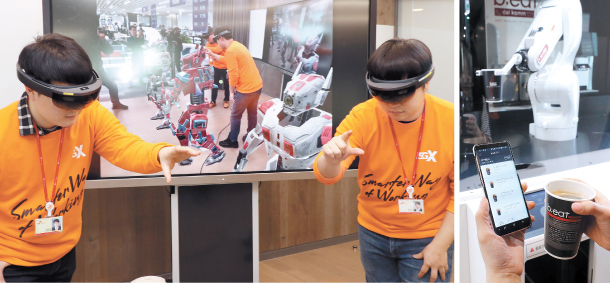
    The carrier said it used roughly 2,300 sensors, including on the ceilings, CCTV and even doorknobs in the bathrooms that track relevant data on employees’ work patterns inside the office. The data collected will be used to develop smart office solutions packages for enterprise customers.

    The desks in the office come with desktop computers connected to mobile routers that convert 5G signals into super-fast Wi-Fi. Beside the computer monitor is a docking station for smartphones. The so-called virtual desktop infrastructure enables employees to bring up what they were working on with their personal computers on the desktop computer using the cloud. Unlike simply mirroring a smartphone display, the phones become an authorization medium that allow the computer to verify which work files are downloaded from the cloud.

    At one side of the office is a space for so-called telemeetings that could cut down the need for frequent business trips. SK Telecom said it used its “T real telepresence” technology to invite multiple users into a virtual space where participants can have meetings while watching videos or 3-D designs of game characters and buildings together.

    After donning Microsoft’s HoloLens, this reporter was invited to a telemeeting to discuss the design of a game character.

    Within the virtual meeting, attendees were able to see and walk around a moving 3-D game character while interacting with the avatars of other people in the meeting.

    The experience wasn’t perfect – the field of view was small and constantly looking around was necessary in order to follow everything that was going on, but the potential of the technology to greatly reduce the need for business trips was evident.

    Other technologies already being used in the office included a barista robot and artificial intelligence-based autonomous vending machine, which can track employee purchases with camera sensors.

    Would any of these innovations be possible without 5G network?

    According to SK Telecom, yes. But, while all of these technologies are possible on the existing 4G LTE network, the new high-speed network, touted to be 20 times faster when fully commercialized, offers faster and more stable internet connection even when a million devices are connected at once.

    In essence, 5G ensures that all these systems work seamlessly without their huge data usage interrupting networks or slowing down work.

    “Dependency on landline internet will be reduced and high-capacity data will be delivered fast enough for real-time telemeetings with 5G,” said Shin Seung-ho, a manager from SK Telecom’s media lab under ICT center.

  • Korean firms team up on insurance

    Korean firms team up on insurance

    SK Telecom, Korea’s top mobile carrier, and Hyundai Motor will jointly enter the insurance business, partnering with Hanwha General Insurance to bring their technology expertise to the industry. The Financial Services Commission (FSC), the country’s top financial regulator, said Wednesday it has given preliminary permission for SK Telecom, Hyundai Motor and Hanwha General Insurance to build an online insurance company that primarily deals with miscellaneous non-life insurance on digital platforms.

    “If the process goes smoothly, it can open in the fourth quarter of this year,” said a spokesperson at SK Telecom.

    In six months, the investing units are required to raise the promised capital, complete recruiting and have the physical operation in place, after which it will file for final approval.

    The companies said the unit will focus on cars, pets and travel.

    Hyundai Motor said the insurer will develop a product that differentiates insurance fees depending on a policy holders’ mileage and other driving behavior. Also on the cards is a system that discounts fees when subscribers are found to drive in a safe manner by adopting a real-time analytical technique to monitor driving habits.

    The insurance firm aims to carve out its own niche with lower fees and relatively short contracts.

    “We want to offer attractive alternatives for consumers who found existing insurance products expensive and requiring long-term commitment,” said Jang Yoo-seong, head of the artificial intelligence (AI) and mobility division at SK Telecom.

    The idea is based on InsurTech, a combination of insurance and technology that has quickly risen to prominence in the global financial industry.

    According to a study by the Korea Insurance Research Institute, the market has been rapidly growing in recently years. Investment in InsurTech start-ups, which amounted to $2.6 million in 2013, surged to $11.9 billion in 2017.

    The global InsurTech market revenue is valued at $532.7 million in 2018 and is expected to reach $1,119.8 million by 2023, according to Research and Markets, a U.S. market tracker.

    Hanwha General Insurance will raise 75.1 percent of the capital while SK Telecom puts in 9.9 percent. Hyundai Motor invested 5.1 percent and Altos Ventures Korea, an investment firm, 9.9 percent.

    In total, the companies will funnel in a total of 85 billion won.

    If passed, the new insurer will be the country’s second internet-only insurance company after Kyobo Life Planet.

  • Seoul, SKT to add 5G to transport system

    Seoul, SKT to add 5G to transport system

    Sensors on roads will be able to alert cars when people are jaywalking and bus stops will tell buses to slow down in crowded areas when Seoul’s 5G infrastructure is ready, the city’s government and SK Telecom said in a joint statement Thursday. The Seoul Metropolitan Government and SK Telecom have teamed up on an initiative called the Cooperative-Intelligent Transport System, an upgrade of the current transportation system in Seoul. The pilot program will run until the end of 2020 with a budget of roughly 25.4 billion won ($22.6 million).

    Seoul already has a digitized public transportation system with signboards at bus stops telling passengers when the next bus is coming and whether it is crowded, and T-Money cards that enable people to transfer between various means of public transportation with little additional cost. The city aims to use 5G to make that transport system even safer.

    SK Telecom will supply 2,000 5G devices for buses, taxis and traffic signal controllers so they can connect with the 5G network. The mobile carrier said the devices will be co-developed with Samsung Electronics.

    Buses and taxis installed with 5G will constantly share data with bus stops, traffic lights and other traffic infrastructure. SK Telecom and the Seoul government will look for dangerous situations by analyzing the shared data to prevent accidents. As SK Telecom operates the country’s largest navigation app – T Map – the carrier said it will send out warnings through the app to reach the largest number of drivers possible.

    SK Telecom said there are about 30 safety services the 5G-based transportation system can offer.

    Roads installed with 5G sensors can detect jaywalkers, the mobile carrier said. While cars may have difficulty spotting people in the dark or during bad weather, 5G-connected sensors will alert nearby cars and prevent accidents. In 2017, 9,590 accidents were caused by jaywalkers, the largest cause of road accidents for pedestrians, according to data from the Korea Road Traffic Authority.

    The country’s largest telecom company also said 5G connectivity between cars can prevent secondary accidents by sending warning messages to following cars when an accidents occur in areas with poor visibility, such as around a corner or a bend in the road.

    As well as partnering on safety services, Seoul and SK Telecom are also preparing to jointly establish an autonomous driving test-bed in Sangam-dong, western Seoul, by the first half of this year. A self-driving vehicle will run back and forth between Digital Media City Station and buildings in the area. The SK Telecom-operated autonomous vehicle will begin running in the area from June at the earliest.

    “The Cooperative-Intelligent Transport System project is a futuristic business that combines state-of-the-art digital technologies, like 5G, autonomous driving, artificial intelligence (AI) and the cloud,” said Ryu Young-sang, an executive vice president of SK Telecom. “We hope to offer a range of traffic safety data to Seoul citizens using 5G and reduce traffic accidents.”

  • SKT, Deutsche Telekom sign co-investment agreement

    SKT, Deutsche Telekom sign co-investment agreement

    SK Telecom and Germany’s Deutsche Telekom have signed a strategic cross-investment partnership aimed at strengthening their competitiveness in 5G.

    Under the agreement, SK Telecom will invest in MobiledgeX, a Deutsche Telekom subsidiary focused on edge computing technology.

    Deutsche Telekom will reciprocate by investing the same amount in ID Quantique, an SK Telecom strategic partner in quantum cryptography communication technology.

    The operators have made the cross-investment in a bid to ensure they are in a position to offer specilized 5G services in the upcoming 5G era, supporting the expected development of intelligent services such as connected vehicles, smart factories and wearable devices.

    As part of the collaboration, SK Telecom and Deutsche Telekom are evaluating applying quantum cryptography communications technologies on their respective 5G trial networks.

    The companies are also reviewing using mobile edge computing technologies to reduce data transfer time, for applications such as enabling authorities to conduct on-site monitoring of disaster-affected areas or responding more quickly to traffic accidents.

    The collaboration will also cover initiatives in new business areas such as artificial and virtual reality. SK Telecom is pleased to enter into a cross-investment agreement with Deutsche Telekom as it will serve as a valuable opportunity for us to further solidify our 5G leadership in the global market and drive new growth,” SK Telecom president and CEO Park Jung-ho said.

  • SKT, Samsung complete 5G NSA call

    SKT, Samsung complete 5G NSA call

    SK Telecom and Samsung Electronics have completed a 5G call using 3GPP non-standalone new radio standards and commercial 5G new radio equipment. The trial at SK Telecom’s 5G testbed at its Bundang office building used end-to-end solutions jointly developed by the two South Korean companies. It utilized 100MHz of 3.5-GHz 5G spectrum and 5G NR, LTE radio and 5G non-standalone core infrastructure.

    The 5G non-standalone new radio architecture has been designed to allow 5G to be supported by legacy LTE infrastructure, allowing mobile devices to be connected to both 4G and 5G for data traffic, and to use the 4G network for non-data traffic  such as exchanging signals for mobility controls.

    This configuration is expected to be one of the promising 5G architectures for initial deployments.

    Sasmsung announced last month that it has secured a contract to deliver 5G equipment including core and RAN technologies for SK Telecom’s 5G deployments, which will commence later this year.

    The companies have been collaborating on 5G development since 2014, and jointly completed the first successful interworking of LTE and 5G new radio utilizing both 3.5-GHz and 28-GHz spectrum during a trial last year.

  • SKT raises $500m to refinance debt

    SKT raises $500m to refinance debt

    SK Telecom has raised $500 million in offshore private loans to help refinance existing debt and secure enough capital to weather a destabilized global economy.

    The company has issued five-year loans at a coupon rate of 3.75% after holding financial roadshows across Asia, the US and Europe, receiving favorable responses from around 60 global bond investors.

    Despite the impact of the recent US-China trade war on the global financial market, SK Telecom managed to draw a positive response from global investors due to its high credit rating, stable cash flow and strong growth potential, the company said in a statement.

    The offer was around seven times oversubscribed from SK Telecom’s estimated bond issuance of $500 million, and the final interest rate was set at 22.5 basis points lower than the initially proposed level.

    “Diversifying the loan maturity structure is expected to improve the company’s financial structure,” SK Telecom said in a statement.

  • SKT steps up efforts to launch 5G earlier

    SKT steps up efforts to launch 5G earlier

    SK Telecom has accelerated its efforts to deploy 5G services earlier than expected with the demonstration of key 5G enabling technologies in a real-world setting.

    The operator has implemented a 5G relay repeater operating in the 28-GHz and 3.5-GHz 5G-candidate frequency bands at its Bundang office. SK Telecom has deployed a 5G trial network at this office.

    Using the in-building 5G relay repeater, SK Telecom was able to achieve speeds of up to 4Gbps.

    While 28-GHz spectrum has a higher potential capacity than lower-band spectrum radio waves in this band are more likely to move in straight lines, meaning they are blocked more sharply by obstacles and have significantly shorter radio coverage. This effect is particularly strong inside buildings where areas are divided by walls.

    The 5G repeater is aimed at improving the quality of indoor service, a key prerequisite for the development of a 5G service.

    SK Telecom has also worked with SK Telesys to develop an in-building relay repeater capable of delivering 5G radio signals over 3.5-GHz using a building’s existing mobile infrastructure. The station uses the existing antennas for 2G, 3G and LTE services, reducing the time needed to build an indoor network for 5G.

    SK Telecom has also demonstrated a 360-degree virtual reality video call using a tablet size device over the trial 5G network between SK Telecom’s Seoul headquarters and an area nearby.

    The demonstration was performed in the CBD and used expected 5G technologies including beamforming as well as network virtualization.

    “The success of 5G wireless communications in the real-world environment will give us momentum to accelerate our effort to roll out 5G service earlier than expected,” SK Telecom SVP and head of network technology R&D Park Jin-hyo said.

    “We at SK Telecom will continue to develop our capabilities to rollout 5G networks in order to offer differentiated services to our customers.”

  • SKT unveils Wi-Fi tech with 5G speeds

    SKT unveils Wi-Fi tech with 5G speeds

    SK Telecom has unveiled a self-developed Wi-Fi technology capable of delivering speeds of up to 4.8Gbps.

    The Wi-Fi technology and access point  is based on the new IEEE 802.11ax standard. It can deliver speeds nearly four times faster than the 1.3Gbps achievable with 802.11ac gigabit Wi-Fi

    The technology uses four antennas to transmit data over 160 MHz of bandwidth – twice that of 802.11ac, operating in both the 2.4-GHz and 5-GHz frequency bands.

    In addition, the Wi-Fi technology supports orthogonal frequency-division multiple access (OFMDA), multi-user MIMO (MU-MIMO) and dynamic sensitivity control (DSC) technology to improve the efficiency of the network.

    SK Telecom plans to start deploying access points for the next generation Wi-Fi next year, concentrating on high traffic density areas. Handsets with chipsets compatible with 802.11ax will be able to benefit from the technology.

    The operator has constructed a Wi-Fi testbed within its R&D center in Bundang to test performance of the technology in various deployment scenarios, and is working on upgrading access points to be commercially deployable by the end of 2017.

    SK Telecom SVP and head of network R&D Park Jin-hyo said the next-generation Wi-Fi technology is expected to be an important complement to 5G networks.

    “By introducing the technology for the next generation Wi-Fi that can deliver as fast as 5G technology, we at SK Telecom have successfully laid foundation to offer better mobile services,” he said.

    “We are thrilled to work on the preparation on commercializing the technology and continue to innovate our capabilities to provide differentiated services to our customers.”

  • SKT expanding use of TANGO AI platform

    SKT expanding use of TANGO AI platform

    SK Telecom is expanding the use of its AI-assisted network operation system TANGO to all its telecommunications networks.

    The operator has already been using TANGO (the T advanced next generation operational supporting system) to help manage its fixed line network, and is now extending the application of the system to the mobile network.

    TANGO uses machine learning to automate the optimization of network operation based on network traffic information broken down by area and period.

    The system is also designed to enhance the accuracy of network management by measuring the quality of network operations delivered to customers, and incorporates virtualization capabilities to help mobile operators adopt new network capabilities including IoT and 5G.

    Last month, SK Telecom entered an agreement to provide the TANGO platform to India’s largest operator Bharti Airtel.

    “The AI-assisted network operation technology based on big data analytics will be essential in the 5G era,” SK Telecom SVP and head of network technology R&D Park Jin-hyo commented.

    “SK Telecom will continue to improve the functionality of TANGO aiming at providing the best-performing network for customers to enjoy.”

  • SKT launches five-band CA, 4X4 MIMO

    SKT launches five-band CA, 4X4 MIMO

    SK Telecom has announced the launch of five-band carrier aggregation (CA) and 4X4 multiple input multiple output (MIMO) technologies as part of its ongoing evolution to 5G.

    The operator has made five-band CA LTE-A Pro available in the main areas of 53 cities across South Korea, supporting data rates of up to 700Mbps.

    The five-band CA service utilizes SK Telecom’s 10MHz of 800-MHz spectrum, 20MHz in the 1.8-GHz band, 10MHz in 2.1-GHZ as well as a 10MHz and 20MHz carrier in the 2.6-GHz bands.

    SK Telecom has meanwhile launched 900Mbps LTE-A Pro in the CBDs of six cities by combining existing three or four band carrier aggregation with 4×4 MIMO. The six cities are  Seoul, Busan, Daegu, Gwangju, Daejeon and Ulsan.

    Among SK Telecom’s handset line-up, currently only the Samsung Galaxy S8 supports these new services, and will require an over-the-air firmware upgrade to do so. But the operator said it anticipates that more upcoming premium smartphones will support the services.

    SK Telecom has set a target of having the two services combined cover more than 50% of the Korean population by the end of the year.

    The operator also plans to launch 1Gbps LTE-A Pro services in the first half of next year by combining five- or four-band CA with other technologies such as 4X4 MIMO.

    “SK Telecom’s LTE-A Pro services represent an early application of 5G technologies that support Gbps-level data speeds and massive network capacity,” SK Telecom SVP and head of infrastructure strategy Choi Seung-won said.

    ““SK Telecom will continue to offer differentiated mobile communications quality through LTE-A Pro service, while utilizing the network to gain a valuable edge in the 5G era.”

  • SKT, DT, Ericsson demo 5G federated network slicing

    SKT, DT, Ericsson demo 5G federated network slicing

    SK Telecom, Ericsson and Deutsche Telekom have successfully built and demonstrated the world’s first intercontinental 5G trial network.

    The companies used federated network slicing for 5G roaming between trial networks in South Korea and Germany.

    The demonstration was hosted at SK Telecom’s 5G Testbed at the BMW driving center at Yeoungjong-do, as well as Deutsche Telekom’s corporate R&D center in Bonn, Germany.

    With 5G technology, network slicing will allow operators to configure end-to-end networks that provide the desired functionality and service parameters. Federated network slicing will extend this functionality to visited networks for roaming services.

    Implementing this will require enhanced cooperation between international operators, because it will require them to open their networks to host partner services.

    This will require pre-existing agreements covering aspects including network slice availability at the access layer, availability in the core network and connections to customer application services. The network slicing will be managed by edge cloud resources.

    “5G is not just a faster network. 5G will provide extreme user experience anywhere and anytime, even when the user roams across different operators globally,” SK Telecom CTO Alex Jinsung Choi  said.

    “Federated network slicing will enable seamless platform sharing among operators at a global scale for continuous and guaranteed user experience.”

    SK Telecom plans to show off federated network slicing functionality at Mobile World Congress 2017 in Barcelona later this month.