Tag: sokcho

  • South Korea Pours 30 Billion Won into Six Regional Retail Districts

    South Korea Pours 30 Billion Won into Six Regional Retail Districts

    South Korea’s Small Enterprise and Market Service will inject up to 5 billion won ($3.68 million) into each of six regional shopping districts through 2027.

    This two-year project targets commercial hubs outside the capital. Funding will cover multilingual infrastructure, foreign payment systems, tax-refund stations and retail startup spaces across provincial cities.

    Funding and rollout for six hubs

    Selected commercial zones include Seorak Rodeo in Sokcho, Octopus 1955 in Yeongju, Hwangnidan-gil in Gyeongju, Gyodong in Daegu, Dongmyeong in Gwangju and the central shopping district of Seogwipo on Jeju Island. Each precinct will upgrade physical storefronts to pull international tourist footfall away from Seoul.

    Municipal operators will install luggage storage points, digital directories in multiple languages and instant tax-refund counters. The program also pays for pedestrian street redesigns alongside joint marketing campaigns with digital content creators.

    Repurposing retail in Sokcho and Yeongju

    In Sokcho, the Seorak Rodeo district spans 443 stores along Jungang-ro, connecting coastal tourism with retail strips. Planners will convert vacant second-floor commercial units into digital media galleries. Ground-floor properties will run as pop-up retail space for local consumer brands.

    Yeongju’s Octopus 1955 commercial area covers 52,400 square meters and 179 stores near Yeongju Station. The site builds a branded retail route around regional food traditions dating back to the 1955 opening of the Yeongdong railway line. It links local merchants with e-commerce platforms for regional produce, beef and ginseng.

    Global infrastructure for Hwangnidan-gil

    Gyeongju’s Hwangnidan-gil district is the largest hub in the program, covering 347,500 square meters and 479 retail and dining units. The district recorded 11 million visitors in 2025. Roughly 300,000 of them were foreign travelers.

    Operators in Gyeongju will install point-of-sale systems accepting overseas digital wallets, translate commercial directories and open pop-up stores to test new consumer products. Foot traffic will be routed directly to older adjacent shopping streets, including Geumridan-gil, Bonghwang-ro and the Jungang and Seongdong traditional markets.

    Decentralising consumer spending beyond Seoul

    For regional store owners and landlords, the state subsidies address a structural headache. South Korea’s retail spending remains heavily concentrated in the Seoul metropolitan area. That leaves provincial shopkeepers dependent on weekend domestic trade and seasonal domestic holidays. Upgraded payment terminals and tax-refund desks lower the barrier for foreign visitors who rarely venture past metropolitan transit zones.

    Retaining independent retail tenants after construction finishes will be the main operational test. Upgraded commercial strips frequently drive up rents. When that happens, higher overhead displaces the independent food vendors and craft retailers who created foot traffic in the first place.

    Government agencies have spent the past three years trying to spread tourism receipts beyond Seoul’s central shopping corridors of Myeongdong and Hongdae, following the post-pandemic reopening of regional flight corridors.

    Participating districts will open their first multilingual traveler centers and pop-up storefronts in early 2027. Total tenant counts and foreign tourist transaction volumes will be tracked through the final funding deadline in December 2027.
  • ‘Pokemon Go’ boosts local businesses in Sokcho

    ‘Pokemon Go’ boosts local businesses in Sokcho

    South Korean retailers are capitalizing on the explosive popularity of Nintendo’s augmented-reality mobile game “Pokemon Go” with new products and services targeting local Pokemon game enthusiasts and fans.

    From a sudden rise in consumer spending at select Pokemon-appearing cities in Korea to the launch of Pokemon-inspired hotels, tour packages and goods, the smash-hit game appears to be leaving a notable imprint on the local retail sector.

    Pikachu is surrounded by children during a Pokemon festival in Tokyo on July 18

    “Pokemon Go,” produced jointly by Nintendo and U.S.-based Google spinoff Niantic, Inc., is a GPS-based mobile game that has users running through real-life locations to discover and collect virtual monsters, such as the all-famous Pikachu, via their smartphones.

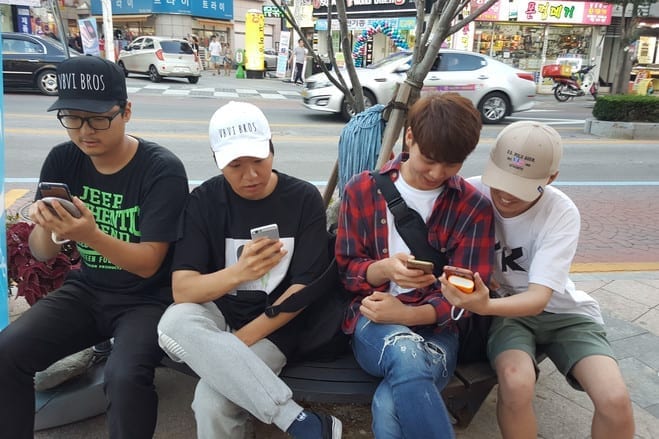
    Though the game has yet to officially launch in Korea, it has been operational in parts of the country, including Sokcho of Gangwon Province since mid-July and most recently parts of Ulsan and Busan, where the game’s GPS signal is active due to technical glitches.

    Eager to play, thousands of avid Pokemon fans here have been flocking to such locations in the past few weeks, boosting business at local retailers in the region and prompting online retailers to introduce an array of Pokemon-inspired products.

    A sign welcoming Pokémon Go players hangs inside at a convenience store inside Sokcho, Gangwon Province, one of the few cities in Korea where the mobile game is active.

    Among the biggest beneficiaries are convenience stores in Sokcho which have been enjoying a sudden sales boom thanks to peaking demand for cell phone battery charging services as well as portable battery chargers.

    CU, the nation’s top convenience store operated by BGF Retail, said its outlets in Sokcho saw their sales from July 11-17 almost double compared to the previous week, thanks to the legions of “Pokemon Go” players in the area.

    During the period, sales of “battery charging” services at CU stores in Sokcho rose by 388 percent from the week before while sales of small electronic devices including portable batteries and earphones rose by 82.4 percent, BGF Retail said.

    A smartphone case featuring Pikachu on sale at Gmarket (Gmarket)

    Game players in Sokcho have been frequenting convenience stores in the area to rest and stock up on necessities such as ice, ice cream and water to fight the summer heat as well, boosting the stores’ daily sales, a CU official said.

    Joining other smaller businesses which have embraced unique forms of “Pokemon Go” marketing, discount supermarket chain E-mart’s Sokcho branch said it has begun offering free ice water to “Pokemon Go” players who capture a Pokemon on its premises.

    Targeting Sokcho-bound travelers, scores of mobile-commerce companies including Ticket Monster, 11st Street, Gmarket and Auction began organizing day-trip bus services from Seoul to Sokcho starting from July 12.

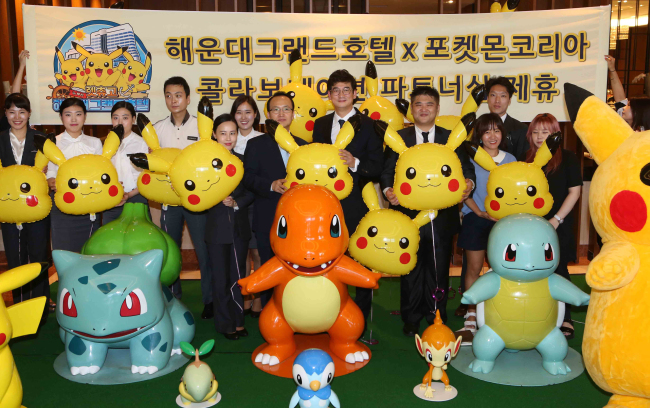
    The Haeundae Grand Hotel in Busan and Pokémon Korea celebrate their partnership during a ceremony held at the hotel on July 21. The hotel is offering diverse Pokémon-themed rooms, merchandise and eateries this summer as part of its joint promotion with Pokémon Korea.

    Meanwhile in Busan, the beachside Haeundae Grand Hotel has partnered with Pokemon Korea Co., in charge of all Pokemon merchandising in Korea, to offer specialized Pokemon-themed rooms, merchandise and eateries that tug at the hearts of local fans.

    Reflecting Pokemon’s resurgent appeal, sales of Pokemon-related toys, stationery and mobile accessories have surged as well. 11st Street saw sales of Pokemon items during July 11-17 rise by 57 percent compared to the previous week while Ticket Monster said sales of such products rose by 211 percent during the same time frame.

    Online retailer 11st Street is even holding a promotional event inspired by “Pokemon Go” — dubbed the “11Mon Go,” in which users can find and collect “11Mon” character while shopping on the website. Those who collect all the characters are eligible for prizes including round-trip bus tickets from Seoul to Sokcho, according to 11st Street.