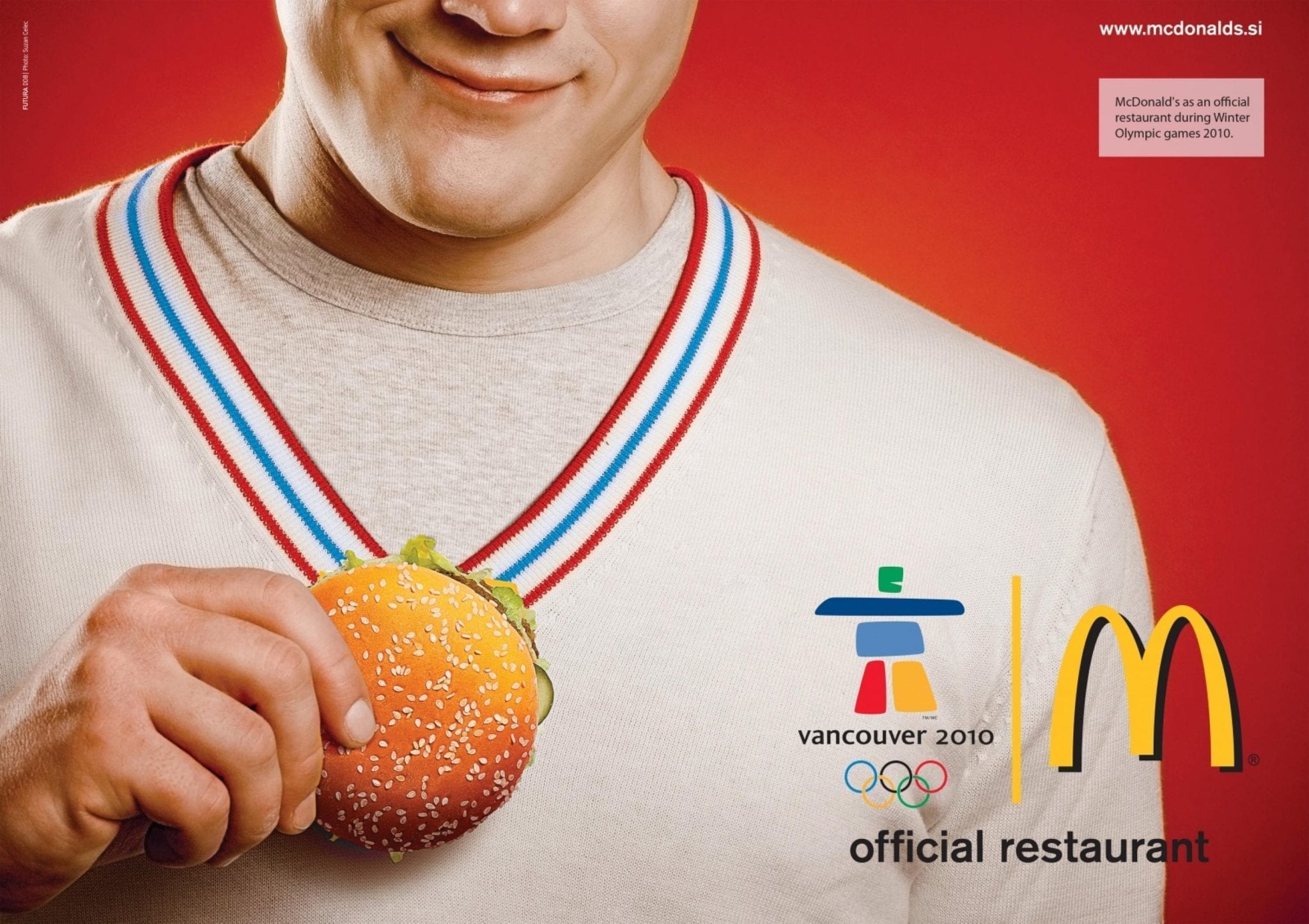
McDonald’s has ended its longtime Olympic sponsorship dating back to 1976, the International Olympic Committee announced today. The fast food giant has supported the Olympics since the Montreal Games and although the split takes place with immediate effect they will continue to be a sponsor at the 2018 Winter Games in Pyeongchang.
“The IOC and McDonald’s have announced that they have mutually agreed to bring their worldwide partnership to an end,” an IOC statement confirmed.
The burger chain, which is cutting its Olympic ties with three years of its contract still to run, was one of the IOC’s heavyweight “TOP” partners along with the likes of Coca Cola, Visa, Bridgestone, Panasonic, Toyota and Omega.
The IOC, giving the reasons behind the divorce, wrote: “In today’s rapidly evolving business landscape, we understand that McDonald’s is looking to focus on different business priorities.”
McDonald’s global chief marketing officer Silvia Lagnado commented: “As part of our global growth plan, we are reconsidering all aspects of our business and have made this decision in cooperation with the IOC to focus on different priorities.”
Whilst McDonald’s first became an official backer at Montreal in 1976 and a TOP partner in 1997, the company’s Olympic appetite was first whetted at the 1968 Grenoble Winter Games. McDonald’s on their website explained how they “airlifted” burgers to Olympic athletes who had become “so homesick for American food” in the French Alpine city.
Over the decades the fast food chain has contributed hundreds of millions of dollars into the IOC’s cash tills and had a popular presence at every Olympic village since. At last year’s Rio Games their promotion of free meals for athletes triggered lengthy queues from sunrise to sunset. One marketing guru suggested the split was logical given the emphasis on health-conscious diets.
Illogical and counterproductive
“The scale of obesity and diet-related disease around the world is alarming, and although we can’t put this at McDonald’s door they must be aware that sponsoring the Olympics has now become ‘illogical’ and even in many ways ‘counterproductive’,” British sports marketing expert Patrick Nally told AFP.
“McDonald’s have many other ways of promoting themselves but the logic of them sponsoring the Olympics does not now fit with the current attitude to fast food,” Nally added.
Looking ahead to their last association with the Olympic movement next year, the IOC said: “McDonald’s will continue to be a sponsor of the Olympic Winter Games Pyeongchang 2018 with domestic marketing rights in the Republic of Korea only.
“The company will deliver its Games-time operations, including restaurants in the Olympic Park and the Olympic Village.”
The IOC said it had “no immediate plans to appoint a direct replacement in the retail food operations sponsorship category”.
The IOC, with over 500 employees on its payroll, receives 70% of its revenue from broadcasting rights, which for 2013-2016 rose by 7.4% to $4.1 billion (3.67 billion) compared to 2009-2012, according to IOC figures.
The bulk of the revenue is paid out to international sports federations, national Olympic committees, and Games organisers.
McDonald’s deal would have run through the Tokyo Olympics in 2020, and bowing out will likely to save it hundreds of million of dollars if it had continued into the next four-year Olympics cycle and beyond.
McDonald’s has been trying to hold down costs as it invests in improving food quality, restaurant service and online ordering to woo back U.S. diners. Intense competition has gnawed away at sales.
“We are reconsidering all aspects of our business and have made this decision in cooperation with the IOC to focus on different priorities,” said McDonald’s Global Chief Marketing Officer Silvia Lagnado.
The company’s move may also reflect a rising view among consumer brands that exclusive Olympics sponsorship deals do not offer the marketing impact they once did. Some companies find it is much cheaper to work directly with athletes or specific countries than the IOC.
Moreover, in a trend that began after the Beijing games in 2008, shrinking television audiences for the games could be diminishing the value of sponsors’ ads. With the Rio de Janeiro games in 2016, many viewers turned to social media alternatives like Twitter and Facebook.
In the United States, Comcast Corp’s NBCUniversal said it had attracted 8.6 percent fewer eyeballs for Rio than it did for London in 2012.
The fast food chain has been part of the IOC’s top sponsors program that contributes more than $1 billion in each four-year cycle for the games.
While terms of Olympic sponsorship are not disclosed, a source who negotiated previous IOC sponsorship deals said that top global sponsors like McDonald’s spend about $25 million a year or about $100 million for a four-year period that includes a summer and winter games.
Reuters previously reported that the IOC had wanted to roughly double fees to $200 million per four year period starting in 2021.
While it is unusual for an Olympic sponsor to leave early, sponsors change regularly within the IOC’s top program. The most recent addition was China’s Alibaba Group Holding Ltd, which signed a deal in January for a partnership through 2028.
The next three Olympics take place in Asia, and this could turn off U.S. sponsors trying to reach a U.S. audience. The U.S. Olympic Committee also has lost recent sponsors such as AT&T and Citigroup ahead of the 2018 winter games in South Korea.
The IOC said it was not planning a direct replacement for McDonald’s, but it is expected to announce a new global deal with Intel next week, according a source familiar with the matter. Intel did not immediately respond to a request for comment.
“Companies with a deep focus on technology are barging in while others migrate out,” said Peter Land, who works with Olympics and Paralympics sponsors for communications firm Finsbury.
The IOC has faced criticism from public health campaigners for allowing sponsors such as Coca-Cola and McDonald’s to use the games to market their products, which are perceived to be unhealthy.
John Lewicki, who oversees global Olympic sponsorship deals for McDonald’s, said last year the company would reevaluate its Olympic relationship after changes to a rule that ended a marketing blackout for companies that sponsor athletes rather than the event itself.