Tag: Standard Chartered Bank

  • Standard Chartered and IBM back Byte Academy’s Singapore fintech school

    Standard Chartered and IBM back Byte Academy’s Singapore fintech school

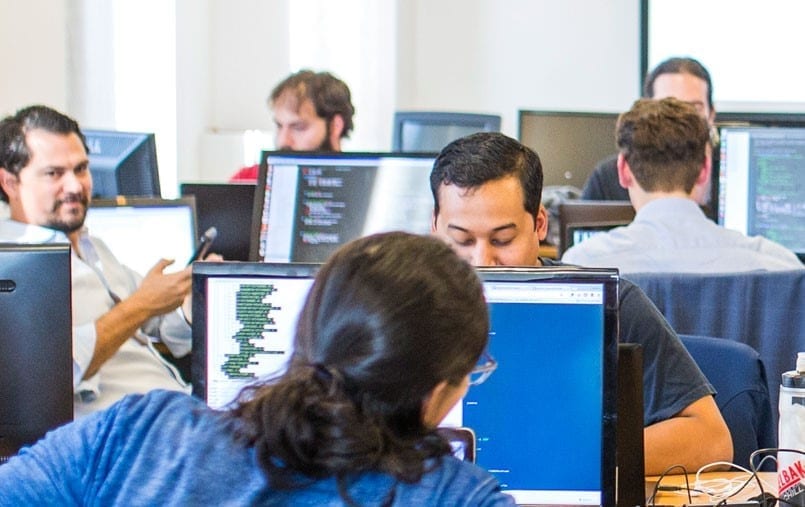
    Standard Chartered Bank, IBM, Insead, Thomson Reuters and Microsoft are backing a fintech school at New York-based Byte Academy’s first international venture, in Singapore.

    The firms have come together to form a fintech skills charter that will guide Byte Academy’s 12-week and eight-week courses for students focussing on fintech and software development.The 12-week full-time courses will provide the fundamentals for students to work on real, industry-specific problems and allow for interaction with industry partners to prepare for direct placement and job matching upon graduation. Students that graduate receive guaranteed job placements at the bank and tech partners.

    Shameek Kundu, global head, data, architecture and innovation, Standard Chartered, says: “The establishment of Byte Academy is another progressive initiative which will help to fuel Singapore’s Smart Nation ambitions by adding to the country’s great ecosystem of financial institutions, technology companies, universities and research organisations.”

    Nobuhiro Ito, director, developer experience and evangelism, Microsoft Singapore, adds: “Byte Academy’s presence here in Singapore will help accelerate skills development that will help contribute to a more vibrant FinTech ecosystem and build a stronger Singapore core.”

  • British bank names first Filipino CEO

    British bank names first Filipino CEO

    Standard Chartered Bank, a British financial services company and the oldest international bank in the Philippines, has announced the appointment of Lynette Ortiz, currently managing director and head of international corporates and financial institutions, as the new chief executive for the Philippine branch effective Oct. 1, 2016.

    Ortiz will replace Anirvan Ghosh Dastidar, who has been appointed as the new chief executive of Standard Chartered Brunei effective same date.

    New Standard Chartered Bank Philippines
    chief executive Lynette Ortiz

    Ortiz returned to Manila in June this year from her regional posting as head of capital markets for Asean based in Singapore. She has gained reputation as a highly regarded banker both locally and within the region having led a number of landmark transactions for Asean issuers, in both domestic and international markets, in recent years.

    Prior to assuming her regional role, Ortiz was financial markets and capital markets head for the Philippines. She has over 25 years of solid banking experience starting with Citibank in New York, and has held senior roles in risk management, treasury, corporate finance and capital markets in foreign and local institutions.

    Coming back to lead the Philippine branch is both pride and tall order for Ortiz. In May, Standard Chartered announced an agreement with EastWest Bank for the transfer of retail banking business which is expected to be completed within the year.

    Post the retail business transfer, Standard Chartered in the Philippines will be operating as a purely corporate and institutional bank. “Our corporate and institutional banking business in the Philippines has built a strong track record as a leader in providing client-centered value propositions that are innovative and transformative. Over the recent years, the business has seen sustained growth in securing mandates for capital markets, corporate finance and transaction banking segments,” Ortiz said.

    Standard Chartered takes pride in having Ortiz as the first female Filipino CEO for its Philippine branch. The bank said that under the leadership of someone with such caliber and solid background in corporate banking, financial and capital markets, it is confident of Ortiz as its new country head.

    “Her appointment demonstrates the bank’s recognition of a local talent that is truly global in quality and competency. Given Lynette’s extensive banking experience, knowledge of the markets and strong client relationships, she will play a key role in delivering growth momentum and further deepen our corporate and institutional banking business in the Philippines,” said Dastidar, the outgoing chief executive.

    Ortiz is expected to lead SCB Philippines’ efforts to build its clout in the developing and growing capital markets in Asean, in a bid to support the financing and investment requirements of its clients in the Philippines, including business players who are actively bidding for major infrastructure projects in the public-private partnership program.

    Standard Chartered has been present in the Philippines for over 144 years, and is the oldest international bank in the country. The bank views the Philippines as a strategic part of its Asean network, and it represents a key part of the bank’s unique international network.

    Standard Chartered has played a key role in helping fuel the Philippines’ trade, economy and markets, participating in the PPP projects, as one of the book-runners in the Republic’s sovereign bond issuances, developing and growing capital markets, acting as a sovereign ratings advisor and supporting corporate clients’ growth into international markets.

    “The work that we have done and continue to do both domestically and overseas with large corporates in the country and with the Republic itself is testament to the importance of the market to us, and of the differentiated value that we bring to it,” said Ortiz.
     

  • Samsung Pay e-wallet to launch in Singapore on June 16

    Samsung Pay e-wallet to launch in Singapore on June 16

    Samsung Pay, the Korean electronics giant’s e-wallet system, will launch in Singapore on June 16.

    At launch, those holding Visa and MasterCard credit or debit cards issued by POSB Bank, DBS Bank, OCBC Bank, Standard Chartered Bank and Citibank will be able to use a compatible Samsung phone to pay at almost all retail outlets that accept credit cards.

    Singapore will be only the fifth country to have Samsung Pay. It was launched in South Korea last August, followed by the United States in September. In March this year, Samsung Pay made its debut in China, while it was launched in Spain just earlier this month.

    “We are excited to bring this service to Singapore consumers and we hope to introduce value-added services to drive and lead innovation in mobile commerce,” said Mr Thomas Ko, vice-president and global general manager of Samsung Pay.

    Samsung Pay allows users to register their credit card details on selected Samsung smartphones with Near-Field Communication (NFC) wireless technology. Once registered, users can tap the phones for payment on almost all credit card payment terminals here.

    This is because Samsung Pay uses a proprietary Magnetic Secure Transmission (MST) technology that works with both traditional magnetic-stripe credit-card terminals and NFC contactless payment terminals.

    Unlike other contactless payment methods that are limited to transactions of $100 or less, Samsung Pay does not have this limit due to its MST technology.

    Four Samsung Galaxy smartphones – the S6 edge+, Note 5, S7 and S7 edge – are compatible with Samsung Pay at launch. Fingerprint authentication is required for each transaction.

    As of February this year, Samsung Pay has over five million registered users and recorded more than US$500 million (S$672 million) worth of transactions globally.

    Rival mobile payment service Apple Pay was launched in April with support for American Express-issued cards only. But as of last month, Apple Pay also accepts Visa and MasterCard credit and debit cards issued in Singapore from five major banks – POSB, DBS Bank, OCBC Bank, UOB Bank and Standard Chartered Bank.

    Apple Pay only works with contactless NFC payment terminals. This limits Apple Pay to only around 30,000 payment terminals in Singapore.

    It also has a $100 cap for most transactions. But UOB has lifted this limit for some merchants, such as Singapore Petroleum Company, Caltex, Metro and The Coffee Bean & Tea Leaf.

  • Moody’s continues to review for downgrade ratings of Standard Chartered Bank Korea

    Moody’s continues to review for downgrade ratings of Standard Chartered Bank Korea

    Moody’s expects to conclude the review in March 2016, after incorporating SCB’s efforts to turn around SCBK’s performance, as well as the detailed results of SCBK’s parent, Standard Chartered Bank’s (SCB, FC deposits Aa2 rating under review for downgrade, BCA a2 rating under review for downgrade) performance for 2015.

    These results will be available in late February.

    Moody’s had originally placed the long-term ratings of SCBK on review on 9 November 2015. Please refer to “Moody’s reviews for downgrade Standard Chartered Bank Korea’s ratings” published on 9 November 2015.

    Moody’s notes that SCB is restructuring its poorly performing Korean retail and commercial banking businesses, introducing some uncertainty as to the future of SCBK’s operations.

    The ratings review of SCBK will consider whether: (1) these initiatives have the potential to change SCBK’s stand-alone credit profile, as expressed by its BCA; and/or (2) to change the strategic importance of SCBK to SCB and therefore potentially to affect the strength of support from SCB.

    The following ratings are on review for downgrade:

    – Local- and foreign-currency long-term deposit ratings of A1

    – Foreign currency senior unsecured MTN rating of (P)A1

    – Local- and foreign-currency short-term deposit ratings of P-1

    – Foreign currency commercial paper and other short-term ratings of P-1/(P)P-1

    – Long-term and short-term counterparty risk assessment of A1(cr) and P-1(cr)

    – BCA of baa2, and adjusted BCA of a3

    The principal methodology used in these ratings/analysis was Banks published in January 2016. Please see the Ratings Methodologies page on www.moodys.com for a copy of this methodology.

    SCBK is headquartered in Seoul, with total assets of KRW61.7 trillion or USD54 billion as of June 2015.