Tag: statista

  • Okada Manila and Dior Lead Philippine Customer Service Rankings

    Okada Manila and Dior Lead Philippine Customer Service Rankings

    Okada Manila topped a Philippine customer service study across 78 categories with a score of 96.87, leading a field led by luxury hospitality and global retail brands.

    Grand Hyatt Manila followed in second place at 95.57, while French fashion house Dior ranked third overall at 95.12. The benchmark, compiled by data portal Statista and the Philippine Daily Inquirer, evaluated both physical and digital operations using more than 90,000 customer reviews collected between February and April 2025.

    How the scores were calculated

    Researchers weighted the final scores equally between a respondent’s likelihood to recommend a brand and five direct performance metrics. Those five criteria, each carrying a 10 percent weighting, covered accessibility, customer focus, quality of communication, professional competence and range of services.

    Participants evaluated companies they had transacted with, visited or researched over the previous three years. The survey spanned five broad sectors: brick-and-mortar stores, online retailers, digital services, hospitality and general consumer services.

    Top performers across retail and hospitality

    Homegrown luxury furniture maker Philux placed fourth with a score of 94.88 in the home goods retail division. Shangri-La Hotels took fifth at 94.81, followed by serviced apartment operator Ascott at 94.41.

    Consumer technology and fast-moving retail also secured spots in the upper tier. LG Electronics Philippines led online home goods with 94.33, while bakery chain Red Ribbon scored 93.5 in the restaurant and leisure bracket. Japanese apparel giant Uniqlo took the final two spots in the top ten, scoring 93.38 for its physical stores and 93.30 for its Philippine e-commerce operation.

    The strong showing of physical flagships alongside digital channels mirrors a broader shift across Southeast Asian retail, where omnichannel consistency dictates customer loyalty. Premium hospitality operators and luxury apparel labels continue to command the highest marks because their operating models justify higher floor staffing and dedicated post-purchase support.

    Statista and local partners plan to track category shifts through the next evaluation cycle, where rising store automation and digital checkouts face direct consumer assessment.
  • Courts online offer doubles

    Courts online offer doubles

    The range of goods sold by Courts online has doubled as part of a revamp of its e-commerce business.

    The Singapore-based listed retail company also operates in Malaysia and Indonesia.

    Specialising in furniture and consumer electronics, Courts originally launched in 2012 with 7000 products. Now, through a partnership with e-commerce agency SmartOSC, the site now offers 14,000 products.

    Research firm Statista estimates Singapore’s e-commerce market will reach US$6.42 billion by 2020. Courts has seen growth throughout Southeast Asia, most notably in Indonesia and Malaysia.

    In April last year the business revamped its traditional stores to engage with customers more effectively, and opened two offline “test beds”, in Causeway Point and Sri Damansara in Malaysia. As a result, the brand is moving toward an integrated shopping experience involving both in-store and online.

    Court’s Group CIO Stan Kim says the strategy is really about creating an omni-channel experience for customers.
    He says Courts is looking to establish a new industry standard for a mobile-first and user-centric experience. The brand plans to also enhance its click-and-collect offering, which now contributes about  half of its online sales.

  • What Are The Key Drivers Of Growth For Estee Lauder?

    What Are The Key Drivers Of Growth For Estee Lauder?

    Focus on the online sales channel, digital initiatives, and revival of its travel retail channel, will be the key drivers for Estee Lauder‘s (NYSE:EL)  growth in the future.  While travel retail showed tremendous growth in 2014, the slowdown in China and natural calamities had a negative impact in 2015.  Estee Lauder feels this setback is temporary and we believe new product launches and initiatives in this segment will boost its revival, and will be a key driver of growth for the company. With booming e-commerce and mobile internet penetration, we believe focus on online sales will be another driver of growth for the company, especially in emerging economies such as China.

    Revival Of The Travel Retail Channel

    In the fiscal year 2014, Travel Retail was one of the highest growth channels for Estee Lauder contributing to 13% of its product distribution. Global Airport retailing information reveals that by 2016, airport retail spending will be $23.2 billion for Asia Pacific, whereas for the Americas and Europe the figures will be $10.1 billion and $12.4 billion. Estee Lauder is leveraging this trend primarily to capture the Asian market. In May 2014, the company launched a flagship boutique at the Detroit Metro Airport, a primary gateway to Asia, via Delta Airlines. This boutique offers a collection of all its luxury brands, High-Touch services, along with other facilities such as a first-class lounge area, free Wi-Fi, and updated information on the flights. Growth in the travel retail channel slowed down in Q4 2015 due to the macroeconomic slowdown in China and spread of MERS virus in Korea, but the company believes this setback is temporary. It is continuing to emphasize  skincare, its most profitable product category, to boost travel retail sales. Estee Lauder recently launched a vast array of products under several brands including Clinique, Bobbi Brown, Jo Malone, Tom Ford, and M.A.C., at the Tax-Free World Association (TFWA) Exhibition, held at Cannes in October. The products include face contouring, eye makeup, lipstick, serums, treatment creams, and fragrances. These new products will be available across Estee Lauder’s travel retail channel. [].We believe revival of the travel retail channel will be a key driver of Estee Lauder’s revenues in the future.

    Focus on Online Channels And Digital Initiatives

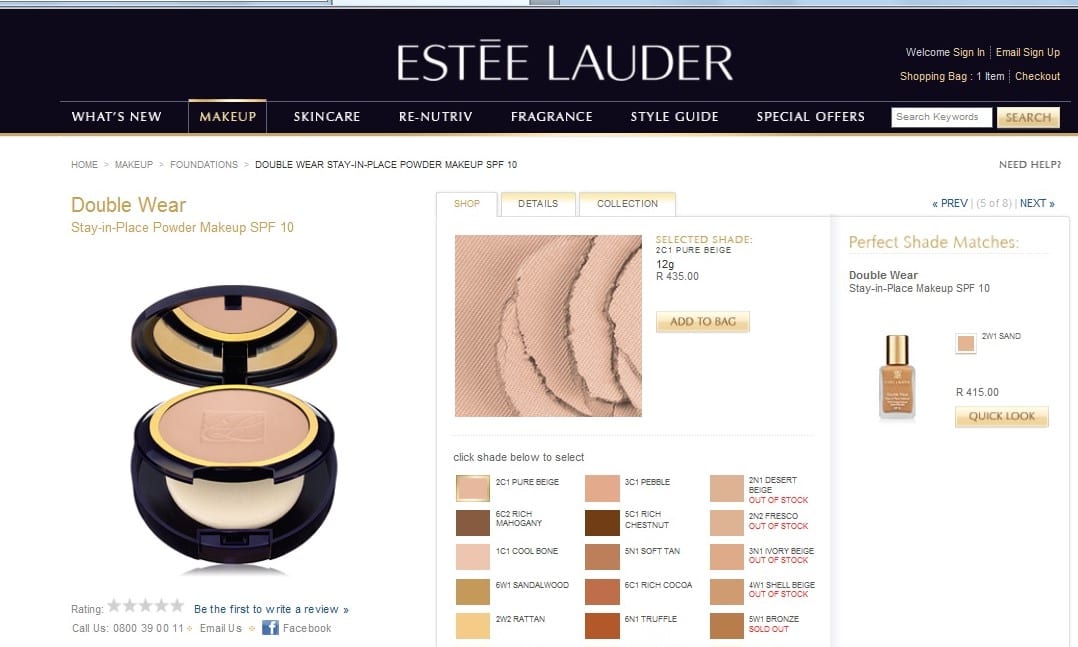
    The shift towards online shopping is evident from the tremendous growth in e-commerce.  New York based research agency, L2 ThinkTank.com found that while the global beauty industry grew at 6% in 2013, sales through the e-commerce channel witnessed a 29.1% growth during the same period. To leverage this trend, Estee Lauder is selling 14 of its brands directly to consumers online through approximately 120 of its own e-commerce and mobile commerce sites.  The company also launched  “Forecast,” a mobile application under its Clinique brand, which provides weather information and skin care tips based on weather conditions.  To expand in the Chinese market, Clinique opened its  flagship store on Alibaba’s Tmall. According to the National Bureau of Statistics cited in Statista, the online transaction value of cosmetics retailing in China is forecast to grow by 123% in 2015. Given the market potential, we believe Estee Lauder’s focus on online sales and digital initiatives, around the use of social media and mobile apps for promotion, will be key drivers of its revenue in the future.