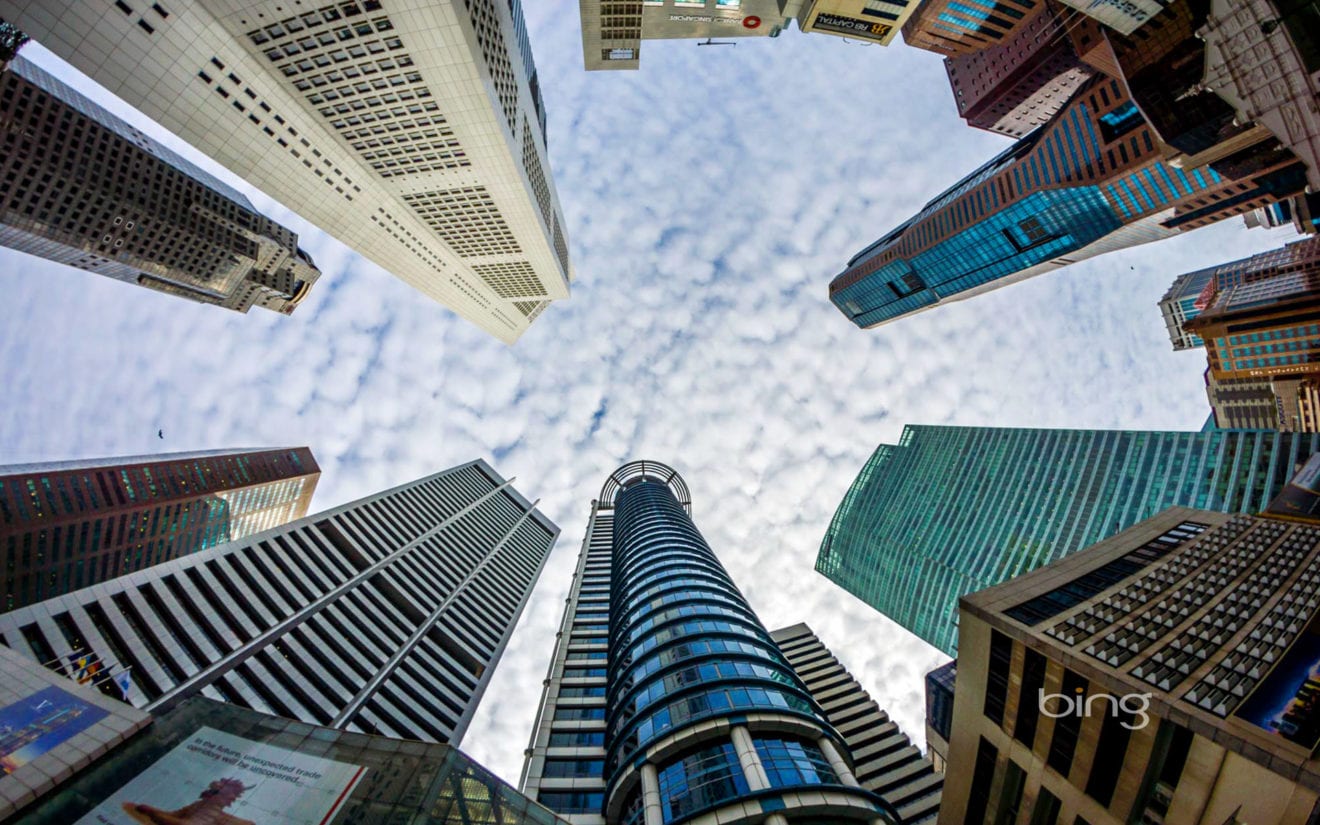
Tag: Tanjong Pagar Centre

  • Guocoland secures temporary occupation permit for Guoco Tower

    Guocoland secures temporary occupation permit for Guoco Tower

    The property has already seen 80% commitment from tenants.

    Prospective tenants of Guoco Tower should be ready to move in anytime as Guocoland secures temporary occupation permit for the office and basement retail component of the building.

    In a statement, GuocoLand claimed the Grade A office tower has already seen a remarkable 80% commitment moving into October despite a highly competitive office leasing market. This has significantly spiked up from 10% at the beginning of the year.

    Guocoland Singapore Managing Director Cheng Hsing Yao said the 890,000 sq ft office tower has attracted demands from a broad range of industries. Some of the companies in the list of committed tenants include Agoda, Amadeus, ASICS, Danone, Straits Trading and Teva Pharmaceutical Industries.

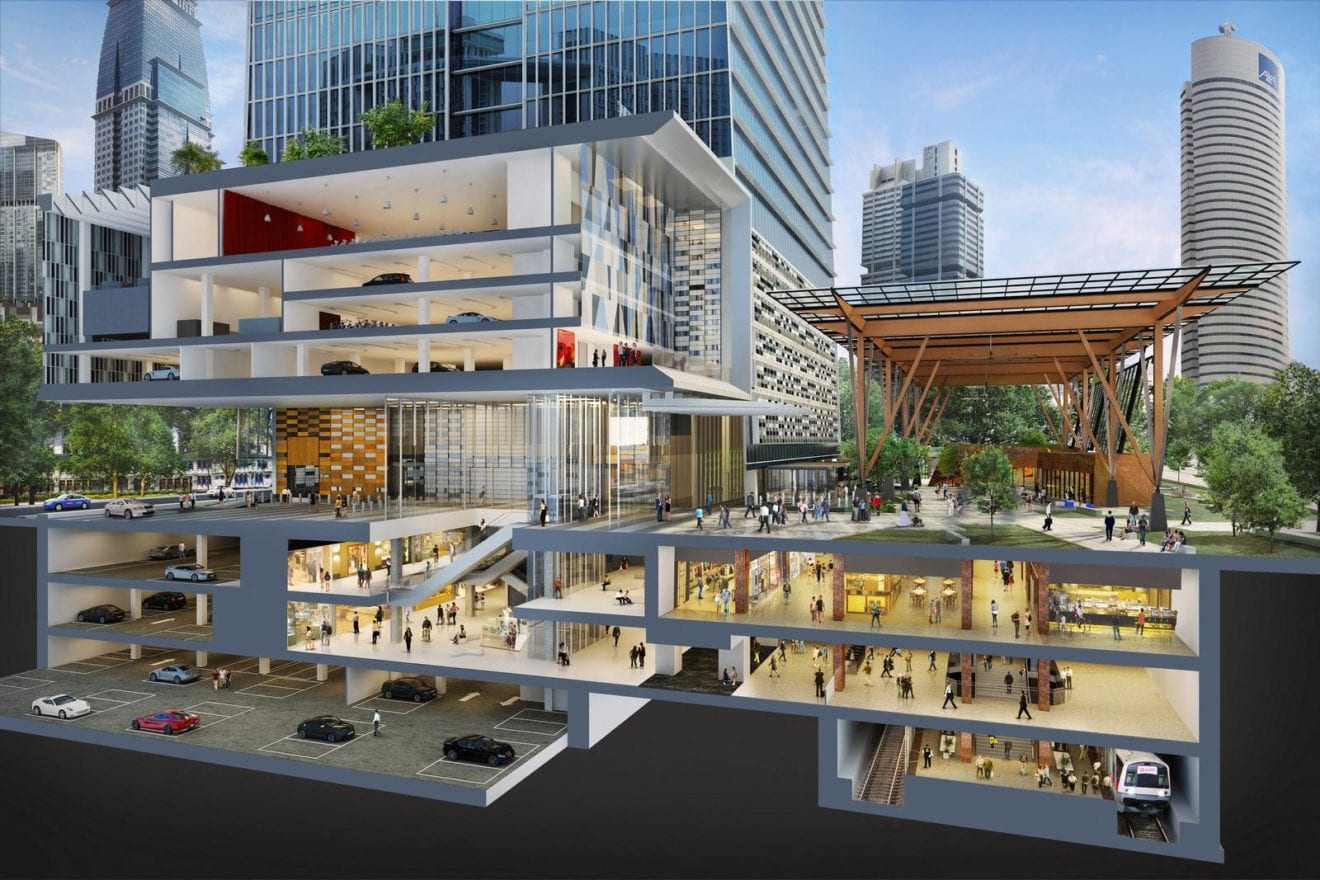
    “Guoco Tower’s ‘liveable vertical city’ concept whereby workplace is integrated with lifestyle amenities makes it attractive to tenants who care for the welfare of their staff. In addition, the prime location, seamless access to the MRT station and its prestige as the tallest building in Singapore also appealed to tenants,” he said.

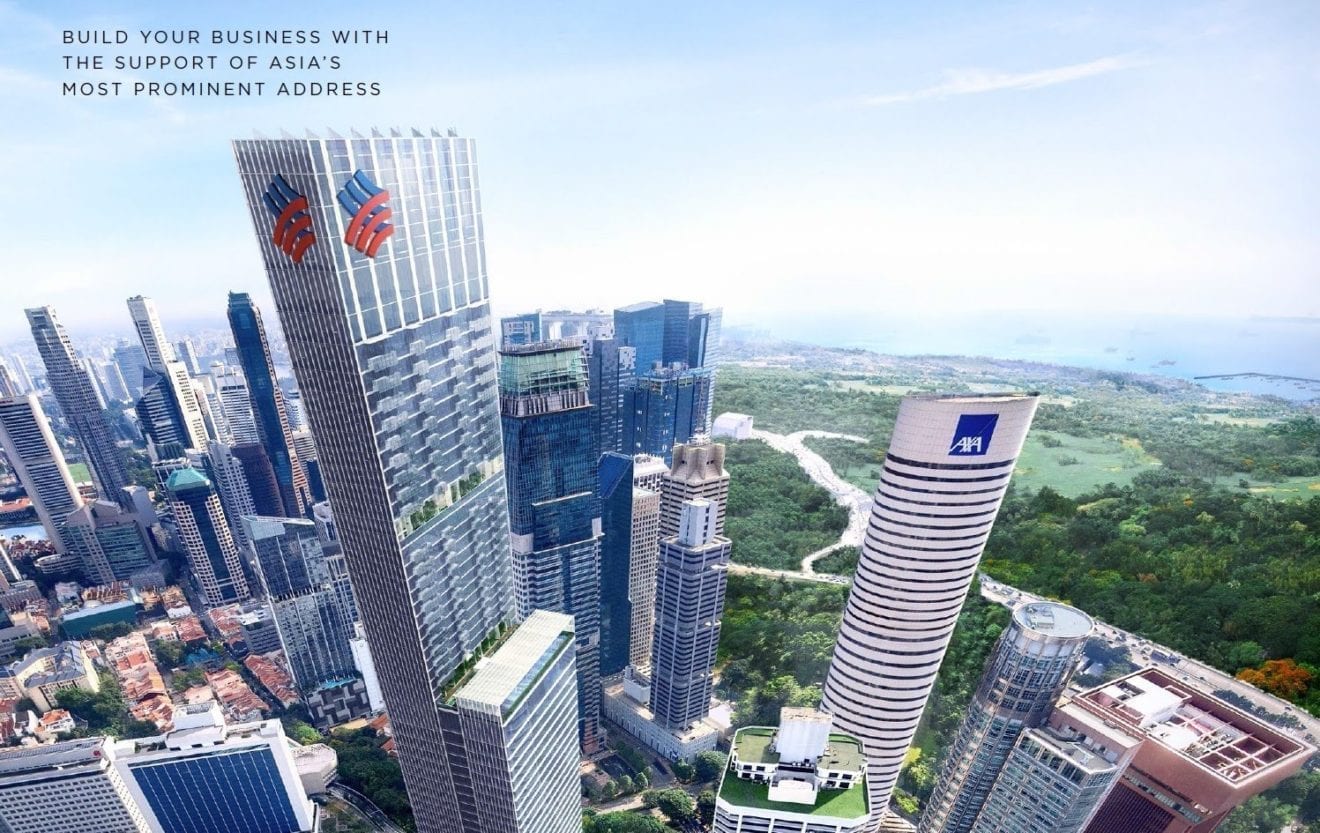
    Guoco Tower is inside the Tanjong Pagar Centre, an integrated commercial, retail, and lifestyle complex with 181 luxury apartments in Wallich Residence, the 222 room Sofitel Singapore City Centre hotel, and a 150,000 sq ft. Urban Park.

    The complex will commence its operations in phases from November this year.

  • Tanjong Pagar Centre — GuocoLand’s crowning glory

    Tanjong Pagar Centre — GuocoLand’s crowning glory

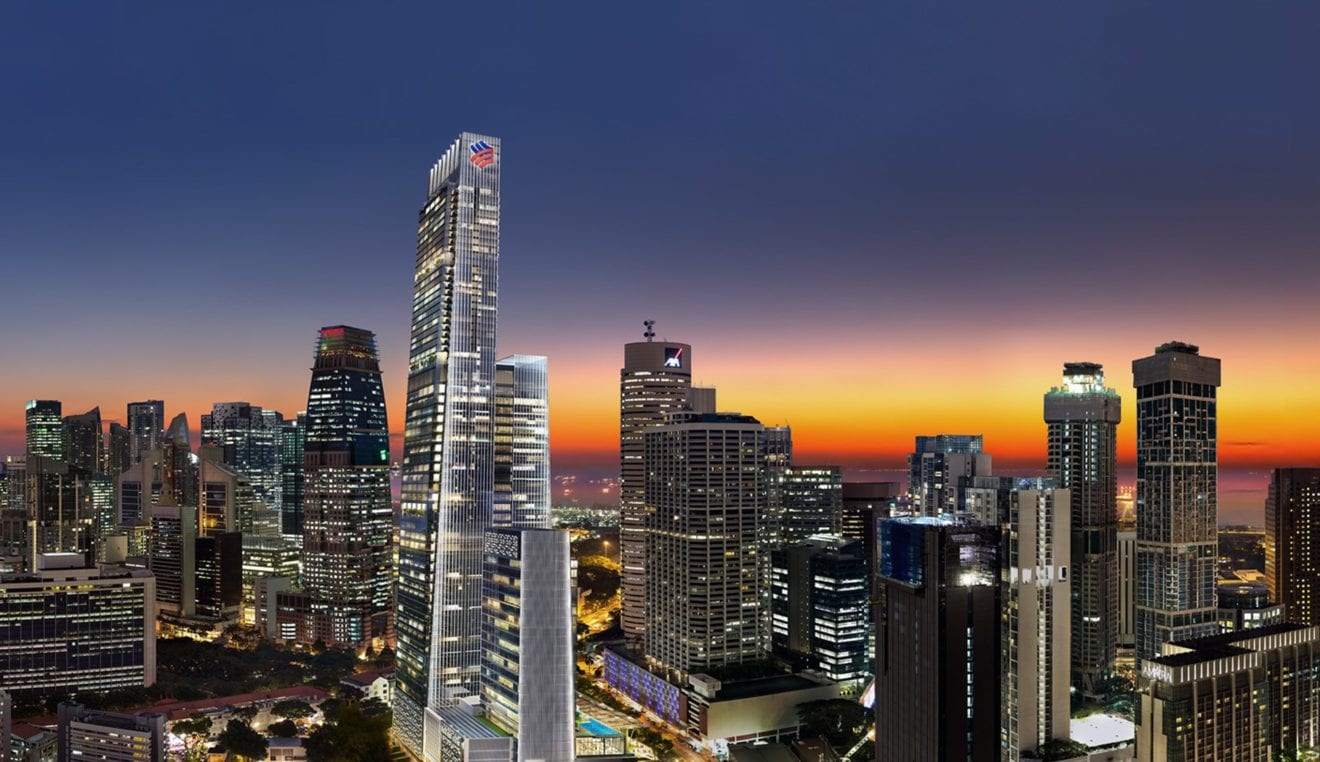
    GuocoLand held the topping-out ceremony of its $3.2 billion Tanjong Pagar Centre on Jan 13. Standing at 290m, it is Singapore’s tallest tower and the latest landmark at Tanjong Pagar.

    The mixed-use scheme will have a total of 1.7 million sq ft when completed and will be integrated with the Tanjong Pagar MRT interchange station. The development will have 890,000 sq ft of office space (Guoco Tower); 100,000 sq ft of retail space; 181 luxury apartments — Wallich Resi dence; the 222-room Sofitel Singapore City Centre; and a 150,000 sq ft landscaped urban park.

    Malaysia’s Employees Provident Fund took a 20% stake in Tanjong Pagar Centre five years ago. Shahril Ridza Ridzuan, CEO of EPF, attended the ceremony, along with Singapore’s Minister for National Development Lawrence Wong.

    The giant mixed-use scheme will be completed in phases. The office and retail components are expected to be completed in 2H2016, followed by the hotel, which is scheduled to open towards year-end. The residential block will be the last phase to be completed.

    Slow take-up of office space
    According to GuocoLand, tenants that have signed up for office space at Tanjong Pagar Centre include DNB Asia (subsidiary of Norway’s largest financial services group DNB Bank ASA), Hong Leong Bank, GuocoLand Group, trading and risk management solutions provider Open Link and serviced office provider Regus, resulting in a take-up rate of 10%.

    “The days of a mega tenant taking up 50% to 70% in a building are gone,” says Cheng Hsing Yao, managing director of GuocoLand (Singapore). In the current economic climate, office landlords prefer to have a diversified tenant base. The office space at Guoco Tower is seeing interest from occupiers looking at half a floor to two whole floors. Such tenants are more likely to commit closer to completion, he adds. Guoco Tower’s premium office floor plates measure 27,000 to 30,000 sq ft.

    “A 10% office space pre-commitment six months before TOP is quite normal,” says Chris Fossick, JLL’s managing director for Singapore and Southeast Asia. Serious discussions are underway for another 40% of the space.

    By contrast, the retail space at Tanjong Pagar Centre has achieved a 60% pre-commitment level. Fitness club Virgin Active is the anchor tenant and will take up 31,000 sq ft (31%) of the retail space.

    Rebranding of hotel, residences

    The hotel and residences at Tanjong Pagar Centre were previously branded Clermont, an extension of The Clermont Club, a members-only casino in Mayfair, London. The club is owned and operated by Clermont Leisure (UK) Ltd, a wholly-owned subsidiary of GuocoLeisure, a sister company of GuocoLand.

    The rebranding of the hotel to Sofitel and the residences to Wallich Residence took place last November. “Both companies [GuocoLand and Guoco- Leisure] felt that it may be too early to bring the Clermont brand to Asia,” explains Cheng. “We wanted a strong hotel group with a strong international network.” That led to its appointment of AccorGroup as the hotel management company and the re-branding of the hotel to Sofitel a week ago.

    The residential component was renamed Wallich Residence, as it sits on Wallich Street. This is in line with GuocoLand’s approach to turn its luxury residences into place makers — for instance Goodwood Residence on Bukit Timah Road, which overlooks Goodwood Hill, and Leedon Residence on Leedon Heights.

    So far, 16 of 54 units released at Wallich Residence have been sold at an average of $3,100 psf. The units are a mix of one- to four-bedroom apartments measuring 614 to 2,034 sq ft. The residential block takes up the 39th to 64th floors, and is crowned by a triplex super penthouse of 21,108 sq ft. GuocoLand’s Cheng says the price of the super penthouse has yet to be finalised. Two years ago, it was tagged at $30 million.

    GuocoLand will launch the residences closer to completion so that potential buyers can appreciate the quality of the final product, says Cheng. “We saw that happen with Goodwood Residence and Leedon Residence.” Both Goodwood Residence and Leedon Residence were launched when they were completed and they emerged the best-selling high-end condos in 2014 and 2015 respectively. Cheng is confident that Wallich Residence will draw a similar response upon completion.

  • Tanjong Pagar Centre: New tallest building in Singapore after 20 years

    Tanjong Pagar Centre: New tallest building in Singapore after 20 years

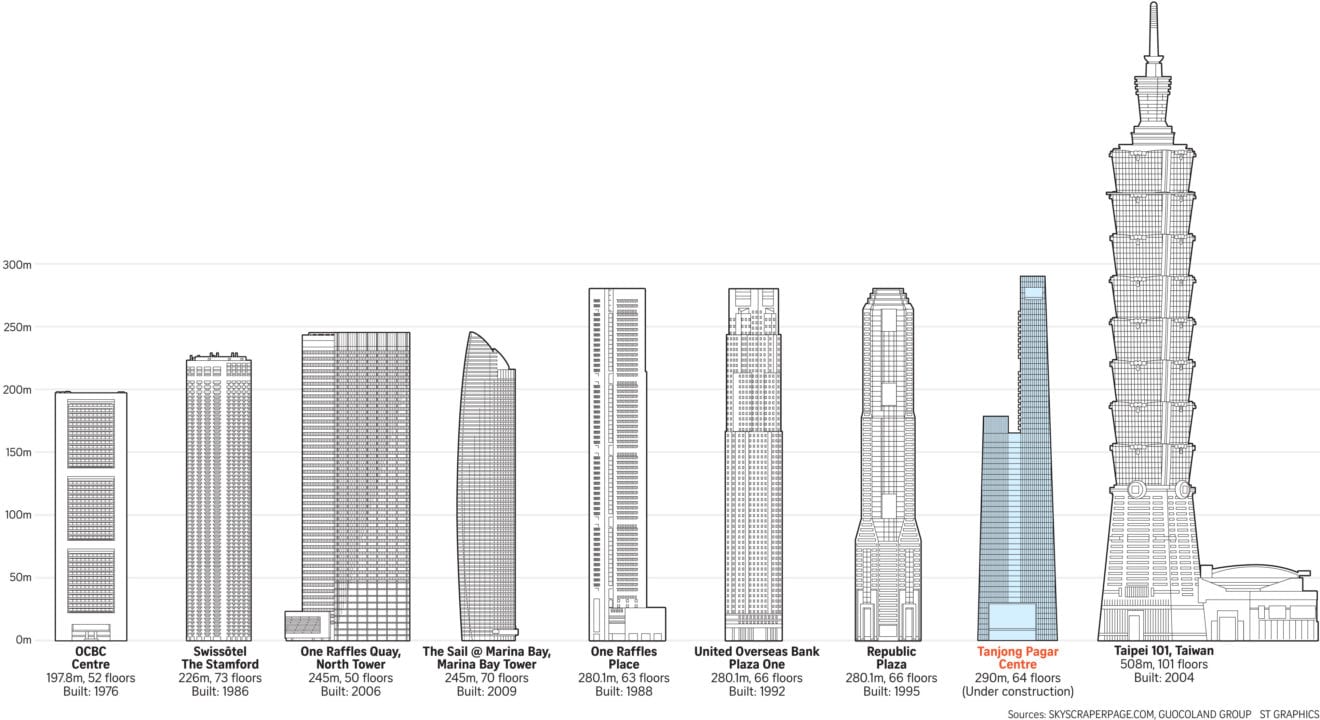
    It’s a record that has held for more than 20 years but by the middle of the year, Tanjong Pagar Centre will claim the title of the tallest building in Singapore – even if it is by just 10m.

    At 290m, Tanjong Pagar Centre will tower over the central business district, displacing UOB Plaza One, One Raffles Place and Republic Plaza, which had jointly held the title.

    The three buildings are about 280m tall – One Raffles Place was completed in 1988, UOB Plaza One in 1992 and Republic Plaza in 1995.

    But the buildings here pale in comparison to some of their overseas counterparts. The tallest building in the world is the 829.8m Burj Khalifa in Dubai; nearer home in Taiwan, Taipei 101 reaches 508m, almost double the height of Tanjong Pagar Centre.

    Last week, Tanjong Pagar Centre’s developer GuocoLand held a topping out ceremony, with National Development Minister Lawrence Wong as guest of honour.


    Sources: SKYSCRAPERPAGE.COM, GUOCOLAND GROUP ST GRAPHICS

    The 64-storey development, which cost $3.2 billion, comprises Guoco Tower, or 890,000 sq ft of Grade A office space; 100,000 sq ft of retail and food and beverage space; a 100,000 sq ft urban park; a 181-unit luxury residential component Wallich Residence; and the 222-room Sofitel Singapore City Centre hotel.

    The take-up rate at Guoco Tower is about 10 per cent. Tenants who have signed on include DNB Asia, Hong Leong Bank, Open Link and Regus. The company is in advanced discussions with tenants who could potentially form another 40 per cent of demand.

    While the office leasing market is not as exuberant as several years ago, there is still activity – from companies looking to upgrade, contract or expand, GuocoLand Singapore managing director Cheng Hsing Yao told reporters yesterday.

    Many interested parties are looking for half a floor, or a floor or two, and they tend to sign on closer to when the building is completed and they can see the product, he said.

    The retail component is 60 per cent committed, with gym operator Virgin Active as the anchor tenant.

    As for Wallich Residence – which was recently renamed from Clermont Residence, to honour its street address – 16 units have been sold since its soft launch at an average price of about $3,200 per sq ft.

    But while the building is the tallest in Singapore, Mr Cheng said it was not given a lofty name because GuocoLand wanted the building to reflect its surroundings.

    “It goes back to why we were interested in this piece of land… It is geographically in the heart of the district, which has offices, residences and hotels, and heritage shophouses… The name will grow and we are confident that we will create a transformation in Tanjong Pagar,” he said.

    And now that the building is close to completion, Mr Cheng said he had seen the view from the top and “it was really amazing”.

  • Bright spots on the retail property horizon

    Bright spots on the retail property horizon

    Singapore’s retail market has been experiencing a drop in sales values. Tourism arrivals and the ongoing labour shortage against the backdrop of an additional reduction in the foreign dependency ratio effective July 2013 are considered some of the key drivers behind this, along with weaker economic sentiment.

    However, the outlook is not all doom and gloom.

    One bright spot is mixed-use developments within the Central Business District that are proving to be very popular among retailers. Offering offices, residences, hotels and retail podiums within landmark new developments in prime CBD locations such as South Beach, Tanjong Pagar Centre and Downtown Gallery (part of a mixed-use property) has been extremely popular with retailers, given the enormous current catchment and the forecast catchment growth in line with the “Live, Work, Play” guidelines.

    Changing consumer attitudes and preferences are other positive aspects of the retail scene and one that is very popular is the healthy lifestyle theme. Taking the CBD as an example, we have seen a huge influx of gym operators – from large-format mega gyms to more bespoke fitness boutiques. This is being followed by growth in the sports apparel market and healthy food options as people take note of their lifestyle choices.

    BACK TO BASICS

    For the retail market to bounce back we need to not only look forward, but also look back at the underlying principles of retailing. While the global retail environment is moving at a frantic pace, the adage of “location, location, location” is still salient today. The key in all retail markets is ensuring that the retail offer is suitable for the catchment profile of its location: Are the customers looking for ease- of-convenience retail or the experience of a retail destination and does the tenant mix reflect this?

    Given the number of retail malls in Singapore and the difficulties highlighted, retail locations that do not meet these parameters or are secondary in doing so are likely to face further difficulties with increased voids (empty shops) and downward pressure on rentals given the large amount of retail space available and economic headwinds.

    During difficult retail cycles, new trends often arise as landlords seek to address occupancy levels and adapt their retail offerings. Over the past few years, we have seen an increase in pop-up stores, where retailers are able to occupy space on short-term agreements. These pop-ups allow existing retailers to experiment and new retailers to test products without the financial commitment that a standard lease requires. Trends like this are beneficial to the marketplace as they create differentiation and attract consumers to retail locations. Voids breed voids so temporary stores are an important option for landlords, and this is something that JLL envisages growing as traditional lease occupancy rates fall in certain locations.

    TENANT MIX IS KEY

    Ultimately, a key aspect in creating successful retail locations is a strong, differentiated and relevant tenant mix. Singapore has seen numerous new-to-market brands and this trend looks set to continue, with JLL working with many such operators.

    Alongside sourcing the correct real estate, one key factor for any new-to- market brand is the rent and lease terms. JLL is seeing a correction in rents in response to market conditions but in some cases lease terms remain prohibitively rigid.

    Creating flagship stores requires high capital expenditure, which must be depreciated and as such longer lease terms are required; redevelopment, relocation and performance clauses make this depreciation difficult in some cases and impossible in others. While this is not reflective of the entire marketplace, increased flexibility in lease terms is equally important for short-term temporary leases as it is to attract the world’s leading retailers – which is key for a vibrant and differentiated retail market.

    With the exception of true convenience locations, malls can no longer just be places to purchase goods. A successful retail tenant mix must also allow social interaction and enrichment to encourage repeat visits, increased dwell time and subsequent increased retail spending.

    Flexibility to attract leading international retailers, temporary stores, new start-ups and more social interaction often comes at the expense of immediate rental values. For such exercises, a long-term view is required as the upfront cost of repositioning/amending the tenant mix must be balanced against sustaining a long-term income and the overall increased appeal of retail locations.

    Tourism arrivals and economic conditions are undoubtedly affecting retailers’ sales but from a real estate perspective, retailers and their business models are also adapting to changing consumer behaviour and market sentiment.

    One outcome of ever-changing technology is that many retailers are reducing their footprint as a result of e-commerce. Historically, increasing the number of stores was one of the key weapons of a retailer in raising market share by presenting its brand to consumers in numerous locations. A strong online presence now allows retailers to ensure that their brand is never out of consumers’ minds and consumers can research, browse and purchase on the go, which ultimately means certain retailers require fewer stores than before.

    Physical stores do continue, however, to play a very important role in brand building, service, loyalty and, of course, point of sale, but their nature is adapting. JLL is seeing an increase in “brand pavilions/flagship stores” that are used by retailers to showcase the very best of the brand and are located in the prime retail locations. These stores are used alongside an online presence to build brand positioning and awareness and they allow customers to feel and try products. In many cases, the newest technology – think virtual fitting, 3D printing, etc – is utilised to maximise consumer experiences. As a result, JLL foresees demand for prime retail space growing to meet these requirements, although this is complicated by the small size of the Singapore prime market.

    To summarise, the Singapore market has been experiencing difficult times with a drop in sales volumes and the impact upon real estate is being exaggerated by the frenetic pace of change in retail itself. The most successful landlords and retailers will be those able to embrace these changes and JLL expects to see some exciting changes in the future. We do, however, foresee further downward pressure on rentals and an increase in vacancy levels in certain locations as retailers downsize their store numbers.