Tag: thailand post

  • Thailand Post to launch e-commerce service offering local products

    Thailand Post to launch e-commerce service offering local products

    Thailand Post is to add e-commerce to its logistics services, offering locally made products from across the country.

    From the fourth quarter, the enterprise will pilot exports of community-made products to Japan by collaborating with Japanese online marketplaces. The move aims to capitalise on cross-border e-commerce to compete with Chinese internet giants dumping their products in Thailand.

    “The company spent 10 million baht to launch Thailandpostmart.com, helping local communities sell their products in a marketplace with special delivery costs,” says Thailand Post president Samorn Terdtampiboon. The website, co-developed with BEC Tero, gathers local products nationwide into a “digital community”, aiming to be the largest distribution channel for agricultural products, crafts, food and One Tambon One Product items.

    The site’s eight categories are halal products, health and beauty, mail products, best cuisine in Thailand, best provincial products, locally made products, home and garden, and automotive.

    In the next phase, the site will integrate with at least 5000 points of sale in communities by year-end through collaboration with the Ministries of Commerce, Industry, Interior, Energy and Agriculture, as well as the Bank for Agriculture and Agricultural Co-operatives, to bring more local products to the e-marketplace.

    After the official launch, there will be an estimated 12,000 stock-keeping units of locally made products by April next, with THB200 million (US$6.2 million) in sales revenue through the website.

    Products can be delivered to buyers within two days after order and payment, and mobile apps for both Android and iOS will be available soon.

    By the fourth quarter, Thailand Post will pilot cross-border products to Japan’s largest e-marketplace for items like crafts, jewellery and locally made goods.

    Thailand Post will next month launch an e-wallet developed with partner 2C2P.

  • Thailand signs up for eCommerce initiatives

    High-level witnesses attended the signing of a letter of intent in China that will see Thailand co-operate with Alibaba on eCommerce initiatives.

    Thailand’s deputy prime minister Somkid Jatusripitak was invited by the eCommerce giant to its headquarters in Hangzhou to witness the signing alongside Alibaba Group executive chairman Jack Ma.

    Initiatives covered by the agreement include training for SMEs and individuals, and exploring ways to enhance logistics capabilities to support digital economy strategies as well as the government’s new Thailand 4.0 economic model, aimed at steering the country toward a value-based economy.

    Other senior Thai government officials also attended the signing along with private-sector representatives. Thailand’s permanent secretary Wiboonlasana Ruamraksathe and Alibaba Group president Michael Evans signed the documents.

    “This visit to Alibaba represents a continuation of the bilateral talks between the prime minister and Jack Ma,” says Somkid Jatusripitak. “To strengthen the competitiveness of Thailand’s SMEs and help them succeed in an increasingly digital era, the prime minister earlier assigned responsibilities to a task force made up of government agencies and private enterprises to work with Alibaba in a joint effort to lift the export capabilities of Thai businesses, starting from the grassroots and community level and extending to mid-tier businesses.”

    “We are very honoured to have this opportunity to work with the Thai government,” Ma said at the signing ceremony, “and I would like to thank the Thai people for their trust, because trust is the basis of any successful partnership.”

    Long-term vision

    He said that since Alibaba was founded 17 years ago, its vision had always been about empowering small businesses and young people, particularly those in developing nations.

    “We want to partner with governments and organisations that share this vision and commitment. By working together and applying technology and innovative ideas, I believe we can make that vision a reality, and magic will happen.”

    Four key areas are covered by the Thailand agreement, the first involving eCommerce training for 30,000 Thai SMEs to help them access both domestic and international platforms. Alibaba and its majority-owned eCommerce platform in Southeast Asia, Lazada Group, will help provide the training.

    The group will also share its experience and expertise with the Thai government to help build the nation’s own national eCommerce platform.

    Secondly, Thailand and Alibaba will collaborate on creating a nationwide program to train around 10,000 individuals so they can be proficient in digital technology. The two sides will also work on nurturing software developers, who will be given access to the China market via Alibaba Cloud’s marketplace for the software apps they create.

    Training for officials

    Furthermore, senior government officials will receive training at the Thailand Digital Government Academy, initially on big data and AI technologies. Alibaba and Lazada will jointly run a train-the-trainer program to groom eCommerce business co-ordinators who will in turn help SMEs establish their own online export capabilities.

    Thirdly, Alibaba and Lazada will contribute to the development of the Thailand’s supply-chain and logistics systems by sharing their experience and expertise with Thailand Post in a bid to expand domestic delivery services to all provinces. Thailand Post will also study Alibaba’s inventory-management systems and international eCommerce fulfillment services to gain insight into the establishment of bonded warehouses and fulfillment centres.

    Finally, Alibaba and the Thai government will explore co-operation opportunities under the Eastern Economic Corridor Development (EECD) project with the aim of helping establish Thailand as a hub of digital technology and regional data centres in Southeast Asia.

    Various Thai agencies lead the taskforce in charge of building upon the bilateral talks, including the Ministry of Commerce, Ministry of Digital Economy and Society, Ministry of Science and Technology, the Office of Small and Medium Enterprises Promotion, the Small and Medium Enterprise Development Bank of Thailand, the Export-Import Bank of Thailand, the Electronic Government Agency (a public organisation), and Thailand Post.

  • Thailand Post plans B500m upgrade

    Thailand Post plans B500m upgrade

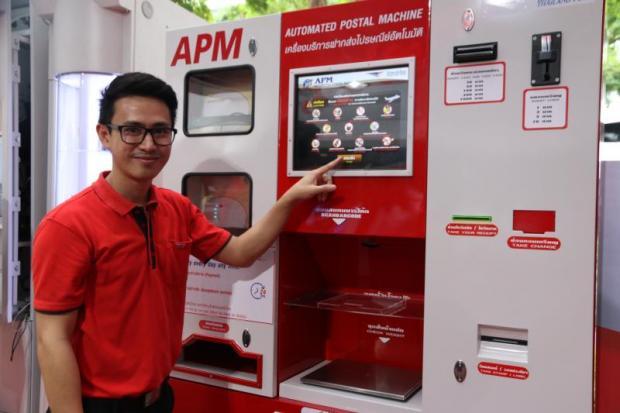
    A Thailand Post staff member shows an Automated Postal Machine — one of several new products and services the agency is offering to enhance e-commerce and to pamper new generation users.

    Thailand Post is spending 500 million baht on upgrading its core information technology (IT) automation systems and distribution centres to boost service innovation for the next-generation of online merchants and digital lifestyle consumers.

    The move is intended to fight back against the influx of no-frills messenger service apps like Lalamove, a Hong Kong-based delivery-matching mobile application, and parcel delivery service providers looking to capitalise on Thailand’s burgeoning e-commerce market.

    Of the total 500 million baht in spending, 300 million will go towards upgrading IT automation systems. The remaining 200 million baht will go to improving flexibility within and across its distribution centres.

    “We’re also in the process of transforming ourselves to become more digital in a drive to improve services and maintain our leadership in the home delivery service market,” said Samorn Terdthampiboon, president of Thailand Post.

    Thailand Post plans to roll out a slew of innovative services over the next seven months.

    For instance, she said PromptPost, a pre-registration mobile app service for high volume parcel delivery, will allow users to reduce the parcel processing time from eight seconds when they employ the service at a post office to two seconds when using Thailand Post’s semi-automated processing counters.

    Mrs Samorn said Thailand Post will soon provide an e-money service called THP Card, which allows people to use a card to pay for all Thailand Post services at its post offices across the country.

    Customers can also top up their cards at Thailand Post locations nationwide.

    She added Thailand Post plans to apply for an operating licence with the Bank of Thailand to provide an e-wallet service in the near future.

    Thailand Post has expanded its cross-border trading and e-commerce services to Indochina, crossing the Cambodian, Laotian and Myanmar borders to reach Chinese consumers.

    Mrs Samorn said Thailand Post is ready to enter Asean Economic Community (AEC) markets following a comprehensive organisational restructuring and the implementation of its enhancement schemes.

    Cross border revenue represented 14% of Thailand Post’s total, boasting bright prospects for revenue growth thanks to the booming business-to-business e-commerce market.

    Up to 37% of cross border revenue comes from its mail delivery service, and 6% from its mail system used to send financial statements and business letters to the retail and financial sectors.

    Mrs Samorn said Thailand Post expects its revenue to grow by 22% to 24.3 billion baht this year. Net profit is expected to reach 3 billion baht this year.