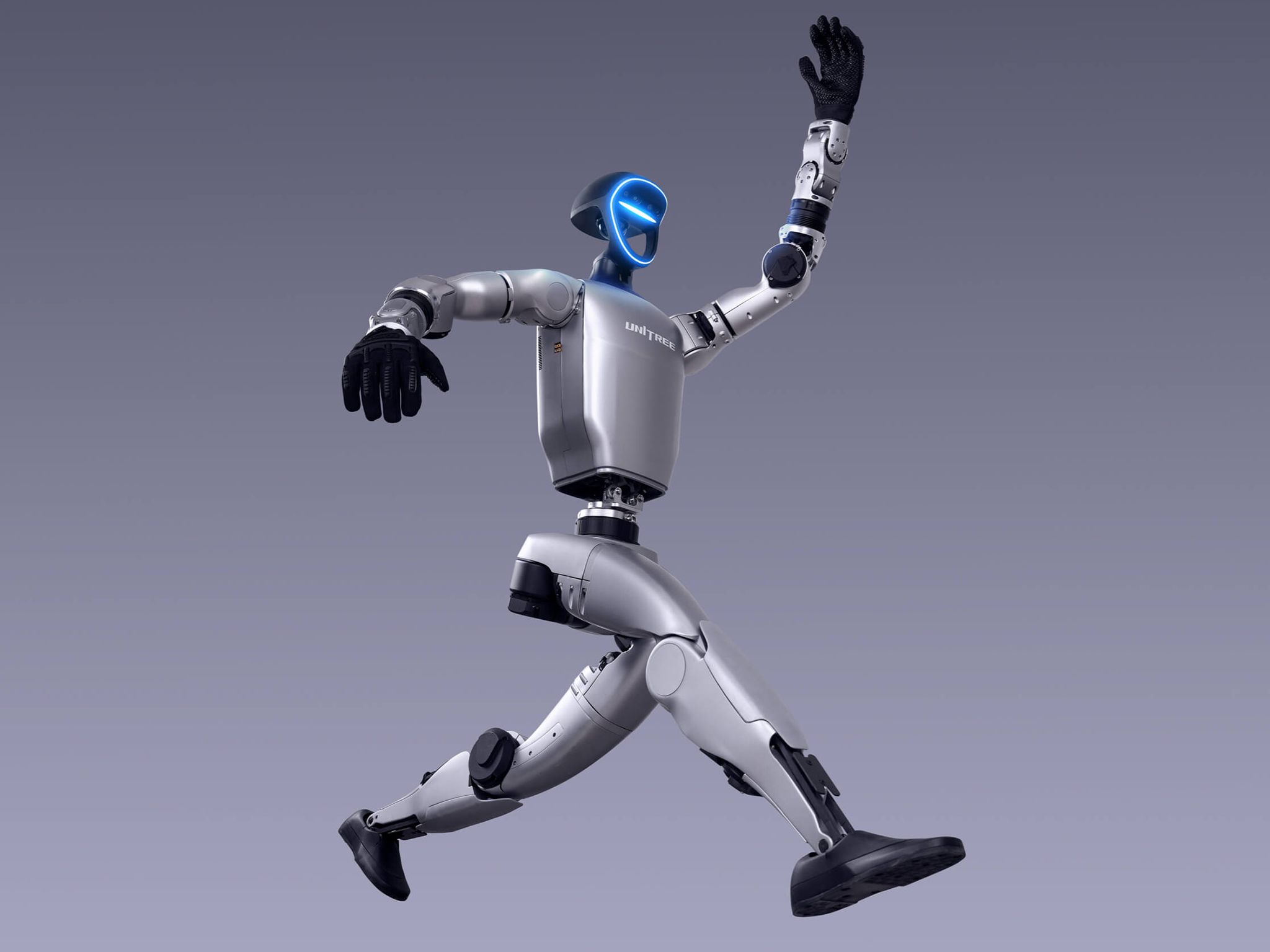
Tag: unitree

  • Unitree Sees Security Robots as Growth Area Amid Overseas Demand

    Unitree Sees Security Robots as Growth Area Amid Overseas Demand

    Unitree founder and chairman Wang Xingxing told a business conference in Hangzhou on November 6 that intelligent security robots represent a promising commercial opening, citing strong overseas demand while conceding that humanoids are not yet in large-scale use.

    Speaking at the eighth Zhejiang entrepreneurs’ conference, Wang presented demonstration video clips showing robots performing security and emergency tasks, such as restraining a simulated attacker, blocking an intruding vehicle and conducting emergency rescues. However, the address served as an outlook rather than a commercial rollout. Unitree announced no dedicated security models, commercial buyers or field deployments alongside the talk, leaving the robots’ actual performance during genuine emergencies unproven.

    Addressing the state of the technology, Wang noted that humanoid machines worldwide have yet to enter large-scale trials or widespread adoption, remaining less efficient than conventional industrial automation. Unitree has pursued factory applications since 2020, testing units in its own production facility as well as with several automakers and automotive parts suppliers.

    Inside predictable factory halls, robots trained on narrow, repetitive tasks can approach a 100 percent completion rate, Wang noted. Domestic living spaces present the opposite extreme, where unpredictable furniture layouts and varied human behaviour continue to block autonomous consumer deployment. Wang framed the ultimate technical goal as an embodied system capable of operating autonomously across unfamiliar physical environments without site-specific pre-programming.

    Millimetre Disconnects in Embodied AI

    Wang projected that within the next year or two, embodied systems might execute roughly 80 percent of tasks across unfamiliar settings relying solely on direct voice prompts. He identified that inflection threshold as the physical robotics counterpart to the emergence of consumer AI chatbots. Reaching that operational baseline remains blocked by hardware control limits.

    The central technical hurdle lies in execution precision, Wang explained. Discrepancies between digital model instructions and mechanical motor responses routinely create positional errors of several millimetres. In delicate assembly, grasping or physical containment tasks, small deviations cause dropped tools, failed grips or mechanical collisions.

    Compute Hardware Outweighs Algorithm Tweaks

    Core advances across modern robotics now stem from automated cycles of data capture, scoring, model retraining and refinement rather than novel algorithm designs, Wang argued. Computational throughput and semiconductor capacity have therefore emerged as the decisive commercial constraints. Large-scale autonomous self-training workflows will demand massive hardware infrastructure before humanoid hardware can handle continuous real-world interaction.

    Wang compared the current generation of robotics hardware to personal computers more than two decades ago. Early personal computers were widely dismissed as dedicated video gaming appliances because business software ecosystems had not matured, a pattern now mirrored in humanoid robots running staged performance routines instead of functional enterprise labour.

    Factory Experience and Autonomous Targets

    Commercial operators evaluating robotic site security or warehouse monitoring face clear operational trade-offs against conventional fixed surveillance. Automated cameras and basic teleoperated patrol rovers carry fractional hardware costs, proven reliability profiles and minimal liability risks compared with dynamic bipeds or quadrupeds attempting physical interventions. For facility managers, deploying unproven autonomous machines to intercept moving vehicles or restrain intruders risks substantial equipment damage, premises liability and erratic mechanical failures.

    Unitree’s trajectory since its 2020 entry into automotive manufacturing facilities demonstrates that repeatable, enclosed manufacturing delivers actual runtime data, whereas multi-terrain security patrols demand open-world adaptation that current spatial models cannot guarantee. While factory pilot programmes with automotive manufacturers supplied training cycles, expanding into international commercial facilities requires crossing the millimetre gap between digital commands and physical joint responses.

    The benchmark to track remains Wang’s 80 percent autonomous voice-task execution threshold across unmapped facilities over the next two years. Until robotic actuators eliminate minor millimetre positioning errors under real-world conditions, commercial deployments will stay restricted to controlled manufacturing cells rather than open security patrols.

  • Chinese Embodied AI Startups Draw 93.5 Billion Yuan in First Half

    Chinese Embodied AI Startups Draw 93.5 Billion Yuan in First Half

    Chinese embodied artificial intelligence developers raised 93.5 billion yuan ($13 billion) across 322 funding deals in the first half of 2026, according to data research firm ITjuzi. That figure represents a fivefold jump from the same period a year earlier, shifting capital from mechanical hardware into the software models that direct autonomous machines.

    Hardware makers are slashing retail prices on bipedal frames and robotic arms to secure market share, destroying manufacturing margins in the process. The shift forces commercial value into cognitive models capable of handling physical labor without custom engineering for every task.

    Where the Capital Lands

    Three specialist software developers, X Square, Galaxea, and Spirit AI, have each reached private valuations of roughly $3 billion, based on company disclosures. Hong Kong-listed UBTech advertised an executive compensation package of up to 124 million yuan ($18 million), including equity and benefits, to recruit a chief scientist for its AI model team. Hangzhou-based Unitree, one of the world’s largest humanoid robot producers by volume, now maintains a team of roughly 30 researchers dedicated to spatial physics and predictive object behavior.

    Hardware has become a commodity faster than expected across supply chains. Chinese builders can assemble a dynamic bipedal chassis at a fraction of Western production costs, but those machines remain commercially useless if every warehouse shelf or retail counter requires months of custom code. The venture money is now chasing generalist models that allow an off-the-shelf unit to unload pallets, stock pharmacy displays, or thread industrial wiring with minimal training.

    That dynamic alters procurement calculus for logistics networks, retail operators, and assembly plants across Asia. Instead of paying hefty integration retainers to robotics vendors, supply chain directors are testing software subscriptions that deploy across mixed fleets of machines. The operational risk lies in real-world error rates: while simulated environments and human video clips allow rapid laboratory demonstrations, factory floors and convenience stores tolerate zero mistakes.

    Data Collection in Pharmacies and Plants

    Different developers are testing competing training methodologies to feed physical data to their networks. Spirit AI hired roughly 1,000 workers to record routine manual tasks and industrial activities, according to co-founder Gao Yang. ACE Robotics strapped wearable sensors onto store clerks and hotel hospitality staff to record precise grip strength and hand movements during service shifts.

    Ant Group’s robotics unit, Robbyant, trained its model using 160,000 hours of operating material, which included 50,000 hours of human-guided mechanical movements. The group tested its software across 20 robot configurations built by 17 different equipment brands, seeking a cross-platform operating system for physical automation. In Shanghai, Robbyant deployed robots into two commercial pharmacies to pick and organize retail prescriptions, leaving human pharmacists to inspect the items before dispatch.

    Industrial plants demand higher precision than retail counters. Battery manufacturer CATL integrated Spirit AI machines into its Zhongzhou production facility, running flexible wire assembly during pack testing. The battery maker reported an insertion success rate above 99 per cent on that specific line.

    Simulations Meet Hardware Bottlenecks

    Other software houses bypass physical recordings entirely. DexForce uses synthetic computer-generated training environments to prepare robotic arms for precision tasks within six to eight hours, reporting operational success rates above 99.9 per cent on defined factory assignments. However, spatial intelligence developers such as Manycore Tech caution that computer graphics fail to simulate micro-friction, material deformities, and changing warehouse lighting conditions.

    The push into advanced physical modeling faces immediate structural constraints inside mainland laboratories. United States export controls on advanced Nvidia processors limit access to the compute clusters needed to train large vision-language-action models. Chinese startups are turning to synthetic data pipelines, model pruning, and domestic processors developed by Huawei to bypass the compute bottleneck, but the processing gap widens as networks scale.

    Next Steps for Industrial Deployment

    The transition from bespoke factory automations to adaptive common-sense robotics marks the next phase of China’s robotic push. Unitree founder Wang Xingxing reported experimental success testing OpenAI’s GPT-6 model on walking units, setting an operational target where robots complete 80 per cent of assignments across 80 per cent of unfamiliar retail and factory environments via direct voice instructions.

    Whether domestic models can match that benchmark without unrestricted access to foreign silicon remains the central variable for Chinese supply chain tech, and will show whether these 93.5 billion yuan in capital commitments translate into profitable labor replacement.