
Tag: uzbekistan

  • Uzbekistan Commits $100 Million to Subsidise AI Across 10,000 Businesses

    Uzbekistan Commits $100 Million to Subsidise AI Across 10,000 Businesses

    Uzbekistan will spend at least $100 million to subsidise artificial intelligence adoption across 10,000 enterprises, covering half the cost of software implementation for commercial operators. The state-backed program targets manufacturing and consumer supply sectors, extending automation subsidies from the textile trade into food processing, electrical engineering, and construction materials.

    President Shavkat Mirziyoyev announced the funding following consultations with business owners in the Khorezm region. Government data presented at the meeting showed that 54 per cent of domestic companies using modern management and AI systems saw product demand increase. A quarter of those businesses lowered production costs, while higher sales allowed 40 per cent to raise worker wages by more than 10 per cent.

    Subsidies for Factory Automation

    Under the initiative, the state will reimburse 50 per cent of what companies spend to introduce automated management systems and machine learning tools. Participating enterprises will also receive access to pre-built, open-platform software designed to eliminate the cost of developing proprietary applications from scratch.

    Hardware support will run through the Center for Digital Government Project Management, where authorities recently brought online Uzbekistan’s first supercomputer cluster. Companies building AI models for commercial products can process workloads on the facility without charge, with research and development bills settled directly by the state budget. Computing capacity at the cluster will triple next year.

    The push reflects how Central Asian governments are attempting to modernize domestic supply chains and bypass legacy enterprise systems. While Southeast Asian manufacturing hubs rely heavily on private capital and foreign software vendors to automate shop floors, Tashkent is using direct treasury subsidies to pull mid-tier producers into modern data workflows.

    Supercomputing and Regional Education

    Administrative processes are seeing similar investments. The Ministry of Digital Technologies signed an agreement with South Korea’s National Information Society Agency and UZINFOCOM to build an AI system that processes and manages citizen appeals to state bodies, starting with a feasibility study and pilot rollout.

    Across the border, Kazakhstan is focusing resources on technical labor. First Vice Minister of Artificial Intelligence and Digital Development Rostislav Konyashkin confirmed the establishment of Qazaq AI Research University under orders from President Kassym-Jomart Tokayev. The institution will embed machine learning coursework into outside degree programs and build research links with partner centers in China, Finland, and the United Arab Emirates.

    Uzbek authorities will open the enterprise application window in stages, with initial disbursements prioritized for food processors and light industrial plants preparing export shipments.
  • Completion of Heaviest and Tallest Cargo Transportation in the History of Uzbekistan

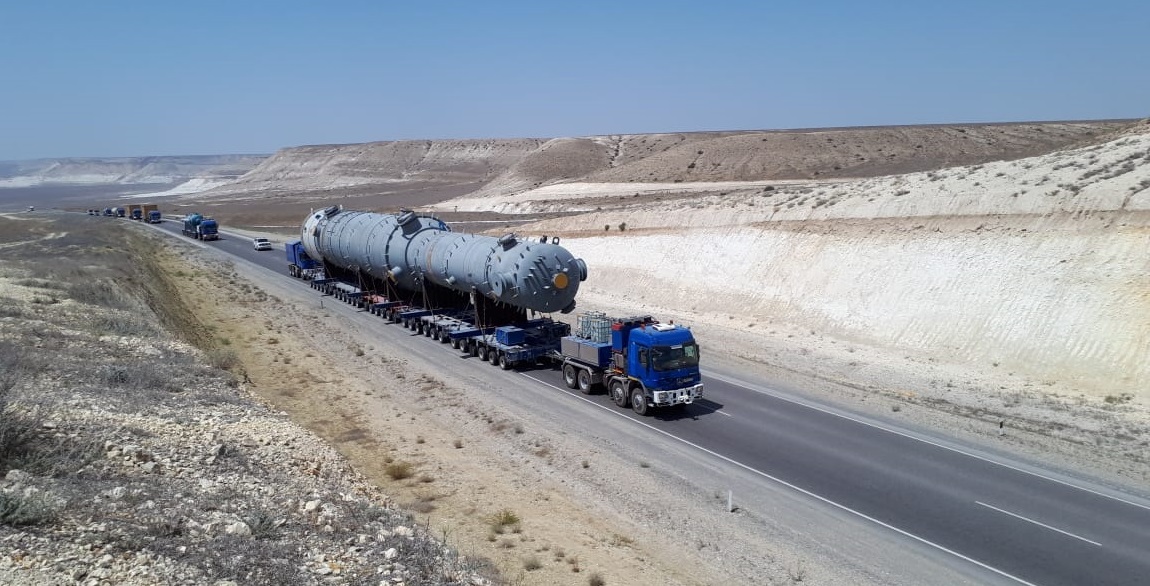
    Completion of Heaviest and Tallest Cargo Transportation in the History of Uzbekistan

    In 2017, Bolloré Logistics Japan was awarded the transportation of materials and equipment from Mitsubishi Corporation for a large-scale fertilizer plant in Navoiy, a city in the central region of Uzbekistan. By September 2018, our team had successfully transported 24 heavy-lift units by hydraulic conventional trailers, including 17 units over 100 MT each.

    Located in Central Asia, Uzbekistan is one of only two landlocked countries in the world surrounded by five countries, namely, Afghanistan, Kazakhstan, Kyrgyzstan, Tajikistan and Turkmenistan. This makes Uzbekistan one of the most difficult areas to transport cargoes. The port of discharge selected by Bolloré Logistics varied from one time to another as there was no standard transportation route. Depending on the port of loading & discharge, weight, dimensions, transit time, and cost efficiency, Bolloré Logistics Japan provided the best transportation route and mode for Mitsubishi Corporation.

    The heaviest unit, an Ammonia Converter, registered at 422 tons and the widest and tallest unit, a Package Boiler, recorded at LWH (mm) 12,700 x 8,700 x 10,720 – making history as those were the heaviest and tallest cargoes handled in Uzbekistan.

    The scope of work included Free On Board (FOB) from various ports of loading to Navoiy’s site, together with import customs clearance formalities.

    Timely arrangement of breakbulk vessel, Volga-Don class sea river vessel or barge, road permits, conventional hydraulic trailers and more were requested from our team in order to meet the construction schedule’s deadline with all the requirements.

    As for the heaviest and most voluminous cargoes, Bolloré Logistics visited the vendor’s factories several times prior to the breakbulk shipments and physically checked the cargo figures, lifting points, lashing points, to successfully design the transportation plan accordingly.

    But the most challenging part remained the inland transportation from the Caspian Sea port to the job site.
    First of all, the distance from the Caspian Sea port to the job site is around 1,700 km. These days, most cases of heavy lifts are handled by self-propelled modular transporter (SPMT), just for short distances only, but in our case it was transported by conventional hydraulic trailers, for 1,700 km. As 1,700 km is a long journey, Bolloré Logistics Japan had to anticipate unexpected trouble on the way and prepare a backup plan, while respecting the construction schedule.

    Road surveys were carried out several times and we decided to adopt the safest transportation route. However, it was still not enough as infrastructures were limited and could not withstand transportation of such heavy and voluminous cargo; it therefore had to be improved.

    As a result, Bolloré Logistics improved 24 bridges (including the construction of a new bridge and installation of new piles on another bridge), constructed 15 bypass roads (including two long ones), expanded five corners, replaced electric poles at one place, and widened roads at four points.

    Yet, it was still not enough. During the transportation of heavy lifts cargo, Bolloré Logistics mobilized construction machinery teams such as dump trucks, road rollers, wheel loaders, etc., in order to improve unpaved road temporarily. We also mobilized an electrical team such as cherry pickers, mobile cranes to shut down / remove power cables and other overhead obstacles.

    Thanks to Mitsubishi Corporation’s full cooperation and Bolloré Logistics’ team effort; we were able to meet the cargo readiness in accordance with heavy lift transportation schedule and unloading heavy lifts on time at the site.