Tag: VIP.com

  • Anais and Greygrei to make China debut

    Anais and Greygrei to make China debut

    Korean clothing brands Anais and Greygrei are set to enter the Chinese market under Korean young-casual clothing firm Maison de Anais.

    The label, which successfully launched in northern Europe earlier this year, will target the late 20’s to late 30’s womenswear market in China after having received interest at the Shandong Korean Product Exhibition last July.

    The Greygrei brand is currently pending its official release on VIP.com, one of the three leading B2C internet shopping malls with the largest sales among Chinese e-commerce mobile apps.

    A Maison de Anais spokesperson said online fashion platforms are attractive to brands as they can help establish brands in the fast-changing Chinese market.

    “By introducing on VIP.com, Maison de Anais hopes to promote the brand to various buyers and distribution channels in China by increasing the brand competitiveness and reference of Greygrei as we establish direct contact with the customers.”

    Company president Jeong Ho Lee added: “Times are changing where a wide range of age groups, especially female consumers from their late 20’s to late 30’s, are taking the main role in invigorating the fashion market in China, from an era where the early-to-mid-20’s used to be at the helm. Greygrei and Maison de Anais hope to write [a] success story with China as the main stage.”
  • VIP.com, first Chinese partner of the London Fashion Week

    VIP.com, first Chinese partner of the London Fashion Week

    The new relationship is truly special as this is the first time a Chinese retailer becomes an Official Sponsor of London Fashion Week. Vip.com will be working closely with British brands to help them launch in its hugely lucrative and ever-expanding home territory.

    “The fashion market in China is extraordinarily sophisticated and fast paced, and hungry for new design talent,” says Jenny Jioe, Managing Director of Fashion at Vip.com. “Our consumer is aware of London’s creative pedigree, and ready for both news and product. I know from first-hand experience that the brands in London, with all their energy and unbridled creativity, are precisely what we are looking for.”

    Vip.com is one of China’s top 3 ecommerce retailers, with annual retail sales of $11.2b, 57.8million active customers, over 335million orders in 2017, and eight individual international sourcing offices. In 2016 Forbes ranked Vip.com as No.2 in its top 100 companies with the highest growth.

    London Fashion Week is a renowned launch pad for emerging fashion talent. “The nature of working with so many new businesses, is that they don’t have the advertising power of the global fashion brands,” says Caroline Rush, Chief Executive British Fashion Council. “What they have is incredible products that a fashion-forward Chinese consumer is going to love. Our role is to shine a light on these businesses and work with our partners at Vip.com to introduce these brands to a highly engaged audience in China.”

    The new partnership takes sponsorship at London Fashion Week into new, global realms of business and marketing savvy. “We are going to stage a show that is exclusive run by Vip.com,” says Paul Tyce, the Chinese e-commerce site’s UK country manager. “We will offer live streaming to our customers in China, in-depth cooperation with designers, and fashion and art exhibitions. This isn’t just about title sponsorship.”

  • VIP to invest in Australia

    VIP to invest in Australia

    A Chinese online shopping giant has arrived in Australia this week to unveil its new Sydney distribution centre.

    VIP.com is one of the largest players in China’s e-commerce space with total orders for the third quarter of 2017 increased by 23 per cent to 74.0 million from 60.1 million in the prior year period.

    “Australia is already a very strong market for VIP.com. We are looking to procure about AUD 500 million of Australian goods in FY18 and we expect to double that figure the year after,” said Hillary Wang, VIP.com’s head of global buying.

    “We have highly effective partnerships with many Australian businesses and have become their primary sales channel in China. We have serious aspirations to become the number one platform in China for many more of our suppliers’ businesses.”

    With Australian brands highly sought after in China – based on consumer’s perceptions of trust and value – VIP recently partnered with Australia’s largest food manufacturer, Nestle,  to introduce Australia’s Uncle Toby’s, Allen’s confectionery and Soothers trademarks to China.

    “We only deal with brand owners directly or through their authorised distributors. Authenticity is critical to building brands and Chinese shoppers know that VIP.com delivers that,” Wang said.

    VIP stated its female skewed audience (+80 per cent) and ability to customise the recommended range of products to shoppers, based on demographic and purchase history, give it major point of differences to its Chinese e-commerce competitors.

    “We are pleased to be investing in Australia,” said Wang.

    “Chinese consumers trust Australia’s production standards and quality of its natural resources.

    “Australia is our number one import market for nutrition and food and beverage, and whilst we have made much progress, we have plans for further significant growth. This trip is about deepening our partnerships with existing suppliers and inviting participation from potential new partners.”

    The online retailer will invest in local infrastructure to enable growth in trade between Australian businesses and its accessible database of 300 million Chinese shoppers.

    Investment is being channelled into supply chain capability and people in Australia to facilitate trade.

    “In discussions with our Australian partners, we are often told the Australian market is a highly contested and offers relatively low growth,” said Wang.

    “We are happy to bring a good news story to these businesses, the opportunity to share with Chinese shoppers brands that are rich in history, made with the best ingredients to the highest standards, by hard working Australians. These are exciting times.”

  • Tencent brand is still China’s most valuable

    Tencent brand is still China’s most valuable

    Chinese technology giant Tencent remains China’s most valuable brand, growing its worth 29 per cent to US$106 billion, according to the BrandZ top 100 most valuable Chinese brands report.

    It shows that technology brands continued to lead the way, with the Tencent brand strengthening its hold on the top spot thanks to the popularity of its social-media platform WeChat. Tencent was also one of three technology brands in the top 20 “risers” listing.

    With Tencent on the top 100 list are NetEase (31) and Sina (61). Making its debut in the 40th spot is e-commerce brand VIP.com.

    Web portal Sina’s initiatives in live video and self-broadcasting through its Weibo platform helped build its following among young people and attract advertising revenue, driving a 43 per cent rise in brand value to $900 million.

    NetEase, which makes online and mobile games and offers an e-mail service, grew 36 per cent to $2.6 billion.

    Sectors still dependent on the traditional economy, such as banks, insurance, and oil and gas, have declined 6 per cent in value. The exceptions are alcohol, and food and dairy.

    Several brands of baijiu, China’s traditional rice wine, have expanded distribution and adjusted pricing and marketing to reach a broader audience. This allowed them to make up for a decline in sales after government measures to limit extravagance at official events reduced demand for alcohol, especially premium brands. Moutai increased 41 per cent in value, entering the top 10 for the first time in ninth position.

    Some entrepreneurial Chinese brands are looking for overseas success before returning attention to their home market, such as digital brands Anker, DJI, Elex and Ninebot.

    Millennials are playing an increasing role in commercial and brand success in China, says the report. They tend to favour brands that are famous or trendy, and the research reveals the brand most successful at increasing millennial loyalty is mobile phone Oppo, up 157 per cent since 2014.

    “Chinese brands are taking the leap and going global on the back of three key factors: the country’s rising international stature, pressure to find alternative sources of growth as the domestic market slows, and increasing overseas consumer receptivity to Chinese brands,” says BrandZ global head Doreen Wang.

  • Hard half-year for Luk Fook Holdings

    Hard half-year for Luk Fook Holdings

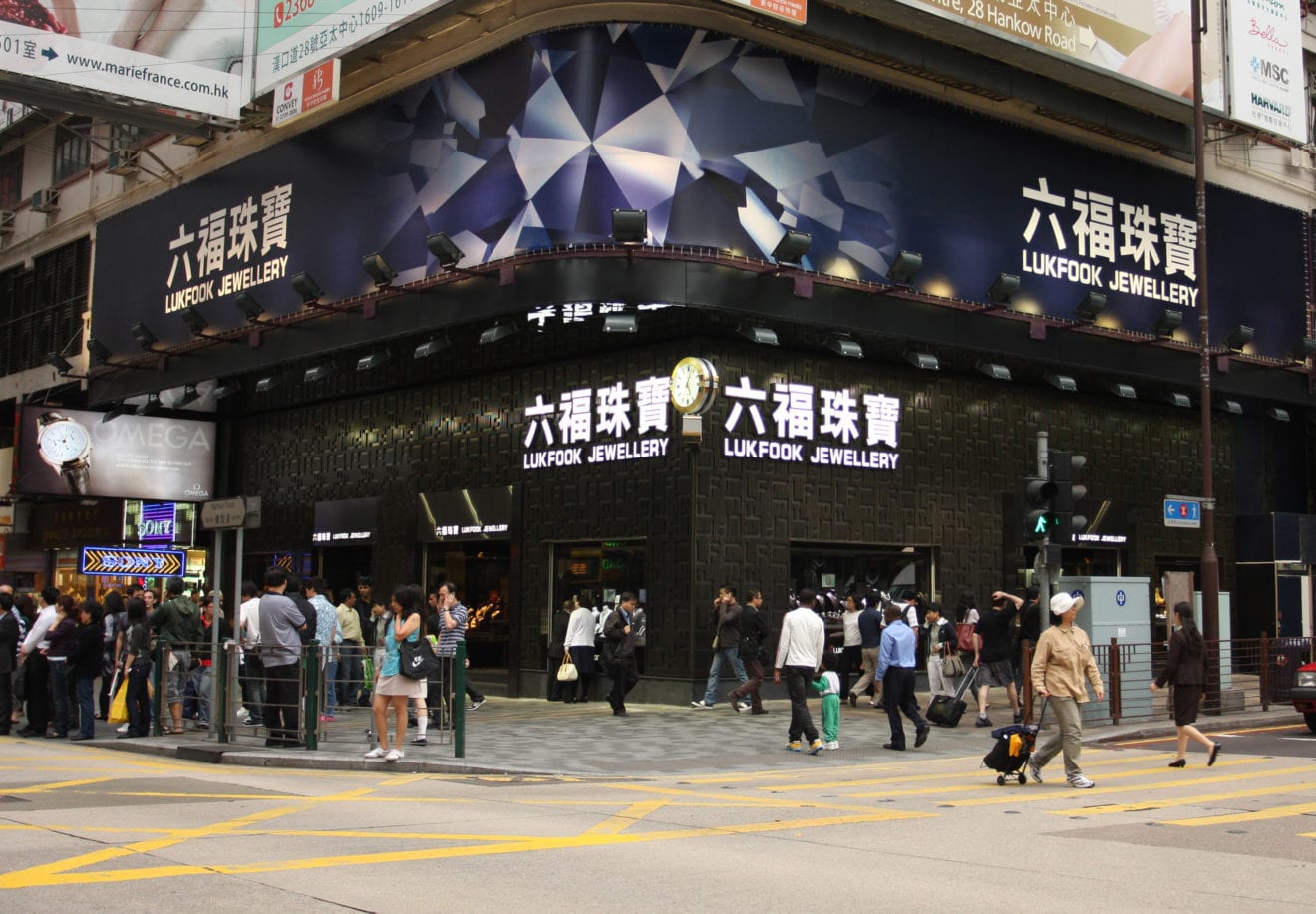
    Revenue plunged by 21.5 per cent for jeweller Luk Fook Holdings (International) to reach HK$5.5 billion (US$709 million) for the six months to September 30.

    Its interim results also show a drop of 31.5 per cent in overall same-store sales for the period.

    However, its overall gross margin improved by 5.3 points to 28 per cent as a result of a relatively high gold price and higher gemset jewellery sales mix. Because of this, the gross profit decreased by only 3 per cent to HK$1.5 billion.

    Mainland China accounted for 54.6 per cent of total profits, an increase of 12.8 points.
    With a lacklustre market, retail revenue in Hong Kong plunged by 33.4 per cent to $2.642 billion, while the wholesale business shot up by 51.1 per cent to $361.6 million because of an increase in scrap gold sales as well as wholesale rough diamonds.

    Luk Fook says a relatively high gold price saw gold sales fall more than expected.

    During the six months, the group added 27 Lukfook shops worldwide, including 24 in China (nine of them licensed shops), a self-run shop in both Macau’s casino district and New York,and  a licensed shop in Seoul. This brought its total to 1455 Lukfook shops (up from 1412 at the same time last year), spanning Australia, Canada, China, Hong Kong, Korea, Macau, Singapore and the US, as well as nine 3D-Gold shops (up from four) on the mainland.

    The group says it has been striving to diversify its product mix, and since 2010 has been trying to expand its mid- to high-end watch business. At the end of September is was the authorised dealer of 34 watch brands including Audemars Piguet, Bulova, Burberry, Bulgari, Emporio Armani, Eterna, Frederique Constant, Longines, Omega, Oris, Rado, Tag Heuer, and Victorinox Swiss Army.

    For the six months, the watch business contributed revenue of HK$104.49 million down from HK$119.39 million for the same period last year, representing 1.9 per cent of the group’s total revenue, a 12.5 per cent decrease.

    Looking ahead, the group aims to continue to develop its eCommerce business and to further strengthen cooperation with eCommerce platforms in China. At the end of September, the group had 15 online sales platforms in China, including JD.com, Suning.com, Tmall.com and VIP.com.