Tag: vn-index

  • Vietnam Stocks Break Records: VN-Index Hits 1,909.01 Points Amidst Market Surge

    Vietnam Stocks Break Records: VN-Index Hits 1,909.01 Points Amidst Market Surge

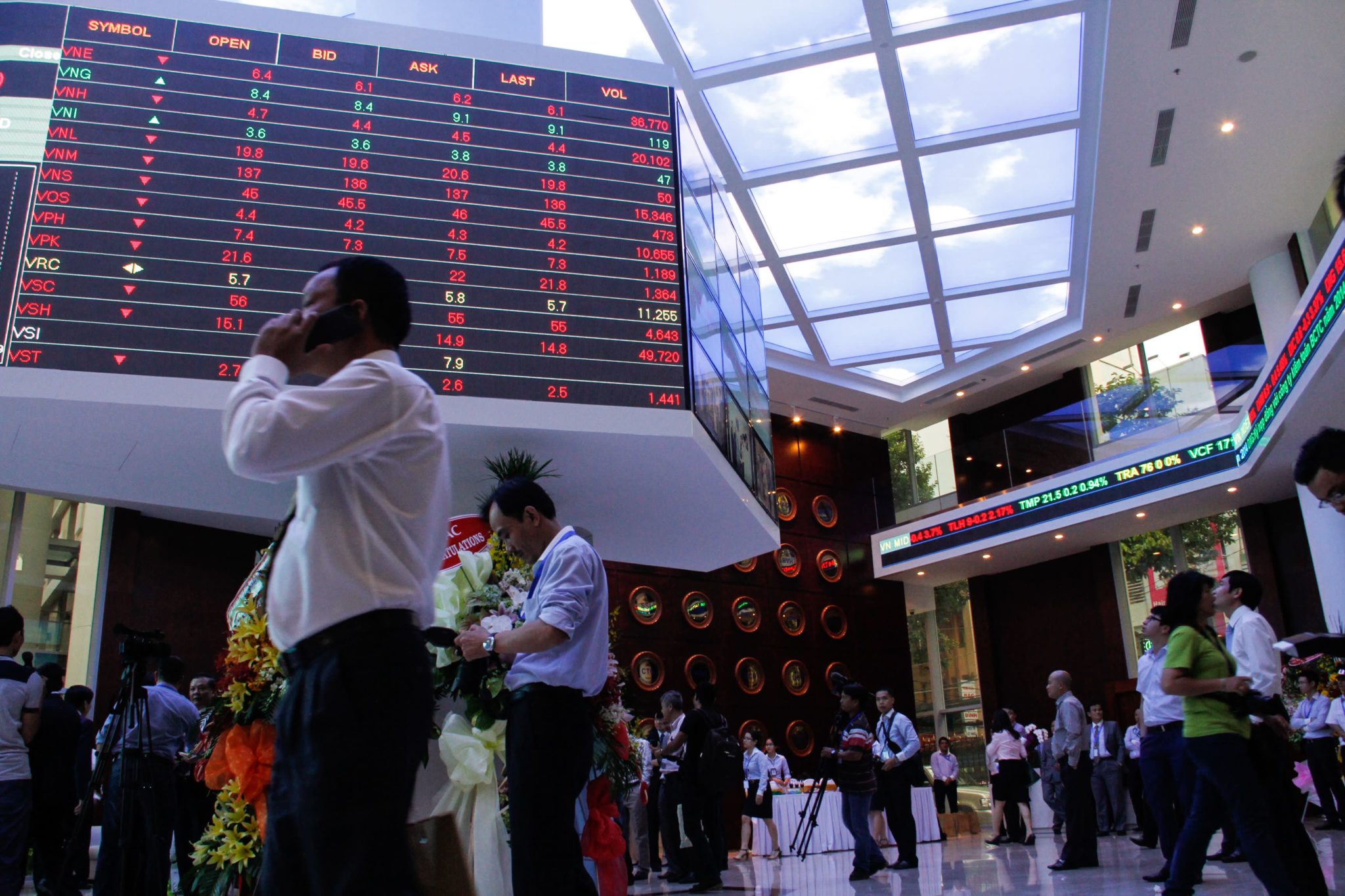
    On Thursday, Vietnam’s principal stock index, VN-Index, concluded trading at an unprecedented high of 1,909.01 points. This represented a 0.94% increase from the previous day’s closing figure. Trading activity on the Ho Chi Minh Stock Exchange, which is the platform where the index is listed, surged by 26%, amounting to a total value of VND30 trillion (US$1.14 billion).

    Key Movers on the VN-Index

    In the VN30 index, which represents the 30 most significant capped stocks, 13 stocks registered gains. Leading the pack were STB of the Ho Chi Minh City-based Sacombank and VHM of the real estate titan Vinhomes, each recording a substantial 7% increase. Other notable gainers included LPB of Fortune Vietnam Bank, which climbed 3.6%, and HDB of HDBank, which closed 3.4% higher.

    However, not all stocks shared in these gains. Thirteen stocks in the VN30 index ended the day in negative territory, with the most significant drop being GAS of state-owned Petrovietnam Gas, which fell by 4%. Other significant losses were registered by DGC of Duc Giang Chemicals Group, which slipped 3.4%, and PLX of fuel distributor Petrolimex, which ended the day 3.3% lower.

    Foreign Investors’ Activity

    For the eleventh consecutive trading session, foreign investors were net sellers, offloading VND311 billion worth of stocks. Among the stocks most sold by these investors were FPT of tech behemoth FPT Corporation, ACB of Asia Commercial Bank, and KDH of property company Khang Dien House.

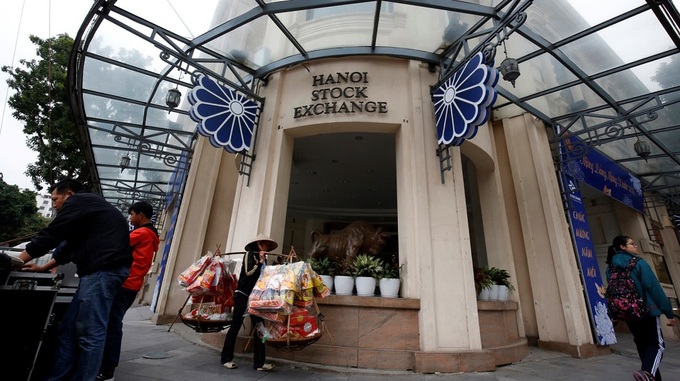
    The HNX-Index, representing stocks on the Hanoi Stock Exchange, which is home to mid and small cap stocks, fell by 0.28%. On the other hand, the UPCoM-Index for the Unlisted Public Companies Market finished the day 0.42% higher.

    Questions & Answers

    What was the closing figure for Vietnam’s VN-Index on Thursday?
    The VN-Index closed at 1,909.01 points on Thursday, marking a new peak.

    Which stocks led gains on the VN-Index?
    STB of Sacombank and VHM of Vinhomes led the gains, each with a 7% increase.

    What was the performance of foreign investors on the VN-Index?
    Foreign investors were net sellers for the 11th consecutive session, selling off VND311 billion.
  • Vietnam’s VN-Index Takes Steepest Dive in a Year Amid Geopolitical Tensions and Skyrocketing Oil Prices

    Vietnam’s VN-Index Takes Steepest Dive in a Year Amid Geopolitical Tensions and Skyrocketing Oil Prices

    Vietnam’s primary stock index, the VN-Index, experienced a significant drop of 5.86% during Monday morning trading, as investors initiated a sell-off due to geopolitical uncertainties and rising oil prices.

    Steep Fall of VN-Index

    On Monday, the VN-Index experienced a 6.38% fall from its reference level, marking the sharpest dip in almost a year. The last substantial drop was seen on April 8, when the index declined by 6.43%. This was a result of a prolonged market correction after the announcement of reciprocal tariffs by the U.S. President.

    Despite pessimistic predictions regarding short-term market developments from many securities companies prior to Monday’s trading, a drastic drop in the VN-Index was not anticipated. Amidst pressure from negative events at home and abroad, MBS analysts predict that the index may drop to around 1,700–1,750 points, a decline of about 20–70 points compared to the previous week’s closing level.

    Similarly, Yuanta Securities Vietnam suggested that the index could decline to a support zone of 1,715–1,740 points before a potential technical rebound occurs.

    Various Factors Influencing the Index Drop

    An MBS analyst pointed out that the domestic stock market showed strong resilience to the pressure of slightly increasing deposit interest rates before the Middle East conflict. The VN-Index had reached the 1,900-point level. However, the market now faces risks related to inflation, exports, financial instability, and supply chain disruptions due to the interest-rate pressure and the Middle East conflict.

    Tyler Nguyen Manh Dung, Senior Director of Market Strategy Research at HSC Securities, attributed the sharp market correction to a sudden increase in margin calls from securities firms. Dung warned of a potential sharp market fall tomorrow if there is a lack of capital to absorb the volume of shares waiting for forced liquidation at floor prices.

    Le Vu Kim Tinh, branch director at Phu Hung Securities, echoed Dung’s thoughts, adding that the deeper cause of the market correction is a series of negative developments related to geopolitical tensions.

    Signs of Hope Amid the Market Decline

    Despite the shocking correction, there are still some positive market signals. Tinh noted that oil and gas stocks continue to act as a market pillar due to benefits from the escalating Middle East conflict.

    Dung also highlighted that shares of some banks and many securities companies have corrected to levels that present attractive buying opportunities.

    Despite the widespread decline, 16 stocks remained in positive territory after an hour of trading on the HoSE, with oil and gas shares accounting for most of these gainers. The rally in oil and gas stocks is expected to continue as Brent crude oil prices surged nearly 20% to $111 due to escalating conflict in the Middle East raising investor concerns that supply could tighten further.

    Questions & Answers

    What was the extent of the drop in the VN-Index?
    The VN-Index experienced a significant drop of 5.86% during Monday morning trading.

    What factors led to the drop in the VN-Index?
    The drop in the VN-Index was attributed to a series of negative developments related to geopolitical tensions and a sudden increase in margin calls from securities firms.

    Despite the market decline, what positive signals were identified?
    Despite the market correction, oil and gas stocks continue to act as a market pillar, and shares of some banks and many securities companies present attractive buying opportunities.

  • Vietnam stock market makes bright start after Tet holidays

    Vietnam stock market makes bright start after Tet holidays

    The VN-Index began the new lunar year with a 1.5-percent jump Monday morning, led by aviation and energy stocks. It gained 22 points to 1,503 points at 11.20 as the market reopened after the nine-day Tet break, reaching a near four-week high. It represents a 4.1-percent recovery from the bottom of 1,439 points reached on January 18 as investors booked profit before the holidays.

    Most brokerages expect the index to rise this week since no negative news came out during the holidays. Analysts at ASEAN Securities and BIDV Securities said the VN-Index is set to stay in the 1,500 levels this week. It closed in the green on an opening day on five of the last six years since 2016, only dipping in 2020 when Covid-19 first hit Vietnam.

    The VN30 basket, comprising the 30 largest capped stocks, saw 24 of them gain Monday, led by VJC of budget airline Vietjet, which rose by 6.6 percent as investors expect a recovery by the aviation industry after the government announced plans to revive international tourism by March-end.

    Vietnam Airlines (HVN) gained 7 percent to the ceiling and its highest in over three months.

    Airports Corporation of Vietnam (ACV) rose by 7.4 percent with volumes reaching 321 percent of the average of the last 10 sessions.

    Energy stocks also rose, with PLX of fuel distributor Petrolimex climbing by 6 percent and GAS of state-owned Petrovietnam Gas gaining 6.2 percent. POW of electricity producer Petrovietnam Power Corporation was up 6.5 percent. Companies expected to benefit from rising consumer demand, such as VRE of real estate retail firm Vincom Retail and MSN of conglomerate Masan Group were the other gainers.

    The HNX-Index on the Hanoi Stock Exchange, home to mid-and small-cap companies, was up 1.2 percent, and the UPCoM-Index on the Unlisted Public Companies Market had gained 1 percent at the time of publishing.

  • Foreign investors return to surging Vietnamese stock markets

    Foreign investors return to surging Vietnamese stock markets

    At over VND3 trillion ($129.21 million), foreign buying in the local bourses from February 1-25 is three times the January figure. Foreign investment since the beginning of the year has been worth over VND4.3 trillion ($185.16 million). They have been focusing on blue chips like Hoa Phat (HPG), one of Vietnam’s leading steel producers. The company, ignored for the last several months, returned to the portfolio of foreign investors and saw millions of shares traded every day in February.

    In the 11 sessions after the market reopened February 11 after the nine-day Lunar New Year (Tet) holiday from Feb 2-10, foreigners bought 20 million shares for more than VND600 billion ($25.8 million). A month earlier they had been net sellers of over 10 million shares.

    Other blue chips like Vietnam’s biggest dairy company Vinamilk (VNM), private conglomerate Masan Group (MSN) and the biggest bank by assets Vietcombank (VCB) have all run up quite sharply as a result of buying by foreign investors.

    The benchmark VN-Index has gained more than 100 points this year, equivalent to over 11 percent. On Monday it closed at 994.43 points, within touching distance of the psychological 1,000-point mark.

    Foreigners have played a significant role in the recovery, having invested over VND4.3 trillion ($185.16 million) in the period, almost half of it since Tet.

    According to Rong Viet Securities Company, foreign investment this year could actually go down as a result of the reduction in monetary easing and fiscal stimulus across the globe this year, meaning there is less foreign cash available to invest in marginal markets such as Vietnam.

    But it also points out that Vietnam is on the verge of being upgraded to ‘emerging’ market, which could be a positive sign for foreign investors.

  • Experts express cautious optimism for Vietnam stock market

    Experts express cautious optimism for Vietnam stock market

    Last year’s uncertainties and unclear future scenarios are reflected in more cautious assessments than number crunching for 2019. Nguyen Duy Hung, chairman of SSI, a leading Saigon broker, said that with a drop of over 20 percent from its peak, when the VN-Index climbed to 1,204 points on April 9, 2018, Vietnam’s stock exchanges have entered a bear market.

    The benchmark VN-Index on the Ho Chi Minh Stock Exchange lost 1.52 per cent to end Thursday at 878.22 points. On Friday afternoon, it rose to 880.9 points.

    Perhaps it will take between 8 to 11 months for the market to recover, Hung said. “Historical data suggests that it would take 21 months for a bear market to recover its old peak after hitting bottom.”

    But the SSI chairman said the main challenges facing the stock market in 2019 include worries posed by the escalation of the U.S.-China trade war, and increasing geopolitical risks.

    “At this point, no one can say how this war will unfold or predict how widespread the impact will be. Along with the decline in oil prices signaling difficulties of the world economy, the rise in geopolitical risks paint a picture of uncertainties for 2019,” Hung said.

    Also mentioning key challenges for 2019, Securities Commission chairman Vu Bang named the slowdown of Chinese and global economies, the escalating trade war and risks from expanding global debt.

    However, these challenges come with opportunities to be seized. The trade war, according to the SSI chairman, is a chance for Vietnam to increase its exports. This does not mean market share growth will happen immediately, he said, explaining that it was an opportunity to build a medium to long term strategy, innovating the country’s economic growth model based on production and commercial activities.

    Vu Bang also emphasized the advantages of macro factors, saying the continuous high growth rate in recent years was a factor that would increase the attractiveness of Vietnam’s market in the region.

    Vietnam’s GDP growth of 7.08 percent in 2018 retained its status as one of the best performing economies in the world. It was the highest growth the country has experienced since 2008 and compared with the median estimate of 6.9 percent in a Bloomberg survey of 12 economists.

    Offering a more optimistic view, Tran Le Minh, deputy general director of VietFund Management, said that the market in 2019 still holds several favorable factors, including the fact that the decline in VN-Index was relatively slower than in other parts of the world.

    “Why is the market declining more slowly? The reality must be seen in macro factors, growth and the fact that foreign institutional investors continue to invest in the market. Cash flow from foreign investors will continue to be a highlight this year,” said Minh, who predicted that the VN-Index will not fall below its current level by the end of 2019.

    Foreign direct investment disbursement in Vietnam reached a record $19.1 billion in 2018, a year-on-year increase of 9.1 percent, according to the Ministry of Planning and Investment.

    For the market players’ perspective, 2019 is not going to be an easy year, experts say.

    “With many unpredictable factors caused by geopolitical and commercial tensions, most analysts agree that the global economy is entering the end of a growth cycle and 2019 will be a difficult year for the stock market,” said an analyst team with Rong Viet Securities (VDSC).

    It will be difficult for Vietnam to buck the global trend, they felt.

    Bernard Lapointe, head of research of Rong Viet Securities said recently that he was optimistic but not too optimistic about the market this year. He expects the VN-Index to stay within the 900-1,000 points range until the end of 2019.

    Meanwhile, Michel Tosto, head of Institutional Sales and Brokerage of Viet Capital Securities, predicted that the VN-Index could reach 1,060 points at the end of 2019.

  • VN-Index ends year 10 percent lower

    VN-Index ends year 10 percent lower

    The VN-Index closed the last trading day of 2018 at 892.54 points, down almost 10 percent from the year’s outset. This was a drop of 93 points from January 2, the first trading day of the year. The benchmark closed below the 900-point mark on Friday, a drop of over 25 percent from its peak at over 1,200 points in April. The VN30-Index, representing the 30 largest tocks in terms of capitalization, closed at 854.99 points, dropping 10.46 from Thursday, or 1.21 percent lower.

    Many stocks in the VN30-Index also ended in the red. Diary giant Vinamilk closed at VND120,000 ($5.2), 2.6 percent lower.

    Vietnam’s top petro importer and distributor Petrolimex fell 5.69 percent to VND53,000 ($2.3), while food company Masan dropped 1.9 percent to VND77,500 ($3.36).

    However, the HNX-Index on the Hanoi Stock Exchange and the UPCoM-Index for unlisted public companies ended in the green, up 0.24 percent and 0.46 percent respectively.

    Vietnam’s largest private firm Vingroup (VIC) ended the day at VND95,300 ($4.13), 6.93 percent lower. Vincom Retail’s VRE stock dropped almost five percent to VND27,000 ($1.17).

    Total market capitalization of all three stock markets, the Ho Chi Minh City Stock Exchange (HOSE), HNX and UPCoM, was VND4 trillion ($173.25 million).

    2018 has proved the most turbulent year for VN-Index since the 2008 crisis, ending an increasing run since 2016.

  • Vietnam’s blue chips fall faster than stock market plunge

    Vietnam’s blue chips fall faster than stock market plunge

    As business results fall short of targets, Vietnamese blue chips are falling faster than the stock market’s continued plunge. Vietnam’s benchmark VN-Index dropped 23.5 percent to 917.97 points on Friday from its April peak over 1,200 points. In corresponding comparison, the fall in value of blue chips stocks has been more than twice as high. A share of Vietnam’s leading stone manufacturer Vicostone (VCS) on Friday was worth VND75,000 ($3.2), down 47 percent from its peak on April 4 at VND141,600 ($6.06).

    Analysts at that time called the stock a “phenomenon,” as its value surged 50 times from VND3,000 (13 cents) in mid-2014 on the Hanoi Stock Exchange (HNX).

    Vicostone’s profits also rose over 50 percent a year from 2014 to 2017, while its revenue increased from VND2 trillion ($85.64 million) to VND4.35 trillion ($186.27 million) in the same period.

    But this year, maintaining double-digit growth seems to be a challenge for the company as its revenue has stayed the same year-on-year at VND3.2 trillion ($137 million), while net profit fell 7 percent to VND790 billion ($33.82 million) in the first nine months of this year.

    Although the company has reassured shareholders that business is normal and that Vicostone plans to buy its own shares to stop the falling momentum, investors have been selling their holdings at increasing speeds.

    A similar situation can be seen at the Vietnam Prosperity Joint-Stock Commercial Bank (VPBank). Its stocks on Friday morning closed at VND21,950 (94 cents), dropping 48.7 percent from its peak on April 9 at VND42,826 ($1.83).

    Last year, as it focused specifically on consumer finance, the bank’s stocks was one of the most sought-after when it was listed on the Ho Chi Minh City Stock Exchange (HOSE) in August.

    But its stocks value has been dropping this year because business results are not as expected, analysts say.

    The company gained a consolidated net profit of VND4.9 trillion ($209.82 million) in the first nine months, up nearly 9 percent year-on-year, but only 60 percent of the year’s target.

    Securities firm Viet Capital Securities (VCSC) said in its recent report that the bank is not likely to meet targets set earlier this year. It said its own forecast on VPBank’s profit and stock prices for the year could be revised downwards 15-20 percent.

    Major plastic stocks are also falling in value.

    Binh Minh Plastic (BMP) and Tien Phong Plastic (NTP), the country’s two leading plastic producers, had their stock values plunge 50 percent from their peak last year.

    The two companies recorded high growth from 2010-2016. Binh Minh Plastic’s revenues went up from VND1.4 trillion ($59.95 million) to almost VND3.7 trillion ($158.43 million), with gross margin going up to nearly 30 percent.

    In the same period, Tien Phong Plastics also doubled their revenue and had its gross margin rise to almost 36 percent.

    Both companies were able to achieve this growth thanks to cheap materials and continual expansion.

    But as investors started to lose faith in the potential of the plastic industry and the entrance of foreign companies along with higher material costs, the plastic manufacturers had to reduce their profit margins.

    Last year, Binh Minh Plastic’s gross margin dropped to below 23 percent, while that of Tien Phong Plastic fell to 33 percent.

    Other stocks in the country have also fallen. The HNX-Index on the Hanoi Stock Exchange on Friday closed at 104.271 points, down 24.4 percent from its peak in April.

    The UPCoM-Index for unlisted companies on Friday closed at 51.872 points, 16 percent lower from its peak in March.

  • Bullish investors can bring Vietnam’s stock market to record high in 2018

    Bullish investors can bring Vietnam’s stock market to record high in 2018

    Vietnam’s stock market is expected to keep its upbeat sentiment of 2017 and drive the benchmark VN-Index to an all-time high at year end, analysts said.

    The Vietnam Stock Index (VN-Index), a capitalization-weighted index of all the companies listed on the Ho Chi Minh City Stock Exchange, already reached 1,000 points on Wednesday, the highest since the global financial crisis in 2007.

    It closed at 984.24 on the last working day of 2017, wrapping a bullish week and setting a 10-year high.

    Analysts believe the momentum will continue and bring the index to surpass the record 1,178 points in 2007.

    The market is seeing very low risks, and high confidence for growth, they said.

    RongViet Securities Corporation in Saigon said in a report that VN-Index will increase at least 17 percent this year or even 67 percent in its best scenario, meaning it could end the year somewhere between 1,170 and 1,640.

    Nguyen The Minh, a senior analyst at Saigon Securities Incorporation, was more specific.

    “VN-Index can reach 1,050 points in the short term and 1,300 at year end,” he said.

    Minh said stocks that have not received much attention last year should create big potentials now.

    The market in 2017 was driven by consumer goods stocks, but banking and energy will take the lead this year, he said.

    Minh said the market will be boosted by interest from the foreign sector. Foreign investors made more than $1 billion of net purchase last year, the biggest in five years, and they will continue to stick around for more privatization at public giants.

    Bloomberg called Vietnam a “frontier market” in Asia last year, as it was the biggest gainer in percentage terms: a 47 percent gain in the VN-Index. The market capitalization increased almost double to nearly $150 billion, fueled by state-owned company sales and listings, it said.

    Vietnam’s economy grew 6.8 percent in 2017, breaking its own 6.7 percent target which both government officials and economists had considered ambitious.

    The country remains one of the fastest growing economies in the world and has set the goal to expand another 6.7 percent this year.